
Have you ever scrolled through a high-end fiber arts gallery and felt a sudden, sharp pang of “craft envy”? You see those intricate, swirling textures, the thick honeycombs, and the delicate, lace-like structures that look like they were woven by a Victorian ghost with a PhD in geometry. You look at your own humble swatch of single crochets—flat, functional, and frankly, a bit boring—and you think, “I could never do that. I don’t have the fingers for it. I don’t have the patience.”
Well, I am here to tell you that you are being lied to. The crochet world has a dirty little secret: the stitches that look the most “impossible” are often the biggest optical illusions in the craft. They are the “magicians’ tricks” of the yarn world. While the basic single crochet requires constant tension control and a precise eye for placement, some of the most complex-looking textures are actually rhythmic, repetitive, and—dare I say it?—incredibly easy. Why are you working so hard to make something that looks simple, when you could be working half as hard to make something that looks like a masterpiece? Are you ready to stop playing it safe and start “cheating” your way to professional-looking results?
The Psychological Barrier of the “Fancy” Stitch
Before we dive into the stitches themselves, we need to address the “Fear of the Chart.” Most beginners see a complex pattern and their brain immediately shuts down. They see loops over loops and think it requires some sort of supernatural dexterity. But crochet is just a series of pulls and wraps. If you can move your hook from point A to point B, you can do anything.
The stitches I’m about to show you don’t require more skill; they just require more “yarn overs.” They use the physics of the fiber to create volume and shadow, making your work look expensive and difficult. We are going to move beyond the flat world of basic stitches and enter the three-dimensional realm of high-impact crochet. Are you tired of being an “average” crafter, or are you ready to become an illusionist?
1. The Alpine Stitch: The “Architectural” Marvel
If you see an Alpine Stitch blanket, you’d swear it was made on a sophisticated loom. It features a stunning, raised diamond-like texture that looks like it belongs in a luxury cabin in the Swiss Alps. It looks thick, warm, and impossibly structural.
But here is the truth: The Alpine Stitch is just a fancy way of doing a double crochet. The “secret” is that you are working your stitches into the “posts” (the vertical bars) of the row below instead of the top loops. Because you are alternating these “Front Post Double Crochets” with regular stitches, the yarn creates a staggering effect. Once you get the rhythm, you can do it while watching a movie. It looks like you spent weeks calculating the geometry, but your hands are actually doing the same motion over and over. Why are you still making flat blankets when you could be building a textured fortress?
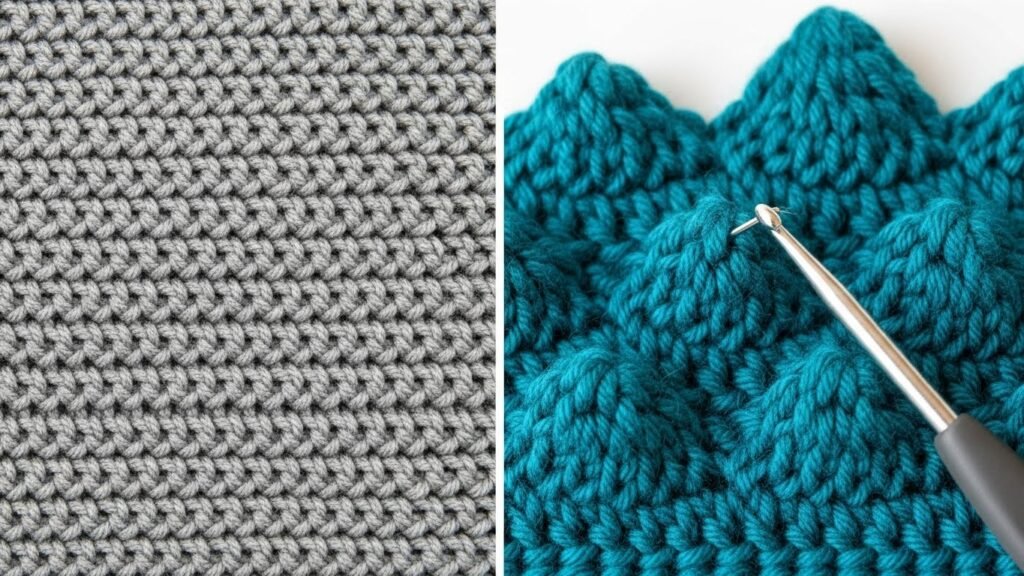
2. The Puff Stitch: The Dopamine Hit of Crochet
The Puff Stitch looks like a tiny, soft marshmallow made of yarn. When you see a “Puff Stitch Flower” or a “Puff Braid,” it looks like a masterpiece of tension control. It looks like you had to carefully manage seven different loops at once, maintaining a delicate balance so they don’t collapse.
In reality? A Puff Stitch is just a “yarn over” party. You just keep wrapping the yarn around your hook and pulling it through the same hole until you have a bunch of loops, then you pull through all of them at once. It is the most satisfying movement in the world. It’s “chunky,” it’s fast, and it uses a lot of yarn—which gives it that heavy, expensive “boutique” feel. The Puff Stitch is the ultimate “low effort, high reward” move. Why are you struggling with tiny, tight stitches when you could be making clouds of soft, puffy joy?
The Secret to “Pro” Puffs
The only reason people think the Puff Stitch is hard is because their hooks are too small. If you use a hook with a “tapered” head, the Puff Stitch becomes a dream. It glides through those seven loops like a hot knife through butter. The “impossible” look comes from the volume, not the technique. You are literally just pulling yarn through a hole. If you can do that, you can make a Puff Stitch that looks like it cost $200 at a high-end store.
3. The Waffle Stitch: The “Expensive” Illusion
The Waffle Stitch is the king of the “Wait, you made that?” reaction. It creates a deep, square-grid texture that looks exactly like—you guessed it—a waffle. It is incredibly thick, squishy, and looks like it required a complex mathematical formula to keep the squares aligned.
But if you can do a double crochet, you can do the Waffle Stitch. It is a simple two-row repeat. The “magic” happens because you are using “Post Stitches” to pull parts of the fabric forward, creating the “walls” of the waffle. Because the pattern is so logical, you’ll find that you stop needing to count after row three. Your hands will just know where the “walls” go. It’s a rhythmic, meditative experience that results in a fabric so professional it looks machine-made. Are you still making “thin” projects because you’re afraid of the “walls”?

4. The Solomon’s Knot (Lover’s Knot): The “Lace” Deception
This is the one that really shocks people. The Solomon’s Knot looks like a complex, delicate netting. It looks like you spent hours tying intricate knots with a microscopic needle. It’s airy, elegant, and looks like something worn by a movie star on a beach in the South of France.
But the Solomon’s Knot is actually easier than a single crochet. It’s literally just a “stretched-out” loop. You pull the yarn up long, do a single crochet into the “back” of the long loop, and repeat. It uses almost no yarn, grows incredibly fast, and creates a stunning, ethereal fabric. While a right-handed world struggles with tiny lace stitches, you can “knot” your way to a shawl in a single afternoon. Why are you still working in solid blocks of yarn when you could be wearing a cobweb of your own making?
The “Speed” Advantage of Solomon’s Knot
Because the Solomon’s Knot is mostly “air,” you can finish a project in record time. A scarf that would take ten hours in single crochet takes about ninety minutes in Solomon’s Knot. And the best part? People will think it took you longer because it looks so intricate. This is the ultimate “Lazy Pro” stitch. Are you ready to stop being a “yarn-drudge” and start being a “lace-illusionist”?
5. The Jasmine Stitch: The Final Boss of “Fake” Difficulty
The Jasmine Stitch is widely considered the most beautiful stitch in crochet. It looks like a field of interlocking stars or flowers. It is thick, reversible, and looks like a 3D mosaic. Most people don’t even try it because it looks like a nightmare of coordination. They assume it requires some sort of secret “voodoo” technique.
The truth? The Jasmine Stitch is just a series of Puff Stitches that “hold hands.” You make three puffs at once and close them together. That’s it. If you can do one Puff Stitch, you can do three. The “star” shape appears automatically when you close the cluster. It is a bit of a “yarn eater,” yes, but the result is so sturdy and professional that you’ll never go back to basic stitches again. Why are you staring at the “stars” in a pattern book when you could be making them with your own hands?

The “Cheat Code” for Jasmine Success
The only thing that makes the Jasmine Stitch “hard” is the fear of losing your loop. But if you use the “pinch” method—where you hold the base of the yarn with your left thumb and middle finger—it’s impossible to fail. You are essentially just “securing” the hole before you dive in. It’s a mechanical trick, not a skill trick.
The Philosophy of the “High-Impact” Crafter
Why do we spend so much time mastering the “basics” and so little time exploring the “spectacular”? We have been conditioned to believe that we have to “earn” the right to do fancy stitches. We think we have to spend years in the trenches of single and double crochet before we can touch the Alpine or the Jasmine.
But crochet doesn’t have a “level-up” system. You can start with the “impossible” stitches on Day 1. In fact, learning these stitches early on is better for your motivation. When you make something that looks incredible, you are more likely to keep going. You are more likely to feel like an artist.
The single crochet is like a plain white t-shirt. It’s necessary, it’s functional, but it doesn’t turn heads. These five stitches are the “evening gowns” of crochet. They are designed to impress, to shock, and to provide a luxurious sensory experience for both the maker and the wearer.
Breaking the “Grandma” Barrier
When people see a flat, beige, single-crochet afghan, they think “Grandma.” When they see a deep-textured, emerald-green Alpine Stitch cardigan or a delicate Solomon’s Knot wrap, they think “Designer.” These stitches are the key to reclaiming crochet as a modern, sophisticated art form. They allow you to compete with high-end retail brands. They allow you to create gifts that people actually want to keep forever.
Are you making “craft fair” items, or are you making “gallery” items? The only difference is the stitch choice.
Your New Roadmap to Perfection
I want you to take that “boring” ball of yarn you have sitting in your basket—the one you were going to use for another plain scarf—and I want you to try one of these five. Don’t “practice” first. Just start the project.
The “impossible” look of these stitches is your greatest ally. It hides minor tension errors. It masks the fact that you might be a beginner. Because the texture is so busy and rich, a missed stitch here or there is almost invisible. This is the ultimate “safety net” for the perfectionist.
Stop being afraid of the “V.” Stop being intimidated by the “Post.” The yarn is just string, and the hook is just a tool. You are the master of both. You are the one who decides how the light will hit your work. You are the one who decides if your project will be a flat surface or a topographical map of creativity.
The Question of “Time” vs. “Value”
People will ask you, “How long did that take?” When you use these stitches, you can give them a mysterious smile. You don’t have to tell them that the Waffle Stitch felt like a vacation for your brain. You don’t have to tell them that the Solomon’s Knot took you two hours. Let them believe you are a technical genius. Let them believe you have the patience of a saint.
Your time is valuable. Why spend 20 hours on something that looks like it took 5, when you can spend 5 hours on something that looks like it took 20? This is the economy of the modern crafter. We are “effort-efficient.” We are “result-oriented.”
A Call to Revolutionary Hooking
The world is full of flat things. We have flat screens, flat roads, and flat lives. Your crochet doesn’t have to be flat. It can be a mountain range. It can be a field of stars. It can be a soft, puffy cloud.
The “impossible” is just a word used by people who haven’t tried yet. The “easy” is a secret shared by those who have.
Pick up your hook. Pick up your yarn. Choose the stitch that scares you the most. Is it the Jasmine? The Solomon’s Knot? Whatever it is, dive in. The yarn won’t bite. The hook won’t judge. And your friends? They won’t believe their eyes.
Are you ready to stop being a “student” of the single crochet and start being a “master” of the impossible? The stitches are waiting. The texture is calling. Your masterpiece is just a few “yarn overs” away. What will you create today that will make someone say, “There’s no way you made that”? That is the power of the “Impossible” stitch. Go out and prove them wrong.

My name is Sarah Clark, I’m 42 years old and I live in the United States. I created Nova Insightly out of my love for crochet and handmade creativity. Crochet has always been a calming and meaningful part of my life, and over the years it became something I wanted to share with others. Through this blog, I aim to help beginners and enthusiasts feel confident, inspired, and supported as they explore crochet at their own pace. For me, crochet is more than a craft — it’s a way to slow down, create with intention, and enjoy the beauty of handmade work.