
You are standing in the yarn aisle of a giant craft store, staring at a wall of acrylic and industrial wool. It’s affordable. It’s durable. It comes in every color of the rainbow. But the moment you touch it, your heart sinks. It feels like a scouring pad. It’s scratchy, stiff, and has that distinct, chemical “crunch” that screams mass production. You look at the luxury hand-dyed cashmere on the top shelf—the stuff that costs more than your monthly car insurance—and you sigh. “Someday,” you tell yourself.
But what if “someday” was today? What if I told you that the only thing standing between your $4 “value” skein and a garment that feels like a $400 boutique masterpiece is a bottle of something sitting in your pantry right now? We are about to dive into the “Vinegar Miracle,” a radical chemical transformation that the big yarn manufacturers would rather you didn’t know about. Are you ready to stop being a victim of your budget and start being a master of fiber chemistry? Why settle for sandpaper when you can wear a cloud?
The Chemical Lie: Why Budget Yarn Is “Crunchy”
To understand the miracle, we must first understand the crime. When yarn is manufactured on an industrial scale—especially acrylic and low-grade wool—it undergoes a brutal mechanical process. To prevent the fibers from breaking on high-speed machines, they are coated in “spinning oils,” industrial lubricants, and stiffening agents known as “sizing.”
These chemicals are designed for the machine, not for your skin. When you buy a budget skein, you aren’t just buying fiber; you are buying a chemical exoskeleton that makes the yarn feel plastic and abrasive. Worse yet, these coatings prevent the fibers from “blooming”—the process where the yarn expands and softens to its true potential. Why are we letting industrial lubricants dictate the comfort of our clothes? Isn’t it time we stripped away the corporate residue and let the fiber breathe?
The pH Factor: Why Soap Isn’t Enough
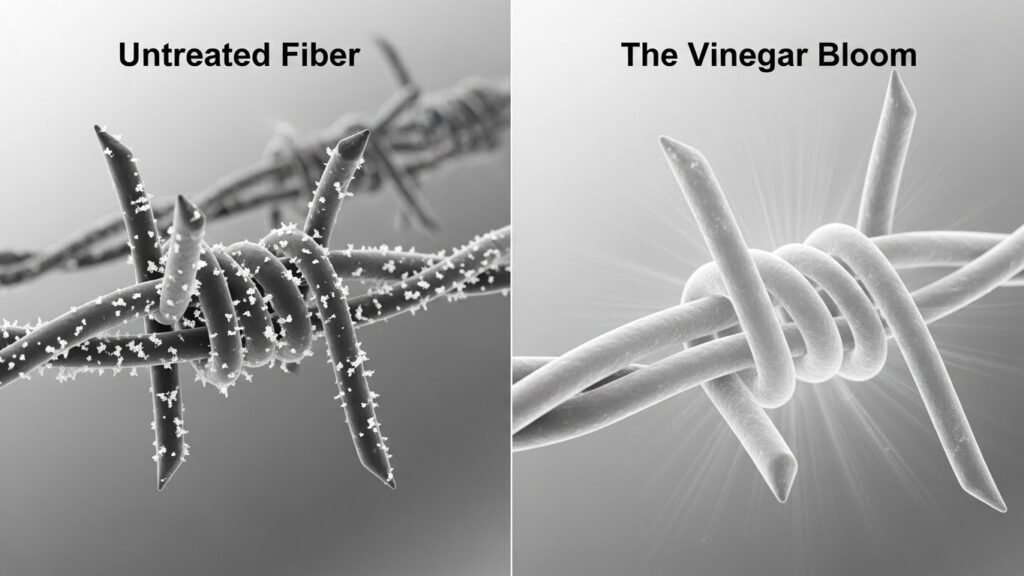
Most people try to fix scratchy yarn with standard laundry detergent or fabric softener. This is a mistake. Most soaps are alkaline. While they clean the dirt, they actually cause the microscopic “scales” on natural fibers (like wool) to flare up and become even more jagged. With synthetic fibers, soap just adds another layer of film.
The Vinegar Miracle works because white vinegar is acidic. This acidity performs a “chemical reset.” It dissolves the alkaline residues and flattens the scales of the fiber, creating a surface that is physically smoother to the touch. It is the same reason people use an apple cider vinegar rinse for their hair—it’s all about the cuticle. Are you treating your yarn like a dirty rug, or are you treating it like the delicate, wearable art it’s supposed to be?
The “Vinegar Bloom” Protocol: A Step-by-Step Revolution
This isn’t just “washing” your yarn; this is a three-stage alchemical process. If you want to achieve “Cashmere Status,” you must follow the protocol with the precision of a scientist.
Stage 1: The Acid Bath
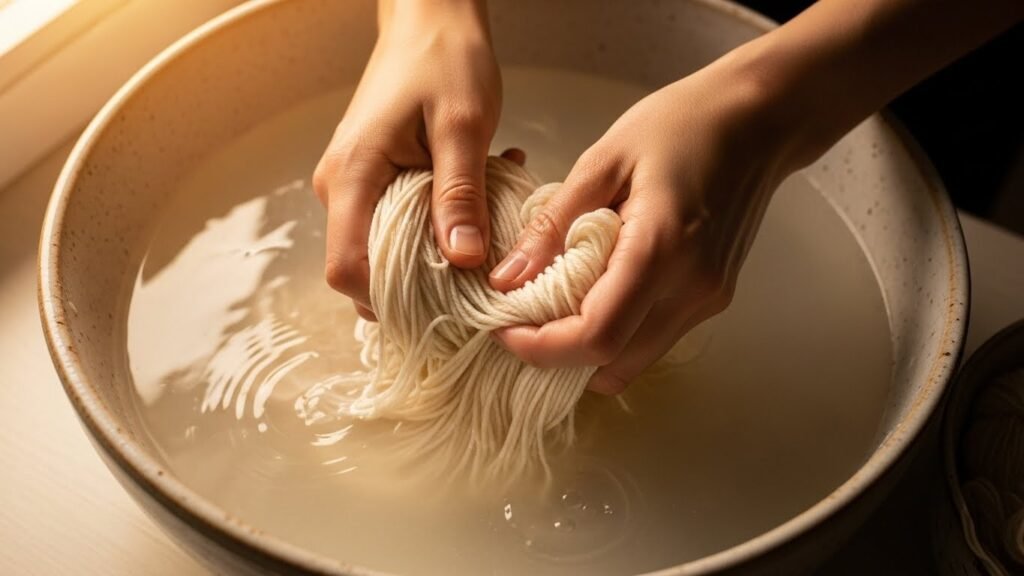
Start with a large basin of lukewarm—never hot—water. Add two cups of white distilled vinegar. Submerge your yarn (either in skeins with the labels removed and secured with ties, or your finished project). Do not agitate it. Let it sit for at least thirty minutes.
During this time, the acetic acid is working its way into the core of the fiber, breaking down the industrial bonds that keep the yarn stiff. You might see the water turn slightly cloudy; that is the “crunch” leaving your yarn. Why have we been taught to fear vinegar’s smell when it is the very scent of liberation for our fibers? (Don’t worry—the smell disappears completely once it dries.)
Stage 2: The Softener Infusion
Once the acid bath is complete, drain the water but do not rinse the yarn yet. Refill the basin with cool water and add a generous amount of high-quality hair conditioner. Yes, hair conditioner. If it’s designed to soften human hair, it’s designed to soften animal hair and even synthetic mimics.
Massage the conditioner into the fibers. Let it soak for another twenty minutes. The vinegar has opened the “pores” of the fiber, and now the conditioner is filling them with emollients. This is where the “Cashmere” feel is born. Why are we using harsh laundry chemicals when we could be giving our yarn a spa day?
Stage 3: The Cold Seal
The final rinse must be done with cold water. Cold water “shocks” the fibers, closing the scales and locking in the softness from the conditioner. Rinse until the water runs perfectly clear. To dry, use the “Towel Burrito” method—never wring the yarn, as that will re-introduce the mechanical stress you just worked so hard to remove.
Lay it flat on a drying rack in the shade. When you touch it again, you will not recognize it. It will be heavy, drapey, and obscenely soft. You have successfully turned “trash” into “treasure.” How many “scratchy” projects have you abandoned in the back of your closet that could be saved by this ten-cent solution?
The Science of the “Hand-Feel”: Why It Works on Acrylic
Many “purists” believe that the Vinegar Miracle only works on natural wool. They are wrong. While acrylic doesn’t have scales like wool, it is a plastic polymer that is highly sensitive to pH changes and thermal “resetting.”
The vinegar soak removes the “plastic-wrap” feel of budget acrylic, while the conditioner acts as a topical lubricant that reduces the “squeak” often associated with cheap yarn. You are essentially “glossing” the plastic. The result is an acrylic that has the drape of a high-end blend. Why should only the wealthy enjoy the feeling of a soft garment against their skin? Isn’t the Vinegar Miracle the ultimate tool for “Fiber Democracy”?
The “Aha!” Moment of the First Wear
The first time you wear a “Vinegar-Bloomed” sweater, you will experience a moment of pure shock. You’ll find yourself constantly touching your own sleeve. You’ll wait for someone to ask, “Is that cashmere?” and you’ll have to decide: do you tell them the truth, or do you let them believe you spent a fortune?
This is the psychological power of the miracle. It removes the “shame” of the budget yarn. It allows you to participate in the highest levels of the craft without the financial barrier. It turns your hobby from an expensive habit into a brilliant investment. Are you ready to be the person who knows the secret, or will you continue to be the person who complains about their itchy neck?
The “Vinegar Miracle” FAQ: Overcoming Your Fears
“Won’t it smell like a salad?”
This is the most common fear. The answer is a resounding no. Acetic acid is highly volatile; it evaporates completely as the yarn dries. Once the yarn is dry, it will smell like whatever conditioner you used—or like absolutely nothing at all. You are trading a chemical, “factory” smell for a clean, fresh finish. Why are you letting a temporary scent prevent a permanent transformation?
“Will it ruin the color?”
On the contrary! Vinegar is a known “mordant” and color-fixative. If you have yarn that tends to “bleed” (especially reds and deep blues), the vinegar soak will actually help lock the dye into the fiber. It makes colors more vibrant and prevents them from fading in the wash. You aren’t just making it softer; you’re making it more beautiful. Is there any reason NOT to do this?
“Can I do this to a finished project?”
Absolutely. In fact, doing it to a finished project is often better because it allows the stitches to “settle” into their final positions. It “blocks” the garment while it softens it. It’s the ultimate “two-for-one” in the crafting world. Why work twice as hard for half the result?
The Ethics of the “Cheap” Skein
There is a lot of “yarn snobbery” in the online community. People are often shamed for using big-box acrylic. But with the Vinegar Miracle, you are reclaiming the ethics of your craft. You are taking something humble and, through your own labor and knowledge, turning it into something extraordinary.
This is the very essence of “making.” It’s not about what you buy; it’s about what you do with what you buy. The Vinegar Miracle is a middle finger to the idea that you need a large bank account to be a “real” artist. It proves that a little bit of science and a lot of heart can overcome any price tag. Are you an artist who relies on a credit card, or an artist who relies on their wits?
The Legacy of the Miracle
I want you to go to your stash right now. Find that one skein—the one you bought because the color was perfect but you’ve never used because it feels like a Brillo pad. I want you to take it to the kitchen. I want you to grab that bottle of white vinegar.
I want you to witness the “Bloom” for yourself.
Once you see the transformation, you will never look at a craft store the same way again. You will see “possibility” where others see “cheapness.” You will see “luxury” where others see “utility.” You have been given the key to the executive lounge of the fiber world. Use it.
Your skin deserves it. Your projects deserve it. Your wallet deserves it. The Vinegar Miracle isn’t just a hack; it’s a lifestyle. It’s the realization that luxury isn’t a product you buy—it’s a result you create. Are you ready to stop scratching and start blooming? The bottle is waiting. The water is lukewarm. The miracle is yours to claim.

My name is Sarah Clark, I’m 42 years old and I live in the United States. I created Nova Insightly out of my love for crochet and handmade creativity. Crochet has always been a calming and meaningful part of my life, and over the years it became something I wanted to share with others. Through this blog, I aim to help beginners and enthusiasts feel confident, inspired, and supported as they explore crochet at their own pace. For me, crochet is more than a craft — it’s a way to slow down, create with intention, and enjoy the beauty of handmade work.