
You’ve been told since the day you bought your first “starter kit” that aluminum is the gold standard. It’s cheap, it’s indestructible, and it’s what your grandmother used. But what if I told you that the very tool you trust is the primary reason you can’t hit your target speed? What if that cold, grey stick in your hand is acting as a literal brake on your creativity? Most crocheters are unknowingly fighting a war against friction, and the metal hook is the enemy’s lead general.
We live in a world obsessed with efficiency, yet in our hobby, we cling to mid-century metallurgy like it’s a sacred relic. Are you tired of that “squeak-squeak” sound when you work with acrylic? Are you frustrated by the way your silk-blend yarn “stutters” across the hook? You aren’t slow; your equipment is sabotaging you. It’s time to talk about the controversial material that top-tier designers use to double their stitches per minute: high-performance, medical-grade resin and carbon fiber. Are you ready to admit that your “trusty” metal hook is actually a ball and chain?
The Friction Fallacy: Why Metal Is a Speed Killer
To understand why metal is slowing you down, we have to look at the physics of the “glide.” Aluminum and steel, while they appear smooth to the naked eye, are covered in microscopic pits and ridges. Furthermore, metal is a thermal conductor. As you work, the friction between the yarn and the hook generates heat. This heat causes the natural oils in your hands and the synthetic waxes in the yarn to become slightly “tacky.”
This tackiness creates “drag.” Every time you pull a loop through, you are fighting a tiny amount of resistance. Over the course of a 10,000-stitch blanket, that drag adds up to hours of wasted movement. Have you ever noticed how your hands feel “heavy” after an hour of work? That’s not just muscle fatigue; that’s the cumulative effect of fighting metal-on-fiber friction. Why are you choosing to work in a state of constant resistance? Do you really think your hands were designed to overcome the limitations of industrial aluminum?
The “Squeak” of the Damned
If you’ve ever worked with 100% acrylic yarn on a metal hook, you know the sound. The high-pitched, rhythmic squeaking that makes your teeth on edge. That sound is the physical manifestation of “slip-stick” friction. The yarn is grabbing and releasing the metal repeatedly.
This stuttering motion destroys your rhythm. In crochet, rhythm is everything. When your hook “glides,” your brain enters a flow state. When your hook “stutters,” your flow state is broken. Resin and high-density polymers, however, have a “self-lubricating” property at the molecular level. They don’t grab; they slide. Why are you subjecting your ears and your nervous system to a “squeaky” nightmare when you could be working in silent, buttery bliss?

The Resin Revolution: The Controversial Champion
For years, resin hooks were dismissed as “pretty toys” for Instagrammers. They were seen as fragile or overly expensive. But the elite tier of the crochet world has moved past the aesthetics. Modern resin hooks are engineered with the same precision as surgical instruments.
Resin has a specific “hand-warmth” that metal lacks. Because it is a thermal insulator, it reaches your body temperature almost instantly and stays there. This prevents the “sweaty palm” syndrome that occurs when your hand tries to compensate for the coldness of a steel hook. When your hand is at its optimal temperature, your tendons are more flexible, and your speed increases naturally. Are you still clinging to “indestructible” metal even though it’s making your joints stiff? Is the durability of the tool more important than the health of the hand?
The Weight of the World
Metal is heavy. Even “lightweight” aluminum creates a centrifugal force at the tip of the hook that your wrist has to counteract with every stitch. Resin and carbon fiber are significantly lighter.
Switching to a resin hook feels like taking off a pair of heavy boots and putting on elite running shoes. Your “return stroke” becomes faster. Your “insertion” becomes more precise. You stop “fighting” the hook and start “guiding” it. If you could increase your output by 20% just by changing the weight of your tool, why haven’t you done it yet? Are you afraid of the “unnatural” lightness of a high-tech material?
Carbon Fiber: The “Dark Knight” of Speed
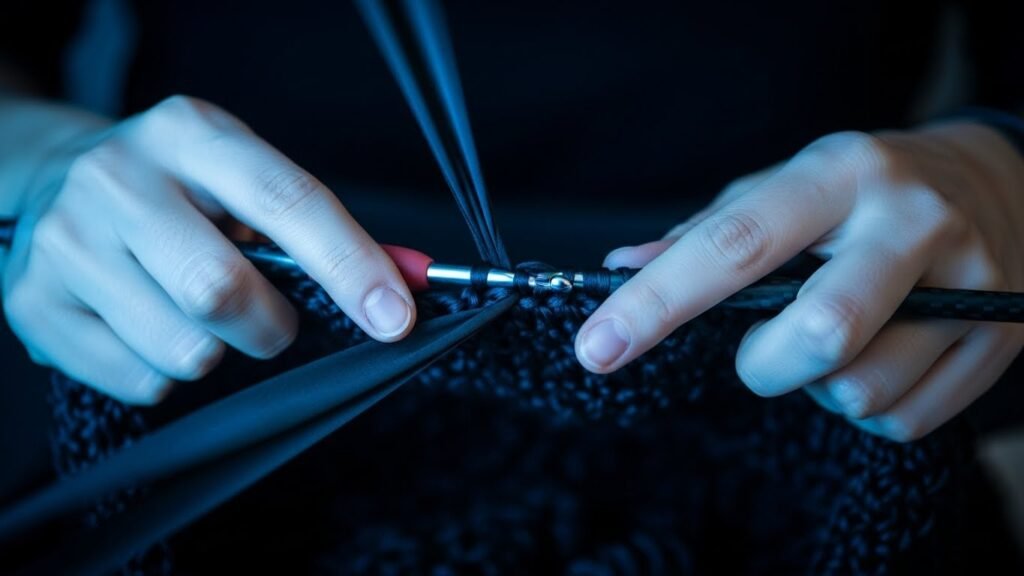
If resin is the “buttery” option, carbon fiber is the “Formula 1” option. Carbon fiber hooks are incredibly stiff, which means zero energy is lost to “flex” when you are working with tight tension or heavy yarns.
In metal hooks, there is a tiny, almost imperceptible amount of vibration that travels up the shaft when the hook hits the yarn. Carbon fiber dampens these vibrations. It provides a “muted” feedback that allows you to feel the tension of the yarn without the “noise” of the tool. It is the ultimate material for the speed-crocheter. Why are you driving a “truck” (aluminum) when you could be driving a “supercar” (carbon fiber)?
The “Slippery” Danger: Can a Hook Be Too Fast?
The most common argument against resin is that it’s “too slippery.” Beginners often find that their stitches slide off the hook before they are ready. But here is the secret: that slipperiness is actually a diagnostic tool.
If your stitches are sliding off, your tension is inconsistent. Metal “hides” poor technique by grabbing the yarn. Resin “reveals” it by letting the yarn go. Once you master a resin hook, you become a better, more consistent crocheter. You learn to control the yarn with your fingers rather than relying on the “grip” of the metal. Are you using metal as a “crutch” for bad tension? Are you ready to graduate to a tool that demands—and creates—perfection?
The “Squeak-Test” Experiment
I challenge you to a simple experiment. Take your “old faithful” aluminum hook and do 50 rows of a simple stitch. Time yourself. Now, do the same with a high-quality resin hook. Don’t just look at the clock; look at the “state” of your hand.
Is it cramped? Is it sweaty? Most people find that while the time difference might only be a few minutes initially, the “fatigue factor” is vastly improved with resin. Speed isn’t just about how fast you can go for one minute; it’s about how fast you can go for four hours. Resin wins the marathon every single time. Why are you sprinting in lead shoes?
The Ergonomic Evolution: Beyond the Stick
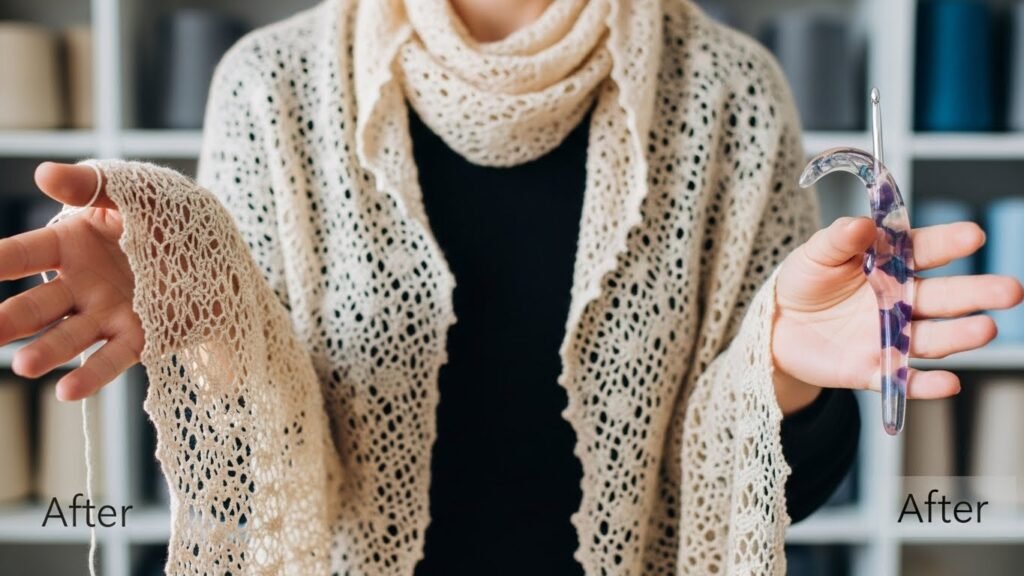
The problem with most metal hooks isn’t just the material; it’s the shape. Most metal hooks are “pencil” style—straight, thin rods. Resin allows for “organic molding.”
Because resin is a cast material, designers can create handles that perfectly fit the “thenar eminence” (the fleshy part of your palm). This is the “Controversial” part: these hooks don’t look like hooks. They look like strange, ergonomic sculptures. But those “strange” shapes are what prevent the “Crochet Claw” and allow for extreme speed. We have been conditioned to think a hook should look like a stick. But your hand isn’t a stick; it’s a complex machine of 27 bones. Why are you using a tool that ignores your anatomy?
The “Investment” Mindset: Stop Being a Budget Maker
“But resin hooks cost five times as much as aluminum!” This is the rallying cry of the “Budget Sinner.” Let’s do the math. If you spend $50 on a high-performance hook and it saves you 100 hours of labor over its lifetime, you have just bought your time back for 50 cents an hour.
Your time is the most expensive part of any project. If you are using a $2 hook to work on a $200 wool blanket, you are committing a “logic crime.” You are devaluing your own labor. A high-performance hook is an investment in your own productivity and physical health. Why are you being “cheap” with the one tool that defines your output? Are you a “consumer” of yarn, or a “producer” of art?
The Soul of the Material
There is also a “spiritual” component to the material you hold. Metal is an industrial product—cold, hard, and indifferent. Resin is often hand-poured by small artisans. It has a soul. It has depth.
When you hold a tool that is a work of art in itself, you treat your stitches with more reverence. You find yourself slowing down to enjoy the “feel,” which ironically leads to a more consistent rhythm and a faster overall finish. It’s the “Zen of the Hook.” You aren’t just “cranking out rows”; you are performing a dance with a partner that respects your touch. Why choose a cold, mechanical partner when you could have a soulful, responsive one?
The “Carbon-Fiber” Future: What’s Next?
We are on the verge of a new era in fiber tools. We are seeing 3D-printed titanium, graphene-infused polymers, and “smart” hooks that can track your stitch count. But for now, the “Resin vs. Metal” debate is the front line of the revolution.
Those who stick with metal will continue to complain about hand pain, slow progress, and “squeaky” yarn. Those who embrace the “controversial” materials will be the ones finishing their holiday gifts in October and starting their spring collections in January. They will be the ones who can crochet into their eighties without a wrist brace. Which side of history do you want to be on? The side that clings to the “Grey Stick,” or the side that glides on “Resin Wings”?
Final Thoughts: The Challenge of the Change
I know it’s hard to change. We have an emotional attachment to our first hooks. We remember the first scarf we made with that scratched-up 5mm aluminum. But growth requires letting go of the tools that served our “beginner” selves to make room for the tools that serve our “master” selves.
Go to a local fiber festival or a high-end online shop. Find one—just one—high-performance resin hook in your most-used size. Commit to using it for one entire project. Ignore the “slippery” feeling for the first ten rows. Let your hands adjust to the warmth.
Watch the yarn. See how it stops “jumping” and starts “flowing.” Feel the lack of tension in your forearm. And then, try to go back to your metal hook. You won’t be able to. You will realize that the metal hook wasn’t a “trusty friend”; it was a “friction trap.”
The “Controversial Truth” is that your tools define your limits. If you want to break your speed records, if you want to save your nerves, and if you want to enjoy the “Buttery Glide” that the pros talk about, you have to put down the aluminum. The future of your craft is not made of metal; it’s made of light, warmth, and high-performance resin. Are you ready to fly, or are you going to keep dragging that grey stick through the mud? The next row is waiting. How fast do you want to get there?

My name is Sarah Clark, I’m 42 years old and I live in the United States. I created Nova Insightly out of my love for crochet and handmade creativity. Crochet has always been a calming and meaningful part of my life, and over the years it became something I wanted to share with others. Through this blog, I aim to help beginners and enthusiasts feel confident, inspired, and supported as they explore crochet at their own pace. For me, crochet is more than a craft — it’s a way to slow down, create with intention, and enjoy the beauty of handmade work.