
You have been a slave to the gauge swatch for long enough. You spend hours meticulously counting stitches, squinting at a plastic ruler, and panicking when your four-inch square measures 4.2 inches. You frog your work, you change your hook size, you curse the designer, and yet, the moment you get “in the zone,” your tension shifts again. By the time you reach the sleeve of that sweater, it looks like it belongs to a different garment than the body.
Why are we treating our crochet like a mathematical prison? Why do we assume that a piece of aluminum or a printed PDF has more control over our work than our own nervous system? The “Great Gauge Lie” is that your hook size determines your stitch size. It doesn’t. Your brain does, but your fingers are the ones doing the talking. We are about to dismantle the traditional “over-the-pointer” yarn hold and introduce you to the Two-Finger Tension Hack—a technique so radical it makes patterns almost obsolete. Are you ready to stop measuring and start mastering the flow? Why would you trust a ruler when you can trust the mechanical memory of your own flesh?
The Anatomy of a Stitch: Where Tension Is Born
To understand the hack, we must first understand the physics of the loop. Most crocheters are taught to drape the yarn over their index finger and use their pinky or ring finger as a “clamp.” This is a high-fatigue, low-accuracy method. Because you are relying on the varying pressure of a single finger joint, your tension is at the mercy of your mood, your caffeine intake, and even the humidity in the room.
When your hand gets tired, your “clamp” loosens. When you get excited during a thriller on Netflix, your “clamp” tightens. The result is a garment that “breathes” in all the wrong places. The Two-Finger Tension Hack moves the responsibility of tension from a muscle (the finger squeeze) to a friction point (the skin-to-yarn wrap). By threading the yarn in a specific “S-curve” between the index and middle fingers, you create a self-regulating braking system. Why are you still manual-shifting your tension when you could be driving an automatic?
The Friction-to-Flow Ratio
In physics, friction is the resistance that one surface or object encounters when moving over another. In crochet, friction is your best friend. By involving two fingers in a specific interlaced pattern, you create multiple contact points for the yarn.
As the yarn moves, it isn’t being “squeezed”; it is being “guided.” The skin’s natural texture provides a constant, unchanging drag. Because the yarn is trapped in a multi-finger path, it cannot move faster or slower than the speed you’ve “programmed” into your hand. This is how pros maintain a machine-like consistency for ten hours straight. Have you ever wondered how some makers create stitches that look like they were 3D printed? They aren’t better than you; they just have a better friction-to-flow ratio.
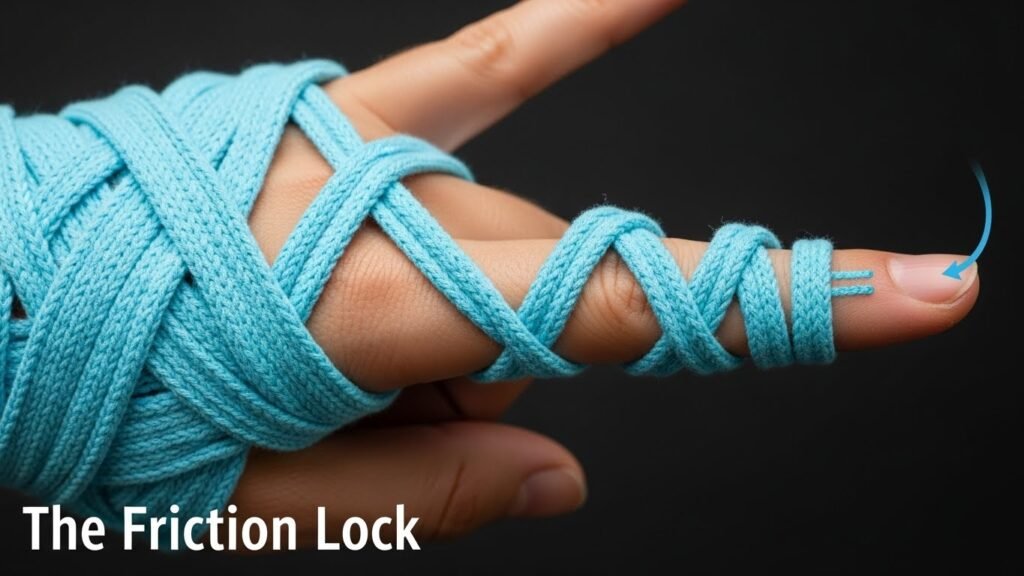
Breaking the “Pencil” Habit: Why Your Hold Is Killing Your Gauge
The way you hold your hook—the “pencil” versus the “knife”—gets all the glory in ergonomic debates. But the way you hold your yarn is actually what dictates your speed and your gauge. Most people hold their yarn finger too high in the air, creating a long “bridge” between the hand and the hook. This bridge is a disaster zone for tension.
The Two-Finger Hack requires a “low-profile” hold. By keeping your index and middle fingers close together and closer to the hook, you shorten the distance the yarn has to travel. This minimizes “yarn bounce.” If the yarn has no room to vibrate or stretch before it hits the hook, the loop size remains identical every single time. Are you tired of your “long-bridge” hold causing your stitches to look like a mountain range of peaks and valleys? Why give the yarn an opportunity to misbehave in mid-air?
The “S-Curve” Revolution: How to Thread the Needle
Here is the secret: take your yarn and lay it over your index finger. Now, instead of just letting it drop, weave it under your middle finger and over your ring finger. This creates two “pinch points” of natural skin tension.
When you pull on the hook, the yarn has to navigate this “S-path.” If you want tighter tension (for amigurumi), you simply close the gap between your index and middle fingers. If you want looser drape (for a summer shawl), you widen the gap. You are now controlling your gauge with the distance between your fingers—a measurement your brain can track subconsciously—rather than a “feeling” in your grip. When was the last time you felt this much authority over a piece of string?
Why You’ll Never Need to Look at a Gauge Swatch Again
This is the “shocking” claim: once you master the Two-Finger Tension Hack, your gauge becomes a constant. You become the “standard.”
Most patterns are written for a “medium” tension, but “medium” is subjective. When you use the S-curve wrap, you are creating a mechanical constant. You can pick up a project after six months of not touching it, wrap your fingers in your signature “S-path,” and your tension will be exactly where it was half a year ago. Your hands have a “memory” that your mind does not. Why are you wasting precious yarn and time on a 4×4 square when you could be building that memory into your hands?
The “Blind” Crochet Test
I challenge you to the “Blind Test.” Once you have practiced the Two-Finger Hack for a week, try crocheting ten rows of a simple stitch while watching a movie—without looking at your hands once. Then, measure your stitches.
With the old “one-finger” method, your rows would likely be a mess of uneven loops. With the Two-Finger Hack, your stitches will be hauntingly identical. Why? because the friction points act as a physical “stop.” The yarn simply cannot be pulled through the hook any tighter or looser than the fingers allow. You have effectively turned your hand into a precision-calibrated tool. Are you a maker, or are you a machine in the making?
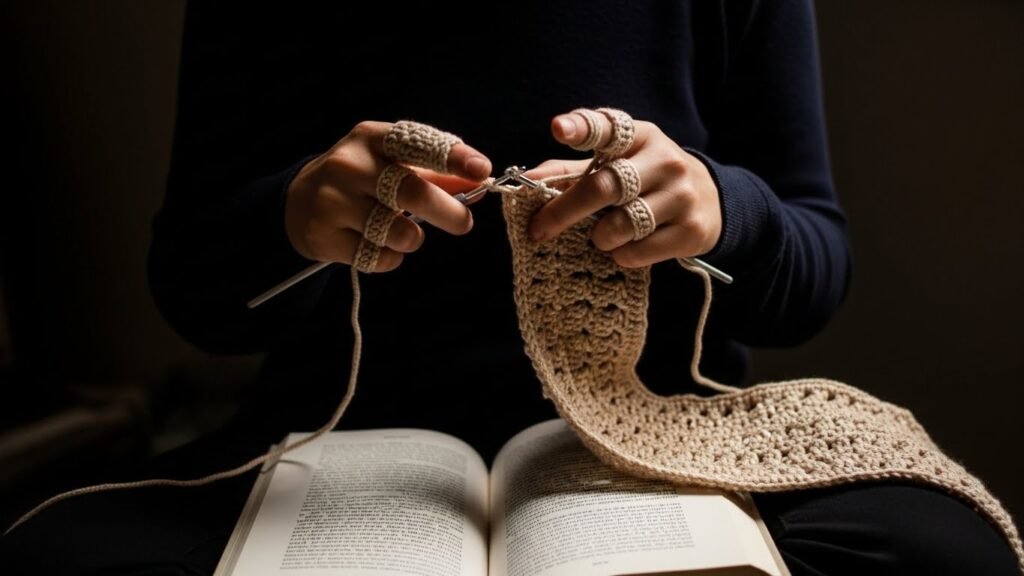
The Ergonomic Bonus: Saving Your Nerves from the “Clinch”
Beyond the perfect gauge, there is a hidden medical benefit to this hack. Most hand pain in crochet comes from “clenching”—the subconscious effort to hold the yarn tight enough to maintain tension. This clenching leads to carpal tunnel, tendonitis, and the dreaded “Crochet Claw.”
The Two-Finger Hack eliminates the need to clench. Because the tension is created by the path of the yarn through the fingers rather than the force of the fingers squeezing the yarn, your hand can remain relaxed. You are using physics instead of muscle. Why are you punishing your tendons for the sake of a blanket? Isn’t it time you worked with your anatomy instead of against it?
The “Death Grip” vs. The “Gliding Path”
If you finish a session and your left hand (the yarn hand) feels stiff and cramped, you are a “clencher.” You are trying to manufacture tension through sheer willpower. The Two-Finger Hack is the cure.
Imagine the yarn is a high-speed train. The old method is trying to stop the train by grabbing the tracks with your bare hands. The Two-Finger Hack is using a sophisticated braking system on the wheels. One is a recipe for injury; the other is a masterpiece of engineering. Which one are you going to choose for the next ten years of your crafting life?
The Psychological Freedom of “Subconscious Gauge”
There is a specific kind of mental “noise” that happens when you are constantly worrying about your tension. It takes the joy out of the craft. You stop feeling the yarn and start analyzing the yarn.
The Two-Finger Tension Hack moves the “gauge-check” from your conscious mind to your subconscious. Once the fingers are wrapped, the “brain-work” is done. You can finally focus on the color, the texture, and the rhythm of the stitch. You can enter a “flow state” that is deeper and more restorative. Why would you keep your brain occupied with the “drudgery” of tension when your fingers are perfectly capable of handling it on their own?
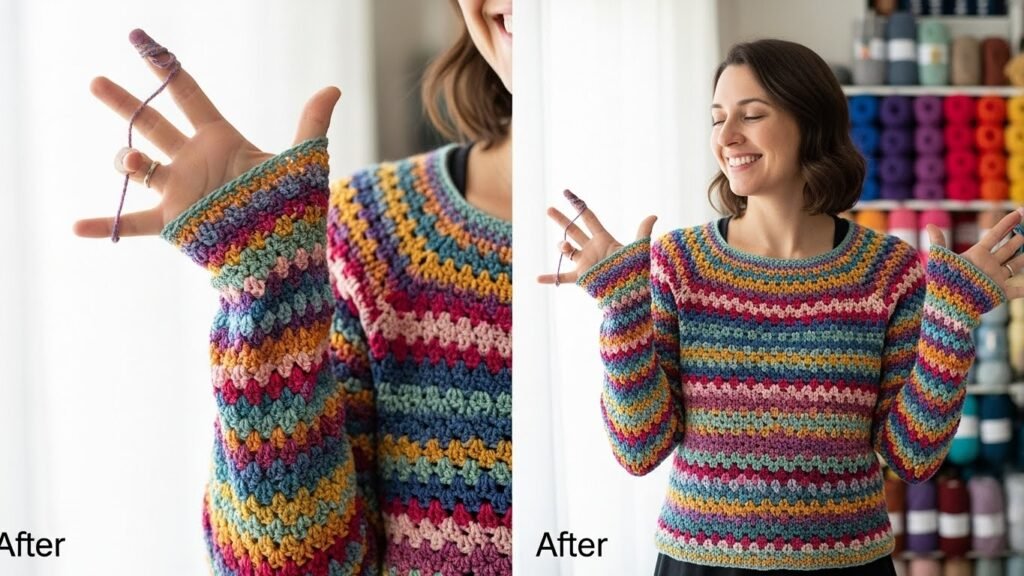
The “Dye-Lot” Variable: How the Hack Handles Different Fibers
Not all yarns are created equal. A slippery silk-blend requires more tension than a “grabby” wool. With the one-finger method, you have to manually adjust your “squeeze” for every different fiber, which is nearly impossible to do consistently.
With the Two-Finger Hack, you adjust by “weaving.” For silk, you might add a third finger into the wrap (the “Three-Finger Lock”). For chunky wool, you might go over only the index finger but keep it pressed tightly against the middle finger. You are creating a “modular” tension system that adapts to the fiber without changing your basic hand posture. Why struggle to “feel” the difference in a new yarn when you can just “gear up” your finger wrap?
The “Squeak” Test for Tension
If your yarn is “squeaking” on the hook, your tension is too tight. If the hook is falling out of the loops, it’s too loose. The Two-Finger Hack allows you to find the “Goldilocks Zone” instantly.
As you pull the yarn through the S-curve, you will feel the vibration of the fiber. If the vibration stops, you’re too tight. If the yarn feels like it’s “flying” through, you’re too loose. This tactile feedback is much faster than any visual check. You are literally listening to your yarn with your skin. Are you ready to stop looking and start listening?
Final Thoughts: Reclaiming Your Craft
The Two-Finger Tension Hack is more than just a technique; it is a declaration of independence. It is the refusal to let “patterns” and “rules” dictate the joy of your movement.
It takes exactly three days to “un-learn” your old, inefficient yarn hold. For those three days, you will feel clumsy. You will want to go back to the “squeeze.” But on the fourth day, something will happen. You will pick up your hook, your fingers will automatically find the S-curve, and the yarn will begin to glide.
You will look down at your work and see a row of stitches so perfect, so uniform, and so professional that you’ll wonder who made them. And the best part? You won’t have looked at a ruler once.
Stop being a slave to the gauge swatch. Stop punishing your hands with the “Death Grip.” Embrace the physics of the S-curve. Your stitches deserve it, your projects deserve it, and most importantly, your hands deserve it. Are you ready to put down the ruler and let your fingers take the lead? The “Two-Finger” revolution starts with the very next loop.

My name is Sarah Clark, I’m 42 years old and I live in the United States. I created Nova Insightly out of my love for crochet and handmade creativity. Crochet has always been a calming and meaningful part of my life, and over the years it became something I wanted to share with others. Through this blog, I aim to help beginners and enthusiasts feel confident, inspired, and supported as they explore crochet at their own pace. For me, crochet is more than a craft — it’s a way to slow down, create with intention, and enjoy the beauty of handmade work.