
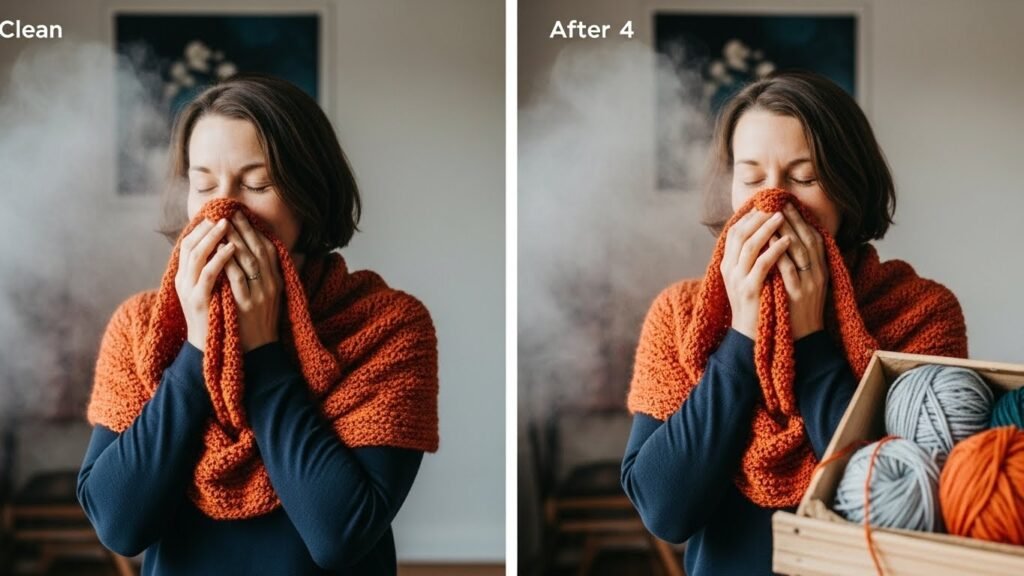
You found it. The Holy Grail of yarn stashes. Perhaps it was at a dusty estate sale in a forgotten corner of the countryside, or maybe it was buried in the back of your great-aunt’s cedar chest. It’s a discontinued, 100% natural fiber luxury yarn that hasn’t been produced since the 1970s. The colors are vibrant, the weight is perfect, and the price was a steal. But then, as you bring it close to your face to admire the twist, the reality hits you like a physical blow. The smell.
It’s the unmistakable, heavy scent of “Vintage.” It’s a cocktail of damp basement, fifty years of stale cigarette smoke, mothball chemicals, and the haunting aroma of a house that hasn’t seen an open window since the Reagan administration. Your heart sinks. You can’t knit a sweater out of this—you’ll smell like a haunted thrift store every time you wear it. But you also can’t wash it. If you submerge these delicate, aged fibers in water, you risk felting the entire batch, bleeding the unstable dyes, or worse, watching the structural integrity of the old wool simply disintegrate. Why are you staring at your yarn like it’s a biological hazard? Are you going to let a little “ghost air” stop you from creating a masterpiece? What if I told you that you could “launder” this yarn using nothing but the air itself and a few pantry secrets? Are you ready to become a textile exorcist?
The Molecular Trap: Why Yarn Holds Odors Like a Grudge
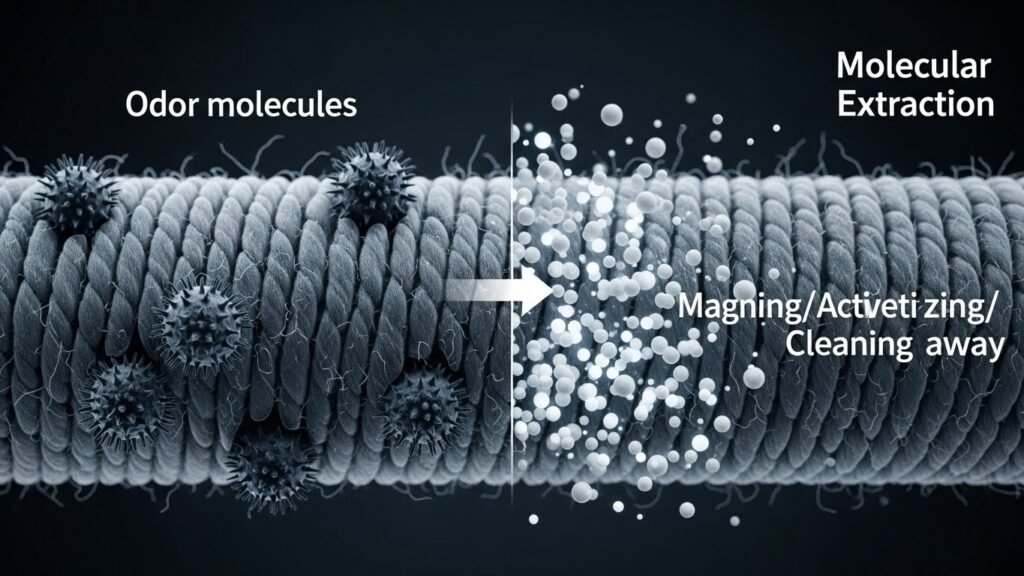
To defeat the smell, you must understand the enemy. Yarn—especially animal fibers like wool, alpaca, and mohair—is not a solid surface. Under a microscope, it is a complex architecture of overlapping scales and hollow cores. These fibers are designed by nature to trap air for insulation. Unfortunately, that air-trapping mechanism is incredibly efficient at trapping volatile organic compounds (VOCs).
When you smell “musty attic,” you are actually smelling the off-gassing of mold spores and the chemical breakdown of old dust. These molecules aren’t just sitting on the yarn; they are wedged under the scales of the fiber. This is why “airing it out” for an hour on your balcony never works. The smell is anchored. Why are you trying to “brush” away a smell that is literally woven into the DNA of the wool? Do you really think a quick spray of a floral “refresher” will do anything other than create a nauseating mix of “Lavender and Decay”?
The “Chemical Masking” Lie
Most people reach for commercial fabric refreshers. This is a fatal mistake for vintage yarn. Those sprays are mostly water, alcohol, and synthetic fragrance. The water can cause the old fibers to swell and trap the odor deeper, while the synthetic fragrances eventually evaporate, leaving the original stink behind, now reinforced by a sticky chemical residue.
Are you a “Creator” or a “Hider”? Why would you contaminate a natural, historic fiber with cheap lab-created perfumes? If you want the yarn to be clean, it needs to be purified, not masked. It needs a non-toxic intervention that respects the age of the material.
The “Dry-Clean” Secret: The Baking Soda Vault
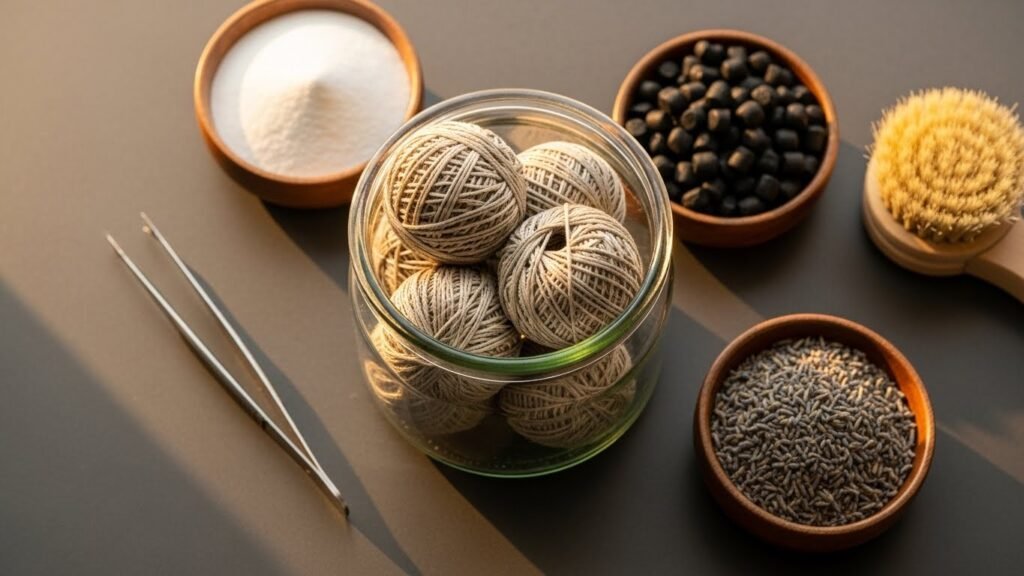
If you can’t use water, you must use a desiccant and an absorbent. The most powerful tool in your non-toxic arsenal is common sodium bicarbonate—baking soda. But you aren’t just going to sprinkle it on and hope for the best. You are going to create a “Deodorizing Vault.”
You need a large, airtight plastic bin. You place a layer of baking soda at the bottom, but here is the trick: the yarn never touches the powder. You place your “smelly” yarn in a mesh laundry bag or on a wire rack suspended above the baking soda. Seal the lid. Now, you wait. Over the next 48 to 72 hours, the baking soda will act as a molecular vacuum, pulling the acidic odor molecules out of the yarn and into its own structure. Why are you in such a rush to start your project that you’re willing to compromise its final scent? Isn’t a forty-year-old yarn worth a three-day “spa treatment”?
The Power of Activated Charcoal
For the truly “nuclear” smells—like heavy tobacco smoke or deep-seated mildew—baking soda might need an ally. This is where activated charcoal comes in. These little black briquettes have a surface area that is mind-bogglingly large on a microscopic level.
One gram of activated charcoal has a surface area of over 3,000 square meters. It is the ultimate “Odor Sponge.” By placing a few sachets of activated charcoal in your “Vault” alongside the baking soda, you are creating a dual-action filtration system that works 24 hours a day. Are you brave enough to trust the silence of a sealed bin, or do you still feel the need to “scrub” something that shouldn’t be touched?
The “Sunlight and Frost” Paradox
Nature has its own ways of cleaning, and they don’t involve a washing machine. Two of the most powerful deodorizers on Earth are UV light and freezing temperatures. However, you must use them with surgical precision.
UV light from the sun kills bacteria and breaks down odor-causing chemicals through a process called photodegradation. But leave your vintage yarn in the direct sun for a day, and you’ll find the colors faded and the fibers brittle. The “Artisan Secret”? Indirect UV. Place your yarn in a shaded, breezy spot outdoors on a day with low humidity. The “scouring” action of the wind combined with the indirect UV rays will lift surface odors without “sun-bleaching” your history. Why are you hiding your yarn in a dark closet when it’s crying out for a “Fresh Air Bath”?
The “Freezer” Kill-Switch
If the smell is being caused by active microbes or (heaven forbid) the microscopic larvae of moths, the freezer is your best friend. Seal the yarn in a zip-top bag, squeeze out all the air, and put it in the back of the freezer for a week.
This doesn’t just “freeze” the smell; it stabilizes the fibers and kills any biological stowaways that are contributing to the “musty” aroma. It’s a “cryogenic reset” for your stash. Have you ever considered that the “Vintage Smell” is actually the sound of a thousand tiny organisms living their best lives in your wool? Isn’t it time to evict the tenants?
The “Zeolite” Miracle: Volcanic Odor Eaters
If baking soda is the “entry-level” solution, Zeolite is the “Pro-Grade” upgrade. Zeolites are natural volcanic minerals that are “microporous.” They were literally forged in fire to absorb gases.
Unlike baking soda, which can eventually become “full” and stop working, Zeolite bags can be “recharged” by sitting in the sun. They are non-toxic, scentless, and incredibly effective at pulling “old house” smells out of textiles. You can tuck a small Zeolite bag into the center of a yarn cake and leave it there while you work. It’s like having a “personal air purifier” for every stitch. Why are you settling for “less smelly” when you could have “absolutely pure”? Are you willing to invest in a mineral that’s been around for millions of years to save a yarn that’s been around for fifty?
The “Dry Coffee” Hack
For those who enjoy a slightly gourmand twist, dry, used coffee grounds (must be 100% dry!) are a fantastic odor neutralizer. The nitrogen in the coffee helps neutralize sulfur smells—the kind often found in yarns that have been stored with old rubber bands or in damp boxes.
Place the dry grounds in a sock, tie it off, and put it in your “Yarn Vault.” It won’t make your yarn smell like a Starbucks, but it will strip away the “rotten egg” undertones of age. Why are you throwing away your morning coffee grounds when they could be the “salvation” of your vintage mohair?
The “Steam-Gentle” Method: For the Brave Only
Wait—didn’t I say “without getting it wet”? Yes. But there is a difference between “Submersion” and “Controlled Vapor.” If your yarn is stiff as well as smelly, it might need a “Humidity Reset.”
Using a garment steamer (held at a safe distance of at least 12 inches), you can pass a very light, hot mist over the yarn. The heat “opens” the scales of the wool, allowing the trapped odors to escape into the air, where they can be whisked away by a nearby fan. You aren’t “washing” the yarn; you are “venting” it. But beware: too much moisture and you’ve just created a “Hot Mildew Soup.” Are you confident enough in your “Steam-Control” to dance on the edge of the moisture barrier? Or is the “Vault” a safer bet for your anxiety levels?
The “Essential Oil” Finish
Once the yarn is truly “Neutral,” you can introduce a scent—but only if it’s a natural, high-quality essential oil used indirectly. Never drop oil onto the yarn itself. Instead, put a drop of cedarwood or sandalwood oil on a cotton ball and place it in the corner of your storage bin.
The yarn will “inhale” the scent of the wood, which not only smells clean but also provides a natural repellent for future pests. Why would you want your yarn to smell like “Summer Breeze” laundry detergent when it could smell like an “Ancient Cedar Forest”?
The “Skein-Shift”: Ensuring 360-Degree Purity
If you are treating a large quantity of yarn, you cannot just leave it in its original “tucked” state. The center of a yarn cake is an “Oxygen-Free Zone.” Odors love to hide in the core.
To ensure total purification, you must “shift” your skeins every 24 hours while they are in the Deodorizing Vault. Flip them, rotate them, and if possible, gently re-wind them into loose “hanks.” This allows the “Cleaning Agent” (whether it’s baking soda or charcoal) to reach every millimeter of the fiber. It is a slow, methodical process. But isn’t that why we crochet? For the slow, methodical beauty of it? Why are you trying to “speed-run” a process that requires the grace of time?
The “Smell-Check” Protocol
Don’t trust your nose after five minutes of cleaning. You will become “scent-blind” to the yarn. The true test? Take the yarn out of the vault, put it in a clean, scent-free room, and walk away for an hour. Come back and take a “First Impression” sniff.
If you still smell the “Attic,” it goes back in for another 48 hours. Patience is the only true “Non-Toxic Deodorizer.” Are you a “Master of the Long Game,” or are you going to give up when the “Ghost of Attic Past” refuses to leave on the first try?
Final Thoughts: A Legacy Restored
Vintage yarn is more than just a material. It is a time capsule. It carries the weight of the sheep it came from, the hands that dyed it, and the decades it spent waiting for you to find it. To treat it with a “Quick Fix” or a “Chemical Spray” is to disrespect its history.
By using these non-toxic, dry-cleaning methods, you are performing a “Resurrection.” You are stripping away the grime of the years without stripping away the “soul” of the fiber. You are proving that “Old” does not mean “Dirty,” and that “Vintage” can be as fresh as the morning air.
The next time you find a “Smelly Secret” at a garage sale, don’t walk away. Reach for your baking soda, find your airtight bin, and prepare for the “Exorcism.” Your “Vintage” project is waiting to be born, and it’s going to smell like a victory.
Are you ready to stop being afraid of the “Attic Funk” and start reclaiming the lost treasures of the fiber world? The “Vault” is ready. The yarn is waiting. Let’s clear the air and get to work.

My name is Sarah Clark, I’m 42 years old and I live in the United States. I created Nova Insightly out of my love for crochet and handmade creativity. Crochet has always been a calming and meaningful part of my life, and over the years it became something I wanted to share with others. Through this blog, I aim to help beginners and enthusiasts feel confident, inspired, and supported as they explore crochet at their own pace. For me, crochet is more than a craft — it’s a way to slow down, create with intention, and enjoy the beauty of handmade work.