
You are three hours deep into a flow state. The yarn is gliding, the pattern is finally making sense, and the world outside your craft room has ceased to exist. But while your mind is in a state of creative bliss, your body is screaming in a language you’ve learned to ignore. Your chin is tucked into your chest, your shoulders are hiked up to your ears like defensive fortifications, and your spine is being molded into a permanent, painful arc.
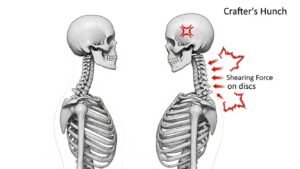
We call it “Crafter’s Hunch,” but doctors call it a looming structural failure. Did you know that for every inch your head tilts forward, you are adding an extra ten pounds of weight to your cervical spine? When you are staring down at that intricate lace border, your neck is supporting the equivalent of a heavy bowling ball—not for a minute, but for hours on end. Are you building a masterpiece with your hands while simultaneously destroying the scaffolding of your own body? Why are we treating our posture like a disposable resource? What if I told you that the secret to a forty-year crafting career isn’t a better chair, but a simple, rhythmic law of physics known as the 20-20-20 Rule?
The Biological Debt of the Deep Lean
To understand the 20-20-20 Rule, we must first look at the “Biological Debt” you are accruing. When you sit in a prolonged “C-Curve” posture, you aren’t just stretching your muscles; you are reshaping your fascia and compressing your intervertebral discs. Your body is incredibly efficient—if you tell it that your primary function is to look down at yarn, it will physically adapt to make that easier. It will shorten the muscles in your chest and lengthen the muscles in your back until the “hunch” becomes your resting state.
Is your “relaxing” hobby actually a form of self-inflicted orthopedic torture? When you finish a session and feel that sharp, burning sensation between your shoulder blades, that is your nervous system sending a frantic distress signal. You might “shake it off” tonight, but what about five years from now? Will you still be able to look up at the stars without pain, or will your world be permanently limited to the two feet in front of your lap?
The “Tech Neck” Cousin: Why Crafters Have it Worse
We hear a lot about “Tech Neck” from cell phone use, but crafters have it significantly worse. While a phone user might look up when they receive a notification, a crafter often remains in a fixed, static position for the duration of a podcast or a movie.
This static loading is a silent killer of joint health. It starves your discs of oxygen and nutrients, which are only delivered through movement. By staying still, you are effectively “stagnating” your own spine. Are you willing to trade your long-term mobility for a few extra rows tonight? Why do we value the tension of our yarn more than the tension in our trapezius muscles?
Decoding the 20-20-20 Rule: Your Creative Life Raft
The 20-20-20 Rule was originally popularized for eye health (look at something 20 feet away for 20 seconds every 20 minutes), but the “Ergonomic Shift” for crafters is much more profound. For us, it is a full-body reset.
Every 20 minutes, you must stop. For 20 seconds, you must look at something 20 feet away while performing a physical “reverse” of your hunch. It sounds too simple to be effective, doesn’t it? But this isn’t just a suggestion; it’s a biological reset button. It interrupts the “creep” of your soft tissues—the process where ligaments start to stretch out and lose their elasticity. Are you disciplined enough to set a timer, or is your ego so tied to your stitch count that you refuse to pause?
The “20 Feet” Optical Liberation
Why look 20 feet away? When you crochet or knit, your eyes are locked in “near-point convergence.” The tiny muscles in your eyes are tightly contracted to maintain focus on the fine details of the fiber.
By looking 20 feet away, you allow those muscles to completely relax. This prevents “Vigilance Fatigue,” which is that mental exhaustion that makes you start making mistakes in your pattern. Looking away isn’t a distraction; it’s a recalibration of your creative vision. Have you ever noticed that you find your mistakes more easily after you’ve stepped away? Why not build that clarity into your process every twenty minutes?
The 20-Second “Anti-Hunch” Maneuver
The physical component of the 20-20-20 Rule is the “Scapular Squeeze.” During those 20 seconds, you must pull your shoulder blades together and down, as if you are trying to tuck them into your back pockets. You must open your chest and bring your ears back over your shoulders.
This move flushes the “lactic acid” out of your tired muscles and re-engages the stabilizers that have gone dormant while you were leaning forward. It is a 20-second insurance policy against a $20,000 neck surgery. Is your health worth a 20-second investment? Or are you so addicted to the “rhythm of the hook” that you’ve lost the rhythm of your own breath?
The “Chin Tuck” Secret
During your 20-second reset, perform a “Chin Tuck.” Gently draw your chin straight back, making a “double chin.” This stretches the suboccipital muscles at the base of your skull—the exact spot where “crafter’s migraines” are born.
If you feel a gentle pull at the base of your head, that is the sound of your spine thanking you. Why do we wait until we are in agony to stretch? Why do we treat our bodies like machines that never need maintenance? Are you ready to stop “fixing” your pain and start “preventing” it?

The Psychological Barrier: Why We Refuse to Stop
The biggest obstacle to the 20-20-20 Rule isn’t the rule itself; it’s our own obsessive nature. We are “completionists.” We want to reach the end of the row, the end of the color change, the end of the chapter.
But here is the hard truth: the yarn will always be there, but your cartilage won’t. When we ignore the 20-20-20 Rule, we are operating out of a scarcity mindset—the fear that if we stop, we’ll lose the magic. But true mastery is sustainable. A master knows when to put the tool down. Are you a slave to your yarn, or are you the commander of your craft? Why do we feel “guilty” for taking a 20-second break, but we don’t feel guilty for the way we’re trashing our bodies?
Overcoming the “Row-End” Obsession
We tell ourselves, “Just one more row.” Then that row leads to a mistake, and we have to fix it, and suddenly forty minutes have passed.
The 20-20-20 Rule demands that you stop mid-row if necessary. This actually helps your memory. When you stop in the middle of a task, your brain keeps the “loop” open, making it easier to jump back in with high focus. It’s called the Zeigarnik Effect. You aren’t losing time; you are hacking your brain for better productivity. Why are you clinging to a “linear” workflow when a “pulsed” workflow is biologically superior?
Ergonomic Accessories: Tools that Enforce the Rule
While the rule is free, you can use your environment to help you. Using a “Prop” for your work—like a nursing pillow or a dedicated lap desk—brings the work higher so you don’t have to hunch as far.
However, even the best pillow won’t save you if you don’t move. The pillow is the “armor,” but the 20-20-20 Rule is the “training.” You need both. Have you invested in a $200 set of hooks but zero dollars in a simple kitchen timer? Why are we so focused on the “tangible” tools and so neglectful of the “intangible” habits that actually keep us in the game?
The “Mirror” Reality Check
If you don’t believe you are hunching, set up a mirror to your side while you craft. Catch a glimpse of yourself ten minutes into your work.
The person you see in that mirror will likely be a distorted version of yourself—shoulders rounded, head jutting forward like a turtle. It’s a shocking sight. That mirror is the “Truth-Teller.” It will make the 20-20-20 Rule feel less like a chore and more like an emergency rescue. Are you brave enough to look at your own reflection while you work? Or are you afraid of seeing the “Hunch” in action?

The Long-Term ROI of the 20-Second Reset
Let’s talk about the Return on Investment. If you follow the 20-20-20 Rule, you will likely add 10 to 15 years to your “active” crafting life.
You will avoid the “nerve impingement” that leads to numb fingers. You will avoid the “tension headaches” that ruin your evenings. You will avoid the permanent “dowager’s hump” that changes how your clothes fit. This is the most valuable “Stash” you have: your own health. Why are we so careful with our “limited edition” yarn but so reckless with our “one-edition” spine? Isn’t your ability to create worth more than a few minutes of interrupted time?
The “Social” Benefit: Crafting with Friends
If you craft in a group, introduce the 20-20-20 Rule to your friends. Make it a communal event. When the timer goes off, everyone looks up, everyone stretches, and everyone breathes.
It changes the energy of the room. It turns a “static” hobby into a “dynamic” one. It shows that you care about the well-being of your community as much as you care about their patterns. Why not be the leader of the “Posture Revolution”? Why not show the world that crafters are as physically disciplined as athletes?
Final Thoughts: The Choice is in Your Vertebrae
Tonight, when you sit down to work on your latest project, you have a choice to make. You can descend into the “Hunch,” slowly crushing your discs and straining your muscles in the pursuit of one more row.
Or, you can embrace the 20-20-20 Rule. You can decide that your art is worth the pause. You can look at the far wall, squeeze your shoulders, and reclaim your spine.
The “Crafter’s Hunch” is not a badge of honor; it is a sign of neglect. True artisans respect their tools—and your body is the most sophisticated tool you own. Stop the hunch. Save your neck. Set the timer. Your 20 seconds start now.
Will you be the artist who can still stand tall at eighty, or will you be the one whose masterpiece is finished while their body is broken? The clock is ticking. Your spine is waiting. Make the shift.

My name is Sarah Clark, I’m 42 years old and I live in the United States. I created Nova Insightly out of my love for crochet and handmade creativity. Crochet has always been a calming and meaningful part of my life, and over the years it became something I wanted to share with others. Through this blog, I aim to help beginners and enthusiasts feel confident, inspired, and supported as they explore crochet at their own pace. For me, crochet is more than a craft — it’s a way to slow down, create with intention, and enjoy the beauty of handmade work.