
Have you ever spent forty hours—actual, irreplaceable hours of your life—meticulously crafting a sweater, only to try it on and realize it looks like a stiff, rectangular box instead of the flowing, ethereal garment promised in the pattern photos? You followed the instructions. You bought the expensive hand-dyed yarn. You even made a gauge swatch. And yet, the result is… wrong. It feels like a betrayal, doesn’t it? You stare at the mirror, wondering if your body is simply the wrong shape or if the designer was playing some cruel joke. But what if I told you that the culprit isn’t your body, your yarn, or even your tension? What if the difference between your “handmade” looking project and a professional, “boutique-level” masterpiece comes down to a single, microscopic movement you make every three seconds without even realizing it?
This is the mystery of the Golden Loop. It is the hidden variable of the crochet world, a ghost in the machine that dictates the height of every single stitch you create. Most beginners are taught about “tension”—how tightly they hold the yarn in their left hand—but tension is only half the story. The other half, the more dangerous and elusive half, is how you manage that very first loop you pull up through a stitch. If you haven’t mastered this adjustment, you are essentially building a house where every brick is a slightly different height. Is it any wonder the walls are leaning?
The Anatomy of a Hidden Saboteur
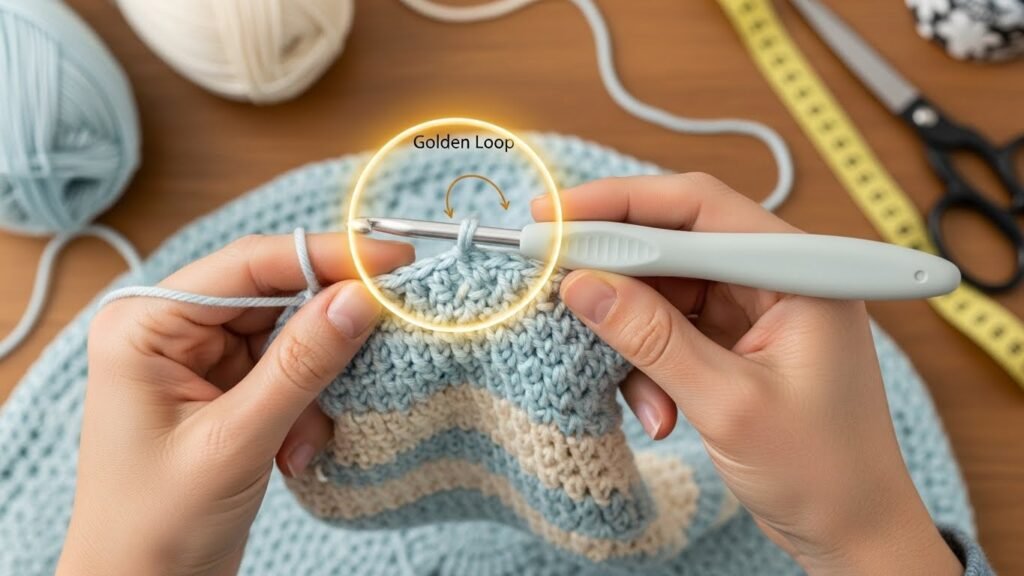
To understand why your projects are failing, we have to look at the anatomy of a crochet stitch with the precision of a surgeon. When you insert your hook into a stitch and yarn over, you pull a loop back through. That specific loop—the first one on your hook after the yarn-over—is the Golden Loop. It sets the vertical height of the stitch. Everything that happens afterward, the subsequent yarn-overs and pull-throughs, only creates the “bulk” and “top” of the stitch. But the height? That’s decided in a split second.
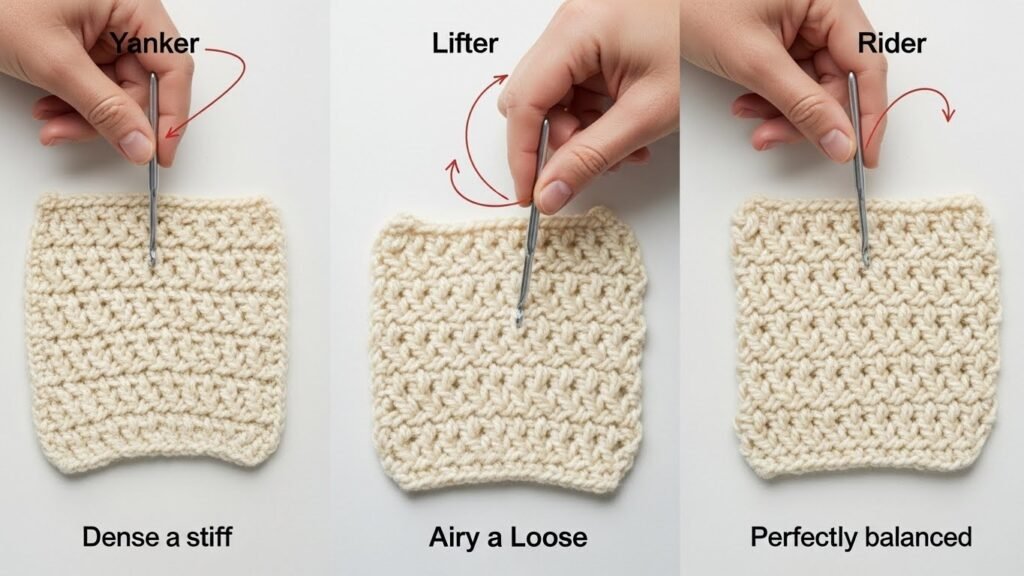
Why does this matter so much? Because crochet is a grid-based architecture. If your Golden Loop is too short, your stitches are squat. If it’s too tall, they are lanky and gappy. Most patterns are written by professionals who have a “standard” Golden Loop, but as a beginner, you likely fall into one of three psychological profiles: The Yanker, The Lifter, or The Rider. Which one are you? Are you the person who pulls the yarn so tight the hook squeaks, or are you the one who pulls the loop high into the air as if trying to reach the ceiling?
The Psychology of the Yanker
The “Yanker” is usually a beginner who is terrified of making a mistake. In their mind, tightness equals security. They insert the hook, pull up the loop, and then immediately tug it down tight against the shank of the hook. They think they are being “neat,” but they are actually strangling the fiber. When you “yank” your Golden Loop, you are creating a fabric that has zero drape. It becomes a shield, not a garment. Have you ever made a scarf that could literally stand up on its own like a piece of cardboard? That is the hallmark of a Yanker.
This isn’t just an aesthetic problem; it’s a physical one. Yanking puts immense strain on your wrists and fingers. It’s why so many beginners quit after a month, complaining of “crochet claw” or carpal tunnel symptoms. You aren’t just fighting the yarn; you’re fighting the very physics of the stitch. Does it feel like a workout every time you try to shove your hook into the next row? If so, your Golden Loop is holding you hostage.
The Lifter and the Illusion of Ease
On the opposite end of the spectrum, we have the “Lifter.” This crafter pulls that first loop up and away from the work, creating a tall, elegant-looking stitch. At first glance, the fabric looks soft and squishy—the dream, right? Wrong. The Lifter is creating a structural nightmare. Because the stitches are too tall for their width, the fabric lacks “memory.” It will look great for the first ten minutes you wear it, but by the end of the day, gravity will take hold. Your sweater will grow two sizes, the sleeves will drag on the floor, and the neckline will sag to your waist.
The Lifter often wonders why their gauge is always “off.” They’ll go down three hook sizes to try to match the pattern, but the fabric still doesn’t feel right. It’s because they are trying to fix a height problem with a width solution. You can’t fix a skyscraper that’s too tall by making the windows smaller. You have to change the foundation. Are you tired of your projects looking like they’ve been melted in the sun?
The Rider: The Professional’s Secret
Then, there is the “Rider.” This is the one tiny adjustment that separates the amateurs from the pros. The Rider pulls the loop up just enough so that it “rides” comfortably on the shank of the hook, perfectly parallel to the work. They don’t tug it down, and they don’t lift it up. They let the diameter of the hook do the work for them. This creates a stitch that is exactly as tall as the hook designer intended.
But here is the “shocking” part: most professionals don’t stay “Riders” all the time. They manipulate the Golden Loop like a master musician manipulates a violin string. If they want a denser fabric for a bag, they become temporary Yankers. If they want a lacy, flowing shawl, they become Lifters. The difference is intentionality. An amateur is a slave to their habit; a pro is a master of their technique. Are you ready to stop being a victim of your own muscle memory?
Why Your Gauge Swatch Is Lying to You
We’ve all been told that the gauge swatch is the “gold standard” of crochet. “Check your gauge!” the veterans scream. So you do. You make a 4×4 inch square, and it matches the pattern perfectly. You celebrate. You spend three weeks making the back panel of a cardigan. And then… it’s four inches too wide. How is that possible? Did the yarn expand? Did the universe shift its gravitational pull?
No. What happened was your emotional state. When you made the swatch, you were focused, perhaps a bit nervous, and you were likely “Riding” your loops. But as you moved into the mindless repetition of the actual project, you relaxed. Or perhaps you got stressed. Your Golden Loop drifted. Over the course of thousands of stitches, a microscopic drift of 0.5 millimeters per loop adds up to inches of error. Your gauge swatch was a snapshot of a single moment, but your project is a movie of your changing moods.
The professional knows that the Golden Loop must be monitored constantly. They don’t just check gauge once; they check their “loop height” every few rows. They recognize that if they are watching a suspenseful thriller on Netflix, their Golden Loop will likely tighten up. If they are listening to a calming podcast, it might grow taller. Do you really want your wardrobe to be a literal map of your TV viewing habits?
The Fiber Science of the Loop
To truly master the Golden Loop, you have to understand what happens to the yarn on a molecular level. Wool, cotton, and acrylic all have different “elasticity.” When you pull a Golden Loop too tight on a wool yarn, you are crushing the natural crimp of the fiber. You are essentially killing the “bounce” that makes wool so desirable. You’re turning a $30 skein of luxury fiber into a piece of string.
On the flip side, if you are working with cotton—which has zero elasticity—and you are a Lifter, your stitches will eventually collapse under their own weight. Cotton doesn’t have the “memory” to stay tall. The Golden Loop isn’t just about measurement; it’s about respecting the material. The pro asks: “What does this fiber need to be its best self?” The amateur just pulls the yarn. Which one are you? Are you a partner to your yarn, or its master?
The “Ghost” in the Pattern
Have you ever noticed that some designers’ patterns always seem to run small for you, while others run large? It’s not necessarily an error in their math. It’s their Golden Loop. Every designer has a “natural” stitch height. If a designer is a natural “Lifter,” and you are a natural “Yanker,” you will never, ever meet their gauge without extreme intervention.
By understanding your own Golden Loop profile, you can “hack” any pattern. If you know you are a Yanker, you don’t just go up a hook size; you consciously practice “lifting” that first loop. This is the “Aha!” moment that changes everything. It’s the moment you stop fighting the pattern and start collaborating with it. It’s the moment you realize that the “mystery” wasn’t a secret held by the elite, but a simple mechanical habit that you can rewrite starting today.
How to Reclaim Your Craft
So, how do you fix it? How do you transition from the frustration of the amateur to the precision of the pro? It starts with the “Mindful Ten.” For the next ten stitches you make, I want you to look at nothing but that first loop. Don’t look at the pattern. Don’t look at the TV. Just look at the loop. Where does it sit on the hook? Does it feel like it’s gasping for air? Is it drooping?
Once you see it, you cannot unsee it. You will start to feel the “sweet spot” where the yarn is supported by the hook but not strangled by it. You will find the rhythm where the height of the stitch is determined by intent, not by accident. This is where the magic happens. This is where the “handmade” look transforms into “handcrafted” excellence.
The Million-Dollar Question
Why aren’t we talking about this more? Why is the Golden Loop treated like a dark secret or an advanced technique when it is the very foundation of every stitch? Perhaps it’s because it requires us to take a long, hard look at our own flaws. It’s much easier to blame the yarn or the hook than to admit our own wrists are being inconsistent. But in that admission lies your greatest power.
Think about the next project you have planned. Is it that gorgeous lace shawl you’ve been eyeing? Or maybe the complex amigurumi that always ends up looking lopsided? Imagine making it and knowing—with absolute certainty—that it will turn out exactly as pictured. Imagine the confidence of a pro. Are you willing to spend twenty minutes of “boring” practice to save yourself hundreds of hours of “failed” projects?
The mystery is solved. The “Golden Loop” is no longer a ghost; it is a tool in your hand. You have the secret code. You have the one tiny adjustment that changes everything. Now, the only question that remains is: will you use it? Or will you go back to the “Yank and Pray” method and hope for the best? Your yarn is waiting. Your hook is ready. And for the first time in your crafting life, you are finally in total control.
The Legacy of the Stitch
When we crochet, we are participating in an ancient lineage of creators. We are using our hands to turn a single thread into a three-dimensional object. It is a miracle of geometry and patience. But to honor that lineage, we must strive for excellence. We must care about the details that others ignore. We must care about the Golden Loop.
When someone sees your work a year from now, and they ask, “Where did you buy that?”, you will smile. You will know that the “boutique” quality they see isn’t the result of a fancy machine or a $50 hook. It’s the result of a choice. A choice to be mindful. A choice to be precise. A choice to master the one tiny adjustment that separates the amateurs from the pros. Welcome to the other side. The water—and the yarn—is fine.

My name is Sarah Clark, I’m 42 years old and I live in the United States. I created Nova Insightly out of my love for crochet and handmade creativity. Crochet has always been a calming and meaningful part of my life, and over the years it became something I wanted to share with others. Through this blog, I aim to help beginners and enthusiasts feel confident, inspired, and supported as they explore crochet at their own pace. For me, crochet is more than a craft — it’s a way to slow down, create with intention, and enjoy the beauty of handmade work.