
There is a specific kind of heartbreak that only a beginner crocheter knows. It usually happens about ten rows into what was supposed to be a beautiful, cozy scarf. You lay your work down on the coffee table, expecting to admire a neat, rectangular foundation, but instead, you are greeted by a “Dorito.” Your work has taken on a life of its own, narrowing at the sides until your square has transformed into a pathetic, unintended triangle. You count your stitches, you rub your eyes, and you wonder: Is the yarn shrinking? Is my hook possessed? Or am I simply not “wired” for this hobby?
The frustration is visceral. You’ve followed the tutorials. You’ve watched the “easy” videos. Yet, here you are, holding a lopsided piece of fabric that looks more like a mountain range than a potholder. Why does this happen? Is there some secret, ancient geometry that you missed out on in high school? The truth is actually far more simple, and arguably, more annoying. You are falling victim to a “visual illusion” that plagues every single person who picks up a hook for the first time. But what if I told you that the difference between your triangular tragedy and a professional-grade square isn’t hours of practice, but a two-second mental shift? Are you ready to stop fighting your yarn and start commanding it?
The Geometry of a Crochet Disaster
To understand why your square is shrinking into a triangle, we first have to look at the “anatomy of the edge.” In a perfect world, crochet rows would be like LEGO bricks—neat, stackable, and perfectly aligned. But crochet isn’t made of plastic; it’s made of loops and tension. When you reach the end of a row, you have to “turn” your work to head back the other way. This turning point is exactly where the disaster begins.
Most beginners treat the end of a row like a suggestion rather than a hard border. They either miss the last stitch because it “looks” different from the others, or they accidentally skip the first stitch of the new row because they aren’t sure where to put their hook. It’s a game of “Hide and Seek” where the yarn is always winning. Have you ever noticed how that last stitch of the row seems to pull downward, tucking itself away like a shy child? If you don’t actively hunt for it, you will miss it. And the moment you miss one stitch at the end of a row, your square begins its slow, inevitable crawl toward becoming a triangle.
The Turning Chain: Your Secret Villain
In almost every crochet project, you are told to “Chain 1” or “Chain 3” before you turn your work. This is known as the turning chain, and it is the most misunderstood element in the entire craft. For some stitches, the turning chain “counts” as a stitch. For others, it doesn’t. Does that sound confusing? It should. It’s a linguistic trap that leads to physical errors.
If you are making double crochets and your pattern says “Chain 3, counts as a stitch,” you are expected to skip the very first hole in the row and work into the second one. If you don’t, you’ve just added a stitch. If you do it at one end but forget to work into the top of the chain at the other end, you’ve lost a stitch. You are essentially adding and subtracting math in real-time while trying to relax on your sofa. Is it any wonder your brain is short-circuiting? This ambiguity is exactly why your edges look like a zigzagging staircase.

The “Hidden Stitch” Ninja
The most common reason for the “Triangle Effect” is the “The Ninja Stitch.” This is the very last stitch of the row that often leans slightly to the side. To the untrained eye, it doesn’t look like a stitch at all; it looks like a knot or a bit of stray tension. So, the beginner ignores it, turns their work, and begins the next row. By doing this, you have just told your project to get narrower. Do this for ten rows, and you’ve lost ten stitches.
Think about it: if you started with twenty stitches and you lose one per row, by row twenty, you have… nothing. A point. A triangle. It’s not a lack of talent; it’s a lack of “stitch-vision.” You have to learn to see the architecture of the yarn rather than just the loops. Can you see the “V” shape at the top of that last, leaning stitch? If you can’t, you’re building a house on a collapsing foundation.
The 2-Second Fix That Changes Everything
Now, let’s talk about the solution. You’ve likely heard experts tell you to “just count your stitches.” This is the most unhelpful advice in the history of crafting. Who wants to count to fifty over and over again while trying to listen to a podcast or watch a movie? It’s tedious, it’s prone to error, and it sucks the joy out of the creative process.
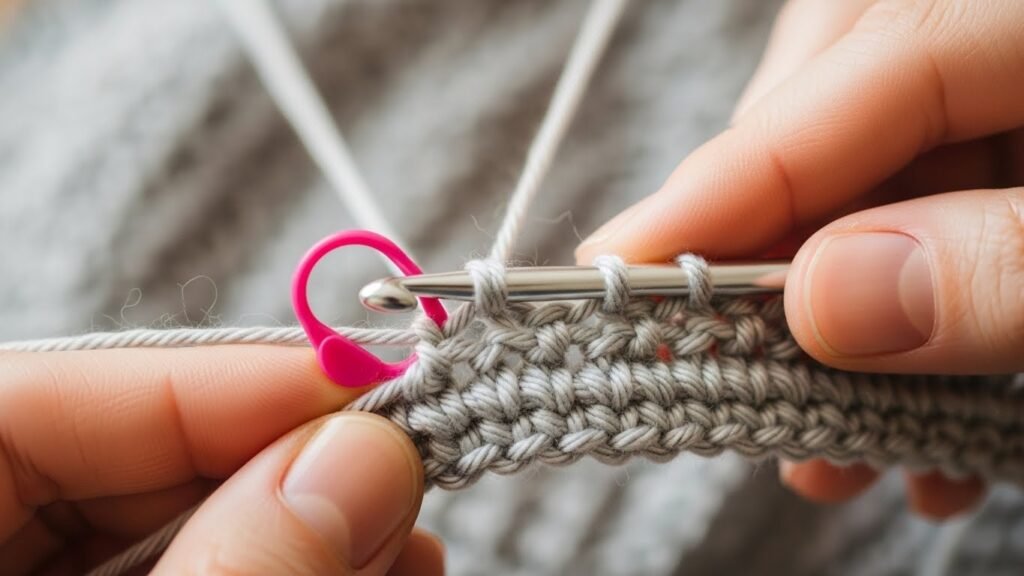
The real fix—the “two-second” miracle—doesn’t involve counting at all. It involves a tiny piece of plastic called a stitch marker. But wait, don’t roll your eyes just yet. It’s not about using markers everywhere; it’s about the “First-Stitch Strategy.”
The moment you make the very first stitch of a new row, you stop. You take exactly two seconds to clip a stitch marker into that stitch. That’s it. Now, when you work your way across the row and eventually come back to that spot, you don’t have to guess where the last stitch is. You don’t have to squint or pray to the yarn gods. You simply work your hook exactly where that plastic marker is sitting. It is a “physical GPS” for your hook. By marking the first stitch, you have guaranteed the location of your last stitch on the return journey. Why didn’t anyone tell you this on day one?
Why We Resist the Simple Solutions
Why do beginners resist using stitch markers? Often, it’s a matter of ego. We want to believe we can “see” the stitches. We want to feel like we are “natural” crafters who don’t need training wheels. But even master crocheters with forty years of experience use markers when they are working with dark yarn or complex patterns.
Using a marker isn’t a sign of weakness; it’s a sign of intelligence. It’s an admission that the human eye is easily fooled by the shadows and twists of fiber. When you use the 2-second fix, you remove the mental fatigue of second-guessing yourself. You can finally relax. Isn’t that why you started crocheting in the first place? To escape the stress of the world, not to add more “where does this hook go” stress to your evening?
The Mastery of the “Turning” Mechanics
Once you’ve implemented the 2-second fix, you’ll start to notice something magical: your edges are straight. But to go from “straight” to “professional,” we need to look at the mechanics of the turn itself. Have you ever noticed how the edges of your work sometimes look “loopy” or “gappy,” even if they are straight? This is the second half of the triangle mystery.
When you chain 3 for a double crochet row, that chain is often thinner than a real stitch. This creates a hole at the edge of your work. The “Pro Hack” here is to actually chain one less than the pattern calls for, or to use a “Chainless Starting Double Crochet.” But for a beginner, the easiest fix is to simply tighten that turning chain. If you treat your turning chain with the same respect as your regular stitches, your edges won’t just be straight—they’ll be crisp.
Tension: The Emotional Variable
We can’t talk about triangles without talking about tension. Have you ever noticed that your work starts out wide and loose at the beginning of the day, but by the end of a stressful afternoon, your stitches are tiny and tight? Your crochet is a physical manifestation of your nervous system. If you are “white-knuckling” your hook, your stitches will naturally shrink, causing your square to pull inward.
This creates a “trapezoid” effect that eventually mimics a triangle. The 2-second fix helps with the stitch count, but you also need a “tension check.” Every few rows, take a breath. Drop your shoulders. Shake out your hands. If you are crocheting while angry, your square will know. It will shrink in protest. Are you letting your emotions dictate the width of your scarf?
Beyond the Square: Why This Matters for Your Future
You might be thinking, “It’s just a square, who cares?” But the square is the foundation of everything in the crochet world. If you can’t make a square, you can’t make a sweater that fits. You can’t make a blanket that lies flat. You can’t make a hat that doesn’t look like a traffic cone.
Mastering the “2-second fix” is your initiation into the world of “Real Crochet.” It’s the moment you stop being a hobbyist who “tries” to make things and start being a crafter who “does” make things. It’s about taking control of the medium. When you stop losing stitches, you stop losing confidence. And when you stop losing confidence, you start attempting the projects you actually want to make—the intricate cardigans, the complex amigurumi, the heirloom blankets.
The Myth of the “Natural” Crocheter
There is a damaging myth in the crafting world that some people are just “good with their hands” and others aren’t. This is total nonsense. Crochet is a mechanical skill, much like typing or driving a car. No one is born knowing how to find the “hidden last stitch” of a row of half-double crochets. It is a learned visual skill.
The people whose first squares look like squares didn’t have “better hands”; they likely just had someone point out that last stitch earlier than you did. By using the stitch marker fix, you are giving yourself the same advantage that the “naturals” have. You are leveling the playing field. Isn’t it time you stopped calling yourself “uncoordinated” and started calling yourself “properly equipped”?
The Psychological Victory of the Straight Edge
There is a profound sense of peace that comes from finishing a row and knowing, without a shadow of a doubt, that you have the right number of stitches. It changes the entire experience of the craft. Instead of a constant, low-level anxiety about whether your project is ruined, you feel a sense of flow.
This flow is where the mental health benefits of crochet live. When you are in the “zone,” your brain produces alpha waves similar to those found in meditation. But you can’t get into that zone if you are constantly worried about your work turning into a triangle. The 2-second fix is the gatekeeper to that meditative state. It removes the “friction” of the learning process.
Final Thoughts: The Triangle Is a Rite of Passage
If you are currently staring at a triangular “square,” don’t throw it away. Keep it. Put it in a drawer and look at it in six months. It is a record of your progress. Every master was once a maker of “Dorito” scarves. The triangle isn’t a sign of failure; it’s a sign that you are in the middle of the learning curve.
But now, you have the secret. You know about the hidden ninja stitch. You know about the deceptive turning chain. And most importantly, you have the 2-second fix. No more counting to a hundred while your family tries to talk to you. No more frogging (ripping out) hours of work because the edges are wonky. Just one little plastic marker, a deep breath, and the glorious, straight-edged future that awaits you.
Are you ready to pick up that hook again? This time, the square stays a square. This time, you are the boss of the yarn. And this time, your first “real” project is going to be magnificent. Why settle for a triangle when you were born to master the square? The journey from amateur to pro is exactly two seconds long. Take the leap.

My name is Sarah Clark, I’m 42 years old and I live in the United States. I created Nova Insightly out of my love for crochet and handmade creativity. Crochet has always been a calming and meaningful part of my life, and over the years it became something I wanted to share with others. Through this blog, I aim to help beginners and enthusiasts feel confident, inspired, and supported as they explore crochet at their own pace. For me, crochet is more than a craft — it’s a way to slow down, create with intention, and enjoy the beauty of handmade work.