
We have all been victims of the “Store-Shelf Deception.” You walk into a craft boutique, you see a ball of yarn that looks like a fluffy marshmallow, you rub it against your cheek, and for a fleeting moment, you think you’ve found it—the softest material in existence. But then you take it home, you work it into a garment, and after three hours against your skin, it starts to itch. Or worse, after one wash, that “cloud-like” softness vanishes, leaving behind a scratchy, pilling mess that feels more like a scouring pad than a luxury knit.
What if I told you that softness isn’t just a feeling? What if I told you that your nerve endings have been lying to you, and that true, objective “softness” can be measured down to the micrometer? We decided to stop guessing. We moved past the marketing fluff and the poetic descriptions on the labels. We went to the lab. We looked at micron counts, staple lengths, and cuticle scales. We tracked down the rarest fibers from the high Andes to the Mongolian steppes to bring you the definitive, science-backed rankings of the softest yarns on Earth. Are you prepared to realize that everything you thought was “soft” is actually sandpaper in disguise?
The Micron Myth: Why Your “Soft” Wool is Actually a Weapon
To understand softness, we have to talk about the micron. A micron is one-millionth of a meter. For context, a human hair is usually between 50 and 100 microns. In the world of yarn, the magic number is 30. If a fiber is thicker than 30 microns, it is physically incapable of bending when it touches your skin. Instead, it stays rigid and pokes your nerve endings. That “itch” you feel? That is literally thousands of microscopic spears stabbing your epidermis.
Most “standard” wools sit at 25 to 28 microns. They are on the edge of the “prickle factor.” But the yarns on our Cloud-Touch Rankings don’t just sit below 30; they shatter the floor of what we thought was physically possible. Why are we still settling for “spears” when we could be wearing “air”?
The “Cloud-Touch” Rankings: Science’s Top 5
We ranked these based on three scientific criteria: Micron Count (fineness), Staple Length (how many ends poke out), and Scale Height (how smooth the surface of the fiber is).
5. Royal Alpaca (18-19 Microns)
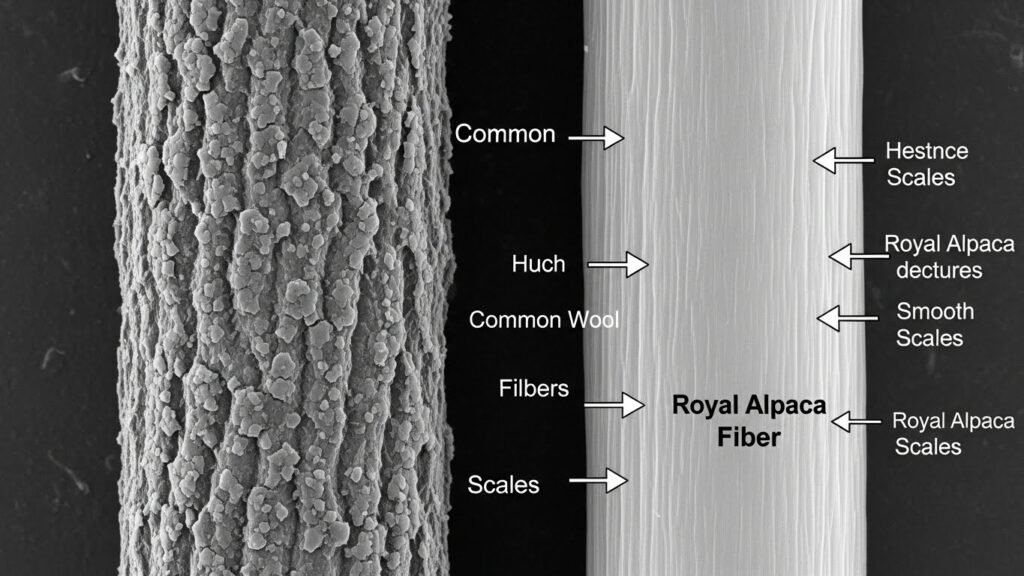
Don’t confuse this with “Baby Alpaca.” In the industry, “Baby” is just a grade, often reaching up to 22 microns. “Royal” is the elite selection, representing less than 1% of the total alpaca harvest. Science shows that Alpaca fiber is unique because it is medullated—it has a hollow core. This creates a thermal barrier that is lighter than wool but significantly smoother.
Because alpaca lacks lanolin, it doesn’t require harsh chemical scouring, keeping the fiber’s natural silkiness intact. But even at number five, is this enough for you? Or are you craving something that feels less like a fiber and more like a ghost?
4. Grade A Cashmere (14-15.5 Microns)
Cashmere is the gold standard for a reason, but the “science” of cashmere is often corrupted by fast fashion. True Grade A cashmere comes only from the underbelly of the Capra Hircus goat. The fibers must be longer than 34mm. Why does length matter for softness? Because the ends of the fibers are what cause irritation. Fewer ends (longer fibers) mean a smoother surface.
When you buy “cheap” cashmere, you are buying short-staple fibers that have been spun together. They feel soft in the shop, but they will pill and prickle within weeks. Scientific Grade A cashmere, however, is a different molecular experience. It creates a fabric that actually becomes softer with use as the fibers “bloom.” But can we go thinner? Can we go deeper into the clouds?
3. Qiviut: The Arctic Treasure (12-14 Microns)
Here is where we move from the luxury to the legendary. Qiviut is the inner undercoat of the Musk Ox. It is eight times warmer than wool and significantly finer than the best cashmere. But the real scientific miracle of Qiviut is that it does not shrink in hot water.
Under a microscope, Qiviut fibers have almost no scales. They are smooth, sleek, and incredibly consistent. Because the Musk Ox lives in the most brutal Arctic conditions, nature has engineered this fiber to be the ultimate insulator without the weight. If you were to knit a sweater out of Qiviut, you wouldn’t feel the weight of the garment; you would only feel a persistent, radiant heat. Why aren’t we all wearing this? Well, the price tag of $100 per ounce might have something to do with it. But can you put a price on perfection?
2. White Cashgora: The Genetic Hybrid (11-12 Microns)
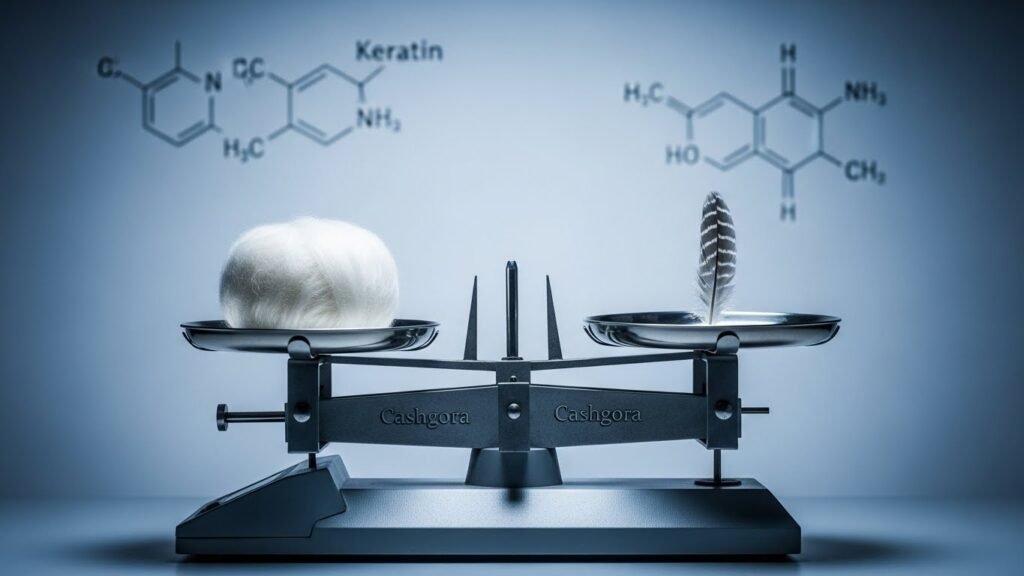
Born from the cross-breeding of Angora (mohair) and Cashmere goats, Cashgora is a scientific marvel. It combines the extreme luster and strength of mohair with the impossible fineness of cashmere. In lab tests, Cashgora consistently outperforms almost every other fiber in “flexural rigidity.”
This means that when the fiber touches your skin, it doesn’t just bend; it collapses. It offers zero resistance. It is the ultimate hypoallergenic experience. If you have skin so sensitive that even the finest wool feels like a burlap sack, Cashgora is your scientific savior. But even this hybrid masterpiece is forced to take second place.
1. Vicuña: The “Fiber of the Gods” (10-12 Microns)
At the top of our list is the Vicuña. This is the finest animal fiber that can be legally harvested on Earth. For centuries, it was reserved only for Incan royalty, and for a good reason. At 10 microns, the Vicuña fiber is so thin that it shouldn’t, by the laws of physics, be able to be spun into yarn.
Vicuña goats can only be shorn once every three years, and they must be caught in the wild. But the science of the fiber is what’s truly shocking. The scales on a Vicuña fiber are so flat and so close together that the fiber feels almost oily—not because of grease, but because of its extreme smoothness. It is the closest a human can get to wearing a cloud. It is the absolute peak of the “Cloud-Touch” scale. If you ever have the chance to touch 100% Vicuña, be warned: every other yarn you ever touch for the rest of your life will feel like sandpaper in comparison. Are you ready to be ruined for everything else?
The “Haptic Threshold”: Why Your Brain Gets Confused
Why do these fibers feel so good? It’s not just about the lack of “prickle.” There is a neurological process called “haptic perception.” When you touch a fiber like Vicuña or Qiviut, the smoothness is so extreme that your brain has trouble processing it as a solid object.
The lack of friction sends a “comfort signal” to the hypothalamus, reducing stress levels and promoting a sense of well-being. Science has actually shown that wearing ultra-soft fibers can lower your heart rate. We aren’t just talking about yarn anymore; we are talking about wearable therapy. Why do we spend thousands on “wellness” retreats when we could just be knitting with better fibers?
The Secret Saboteur: How Processing Destroys Softness
You could have the finest Vicuña in the world, but if the mill processes it incorrectly, it will feel like garbage. This is the “Industrial Sin” that the pros won’t tell you about.
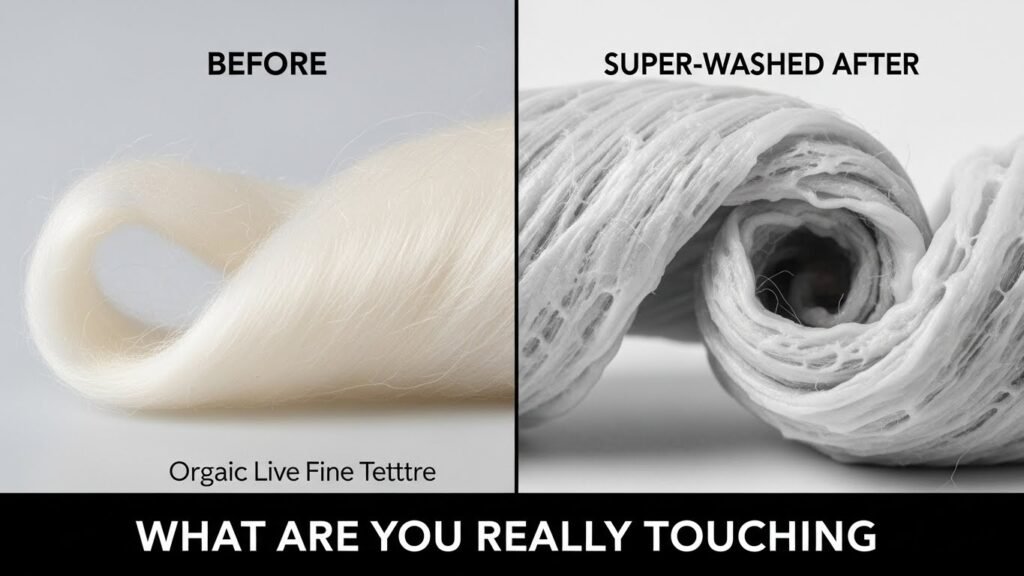
Many commercial yarns are treated with harsh detergents and “superwash” resins to make them easy to care for. These chemicals strip the natural oils and coat the fibers in a thin layer of plastic. While this makes them “smooth,” it also makes them “dead.” A scientifically soft yarn should feel alive. It should have “bounce.”
If you want to maintain the “Cloud-Touch” rating, you have to look for yarns that have been minimally processed. Look for “undyed” or “botanically dyed” options. The more chemicals you add to a 12-micron fiber, the more you turn it into a 30-micron lie. Are you willing to trade the soul of your yarn for the convenience of a washing machine?
The Vegan Cloud: Can Plants Compete?
Until recently, the science of plant fibers was a desert of stiffness. Cotton and linen, while breathable, are structural giants—heavy and rigid. But a new scientific breakthrough has entered the rankings: Lotus Silk.
Extracted from the stems of the lotus flower, this fiber is harvested by hand in a process that takes weeks. The resulting yarn is incredibly fine, naturally breathable, and possesses a softness that rivals high-end cashmere. While it doesn’t have the “warmth” of animal fibers, in terms of “cutaneous comfort” (how it feels against the skin), it is a top-tier contender.
Is the future of softness found in the animal kingdom, or in the laboratory-refined fibers of the botanical world? As we move toward more ethical sourcing, the science of plant-based “Cloud-Touch” is the new frontier. But for now, the Crown remains with the Vicuña.
How to Protect Your Investment (The Lab-Approved Method)
If you are brave enough (and wealthy enough) to invest in a “Cloud-Touch” yarn, you cannot treat it like a regular ball of wool. These fibers are delicate. Their softness is a result of their fineness, which also makes them fragile.
-
Never use hot water: Heat can “shock” the fine scales, causing them to lift and create friction (the death of softness).
-
Use specialized pH-neutral soaps: Traditional detergents are too alkaline and will eat away the protein structure of these elite fibers.
-
Avoid high-friction areas: Don’t use a 12-micron yarn for a pair of socks. The friction of walking will turn your $500 investment into a hole in twenty minutes. Use these for things that touch the neck, the face, or the heart.
The Philosophical Cost of Softness
As we reach the end of our scientific journey, we have to ask: Why are we so obsessed with softness? Is it a regression to our childhood need for comfort? Or is it a rebellion against an increasingly harsh, digital, and “prickly” world?
When we choose a yarn that sits at the top of the “Cloud-Touch” rankings, we are making a statement. We are saying that our tactile experience matters. We are choosing to interact with the world through a lens of extreme gentleness.
The Ultimate Question for the Maker
Now that you know the truth—now that you’ve seen the micron counts and the scale heights—can you ever go back to the “Value Acrylic” aisle? Can you ever look at a 30-micron wool without seeing the “spears” waiting to stab your skin?
The science is clear. Softness isn’t a luxury; it’s a biological imperative for comfort. We have found the softest yarns on Earth, and they are waiting to change the way you feel the world. The question is, is your skin ready for the truth? Or would you rather stay in the dark, wrapped in your “polyester cloud,” pretending you don’t feel the itch?
The clouds are calling. The Vicuña is waiting. The science has spoken. What will you cast on next: a masterpiece of molecular comfort, or another “plastic lie”?

My name is Sarah Clark, I’m 42 years old and I live in the United States. I created Nova Insightly out of my love for crochet and handmade creativity. Crochet has always been a calming and meaningful part of my life, and over the years it became something I wanted to share with others. Through this blog, I aim to help beginners and enthusiasts feel confident, inspired, and supported as they explore crochet at their own pace. For me, crochet is more than a craft — it’s a way to slow down, create with intention, and enjoy the beauty of handmade work.