
The Great Crafting Lie: Why “Slow” Doesn’t Always Mean “Better”
We have been sold a romanticized myth for decades: the idea that for a handmade garment to be valuable, it must take months of agonizing labor. We picture a Victorian woman by a flickering candle, losing her eyesight over cobweb-thin lace, and we think, “That is the pinnacle of devotion.” But let’s be brutally honest for a moment—do you actually enjoy having a project sit in your basket for six months, gathering dust and guilt, while the fashion season passes you by?
In 2026, time is the ultimate luxury. We are living in an era where the “Finished Object” (FO) high is the fuel that keeps our creativity alive. What if I told you that the difference between a project that lingers for a quarter of a year and one that is draped over your shoulders in 48 hours isn’t your skill level, your speed, or your caffeine intake? The secret lies in the mathematics of yarn weight.
Are you ready to stop being a martyr to the fine-gauge needle and start hacking the physics of fiber?
The Physics of the “Quick-Win” Aesthetic
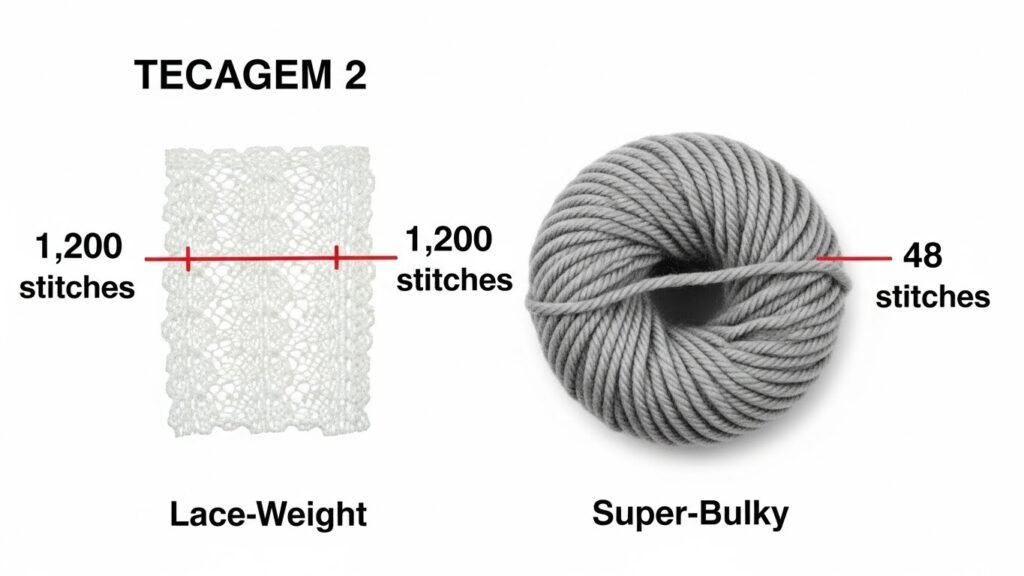
Think about the surface area of a sweater. To cover your torso in a fingering-weight wool, you might need to pull a loop through another loop roughly 100,000 times. Now, imagine using a bulky or super-bulky weight. Suddenly, that number drops to 20,000 or less. You are essentially doing the same amount of “work” in terms of physical motion, but each motion is five times more productive.
But here is the shocker that most traditionalists won’t tell you: the bulky version often looks more “designer” than the thin one. We’ve moved into a decade where texture, silhouette, and “the chunky knit” have moved from the craft fair to the runways of Milan. Why spend 200 hours trying to mimic a machine-knit t-shirt when you can spend 20 hours creating an architectural masterpiece that no machine could ever replicate?
The 48-Hour Blueprint: Anatomy of a Fast Build
To transform your crafting life, you have to stop looking at yarn weight as a suggestion and start seeing it as a strategic tool. If you have a weekend—just 48 hours—can you truly go from a skein of yarn to a wearable garment? Absolutely. But you have to abandon the “delicate” mindset.
When we talk about the 48-hour transformation, we are looking at the “Bulky” (Category 5) and “Super Bulky” (Category 6) weight classes. These are the heavy hitters. These are the fibers that don’t just fill space; they command it.
Why We Fear the Big Hook and Needle
There is a common misconception that thick yarn makes people look “bulky.” This is a design flaw, not a fiber flaw. The 48-hour transformation relies on choosing fibers that have high “loft” but low “mass.”
In 2026, we have access to “blown” yarns—fibers where alpaca or merino is blown into a nylon tube. They look as thick as a thumb but weigh as little as a feather. Have you been avoiding the big yarn because you’re afraid of looking like a marshmallow? What if the right weight actually gave you the structure and drape you’ve been missing in those flimsy, thin-gauge projects?
Choosing Your Weapon: The Weight-to-Style Ratio
To halve your project time, you need to understand the relationship between the “ply” and the “speed.” Not all thick yarns are created equal. If you choose a dense, tightly plied cotton in a bulky weight, you’ll end up with a garment that weighs five pounds and drags on your shoulders.
The secret to the high-speed transformation is the Roving-Style or Chainette construction. These yarns allow the hook or needle to glide through the loops with zero resistance.
The Mathematical Reality of the Swap
Let’s look at the numbers. A standard medium-sized sweater in “Worsted” weight (the industry average) takes the average crafter about 40 to 60 hours of active work. If you only have two hours an evening, that’s a month of your life.
By swapping that Worsted weight for a Super Bulky weight and a 12mm or 15mm tool, you reduce the stitch count by nearly 70%. Your “40 hours” becomes “12 hours.” Suddenly, that “weekend project” isn’t a pipe dream; it’s a mathematical certainty. Do you want to be the person who is knitting a sweater, or the person who is wearing a sweater?
The Psychological Power of the Fast Finish
There is a phenomenon in psychology called the “Endowment Effect,” but in crafting, we call it the “Finished Object Momentum.” Every time you finish a project, your brain releases a hit of dopamine. This dopamine fuels your desire to start the next one.
When you work with thin yarns, that dopamine hit is delayed for months. You enter the “Sleeve Island” or the “Mid-Project Slump,” where the excitement vanishes and the project becomes a chore. By utilizing the 48-hour transformation, you keep your brain in a constant state of reward. You finish, you wear, you post, you celebrate. Repeat.
Is Your Crafting Style a Slow Burn or a Controlled Explosion?
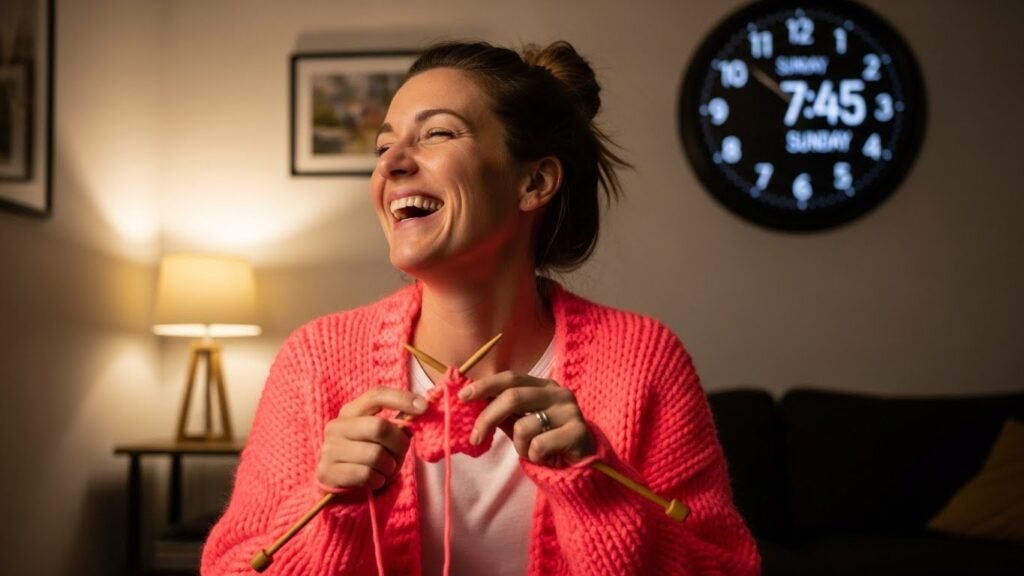
There is room for both, of course. But why have we been conditioned to think that the “slow burn” is the only virtuous way to create? In a world that moves as fast as ours, being able to pivot your wardrobe in 48 hours is a superpower. Imagine getting a last-minute invite to a mountain cabin and being able to whip up a luxury mohair-blend chunky cardigan before the car is packed. That isn’t just crafting; that’s magic.
Strategic Stitch Selection for High-Speed Results
The yarn weight is the engine, but the stitch pattern is the transmission. If you use a bulky yarn but choose a complex, tight cable or a dense bobble stitch, you are fighting against the speed of the fiber.
To truly halve your time, you must embrace the “Open Architecture” of the stitch.
-
For Knitters: The elongated stitch or the oversized rib.
-
For Crocheters: The extended double crochet or the v-stitch.
These stitches allow the yarn to breathe. They create a fabric that is supple, modern, and—most importantly—incredibly fast to produce. When the yarn is the star of the show, you don’t need complicated patterns to make it look “high-end.” The weight of the yarn provides the drama.
The “Cost per Hour” Paradox
Let’s talk money. High-quality bulky yarn is often more expensive per yard than thinner yarn. You might look at the price tag of a premium Peruvian highland wool in a super-bulky weight and winced.
But look at the “Cost per Hour of Joy.” If you spend $100 on yarn and finish a sweater in 12 hours, your investment in your own wardrobe is immediate. If you spend $40 on cheap, thin yarn and spend 100 hours of your life on it, you have “paid” for that sweater with an immense amount of your most precious resource: your time.
In 2026, we are finally realizing that our labor is not free. When you use the right yarn weight, you are respecting your own time.
Case Study: The Friday-to-Sunday Transformation
Let’s break down how a real 48-hour transformation looks in the wild.
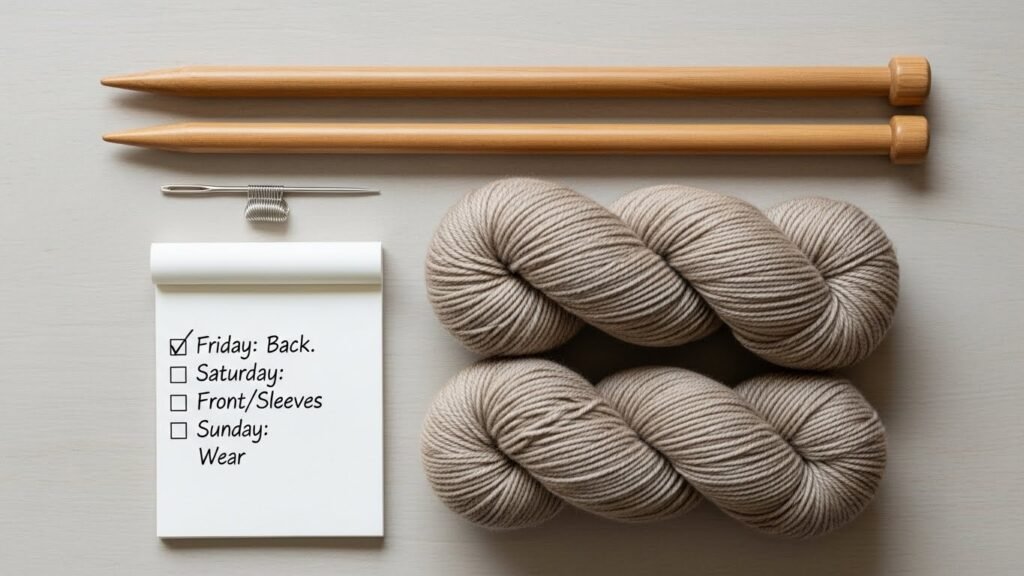
Friday Night (The Launch – 3 Hours): You cast on using a 15mm circular needle and a luxury wool-roving blend. By the time the movie is over, the entire back panel is finished. Why? Because each row is nearly an inch tall.
Saturday (The Heavy Lifting – 6 Hours): Morning coffee brings the front panels. Afternoon tea sees the start of the sleeves. Because the stitches are large, you can clearly see the anatomy of your garment. Mistakes are caught instantly because they are the size of a thumb, not a grain of rice.
Sunday (The Victory Lap – 3 Hours): Seaming a bulky garment takes minutes, not hours. You aren’t hunting for microscopic loops; you are joining bold, clear stitches. By Sunday dinner, the ends are woven in, the garment is blocked (a quick steam will do for these fibers), and you are ready for Monday morning.
The “Designer” Secret: Texture is the New Detail
Why do brands like Loewe or Hope Macauley charge hundreds, even thousands, for simple chunky knits? Is it because they are hard to make? No. It’s because they understand that Texture = Emotion.
A fine-gauge sweater is a garment; a chunky-gauge sweater is an experience. It has a tactile presence that demands attention. When you move to a heavier weight, you aren’t just finishing faster; you are changing the “volume” of your style. Are you tired of your handmade clothes blending into the background? Are you ready to be the person people stop on the street to ask, “Where did you get that?”
Overcoming the “Imposter Syndrome” of Fast Crafting
There is a lingering voice in the back of many crafters’ minds that whispers, “If it was fast, it doesn’t count.” We feel like we are “cheating” the system.
But let’s look at other art forms. Does a painter who uses a wide brush and bold strokes get less respect than a miniaturist who uses a single-hair brush? Does a chef who sears a perfect steak in six minutes get less acclaim than one who simmers a sauce for six hours?
Of course not. The result is what matters. The 48-hour transformation is about the efficiency of beauty. It is about acknowledging that we live in a world that is exhausting, and our hobbies should provide us with more wins than worries.
Why the Right Weight is Actually Better for Your Health
Let’s talk ergonomics. Working with tiny needles and thin yarn requires micro-movements of the fingers and wrists. Over thousands of repetitions, this can lead to RSI (Repetitive Strain Injury) or carpal tunnel.
Thicker tools require larger, more “macro” movements. They engage the larger muscles of the arms and shoulders. Many crafters find that switching to a heavier weight allows them to craft for longer periods without the cramping associated with fine-gauge work. Is your hobby hurting you, or is it healing you?
The 2026 Aesthetic: The “Lo-Fi” Luxury
The trend for 2026 is “Lo-Fi Luxury”—items that look raw, organic, and substantial. This aesthetic is impossible to achieve with lace-weight or fingering-weight yarns. It requires the “honesty” of a thick fiber.
When you use the right weight, you are highlighting the stitch itself. You are saying, “This was made by hand, and I am proud of the scale of that work.” It is a rebellion against the invisible, micro-stitched perfection of the factory machine.
Rhetorical Challenge: What Could You Do With All That Extra Time?
If you began halving your project times today, what would you do with the hundreds of hours you’d save over the next year?
-
Would you knit an entire wardrobe instead of just one sweater?
-
Would you make personalized, high-end gifts for every person you love?
-
Would you finally have the time to learn a new technique, like brioche or thrumming, because the “time cost” is no longer a barrier?
The 48-hour transformation isn’t just about speed; it’s about liberation. It’s about freeing yourself from the “sunk cost” fallacy of projects that no longer bring you joy.
Final Thoughts: The Revolution in Your Yarn Bowl
The next time you stand in front of a wall of yarn, I want you to look past the colors and the labels. I want you to look at the “Potential Energy” of the weight.
Don’t buy the thin yarn because you think you “should.” Buy the thick, glorious, chunky roving because you can. Embrace the 48-hour transformation. Challenge yourself to a weekend of high-intensity creation.
The world doesn’t need more half-finished projects lurking in the bottom of closets. The world needs your finished vision. It needs the warmth, the texture, and the soul of your work. And if you can get that work out into the world in half the time, why on earth would you wait?
Stop counting the stitches. Start counting the days. How many masterpieces are you going to create this month?

My name is Sarah Clark, I’m 42 years old and I live in the United States. I created Nova Insightly out of my love for crochet and handmade creativity. Crochet has always been a calming and meaningful part of my life, and over the years it became something I wanted to share with others. Through this blog, I aim to help beginners and enthusiasts feel confident, inspired, and supported as they explore crochet at their own pace. For me, crochet is more than a craft — it’s a way to slow down, create with intention, and enjoy the beauty of handmade work.