
You are three hours into a late-night “flow” state. The pattern is finally making sense, the yarn is gliding, and the sweater of your dreams is growing row by row. But then, it hits you—a dull, throbbing ache in the base of your thumb. You try to shake it off, but within twenty minutes, your pinky finger has gone numb, and your wrist feels like it’s being squeezed by a hot iron band. You set your hook down, but your hand stays locked in that curved, rigid position. You’ve officially developed the “Crochet Claw.”
We talk about crochet as a healing art, a mental health sanctuary, and a slow-fashion revolution. But we rarely talk about the physical toll it takes on the very tools that make it possible: our hands. Why do we treat our bodies like disposable machines in the pursuit of a handmade life? Is a beautiful scarf worth a lifetime of Carpal Tunnel Syndrome? We have been conditioned to believe that “no pain, no gain” applies to crafting, but that is a dangerous lie. If your hobby is hurting you, you aren’t doing it “right”—you are slowly breaking yourself. It is time to stop the cycle of craft-induced injury and reclaim the longevity of your hands. Are you ready to admit that your obsession might be causing permanent damage, and more importantly, are you ready to fix it?
The Anatomy of a Crafting Injury
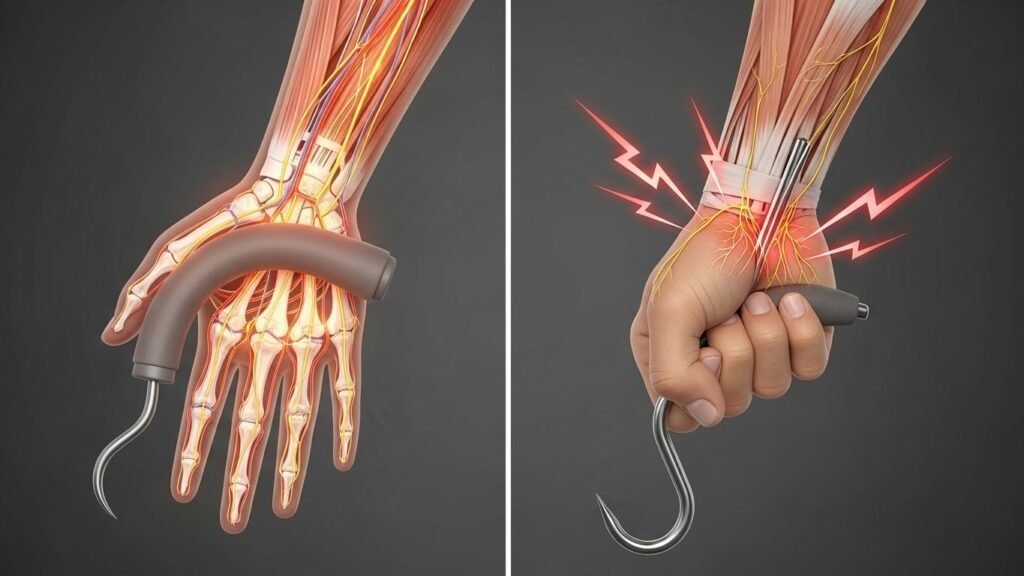
To solve the mystery of hand pain, we have to understand what is happening under the skin. Crochet is a repetitive motion task. Every single stitch requires a micro-adjustment of the wrist, a pinch of the fingers, and a subtle rotation of the forearm. If you are making a queen-sized blanket, you are performing these movements hundreds of thousands of times. In any other context, this would be considered high-intensity industrial labor. Why do we think our tendons are immune just because we are sitting on a comfortable sofa?
The most common culprit is “Overuse Syndrome.” When you perform the same tiny movement over and over without rest, the tendons that slide through the narrow tunnels of your wrist become inflamed. This inflammation creates friction, which leads to pain, which leads to scarring. If you ignore the “dull ache,” you are essentially ignoring a fire alarm in your own body. Have you ever considered that the tingling in your fingertips is actually a scream for help from your median nerve?
The “Death Grip” Phenomenon
The number one mistake beginners (and stressed-out pros) make is the “Death Grip.” This is when you hold your hook so tightly that your knuckles turn white. Usually, this happens because your tension is too tight, and you are fighting the yarn to get the hook through the loops. You are engaged in a literal wrestling match with a piece of string.
This constant isometric contraction—the act of holding a muscle tight without moving it—restricts blood flow to your fingers. It’s like kinking a garden hose. Without fresh, oxygenated blood, your muscles fatigue faster and your nerves begin to misfire. Why are you holding that hook like your life depends on it? The yarn isn’t going anywhere. The hook isn’t trying to escape. The tighter you grip, the more you suffer, and the worse your stitches actually look.
The Ergonomic Revolution: Throw Away Your Thin Hooks
If you are still using those thin, cold, aluminum hooks that look like oversized needles, I have a difficult truth for you: you are sabotaging your future. Those hooks were designed for a time when people had smaller hands and different ergonomic standards. Holding a thin metal rod requires a “precision pinch” that is incredibly taxing on the small muscles of the hand.
The solution is the “Ergonomic Hook.” These hooks have thick, cushioned handles that allow for a “power grip” rather than a “pinch grip.” By increasing the diameter of the handle, you reduce the amount of force your hand has to exert to keep the hook stable. It’s the difference between trying to write with a toothpick and writing with a comfortable pen. Why are you still using 19th-century technology to solve a 21st-century stress problem? Upgrading your tools isn’t “cheating”—it’s medical prevention.
The Hook Grip Swap: Knife vs. Pencil
Did you know that the way you hold your hook can completely change which muscles you are straining? There are two primary grips in the crochet world: the “Knife Grip” and the “Pencil Grip.”
The Knife Grip uses the larger muscles of the forearm and shoulder, while the Pencil Grip relies heavily on the fine motor skills of the fingers and wrist. If you are experiencing pain in your thumb, switching to the Knife Grip might save your hobby. Conversely, if your wrist is the problem, the Pencil Grip might offer relief. A truly sustainable crocheter is “ambidextrous” in their grip—they switch back and forth to give different muscle groups a break. When was the last time you challenged your muscle memory to save your joints?
The 20-20-20 Rule for Crafters
We’ve all been there: “Just one more row.” And then it’s 2 AM and you can’t feel your arm. We need to implement a strict regime of “Active Recovery.” In the corporate world, they tell you to look away from your screen every twenty minutes. In the crochet world, we need the 20-20-20 rule: Every 20 minutes, put the hook down for 20 seconds, and look at something 20 feet away.
During those 20 seconds, you shouldn’t just sit there. You need to perform “The Great Reset.” Shake out your hands like you’re trying to get water off your fingertips. Stretch your fingers wide, then make a soft fist. Roll your shoulders back. Most hand pain actually starts in the neck and shoulders. If your posture is slumped, you are pinching the nerves that travel all the way down to your crochet hook. You are effectively “choking” your hands from the top down. Is that “one more row” worth a month of physical therapy?

Stretching for Longevity: The Secret Exercises
If you want to crochet until you’re ninety, you need to train like an athlete. Yes, a “Fiber Athlete.” There are specific stretches that target the “Crochet Claw” muscles.
-
The Reverse Wrist Stretch: Extend your arm with the palm facing out and fingers up, then gently pull the fingers back.
-
The Thumb Circle: Your thumb is the most “human” part of your hand and the most overworked in crochet. Rotate it slowly in both directions to lubricate the joint.
-
The Finger Fans: Spread your fingers as wide as possible, hold, and relax.
These aren’t just suggestions; they are the “maintenance” required for your biological machinery. If you don’t take time for your wellness, you will be forced to take time for your illness. Which would you prefer? Five minutes of stretching a day, or six months of being unable to hold a fork?
The Environment of Pain: Lighting and Seating
Believe it or not, your hand pain might be coming from your eyes or your chair. If you are crocheting in dim light (common for late-night crafters), you are unconsciously leaning forward and tightening your grip to “see” the stitches better. This “crouched” posture creates a chain reaction of tension that ends in your wrist.
Invest in a high-quality neck light or a dedicated floor lamp. When you can see clearly, your body relaxes. Furthermore, where are you sitting? If you are on a soft couch that causes you to “slump,” your elbows are likely unsupported. The weight of your arms is being held up by your neck and shoulder muscles. Use a “crochet pillow” or even a standard bed pillow to prop up your elbows. When your arms are supported, your hands don’t have to work as hard. Why are you making your body fight gravity while you’re trying to make a blanket?
The Temperature Factor: Warm Hands are Happy Hands
Have you noticed that your hands hurt more in the winter? Cold muscles are stiff muscles. Stiff muscles are prone to micro-tears. If you crochet in a cold room, your blood vessels constrict, reducing the lubrication in your joints.
The Lazy-but-Smart solution? Compression gloves. These fingerless gloves provide gentle pressure (which reduces swelling) and keep the heat trapped in your joints. They feel like a constant hug for your hands. Many professional crocheters swear by them for long sessions. If you can’t keep your room warm, keep your hands “pre-heated.” Are you protecting your yarn from moths but leaving your joints to freeze?

The Psychological Trap of the “Project Deadline”
We are often our own worst enemies when it comes to pain because we are chasing a deadline. Whether it’s a Christmas gift, a baby shower, or a market prep, we push through the pain because we “have to finish.”
But let’s be honest: no one wants a gift that caused the giver a repetitive strain injury. When you push through the pain, you are actually slowing yourself down in the long run. An injury that takes you out for two weeks is much more “expensive” than a project that takes two days longer because you took breaks. We need to dismantle the “hustle culture” of crafting. Crochet is a slow art. If we try to make it fast, we break the very thing that makes it beautiful. Can you learn to value your hands as much as you value the yarn they hold?
Listening to the “Whispers” Before the “Screams”
Body pain follows a specific trajectory. It starts as a “whisper”—a slight stiffness, a bit of warmth in the joint, a tiny tingle. If you ignore the whisper, the body starts to “talk”—a dull ache, a sharp pinch. If you still ignore it, the body “screams”—stabbing pain, loss of grip strength, and permanent numbness.
Most of us wait until the “scream” to change our habits. But the “whisper” is where the cure happens. If you feel even a tiny bit of discomfort, stop. Not in five minutes. Not at the end of the row. Now. The “row” will be there tomorrow; your nerve endings might not be. Why are we so afraid to stop? Are we afraid the project will disappear if we aren’t constantly touching it?
The Long-Term Plan: Building Hand Strength
While stretching is vital, strength is the ultimate protector. The stronger the muscles in your forearms and hands, the more “load” they can handle before they get tired. You don’t need to go to the gym, but using a simple stress ball or a “hand grip” exerciser while you’re not crocheting can build the “buffer” you need for those long sessions.
Think of it as cross-training. You are preparing your body for the “marathon” of a complex project. A strong hand is a hand that can handle tension without cramping. A strong hand is a hand that can switch between a 2mm hook and a 10mm hook without skipping a beat. Are you investing in your “physical capital,” or are you just spending it until you’re bankrupt?
The Return to Joy: Life After the “Claw”
Imagine a world where you finish a long crochet session and your hands feel… fine. No throbbing. No numbness. No “locking” of the fingers. This isn’t a fantasy; it is the reality for crafters who respect their biology.
When you eliminate the “Crochet Claw,” the hobby changes. It stops being a source of secret stress and returns to being a source of pure joy. You can tackle those bigger projects. You can experiment with those tiny hooks and lace yarns. You can finally enjoy the “flow” without the fear of the “aftermath.”
Your hands are the most sophisticated tools in the world. They are capable of creating heirlooms, providing comfort, and expressing your deepest creativity. They deserve more than “just getting by.” They deserve to be pampered, protected, and prioritized.
The next time you pick up your hook, take a second. Check your grip. Check your shoulders. Check your light. And for heaven’s sake, if it starts to hurt, put it down. You have a lifetime of beautiful things to make—don’t trade the next forty years of crafting for forty more minutes tonight. Your hands have given you so much; isn’t it time you gave something back to them? The “Crochet Claw” doesn’t have to be your destiny. It’s just a symptom of a habit that needs to change. Change the habit, save the hobby, and keep the “claw” in the past where it belongs. What will you do today to make sure you can still crochet tomorrow?

My name is Sarah Clark, I’m 42 years old and I live in the United States. I created Nova Insightly out of my love for crochet and handmade creativity. Crochet has always been a calming and meaningful part of my life, and over the years it became something I wanted to share with others. Through this blog, I aim to help beginners and enthusiasts feel confident, inspired, and supported as they explore crochet at their own pace. For me, crochet is more than a craft — it’s a way to slow down, create with intention, and enjoy the beauty of handmade work.