
There’s a specific kind of exhaustion that only crocheters understand. Not the tired hands or sore fingers, but the mental fatigue that comes from doing something over and over, convinced you’re missing a secret everyone else seems to know. You follow tutorials. You rewind videos. You read patterns twice. And still, things take longer than they should. Projects unravel. Confidence unravels with them.
At some point, you don’t feel like a beginner anymore. You feel stuck.
Looking back, there are things I desperately wish someone had told me before I ever picked up a hook. Not tips buried in footnotes. Not vague encouragement. Clear, uncomfortable truths that would have saved me hours—maybe even months—of frustration.
Not because crochet is hard. But because the way it’s usually explained skips the parts that matter most.
The Biggest Lie I Believed When I Started
I believed that if I just practiced enough, everything would eventually fall into place.
Practice more chains. Practice straighter rows. Practice tension. Practice stitch consistency.
That advice sounds responsible. It also wastes an incredible amount of time when you don’t know what you’re practicing for.
Practice Without Understanding Is Just Repetition
I spent hours crocheting rows I didn’t care about, hoping muscle memory would magically turn into skill. But muscle memory without understanding is fragile. It breaks the moment something changes—new yarn, new hook, new stitch.
Understanding is what turns repetition into learning.
Without it, you’re just moving yarn around.
Why More Time Didn’t Equal More Progress
I assumed slow progress meant I needed more patience. What I actually needed was better information.
I wasn’t bad at crochet. I was uninformed about how it actually works.
That difference matters more than people admit.
The Emotional Cost of Not Knowing This
When progress feels slow for no clear reason, you internalize it. You start thinking crochet just “takes time” for some people. Or that you’re not naturally good at it.
Neither of those thoughts are helpful. And neither of them are true.
What Actually Controls Crochet (And Why No One Explains It First)
If someone had explained the core mechanics of crochet early on, everything would have clicked faster.
Crochet Is About Loops, Not Stitches
This sounds obvious, but it isn’t taught that way.
Beginners are taught stitch names before they understand loop anatomy. But every crochet stitch is just a variation of how many loops you pull through and when.
Once you understand loops, stitches stop being mysterious. They become logical variations.
This single realization would have saved me countless hours of confusion.
Tension Is a Result, Not a Skill
I wasted so much energy trying to “fix” my tension. Loosening my grip. Tightening it. Watching my hands like they were misbehaving children.
No one told me that tension stabilizes after your hands feel safe.
When movements become familiar, tension evens out naturally. Trying to control it too early only creates stiffness.
Yarn Does Half the Work
I blamed myself for things that were never my fault.
Splitting stitches. Uneven fabric. Limp results. I assumed these were beginner problems. In reality, many were yarn problems.
No one told me that some yarns fight crochet by design.
The Things I Learned the Hard Way That Should Be Taught First
These lessons didn’t come from tutorials. They came from frustration.
You Don’t Need to Start With Chains
The foundation chain is one of the most difficult parts of crochet for beginners. It requires consistent tension before you even know what tension feels like.
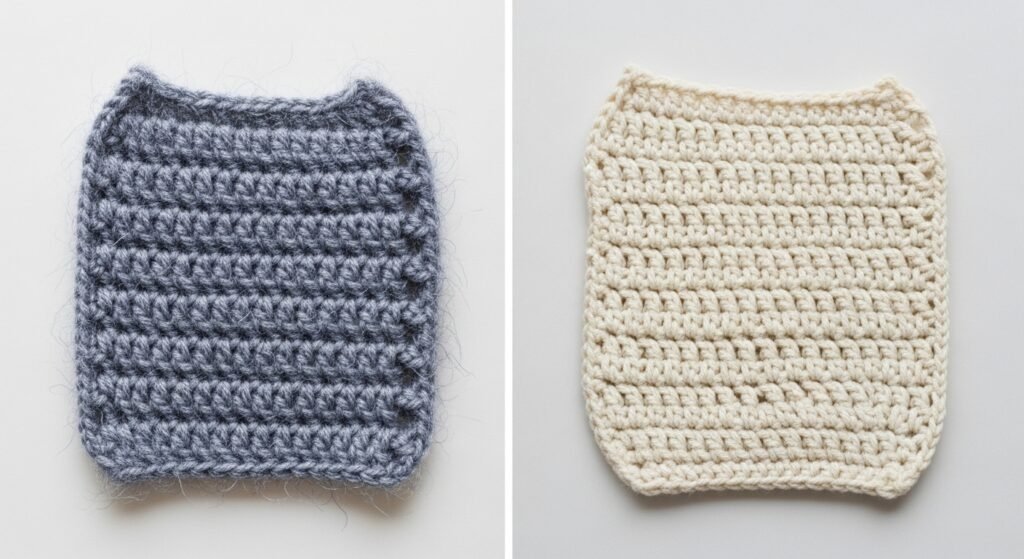
Starting with short rows or small shapes makes learning far less punishing.
Why begin with the most fragile step?
Patterns Are Not Instructions, They’re Maps
I treated patterns like commandments. Follow exactly or fail.
In reality, patterns assume a level of understanding they rarely explain. They’re shorthand, not hand-holding.
Once I stopped treating patterns as rules and started treating them as guidance, my confidence changed.
Frogging Isn’t Always the Answer
Undoing mistakes has its place. But constantly frogging teaches fear.
Leaving small mistakes taught me something more valuable: most crochet survives imperfection.
Not everything needs to be fixed to be functional.
What Would Have Saved Me the Most Time
If I had to condense everything into a few principles, these would be it.
Make Real Things Early
Practice is important. But projects teach faster.
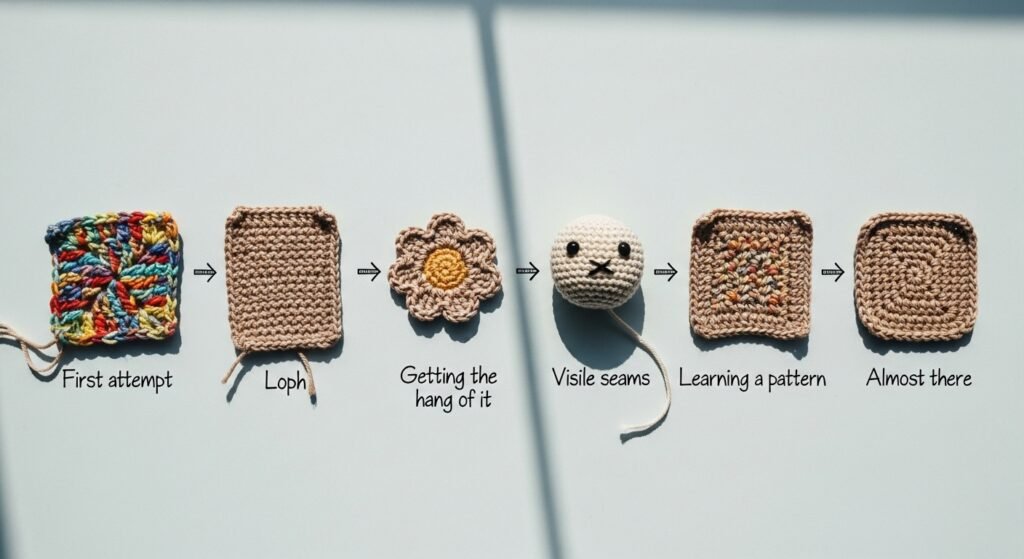
Even small, ugly, imperfect projects give context to every lesson. They answer the question “why does this matter?”
Purpose accelerates learning.
Learn One Concept Per Project
Trying to master everything at once slows progress. Focusing on one idea—edges, tension, stitch height—creates clarity.
Depth beats speed every time.
Stop Comparing Early Work to Finished Work Online
Online crochet often represents years of experience, edited photos, and ideal conditions.
Comparing your learning phase to someone else’s mastery is a guaranteed motivation killer.
The Mental Shift That Changed Everything
The biggest breakthrough wasn’t technical. It was psychological.
Crochet Is a Conversation, Not a Test
Every project gives feedback. Stiff fabric, loose edges, uneven rows—they’re messages, not grades.
Once I stopped judging results and started reading them, learning sped up dramatically.
Struggle Isn’t Proof of Failure
Struggle means you’re touching something unfamiliar. That’s where learning lives.
Ease comes later.
Time Isn’t Wasted If You Understand More
A slow project that teaches you something is more valuable than a fast one that leaves you confused.
Hours only feel wasted when nothing clicks.
Why Beginners Deserve Better Information
Crochet has a retention problem. Many people try it once and quietly walk away. Not because they lack interest, but because the early experience feels unnecessarily hard.
This isn’t a personal failure. It’s an instructional one.
The Craft Isn’t the Problem
Crochet itself is flexible, forgiving, and intuitive once the basics are framed correctly.
The issue is how rarely those basics are explained in a way that matches how humans actually learn.
Learning Should Reduce Friction, Not Increase It
Good teaching removes unnecessary obstacles. It doesn’t test endurance.
Beginners shouldn’t have to earn enjoyment.
If I Could Speak to My Beginner Self
I would say this:
You’re not slow. You’re not uncoordinated. You’re not missing some innate talent.
You’re just learning something complex without being shown how the pieces connect.
Once they do, progress accelerates.
The Quiet Truth About Saving Time in Crochet
Saving time doesn’t mean rushing. It means removing confusion.
It means understanding why something works before forcing yourself to repeat it. It means choosing materials that cooperate. It means letting learning be messy without letting it be meaningless.
If someone had told me these things before I started crocheting, I would have saved hours.
Not by working faster.
But by finally working with the craft instead of against it.

My name is Sarah Clark, I’m 42 years old and I live in the United States. I created Nova Insightly out of my love for crochet and handmade creativity. Crochet has always been a calming and meaningful part of my life, and over the years it became something I wanted to share with others. Through this blog, I aim to help beginners and enthusiasts feel confident, inspired, and supported as they explore crochet at their own pace. For me, crochet is more than a craft — it’s a way to slow down, create with intention, and enjoy the beauty of handmade work.