
Why are we still teaching people how to crochet as if we are living in a 19th-century finishing school? If you have ever tried to learn this craft, you know the drill: you are told to sit in a corner and make a chain. Just a chain. A long, purposeless, boring string of loops that looks like nothing and serves no one. You are told to “practice” until your tension is perfect, which is like being told to practice scales on a piano for six months before you’re allowed to touch a single melody. It is boring, it is demoralizing, and frankly, it is the number one reason why thousands of potential creators quit before they ever finish a single row.
We live in an era of rapid prototyping and instant gratification—not because we are “lazy,” but because our brains are wired for meaning. We don’t want to “learn a stitch”; we want to “own a sweater.” We don’t want to “practice a loop”; we want to “style a beanie.” The “Project-First” method is a radical departure from tradition. It suggests that the best way to learn is by diving headfirst into a high-stakes, high-reward project that forces you to acquire skills on a “need-to-know” basis. Are you ready to stop being a student of string and start being an architect of fabric? Is your weekend worth more than a pile of discarded practice swatches?
The Fallacy of the Perfect Practice Swatch
Traditionalists will tell you that you must master the foundations before you build the house. They want you to make dozens of 4×4 inch squares that will eventually end up in the trash. But here is the psychological truth: a practice swatch has no soul. When you make a mistake on a swatch, you don’t care. When you get bored on a swatch, you stop. The “Project-First” method hacks your brain’s dopamine system by making the stakes real from Minute One.
When you start with a real project—let’s say, a chunky, oversized “Cloud Cardigan”—every stitch matters. You aren’t “practicing” a double crochet; you are “building a sleeve.” This shift in perspective transforms the learning process from a chore into a mission. Your brain is a survival machine; it learns much faster when it perceives that the task at hand has a functional, tangible result. Why waste your precious weekend on “practice” when you could spend it on “production”?

The “Big Hook” Theory: Scaling Your Success
If you want to master crochet in forty-eight hours, you have to abandon the tiny hooks. Small hooks (3mm to 5mm) are for people with patience and three months of free time. For the Project-First weekend, you need a hook that looks like a weapon. We are talking 10mm, 12mm, or even 15mm.
When you scale up the tools, you scale up the feedback. With a 12mm hook and jumbo yarn, a “single crochet” is the size of a golf ball. You can see exactly where the hook goes. You can see how the yarn twists. You can see your mistakes from across the room. More importantly, your project grows at an intoxicating speed. You can finish a chunky scarf in two hours and a full-sized throw pillow in four. This “Visual Velocity” is what keeps you hooked when the initial excitement fades. Have you ever considered that your “clumsiness” with small hooks was actually just a lack of visual feedback?
Saturday Morning: The “No-Chain” Foundation
The first thing we do in the Project-First method is kill the foundation chain. Traditional chains are the hardest part of crochet to get right—they twist, they’re too tight, and they’re impossible to work back into. Instead, we start with “Foundation Stitches.”
Today, you are going to learn how to create the stitch and the base at the same time. It sounds complex, but it is actually more intuitive. You are building the “floor” and the “walls” of your project simultaneously. By 10:00 AM on Saturday, you won’t have a string; you will have a solid, three-inch-tall band of fabric. This is the moment you realize: I am actually doing this. You’ve bypassed the most frustrating barrier in the craft. Do you really want to spend your Saturday untangling a foundation chain, or do you want to be halfway up the first panel of your new vest?
The “Google-it-as-you-go” Curriculum
In the Project-First method, we don’t watch a three-hour course. We identify a project—let’s say a “Checkered Tote Bag”—and we only look up the specific movements required for the next ten minutes of work. This is “Just-In-Time” learning.
Need to change colors? Look it up, do it once, and move on. Need to decrease for a handle? Look it up, do it, move on. This prevents “Information Overload.” Your brain only stores what it is currently using, which is the most efficient way to build long-term muscle memory. You aren’t memorizing a dictionary; you are writing a poem. Is your mind a storage unit for unused facts, or is it a processor for immediate action?

Saturday Night: The Crisis of the “Messy Middle”
Every Project-First weekend hits a wall around 8:00 PM on Saturday. Your hands are a bit tired, your project looks like a giant, colorful blob, and you start to wonder if you’ve bitten off more than you can chew. This is the “Messy Middle.”
This is where the Project-First method wins. Because you aren’t doing a swatch, you can’t just throw it away. You’ve already spent $40 on premium yarn and six hours of your life. The “Sunk Cost” becomes your greatest motivator. You don’t keep going because you’re a “good student”; you keep going because you want that bag.
This is the psychological “bridge” that traditional learning lacks. When the going gets tough, the “project” pulls you through. By the time you go to bed, you should have 70% of the main body finished. You’ll sleep with the scent of wool in your hair and the rhythm of the hook in your dreams. When was the last time a “hobby” felt this much like an adventure?
Sunday Morning: The Anatomy of a Finish
Sunday is not for learning new stitches. Sunday is for “Assembly and Finishing.” This is the most underrated part of the craft. In a traditional class, you might not get to assembly for weeks. In the Project-First method, you are learning how to “weave in ends” and “seam edges” while the excitement of the project is still fresh.
You will learn the “Mattress Stitch” not as a theory, but as the literal thread that turns two flat panels into a wearable garment. There is a profound magic in the moment a 2D object becomes 3D. It is the closest a human can get to actual alchemy. You are taking a linear element (yarn) and turning it into a spatial volume (clothing). Why do we treat this like a craft when it is clearly a form of structural engineering?
The “Perfectionist” Detox
By mid-Sunday, you will see flaws. You will see a spot where your tension wavered because you got distracted by a text message. You will see a stitch that looks a bit “creative.”
The Project-First method teaches you to love these flaws. They are the “proof of life” in your work. In a world of AI-generated images and machine-made fast fashion, a “perfect” crochet item is actually suspicious. It lacks the human vibration. Your “Weekend Project” is a diary of your learning. Row 1 is your struggle; Row 50 is your mastery. Why would you ever want to hide your own evolution?
Sunday Afternoon: The “I Made This” High
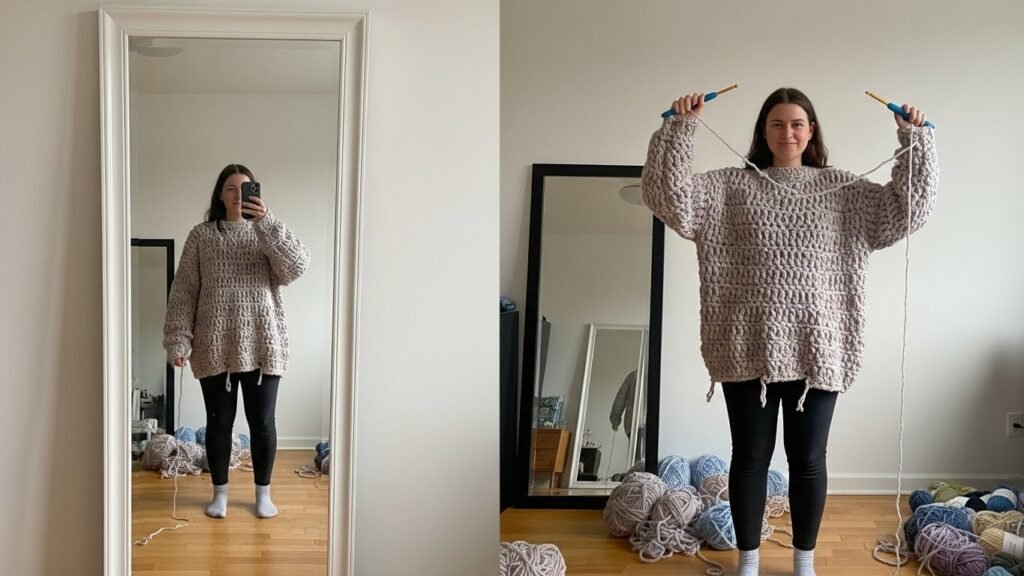
By 4:00 PM on Sunday, the project is done. You’ve snipped the last thread. You’ve put it on. You’ve looked in the mirror.
In forty-eight hours, you have bypassed months of “traditional” boredom. You have a functional, beautiful object that didn’t exist on Friday night. But more importantly, you have “Crochet Literacy.” You now understand how stitches interact. You understand the “logic” of the yarn. You aren’t a beginner anymore; you are a maker who just finished their first commission for themselves.
Is it possible that we have been over-complicating creativity all along? Is it possible that the only difference between an “artist” and a “bystander” is the willingness to start something they don’t know how to finish?
The Economics of the Project-First Weekend
Let’s talk about the AdSense-friendly reality: Crochet is a multi-billion dollar industry. But the real “value” isn’t in the yarn you buy; it’s in the mental health you save. A Project-First weekend is a total “digital detox.” You can’t scroll TikTok while your hands are busy with a 12mm hook. You can’t worry about Monday’s meeting when you’re trying to count the stitches in a cable twist.
You have essentially paid for a high-end wellness retreat for the price of three balls of yarn. You’ve re-trained your brain to focus on long-form tasks. You’ve conquered the “fear of the new.” And you got a cool sweater out of the deal. Is there any other investment with a 100% ROI in just two days?
Beyond the Weekend: Your New Identity
The weekend is over, but your identity has shifted. You are no longer “someone who wants to learn to crochet.” You are “someone who crochets.” This is a permanent neurological change. The next time you walk into a clothing store, you won’t look at the price tag first; you’ll look at the seams. You’ll look at the stitch pattern. You’ll think, “I could do that.”
This is the true power of the Project-First method. It’s not about the scarf; it’s about the “Audacity.” It’s about the realization that the world is “buildable.” Everything around you—your clothes, your blankets, your curtains—is just a series of solved problems. And you just solved a big one in forty-eight hours.
The Challenge to the Reader
So, here is my question to you: What are you doing next Friday night? Are you going to lose another weekend to the “infinite scroll”? Are you going to tell yourself for the thousandth time that you’re “not really the creative type”?
Or are you going to go out, buy the biggest hook you can find, pick the most “impossible” project on Pinterest, and dare yourself to finish it by Sunday dinner? The Project-First method doesn’t require “talent.” It only requires “hunger.” It requires a refusal to be bored by the basics.
The chain is a prison; the project is the escape. Don’t spend your life making chains. Build the house. Wear the sweater. Shock your friends. Shock yourself. Your “Masterpiece Weekend” is waiting for you. All you have to do is pick up the hook and refuse to put it down until the job is done. Are you in, or are you just going to keep watching from the sidelines?

My name is Sarah Clark, I’m 42 years old and I live in the United States. I created Nova Insightly out of my love for crochet and handmade creativity. Crochet has always been a calming and meaningful part of my life, and over the years it became something I wanted to share with others. Through this blog, I aim to help beginners and enthusiasts feel confident, inspired, and supported as they explore crochet at their own pace. For me, crochet is more than a craft — it’s a way to slow down, create with intention, and enjoy the beauty of handmade work.