
Most fiber artists are living in a two-dimensional world, and they don’t even realize it. They spend decades perfecting the “flat” stitch—obsessing over tension, alignment, and uniformity—all while their work looks like a photocopy of a photocopy. They create fabric that is meant to be looked at, but rarely felt. But why settle for a flat surface when you can create a landscape? Why follow the rules of “traditional” fabric when you can force your yarn to defy gravity and erupt from the foundation of your work?
We are entering the era of the “3D Texture Hack.” This isn’t about simple ribbing or a basic cable; this is about structural manipulation. It is about stitches that literally “pop” off the fabric, creating shadows, depth, and a tactile experience that borders on the surreal. Have you ever touched a piece of crochet and felt like it was touching you back? Have you ever wondered why your projects look “amateur” compared to high-end, avant-garde textile art? The secret isn’t in the yarn, and it isn’t in the color palette—it is in the Z-axis. Are you ready to stop making blankets and start making sculptures?
The Physics of the “Pop”: Why Most Textures Fail
To understand how to make a stitch stand up, you first have to understand why most stitches lie down. Standard crochet and knitting are designed to be efficient—they use the minimum amount of yarn to cover the maximum amount of surface area. This creates a thin, flexible, and ultimately flat fabric. To achieve 3D texture, you must commit a “textile sin”: you must over-saturate a single point with an excessive amount of yarn.
When you cluster five, ten, or even fifteen stitches into a single space, you create internal pressure. The yarn has nowhere to go but out. This is the fundamental “hack” of 3D texture. It’s a mechanical rebellion against the flat grid. Have you ever noticed how a popcorn stitch looks like a clenched fist? That is stored energy. By mastering the art of the “yarn-over overload,” you can turn a boring scarf into a sensory journey. But be warned: once you start seeing in 3D, a flat single crochet will feel as exciting as a piece of plain white bread.
The Bullion Stitch: The Architect of Height
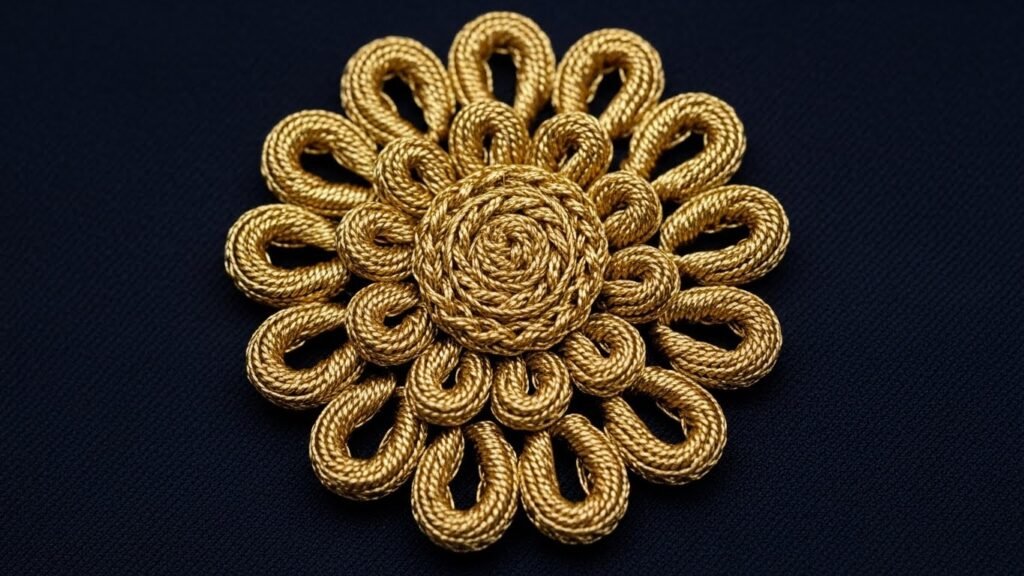
If there is a king of the 3D world, it is the Bullion Stitch. For the uninitiated, the Bullion is a stitch where you wrap the yarn around the hook many times—sometimes up to 20 or 30 times—before pulling through. The result is a thick, coiled cylinder that stands completely independent of the background fabric.
The Bullion stitch is notorious for being difficult, but that is because most makers try to “force” it. The hack to a perfect, gravity-defying Bullion is all in the hook shape and the tension of the wraps. When done correctly, these stitches can be arranged to look like flower petals, architectural pillars, or even biological structures. Why are we so afraid of a little challenge when the reward is a fabric that people can’t stop touching? Is your fear of a “difficult” stitch holding your creativity hostage in a 2D prison?
Post Stitches: The “Skeleton” Hack for 3D Geometry
While clusters and bullions provide the “meat,” Front Post and Back Post stitches provide the “skeleton.” Most people use post stitches for simple ribbing, but the 3D hack involves using them to create raised “walls” on your fabric. By stacking post stitches in specific geometric patterns—triangles, diamonds, or hexagons—you create a honeycomb effect that adds massive structural integrity.
This technique is what separates “crafty” projects from “designer” pieces. When you use post stitches to build a raised grid, you aren’t just adding texture; you are changing how the fabric reflects light. The ridges create shadows, and the shadows create depth. Have you ever looked at a designer sweater and wondered why it looks so “expensive”? It’s because the designer understood that shadows are free, and texture is the best way to use them. Are you designing with color, or are you designing with light and shadow?
The “Waffle” Evolution: Deep Relief Crochet
The Waffle stitch is often the “gateway drug” to 3D texture, but the hack involves taking it further. By doubling the height of the posts and using a high-twist yarn, you can create a “Deep Relief” waffle that is nearly half an inch thick. This isn’t just a pattern; it’s an insulation system. A blanket made with deep-relief 3D hacks will be twice as warm as a flat blanket of the same weight. Why are we still making “thin” blankets when we could be living in a plush, 3D fortress of our own making?
Hyperbolic Crochet: The “Coral Reef” Aesthetic
In the late 1990s, a mathematician discovered that crochet was the only way to model hyperbolic planes—complex geometric shapes that occur in nature, like the ruffles of coral or the leaves of kale. This is the ultimate 3D texture hack.
By increasing the number of stitches in every single row at a constant rate, the fabric begins to ruffle and fold in on itself. It becomes a chaotic, beautiful, and completely three-dimensional object. This technique “explodes” off the fabric because it literally runs out of room to exist in two dimensions. It is a mathematical inevitability. Why are we trying to keep our crochet “straight” and “tidy” when nature is telling us to let it ruffle? Are you brave enough to let your yarn decide its own shape, or are you too obsessed with the “flatness” of a traditional pattern?

The “Bobble-and-Mesh” Contrast: Visual Trickery
One of the most effective hacks for making texture “pop” is the use of negative space. A 3D stitch—like a puff or a bobble—only looks impressive if it is surrounded by a flat or “empty” area.
Think of it like a mountain range. A mountain only looks tall because of the valley next to it. By pairing dense 3D elements with open, airy mesh (like trellis or filet crochet), you create a visual shock. The eye is drawn to the “mountain” of yarn, and the contrast makes the texture seem even taller than it actually is. Are you overwhelming your projects with too much “noise,” or are you using the power of the “valley” to make your “peaks” truly stand out?
The “Puff” Secret: Volume Without Weight
The Puff stitch is often criticized for being a “yarn eater,” but the hack is to use a lightweight, “blown” yarn (where fibers are blown into a nylon tube). This allows you to create massive, 3D puffs that are as light as air. You get the visual impact of a heavy, textured garment without the physical burden of wearing a ten-pound sweater. This is the “high-fashion” approach to 3D texture—maximum volume, minimum density.
3D Embroidery on Crochet: The Final Layer
For those who want to reach the absolute peak of the 3D world, the hack isn’t in the crochet itself—it’s in what you do to the crochet. Surface crochet and “slip-stitch embroidery” allow you to draw 3D lines on top of your finished fabric.
Imagine a simple, flat sweater with a 3D vine “growing” across the shoulder and down the sleeve. By working into the “legs” of your existing stitches, you can anchor new yarn to the surface, creating a second layer of 3D reality. This is the “Inception” of the fiber arts—a project within a project. Why stop at one layer of fabric when you can build an entire ecosystem on top of it?
The Practical Side: Will 3D Texture Survive the Real World?
One of the reasons people avoid 3D hacks is the fear of “snagging.” Yes, a 3D stitch is more likely to get caught on a door handle or a piece of jewelry. But is “safety” the goal of art? If we wanted something purely functional and indestructible, we would buy a mass-produced polyester fleece.
The beauty of 3D texture is its vulnerability. It is a statement that this item is special, that it requires care, and that it is not “disposable.” However, the hack for durability is to use “plied” yarns with a high twist. This keeps the individual fibers locked together, preventing your 3D masterpieces from becoming a fuzzy mess. Are you making items to “endure” a boring life, or are you making items to “celebrate” a beautiful one?

Designing for the Senses: The “Autism-Friendly” Texture
In the world of sensory-seeking individuals, 3D crochet is more than just an aesthetic; it is a tool. The “3D Texture Hack” can be used to create “Fidget Blankets” or “Sensory Sleeves.” By alternating different types of 3D pops—bumpy popcorns, smooth bullions, and ridged post stitches—you create a playground for the hands.
This is the most “humanized” version of the craft. It’s using our skills to provide comfort and stimulation to those who experience the world through their fingertips. Why are we so focused on how our projects look on a screen when the most important thing is how they feel in a lap? Is your crochet doing any “work,” or is it just sitting there being flat?
The Economics of the 3D Hack
Let’s be honest: 3D texture uses more yarn. A “Popcorn” blanket will cost you 30% to 50% more in materials than a flat blanket. But here is the Adsense-friendly truth: the value of the finished item increases by 200%.
A flat crochet blanket is a commodity. A 3D-textured “sculptural” throw is a piece of art. If you are selling your work, the 3D hack is the fastest way to move from “craft fair” prices to “gallery” prices. People are willing to pay for what they can see from across the room. They are willing to pay for the “wow” factor. Are you undercharging for your labor because your projects don’t “pop”?
The “Yarn-Saver” 3D Hack
If you are on a budget, you can still play in the 3D world. The secret is “Strategic Placement.” You don’t need a whole sweater of Bullion stitches. You only need them on the cuffs or the collar. By placing your 3D hacks at the “high-visibility” points of a garment, you trick the brain into thinking the entire piece is more complex than it is. It’s the ultimate “Gold-Leaf” strategy for yarn.
Final Thoughts: Escaping the 2D Trap
The “3D Texture Hack” is a call to action for every maker who has ever felt “bored” with their hook. It is a reminder that the yarn is not a flat ribbon; it is a 3D material with volume, weight, and potential.
We have spent too long trying to fit our art into the “flat” boxes of tradition. It’s time to let the stitches rise. It’s time to embrace the “messy” height of a popcorn, the “complex” coil of a bullion, and the “mathematical” chaos of a hyperbolic ruffle.
When you look at your next project, don’t ask yourself “What color should this be?” Ask yourself “How high can this go?” Ask yourself “What kind of shadow will this cast?” Escape the 2D trap and join the revolution of texture. The world is three-dimensional—shouldn’t your crochet be, too?
Stop settling for “smooth.” Start reaching for “spectacular.” The yarn is in your hands, and the Z-axis is waiting. Will you continue to build a flat world, or are you ready to make your art literally pop off the fabric?

My name is Sarah Clark, I’m 42 years old and I live in the United States. I created Nova Insightly out of my love for crochet and handmade creativity. Crochet has always been a calming and meaningful part of my life, and over the years it became something I wanted to share with others. Through this blog, I aim to help beginners and enthusiasts feel confident, inspired, and supported as they explore crochet at their own pace. For me, crochet is more than a craft — it’s a way to slow down, create with intention, and enjoy the beauty of handmade work.