
The Illusion of the Designer Label
Have you ever walked into a high-end boutique, felt the weight of a $1,200 hand-knit sweater against your fingertips, and thought, “I could make this”? It is the ultimate crafter’s hubris, isn’t it? We see a simple raglan sleeve or a classic cable knit under a designer tag and immediately begin calculating the yardage in our heads. But then, you go home, pick up that economy acrylic blend you bought on sale, and sixty hours of labor later, you’re left with something that looks… well, “homemade.”
Why does the sweater in the window scream “Parisian Chic” while the one on your couch screams “Craft Fair Clearance”?
The secret isn’t always in the complexity of the stitch or the perfection of the tension—though those certainly play their parts. The real magic, the silent architect of luxury, is the fiber. If you want to move from the realm of the hobbyist to the world of the “couture maker,” you have to stop thinking about yarn as just a medium and start viewing it as an engineering component. Are you ready to stop settling for “fine” and start demanding “extraordinary”?
The Psychological Weight of the “Homemade” Label
Before we dive into the technicalities of the swap, we must address the elephant in the craft room: the stigma of the “homemade.” For decades, handmade knitwear was associated with necessity and thrift. It was the itchy sweater your aunt made because she couldn’t afford the store-bought version. In 2026, however, the paradigm has shifted. We live in an era of mass-produced fast fashion that falls apart after three washes. In this landscape, a hand-knit garment should be the pinnacle of luxury.
But if your choice of yarn mimics the flat, lifeless texture of a factory-made polyester blend, you are doing yourself a disservice. A designer garment has “heft.” it has a specific way of catching the light. It has a “drape” that follows the body’s movement rather than standing stiffly away from it. To achieve this, we must transcend the big-box store aisles and learn the language of luxury fibers.
Understanding the “Hand” of Luxury
In the textile industry, experts talk about the “hand” of a fabric. This refers to how it feels against the skin, how it compresses when squeezed, and how it recovers from being stretched. Most budget-friendly yarns are designed for durability and ease of care, which often results in a “plastic” hand.
When a designer selects a yarn, they aren’t looking for what’s easiest to toss in a washing machine. They are looking for soul. They want the halo of mohair, the cool fluidity of silk, and the bouncy resilience of high-twist merino. If you want to elevate your work, your first step is to develop your “hand.”
Ask yourself: If you closed your eyes and touched your project, would you believe it cost a week’s salary? If the answer is no, it’s time for a swap.
Swap 1: From Squeaky Acrylic to “Dry” Wool and Cotton Blends
We’ve all been there. You see a beautiful variegated acrylic yarn that looks like a sunset in the skein. But as you knit with it, it squeaks on your needles. Once finished, it lacks breathability and develops a tell-tale fuzzy pilling within weeks.
To get that designer look, especially for transitional pieces, swap your standard acrylics for “dry” blends. Designers like Isabel Marant often use cotton-wool blends that provide the structure of cotton with the lightness of wool.
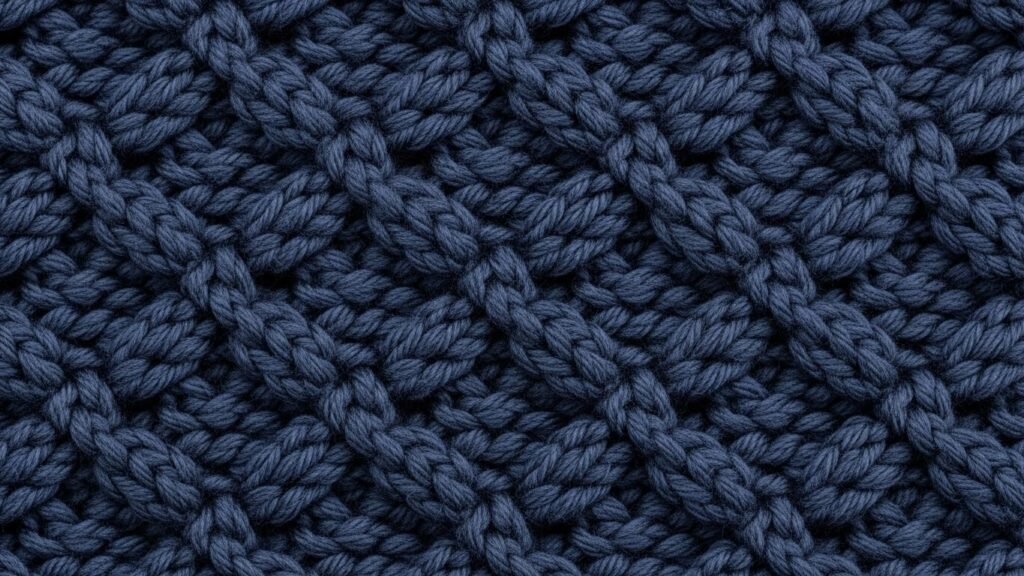
The “dry” texture is key for that modern, architectural look. It allows cables to pop with a 3D effect that soft, mushy yarns simply can’t replicate. When you use a high-quality cotton-merino blend, you’re not just making a sweater; you’re sculpting a garment. Do you want your work to look like a soft cloud, or a sharp statement?
The Mohair Secret: The “Filter” Effect
If there is one fiber that defines the “high-end” aesthetic of the last five years, it is kid mohair silk. Often used as a “carry-along” thread, mohair acts like a real-life Instagram filter for your knitting.
When you held a strand of basic wool next to a strand of silk-mohair, did you realize you were holding the secret to the “halo”? This fine, fuzzy fiber fills in the gaps between stitches, softening the overall look and giving the garment a glow that seems to radiate from within.
Why the Mohair Swap Works
Designer brands like Loewe and Miu Miu frequently utilize this layered approach. By holding a strand of lace-weight mohair together with a fingering-weight wool, you create a fabric that is:
-
Lightweight yet warm: Perfect for that “effortless” drape.
-
Luminous: The silk core of the mohair catches the light in a way that synthetic “fuzz” never will.
-
Forgiving: It hides minor tension inconsistencies, making your work look professionally blocked.
If you are currently working on a pattern that calls for a chunky wool, try swapping it for three strands of mohair held together with one strand of silk. The result is a garment that feels like a whisper but looks like a million dollars.
Swap 2: From Shiny Rayon to Sand-Washed Silk
Many “budget luxury” yarns use rayon or bamboo to provide shine. While these are soft, they often have a “greasy” luster that screams mass-market. High-end designers prefer the matte, sophisticated sheen of sand-washed silk or “spun silk.”
Spun silk has a weightiness to it. It hangs. When you walk, a silk garment moves with a certain rhythmic swing. If you want to recreate a high-end tank top or a sleek summer dress, look for silk-linen blends. The linen provides the “crunch” and structure, while the silk provides the luxury.
The Geometry of Twist: Why It Matters
Have you ever wondered why some knits look “messy” even when the stitches are technically perfect? It’s often the yarn twist. Most affordable yarns are loosely plied to keep them soft and cheap to produce. However, luxury yarns often feature a “high-twist” or a “multi-ply” construction.
A high-twist yarn is like a coiled spring. It provides incredible “stitch definition.” In the world of high-end fashion, detail is king. If you are knitting a complex lace pattern or a subtle textured stitch, a loose, low-ply yarn will swallow the detail. A high-twist merino, however, will make every single yarn-over look intentional.
The Cashmere Trap: Quality Over Label
Here is a shocking truth: Not all cashmere is created equal. In fact, a high-quality wool will always look more “designer” than a low-quality cashmere.
Cheap cashmere is made from short fibers that break easily, leading to excessive pilling and a garment that looks “shabby-chic” (minus the chic) after two wears. If your budget doesn’t allow for $60-per-skein Loro Piana-level cashmere, do not settle for the “budget” version. Instead, swap it for a Superfine Alpaca or a Yak blend.
Yak fiber is the industry’s best-kept secret. It is warmer than wool, as soft as cashmere, but has a much longer staple length, meaning it won’t pill nearly as much. It also has a natural chocolatey-grey undertone that gives dyed colors a depth and “moodiness” that screams luxury.

Swap 3: From Flat Dyes to Hand-Painted Semi-Solids
Color is the most immediate way our brains process “value.” Flat, industrial dyes often look “flat” because they are perfectly uniform. While this sounds good in theory, it lacks the vibration of high-end textiles.
Designer knitwear often utilizes “semi-solid” or “tonal” hand-dyed yarns. These aren’t the wild, variegated “clown barf” yarns of the early 2000s. These are yarns where the dyer has used subtle shifts in saturation.
When you knit with a tonal yarn, the resulting fabric has “movement.” A navy blue sweater isn’t just navy; it’s a collection of midnight, indigo, and deep ocean hues. This depth of color mimics the way light hits expensive fabrics like velvet or heavy silk.
The Importance of Weight and Scale
One of the biggest mistakes home crafters make is choosing the wrong “weight” for the “look.” For a long time, the DIY community was obsessed with “super bulky” yarns because they were fast to knit. But let’s be honest: how many super bulky garments do you see on the runway at Paris Fashion Week?
The “designer” look is currently dominated by two extremes:
-
The Gossamer Fine: Lace-weight garments that look like air.
-
The Oversized Structure: Heavy-weight yarns that still maintain a crisp shape.
To achieve the “High-End” look, consider swapping your “Aran” weight for a “Fingering” weight held double. This gives you more control over the fabric density and allows you to mix fibers (like a wool and a silk) to create a custom “designer” blend that literally doesn’t exist in any store.
The Finishing Touches: Hardware and Blocking
You’ve spent $200 on hand-dyed silk-merino. You’ve spent 100 hours knitting a flawless cardigan. And then… you sew on plastic buttons from a multi-pack.
Stop. Just stop.
A designer garment is a cohesive ecosystem. If the yarn is the body, the buttons are the jewelry. Swap those plastic buttons for:
-
Horn or Bone: For a rugged, timeless look.
-
Mother of Pearl: For a delicate, feminine glow.
-
Italian Enamel: For a modern, high-fashion pop.
And then, there is the “blocking.” Many hobbyists skip this step, but for a designer, blocking is non-negotiable. It is the process of washing and shaping the garment to its final dimensions. It “sets” the stitches. It allows the yarn to bloom and the drape to settle. Without blocking, your work is just a collection of loops. With blocking, it is a garment.
Swap 4: From “Fuzzy” Mohair to Brushed Alpaca
If mohair feels too “itchy” or too “retro” for your style, the high-end swap is Brushed Suri Alpaca. It provides the same volume and halo as mohair but with a much softer, silkier feel and a more contemporary “matte” fluff.
Designer brands like The Row often opt for this “brushed” look. It’s sophisticated, understated, and feels incredibly expensive against the skin. It’s the difference between a “crafty” sweater and a “quiet luxury” piece.

The “Investment” Mindset
At this point, you might be thinking, “But these yarns are expensive!” And you are right. They are.
But let’s do the math. If you spend $30 on cheap yarn and 50 hours of your life making a sweater you only wear twice because it looks “homemade,” you have wasted $30 and 50 hours.
If you spend $150 on exquisite yarn and 50 hours making a masterpiece that you wear for the next ten years, a garment that garners compliments every time you leave the house, you have made a stellar investment.
The “High-End” look is as much about your mindset as it is about the fiber. It’s about respecting your own time enough to use materials that are worthy of your labor. Why would you put a Ferrari engine in a cardboard box? Why would you put your talent into a yarn that’s 100% petroleum-based?
Rhetorical Check-In: What Is Your Legacy?
When someone asks, “Where did you get that?”, do you want to say “I made it” with a hint of apology, or do you want to say “I made it” with the pride of a master craftsman?
The transition from homemade to high-end isn’t about being a “better” knitter; it’s about being a more “discerning” one. It’s about understanding that the yarn is 50% of the design. When you choose the right fiber, the yarn does the heavy lifting for you. It creates the drape, it provides the glow, and it commands the respect of anyone who sees it.
Your Path to the Designer Look
If you are ready to make the leap, start small. You don’t have to knit an entire floor-length cashmere coat tomorrow.
-
Start with a Hat: Buy one skein of the most expensive, luxurious yarn you can find. A yak-silk blend, perhaps? Feel how it moves on your needles.
-
Observe the Drape: Watch how it sits on your head compared to your acrylic hats.
-
Analyze the Color: Notice how the light interacts with the fibers.
Once you see the difference, there is no going back. You will become a yarn snob, and you should wear that title like a badge of honor. Because being a yarn snob just means you’ve finally realized what your work is worth.
The world is full of “homemade” things. But the world is starving for beauty, for quality, and for things made with intention. By choosing the right yarn swaps, you aren’t just making a sweater—you are making a statement. You are telling the world that your time, your skill, and your vision are worth the very best.
So, what will your next “designer” piece be? Will you choose the glowing halo of mohair, the architectural crispness of high-twist wool, or the weighted elegance of silk? The needles are in your hands, but the luxury? The luxury starts in the skein.

My name is Sarah Clark, I’m 42 years old and I live in the United States. I created Nova Insightly out of my love for crochet and handmade creativity. Crochet has always been a calming and meaningful part of my life, and over the years it became something I wanted to share with others. Through this blog, I aim to help beginners and enthusiasts feel confident, inspired, and supported as they explore crochet at their own pace. For me, crochet is more than a craft — it’s a way to slow down, create with intention, and enjoy the beauty of handmade work.