
Let’s be brutally honest for a second: you are convinced that you possess the creative manual dexterity of a drunken lobster. You’ve walked through craft stores and felt a mixture of awe and seething resentment. You’ve seen those people—the ones who casually whip out a crochet hook on a plane and emerge two hours later with a beanie—and you’ve thought, “That could never be me.” You are the person who glue-gunned their fingers together in third grade. You are the “chronically un-crafty.” You believe that the “maker gene” skipped you entirely, leaving you stranded in a world of IKEA furniture and mass-produced polyester.
But what if I told you that your lack of talent is a total myth? What if the only thing standing between you and the intoxicating pride of saying “I made this!” isn’t a lack of skill, but a fundamentally broken approach to learning? We have been taught that crafting is a slow, agonizing apprenticeship. I am here to tell you that’s garbage. In seven days, we are going to take you from a state of “What is this string even for?” to a finished, wearable piece of art. We aren’t going to “practice.” We are going to execute a high-speed heist on the world of crochet. Are you ready to stop being a spectator and start being a creator? Or are you too comfortable in your self-imposed prison of “I’m just not the creative type”?
Day 1: The Tactical Acquisition of Power (Not Just Shopping)
Most beginners fail before they even start because they buy the wrong tools. They walk into a giant craft store, get overwhelmed by 5,000 types of yarn, and buy a thin, metal hook and a dark, fuzzy yarn because it “looks pretty.” This is the equivalent of trying to learn to drive in a Formula 1 car on a foggy night.
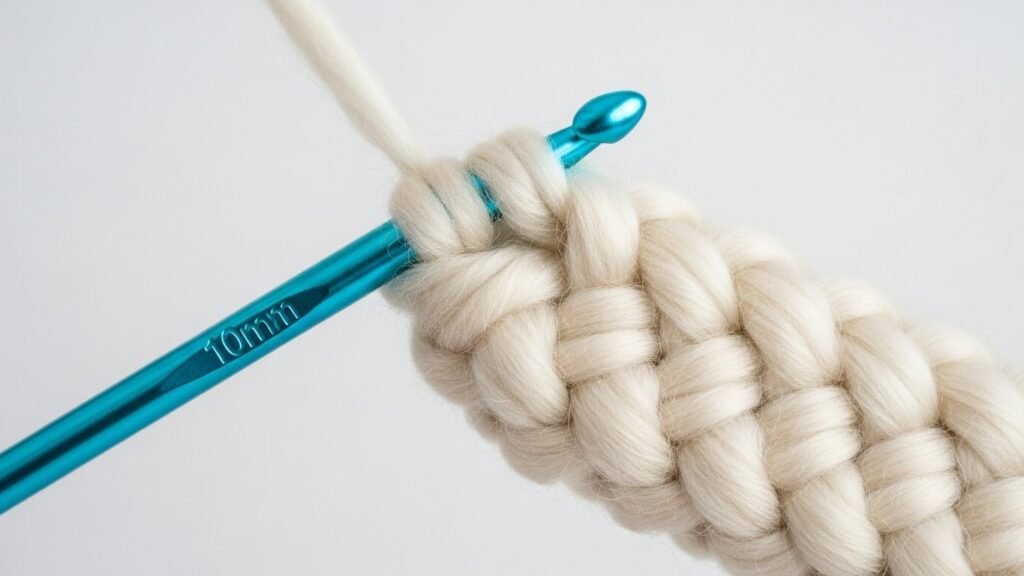
On Day 1, your mission is simple: Buy “Cheat Code” materials. You need a 10mm ergonomic crochet hook—it should look like a chunky toy, not a surgical instrument. You need Super Bulky (Size 6) yarn in a bright, solid, screaming color like mustard yellow or electric teal. Why? Because you need to see what you are doing. You need to see the “anatomy” of the stitch. If you can’t see it, you can’t learn it. Are you going to keep making things hard for yourself, or are you finally going to give your brain a fighting chance?
The Psychology of the “Big Hook”
There is a secret reason we start with the big stuff. When you use a massive hook and thick yarn, every movement is magnified. You aren’t squinting at tiny loops; you are building a structure. More importantly, it grows fast. On Day 1, you aren’t going to make anything. You are just going to make a “Chain.” But because the yarn is so thick, your chain will look like a heavy-duty nautical rope. It feels substantial. It feels like progress. Most people quit because they feel like they’ve done a lot of work for a tiny result. We are going to flip that script. We want maximum dopamine for minimum effort.
Day 2: The “Slipknot” Initiation and the War on Perfection
Day 2 is about the most intimidating part of crochet: the beginning. Many people spend three hours trying to make a perfect slipknot. Here is the secret: it doesn’t have to be perfect. It just has to hold.
Today, you are going to learn the “Single Crochet.” But you aren’t going to make a swatch. You are going to start “The Project.” We are making a Chunky Infinity Scarf. Why a scarf? Because it’s a rectangle. If you can make a square, you can make a rectangle. If you can make a rectangle, you can conquer the world.
Your mantra for Day 2 is “Embrace the Wonk.” Your first ten stitches will be hideous. They will look like they were made by someone in a wind tunnel. Good. If you try to make them perfect, you will quit. If you allow them to be ugly, you will finish. Which do you prefer: a perfect pile of nothing, or a finished, “charismatic” scarf?
The “Muscle Memory” Myth
People talk about muscle memory like it’s a magical gift. It’s not. It’s just repetitive boredom. On Day 2, your hands will feel like they belong to someone else. They will be stiff, awkward, and rebellious. This is your brain literally growing new neural pathways. It’s supposed to feel weird. If it feels easy, you aren’t learning. Are you willing to look like a fool for twenty minutes to become a master for a lifetime?
Day 3: The “Middle Row” Meditative State
By Day 3, the novelty has worn off. This is the “Valley of Despair” where most hobbyists die. You’ve done four rows, it’s about three inches long, and you realize you have forty more inches to go.
Today is not about skill; it’s about rhythm. This is where crochet stops being a “task” and starts being “therapy.” Turn off your phone. Put on a podcast or a movie you’ve seen a hundred times. Let your hands move. You will notice that you’ve stopped looking at the tutorial every ten seconds. You are starting to “feel” the stitches.
Have you ever felt the “flow state”—that magical moment where time disappears and your anxiety mutes itself? That is the real product we are making here. The scarf is just a side effect of you finally calming your nervous system. Why are we so obsessed with the destination that we forget the peace found in the journey?

Day 4: The Crisis of the “Shrinking Scarf”
Around Day 4, you will look at your work and realize something horrifying: your scarf is getting narrower. Or wider. It’s becoming a triangle. You missed a stitch at the end of the row, or you added one by accident.
In the old world of crafting, this is where you would cry and give up. In the 7-Day Roadmap, this is where we learn the most valuable skill in life: The Pivot.
So you missed a stitch? Who cares? Increase in the next row. It’s a “handmade” item, not a precision-engineered aerospace component. The “un-crafty” person thinks a mistake is a failure. The “maker” knows a mistake is a “design feature.” Today, you will learn how to count your stitches—not because you need to be perfect, but because you want to be the boss of the yarn. Are you going to let a single missing loop ruin your entire week, or are you going to keep moving like the creative force you are?
The “Frog” and the Phoenix
If the mistake is too big to ignore, you will “Frog” it (rip it out). This is the ultimate test of character. Ripping out three hours of work feels like a tragedy until you realize that the yarn is still there. You haven’t lost the material; you’ve just gained more practice. You are a phoenix rising from the pile of crinkly, ripped-out yarn. Every time you restart, you do it faster. You are becoming a speed-demon of the hook.
Day 5: The Sensory Peak
By Day 5, the “Chunky Infinity Scarf” is taking up significant space in your lap. It’s heavy. It’s warm. It’s soft. Today, you are going to experience the “Sensory Peak.”
The un-crafty person usually lives in a world of glass screens and plastic keyboards. We are starved for texture. As you work on Day 5, pay attention to the way the wool feels against your skin. Pay attention to the sound the hook makes as it slides through the loops.
We are reclaiming our humanity from the digital void. You aren’t just “making a thing”; you are engaging with the physical world in a way that our ancestors did for millennia. Does the yarn smell like sheep? Does the hook feel warm in your hand? Welcome back to the real world. How long has it been since you actually felt the things you were holding?

Day 6: The “Holy Crap, I’m Almost Done” Surge
Day 6 is the most dangerous day. You can see the finish line. You have about six rows left. The adrenaline is pumping. This is where people start rushing and making sloppy mistakes.
Slow down. Today is about the “Finishing Touches.” You will learn how to “fasten off” and “weave in your ends.” These sound like technical, boring terms, but they are actually the moments of finality. They are the “period” at the end of the sentence.
When you cut that yarn for the last time, you are severing your tie to the “un-crafty” version of yourself. You are no longer someone who “tries” things; you are someone who “finishes” things. How many projects have you started in your life that are currently sitting in a box? Today, you break that cycle. Today, you are a finisher.
The Mirror Moment
Before you even join the ends of the infinity scarf, I want you to drape it around your neck and look in the mirror. Look at the person looking back at you. That person just created an object out of a single long string. That person bypassed the global supply chain. That person proved their own self-doubt wrong. Do you see the sparkle in your eyes? That isn’t just vanity; that’s the glow of self-efficacy.
Day 7: The Debut and the “I Made This!” Declaration
Today is the day of the “Big Reveal.” You are going to sew the two ends of your scarf together to create the “Infinity” loop. You will put it on, fix your hair, and walk out the door.
Your mission on Day 7 is to find someone—anyone—and wait for them to notice the scarf. And when they say, “Oh, I love your scarf! Where did you get it?” you will say those three magic words: “I made it.”
Watch their face. Watch the way their eyebrows go up. They won’t believe you. They’ll think you bought it at a high-end boutique. And in that moment, the transformation is complete. You are no longer “un-crafty.” You are a maker. You have successfully navigated the 7-Day Roadmap, and you have the physical evidence to prove it. Now, the question isn’t “Can I do this?” but “What am I going to make next?”
Beyond the Scarf: The “Maker” Mindset
The scarf is just the beginning. The real gift of the last seven days isn’t a piece of clothing; it’s a shift in your reality. You now look at the world and see “possibility” instead of “products.” You look at a hat in a store and think, “I could make that, but better.” You look at a complex problem at work and think, “If I can figure out the Waffle Stitch, I can figure this out.”
You have unlocked a superpower. You have realized that “talent” is just the willingness to be bad at something until you aren’t. You have learned that the “chronically un-crafty” are just people who haven’t found their “big hook” yet.
The Manifesto of the New Creator
We live in a disposable age. We buy things we don’t need with money we don’t have to impress people we don’t like—and then we throw those things away three months later. By learning to crochet in seven days, you have stepped outside of that cycle. You have created something that has a story. You have created something that has your time woven into it.
The next time you feel “un-talented,” look at your scarf. The next time you feel like you can’t learn anything new, look at your scarf. The next time the world feels too digital and too fast, touch your scarf.
You are a maker now. There is no going back. The lobster-hand era is over. The era of the “I Made This!” has begun. Are you going to stop here, or are you ready to see how deep this rabbit hole goes? The hook is in your hand, the yarn is at your feet, and the world is waiting for your next creation. What are you waiting for? Go make something else!

My name is Sarah Clark, I’m 42 years old and I live in the United States. I created Nova Insightly out of my love for crochet and handmade creativity. Crochet has always been a calming and meaningful part of my life, and over the years it became something I wanted to share with others. Through this blog, I aim to help beginners and enthusiasts feel confident, inspired, and supported as they explore crochet at their own pace. For me, crochet is more than a craft — it’s a way to slow down, create with intention, and enjoy the beauty of handmade work.