
Have you ever been in the “zone”? You’re sitting in your favorite chair, the lighting is perfect, your tea is warm, and your project is growing row by row. Then, it happens. The silent killer of creativity strikes. Your hook or needle doesn’t go under the yarn; it goes through it. A single ply snags, creating a fuzzy, distorted mess that ruins your stitch definition and forces you to rip back three inches of hard work.
Why does this happen? Why, in an era of high-tech textiles, are we still fighting with yarn that acts like a disorganized pile of cat hair? We’ve been conditioned to believe that “softness” is the only metric that matters, but we’ve forgotten about the structural integrity of the twist. We spend hundreds of dollars on ergonomic hooks and luxury needles, yet we feed them “splitty” yarn that turns our relaxing hobby into a high-stakes surgical procedure. Isn’t it time we stopped settling for yarn that fights us back?
The truth is, most yarn on the market today is designed for the shelf, not the stitch. It’s spun loosely to feel soft to the touch in the store, sacrificing the very “ply security” that makes crafting a joy. But a few elite fibers—the industry’s best-kept secrets—guarantee a snag-free experience. Are you ready to stop fighting your fiber and start commanding it?
The Anatomy of a Snag: Why Your Yarn Is Falling Apart
Before we reveal the “Holy Trinity” of non-splitting yarns, we have to understand the enemy. Splitting occurs when the individual plies of a yarn aren’t twisted tightly enough or when the fiber length is too short to stay anchored. In the textile world, this is known as “low twist” or “roving-style” construction.
When you use a pointed needle or a sharp hook, it hunts for the path of least resistance. In a loosely spun yarn, that path is right through the center of the strand. Have you ever considered that your “luxury” merino might actually be a structural failure masked by a soft halo? Every time your yarn splits, it’s a tiny scream for better engineering.
The Cable-Plied King: Cotton Like You’ve Never Felt It
Most people hear “cotton” and think of the stiff, splitty, kitchen-scrubby yarn found in bargain bins. But there is a specific type of construction that eliminates splitting entirely: the Chainette or Cable-Ply.
Imagine a yarn that isn’t just twisted, but literally braided or “cabled” like a suspension bridge. This is the first of our guaranteed stress-free yarns. When a yarn is cabled, the plies are twisted around each other, and then those groups are twisted again in the opposite direction. This creates a rounded, rope-like structure that is physically impossible for a hook to penetrate.
Why It’s a Game Changer for Beginners and Pros Alike
When you work with a high-end cabled cotton or a cotton-nylon chainette, your speed triples. Why? Because you no longer have to look at your stitches. You can trust that the hook will grab the entire strand every single time. It provides a “clicky” satisfaction that soft, fuzzy yarns can never match.
But why don’t all brands do this? Because it’s expensive. It requires more machinery and more time on the spinning frame. Most manufacturers would rather give you a “splitty” single-ply and call it “artisanal.” Are you going to keep paying for their lack of effort, or are you going to demand the structural perfection of a cabled ply?

The Mercerized Legend: The Science of Smooth
The second yarn on our list is a classic that has been forgotten by the “boho-chic” wool crowd: Highly Mercerized Long-Staple Cotton. Mercerization is a chemical process that treats cotton with sodium hydroxide, which swells the fibers and flattens their surface. While the industry pushes it for its “sheen,” the real benefit for the crafter is the elimination of the “halo.” By removing the fuzzy bits and tightening the fiber structure, mercerized yarn becomes a sleek, polished cylinder.
The Friction-Free Flow
Have you ever felt a yarn that felt “sticky” on your needles? That’s friction. Friction leads to snags, and snags lead to splitting. Mercerized yarn has the lowest friction coefficient of any natural fiber. It glides. It behaves like a liquid.
The “pros” often look down on mercerized cotton as being too “stiff,” but that stiffness is actually “stitch memory.” It holds its shape, it refuses to split, and it showcases your stitch work with architectural precision. If you are doing complex lace or cables, why would you use a fuzzy yarn that hides your talent? Use the yarn that was built to show off every single wrap of your hook.
The Synthetic Revolution: The “Tube” Yarn
For years, “synthetic” was a dirty word. But the third yarn in our stress-free arsenal is the pinnacle of modern textile technology: The Cotton-Jersey Tube Yarn. This isn’t really yarn in the traditional sense. It is a finely knit tube of fabric, often filled with a lightweight polyester core. It looks like a miniature version of the “chunky” roving yarns, but with one massive difference: the outside is a solid, knitted skin.
Why You Can’t Split It Even If You Try
Because the surface is a continuous knit fabric, there are no individual plies for your hook to catch. You could try to split this yarn with a sewing needle and you’d still struggle. It is the ultimate “stress-free” material for home decor, bags, and structural garments.
Have you ever spent hours on a project only for it to look “fuzzy” and worn out before you even finished it? Tube yarns stay pristine. They don’t pill, they don’t shed, and they most certainly don’t split. They are the “bulletproof vest” of the fiber world. If you’re tired of your yarn disintegrating in your hands, isn’t it time to switch to a material that’s actually built for the 21st century?
The Psychology of the Split: How Fiber Stress Affects You
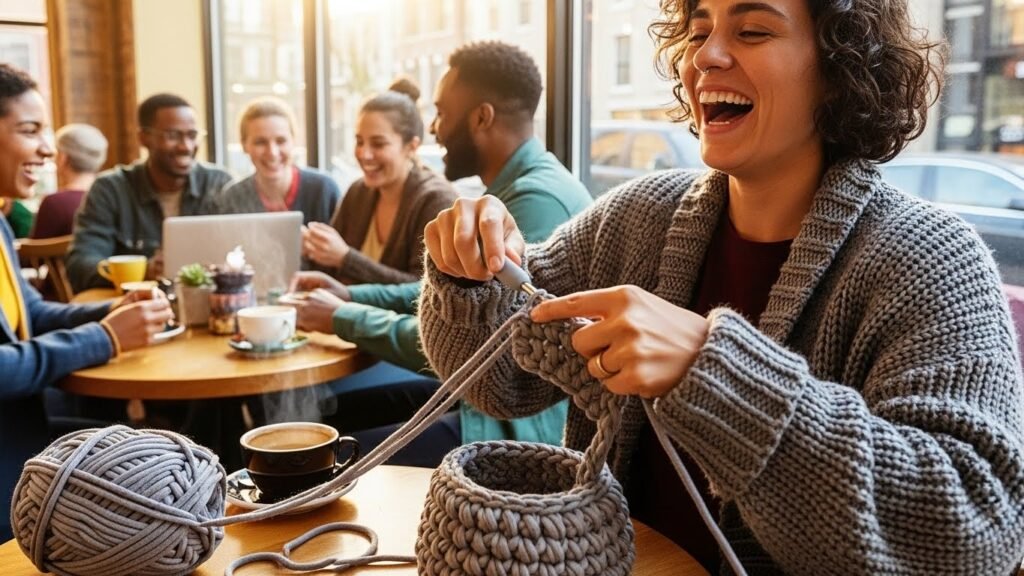
We don’t talk enough about the mental health aspect of our crafts. We knit and crochet to relax, to find “flow,” and to decompress from a digital world. When your yarn splits, it breaks that flow. It triggers a micro-stress response. Your heart rate increases, your shoulders tighten, and the “meditative” hobby becomes a source of frustration.
By choosing one of these three yarns, you aren’t just buying material; you are buying insurance for your peace of mind. You are guaranteed a “flow state” because the mechanical barrier to your success has been removed. Why do we tolerate “splitty” yarn in our leisure time? We wouldn’t tolerate a pen that skips or a car that stalls—why do we accept yarn that fails?
The “Squish” Test vs. The “Twist” Test: How to Shop Like a Pro
The next time you’re in a yarn store, I want you to ignore the softness for a moment. Instead of squishing the skein against your cheek, perform the Twist Test.
Take a loop of the yarn and twist it in the opposite direction of its natural ply. If the yarn immediately fans out and reveals a bunch of loose, fluffy hairs, put it back. That yarn is a “splitter.” If, however, the yarn resists the untwisting or stays relatively contained, you’ve found a winner.
The professionals don’t buy yarn based on how it feels in the skein; they buy it based on how it will behave on the hook. Are you a consumer of soft clouds, or a creator of perfect stitches?
The Hidden Cost of Cheap Construction
“But these yarns are more expensive!” you might argue. Are they? Think about the “Time-Value of Fiber.” If a $10 skein of splitty wool takes you 20 hours to knit because you have to constantly fix snags, but a $15 skein of cabled cotton takes you 12 hours of pure, uninterrupted joy, which one is actually cheaper?
We are wasting our most precious resource—time—on inferior materials. The industry counts on us being “frugal” so they can keep selling us low-twist garbage that they can produce at lightning speed. Break the cycle. Invest in the engineering, not the marketing.

Reclaiming the Joy of the Stitch
The “No-Split” revolution isn’t just about making better sweaters; it’s about reclaiming the tactile pleasure of our crafts. We live in a world that is increasingly intangible and digital. When we sit down with yarn and hook, we want a physical experience that is harmonious and satisfying.
When you use a yarn that refuses to split, you feel a sense of mastery. You aren’t fighting the material; you are dancing with it. You can attempt more complex patterns, you can work in lower light, and you can finally achieve that “perfect” stitch definition that looks like it was made by a machine.
A Challenge to the Fiber Industry
Why are these “stress-free” yarns so hard to find in the mainstream? It’s because the industry has prioritized the “first touch” over the “thousandth stitch.” They want you to fall in love with the fluffiness in the aisle, regardless of the headache it causes you at home.
It’s time we start voting with our wallets. Stop buying the “roving” yarns that fall apart. Stop buying the loosely plied merinos that snag on every third stitch. Demand the cable-ply, search for the mercerized, and embrace the tube.
Your Next Project: A Promise of Peace
I want you to imagine your next project. Imagine casting on and knowing—absolutely knowing—that you won’t have to fix a single split stitch. Imagine the speed, the rhythm, and the sheer pride of looking at a fabric that is perfectly uniform.
This isn’t a dream. It’s the reality of choosing the right tool for the job. You’ve spent enough time “saving” money and “spending” frustration. It’s time to flip the script. The “Holy Trinity” of non-splitting yarns is waiting for you.
Will you go back to the fuzzy, splitty chaos of the past? Or are you ready to experience the “Magic Glide” of a yarn that actually respects your time and your talent? The choice is at the tip of your hook. Choose wisely, and let the stress-free stitching begin.
The craft world is full of beautiful lies, but the “No-Split” guarantee is a truth you can feel in every row. It’s time to stop fighting your yarn and start loving your stitches again. After all, isn’t that why we started this in the first place?

My name is Sarah Clark, I’m 42 years old and I live in the United States. I created Nova Insightly out of my love for crochet and handmade creativity. Crochet has always been a calming and meaningful part of my life, and over the years it became something I wanted to share with others. Through this blog, I aim to help beginners and enthusiasts feel confident, inspired, and supported as they explore crochet at their own pace. For me, crochet is more than a craft — it’s a way to slow down, create with intention, and enjoy the beauty of handmade work.