
You are halfway through the most beautiful shawl you’ve ever attempted. The sun is setting, your tea is getting cold, and then it happens. Your phone pings. Or your cat jumps on your lap. Or someone asks you what you want for dinner. In that split second, the number you were holding in your head—was it 47? 48?—vanishes into the ether. You stare at your work, heart sinking, and start the soul-crushing process of counting back from the beginning of the row. “One, two, three, four…”
Why are we doing this to ourselves? Why have we turned a therapeutic, creative outlet into a grueling exercise in elementary school arithmetic? If you spend your crafting time chanting numbers like a monk in a digital trance, you aren’t “relaxing”—you are performing unpaid data entry. We have been conditioned to believe that counting is the only way to ensure accuracy, but I am here to tell you that counting is a crutch. It is a slow, error-prone, and mentally exhausting relic of the past. There is a better way. There is a “Radical Visual Method” that allows you to read your fabric like a map rather than a spreadsheet. Are you ready to fire your internal accountant and finally start seeing your crochet?
The Cognitive Tax of Constant Counting
When you count every stitch, you are using your “working memory.” This is the part of your brain that is the most easily fatigued and the most susceptible to distraction. Every “one, two, three” is a withdrawal from your mental energy bank. This is why, after two hours of complex lacework, you feel like you’ve just taken a math final instead of enjoying a hobby.
But the brain is actually terrible at long-sequence counting. Evolution didn’t design us to keep track of 250 identical loops of string; it designed us to recognize patterns, detect anomalies, and navigate landscapes. By forcing yourself to count, you are fighting against your own biology. Have you ever wondered why you can recognize a friend’s face in a crowded room in milliseconds, yet you can’t tell if you have 19 or 20 stitches without touching each one? It’s because your brain is a pattern-recognition machine, not a calculator. Why are you using the weakest part of your brain to do the heaviest lifting?
The “Stitch-Blindness” Epidemic
The biggest problem with counting is that it makes you “stitch-blind.” When you are focused on the number, you stop looking at the structure. You might hit the correct number at the end of the row, but if you missed a “yarn over” ten stitches back, the number won’t save you. The count is right, but the fabric is wrong.
The Visual Method flips this. It teaches you to look for the “landmarks” in your work. Once you learn the “V-shape” of a double crochet or the “horizontal bar” of a half-double, you no longer need to count them. You simply see them. It’s like driving home; you don’t count the number of houses you pass, you look for the blue mailbox and the big oak tree. Are you navigating your crochet like a local, or are you a tourist who’s lost without a GPS?

The “Anchor” System: Breaking the Row into Landmarks
The first step in the Radical Visual Method is abandoning the “long count.” Instead of counting to 100, you identify “Anchors.” Anchors are structural points in your pattern where the geography changes—an increase, a decrease, a corner, or a change in stitch type.
In a standard sweater pattern, your “Anchors” are the raglan increases. Between those increases, the stitches are just “filler.” Instead of counting 50 stitches between corners, you simply look for the “V” of the previous row’s increase. Your brain naturally seeks out these deviations. When you approach an Anchor, you know exactly what to do. The space between the Anchors becomes a “free-flow” zone where you can talk, watch TV, or daydream without losing your place. Why are you measuring the distance in inches when you could be measuring it in landmarks?
Reading the “Valley” and the “Peak”
If you are working a ripple or chevron pattern, the counting can be particularly brutal. But ripples have a natural topography. There is a “Peak” (the increase) and a “Valley” (the decrease).
Instead of counting “1, 2, 3, 4, 5, decrease,” you simply look at the slope. You can see when you are reaching the bottom of the valley. The stitches start to “lean” into each other. When you stop counting and start “scoping” the landscape, your speed will double. You are no longer building a row; you are riding a wave. Have you ever felt the sheer physical relief of trusting your eyes more than your tally marks?
The Anatomy of a Stitch: Why Your Eyes are Better than Your Ears
To master the Visual Method, you must become a “Stitch Anatomist.” Most crafters know what a stitch is, but they don’t know what it looks like from every angle.
Every crochet stitch has a “head” (the V on top), a “body” (the vertical or diagonal bars), and a “foot” (where it enters the row below). When you understand the alignment of these three parts, you can “read” your work like a book. If the “head” of a stitch isn’t sitting directly over the “foot” of the stitch below, you know immediately—visually—that you’ve made a mistake. You don’t need a count to tell you the alignment is off.
The “Shadow Play” Trick
If you struggle to see the anatomy of your stitches, change your lighting. Overhead lighting “flattens” the fabric, making it harder to read. Use a side-lamp or a “neck light” that casts shadows across the rows. These shadows turn your crochet into a 3D map.
Suddenly, the “back loops” look like ridges and the “front loops” look like valleys. Your brain will lock onto these textures instantly. This is how masters can crochet with black yarn in the dark—they aren’t counting; they are feeling and seeing the “shadows” of the loops. Why are you working in the dark of “number-crunching” when you could be working in the light of visual clarity?
The “Marker-Less” Revolution: Using Your Yarn as a Compass
We’ve all been told that stitch markers are essential. But markers can be a trap. They become another thing to manage, another thing to count between.
In the Visual Method, we use the yarn itself as a compass. If you are working in the round, look at the “seam” or the “jog” where the row begins. That is your North Star. By observing the diagonal drift of your stitches, you can tell exactly which row you are on without ever touching a plastic clip.
Furthermore, you can use “Life-Lines.” Run a scrap piece of contrasting yarn horizontally across a completed row. This creates a “Visual Horizon.” If your next ten rows don’t look perfectly aligned with that horizon, you know you’ve drifted. It’s a passive safety net that doesn’t require active counting. Is your work a forest where you’re lost, or have you finally learned to read the moss on the trees?
The “Pattern-Match” Reflex
Have you ever noticed how a musician doesn’t count the beats in a measure once they know the song? They feel the “downbeat.” Crochet has a downbeat, too. It’s the repetitive rhythm of the pattern.
If you are doing a “two-double, one-chain” sequence, your hands will eventually develop a “tempo.” If you accidentally do “three-double,” the tempo will feel “heavy.” Your hands will actually tell your brain before your eyes even see the mistake. This is the “Pattern-Match Reflex.” By stopping the verbal counting in your head, you allow this physical “tempo” to take over. You are no longer a mathematician; you are a percussionist. Why are you still “counting 1-2-3” when you could be “feeling the beat”?
The “Negative Space” Hack
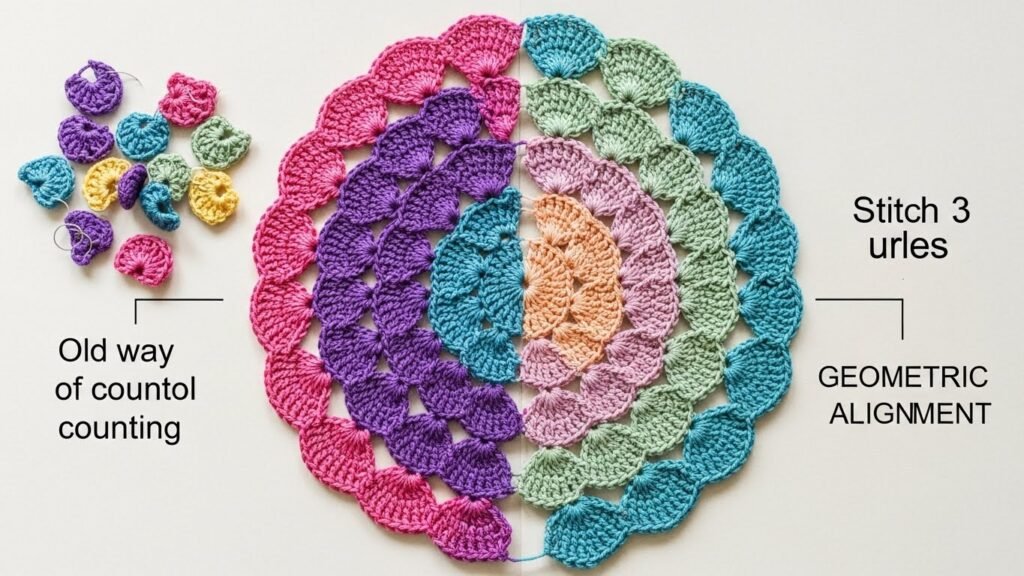
One of the most radical parts of the Visual Method is looking at what isn’t there. In lace or filet crochet, the “Negative Space” (the holes) is just as important as the “Positive Space” (the stitches).
Instead of counting how many stitches are in a block, look at the size of the hole next to it. If the hole looks like a perfect square, you’ve done it right. If it looks like a rectangle or a triangle, something is wrong. Your eye is incredibly sensitive to “symmetry” and “proportion.” It can detect a 1-millimeter deviation in a geometric grid faster than you can count to ten. Why are you ignoring the most powerful diagnostic tool in your possession?
The “Mirror” Technique for Perfectionists
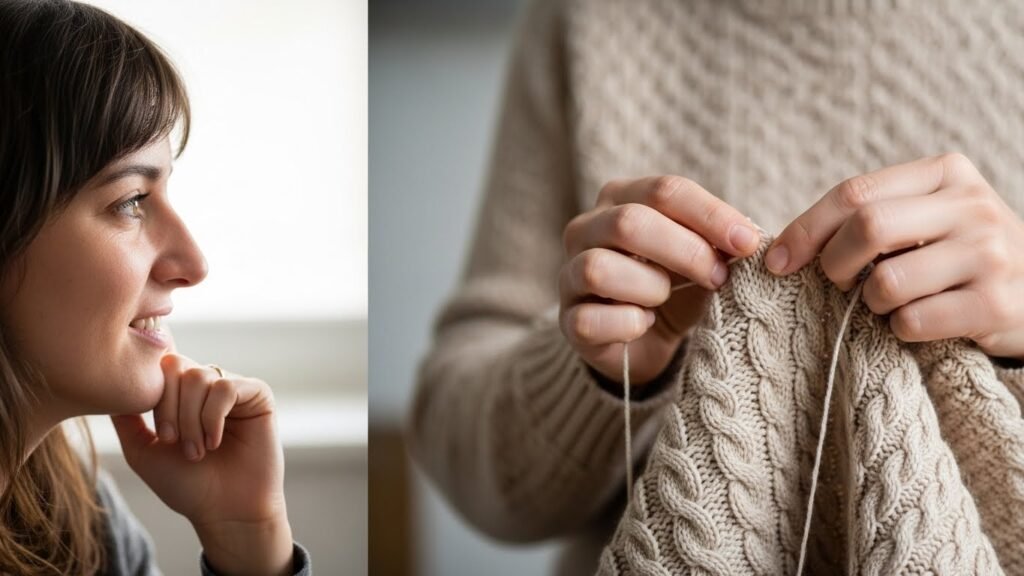
If you suspect something is off but can’t find the mistake, hold your work up to a mirror. This “flips” the perspective and breaks your brain’s “habituation” to the piece. Mistakes that were invisible when looking directly at the fabric will suddenly “pop” out in the reflection. It’s like looking at a word spelled correctly in a mirror—your brain has to re-process the image, which makes it hyper-aware of errors. Are you ready to see your work through a new lens, or are you too afraid of what the mirror might show you?
Overcoming the “First-Row” Anxiety
The most common objection to the Visual Method is: “But what about the first row? I have to count the foundation chain!”
Actually, no. Even the foundation can be hacked. Use the “Foundation Single Crochet” (FSC) method. This allows you to create the chain and the first row of stitches at the same time. Because you are building the fabric vertically as you go, you can simply lay it against a tape measure or an existing garment to see if it’s long enough.
Stop counting “150 chains” and then realizing you’re two inches short. Just crochet until the fabric is the right size. It is a “Responsive” way of building that eliminates the “Math-First” anxiety of starting a project. Why are you letting a number dictate the size of your joy when you could be using a ruler?
The “Visual Audit” at the End of Every Row
Instead of counting your stitches at the end of every row (which takes forever), perform a “Visual Audit.” Hold the row up and look at the “columns.” Each stitch should sit squarely on the one below it. If you see a “lean” or a “gap,” you know you’ve made a mistake.
A visual audit takes five seconds. Counting the row takes sixty. Over the course of a project, this “Visual Method” saves you thousands of minutes of mental labor. What would you do with an extra ten hours of life? Would you make another sweater, or would you finally take that nap you’ve been dreaming of?
The Psychological Freedom of “Number-Free” Crafting
The real magic of the Visual Method isn’t just that it’s faster or more accurate. It’s that it changes the quality of your experience.
When you stop counting, the “noise” in your head goes quiet. You can finally listen to the music, engage in a real conversation, or simply enjoy the silence. You are no longer a slave to the “next number.” You are a master of the “next movement.”
This is the state of “Mindfulness” that everyone talks about but few actually achieve in crochet. You can’t be mindful if you’re constantly saying “thirty-four, thirty-five, thirty-six” in your head. True mindfulness is the observation of the present moment—the sight of the yarn, the feel of the hook, the rhythm of the stitch. Are you ready to stop being a “counter” and start being a “witness”?
Reclaiming Your Creative Flow
The “Flow State” is the peak of human experience—where we are so immersed in a task that we lose our sense of self. Counting is a “Flow-Killer.” It keeps you tethered to your analytical, ego-driven brain. The Visual Method is the “Flow-Key.” It allows you to sink into the intuitive, artistic part of your mind.
When you look back at a project made with the Visual Method, you don’t remember the numbers. You remember the feeling of the wool, the way the colors shifted, and the peace you felt while making it. You remember the “experience,” not the “equation.”
A Call to Visual Arms
I challenge you, on your next project, to leave the tally marks behind. Leave the “row counter” in the drawer.
Start by learning the “Landmarks.” Identify your “Anchors.” Look at the “Anatomy.” Trust your eyes. They have been evolving for millions of years to do exactly this. Your eyes want to help you; they want to see the beauty and the errors alike.
Stop “counting” stitches. Start “reading” them. Your hands already know the way; it’s time to let your eyes lead. The radical truth is that the most perfect projects aren’t the ones that were counted the most—they are the ones that were seen the most clearly. Are you ready to open your eyes and finally see the masterpiece you’re holding in your hands? The “Radical Visual Method” isn’t just a way to crochet; it’s a way to live more deeply in your own creativity. Put down the calculator. Pick up the hook. And just look.

My name is Sarah Clark, I’m 42 years old and I live in the United States. I created Nova Insightly out of my love for crochet and handmade creativity. Crochet has always been a calming and meaningful part of my life, and over the years it became something I wanted to share with others. Through this blog, I aim to help beginners and enthusiasts feel confident, inspired, and supported as they explore crochet at their own pace. For me, crochet is more than a craft — it’s a way to slow down, create with intention, and enjoy the beauty of handmade work.