
The Heartbreak of the 100-Hour Failure
Have you ever spent three months of your life pouring every ounce of your soul into a sweater, only to try it on and realize it looks like a costume borrowed from a much larger, slightly melting giant? You followed the pattern. You checked your gauge—or at least you told yourself you did. You bought the expensive hand-dyed wool that cost more than your monthly grocery bill. Yet, there you stand in front of the mirror, looking at a garment that is technically a sweater, but emotionally a disaster.
Why does the shoulder seam sit three inches too low? Why does the fabric bunch under your arms like a trapped squirrel? Why does the back of the neck ride up while the front sags?
Most knitters and crocheters believe that if they get the “Bust,” “Length,” and “Sleeve” measurements right, the rest will fall into place. But they are wrong. They are missing the “Hidden Dimension.” If you don’t learn this specific rule of spatial engineering, you should stop making sweaters immediately. You are just wasting yarn, time, and hope. Are you ready to stop being a “garment maker” and start being a “fashion architect”?
Beyond the Flat Grid: The Human Body as a Sculpture
The fundamental mistake we make is treating the human body like a 2D surface. We look at a pattern schematic—a flat drawing of a front, a back, and two sleeves—and our brains try to project that flatness onto our curves. But you are not a piece of paper. You are a complex, moving, breathing three-dimensional sculpture.
The “Hidden Dimension” measurement rule is what separates a “homemade” sweater from a “couture” garment. It is a measurement that 99% of commercial patterns ignore, yet it is the single most important factor in how a garment moves with you. It is called The High Point Shoulder (HPS) to Underarm Depth Diagonal.
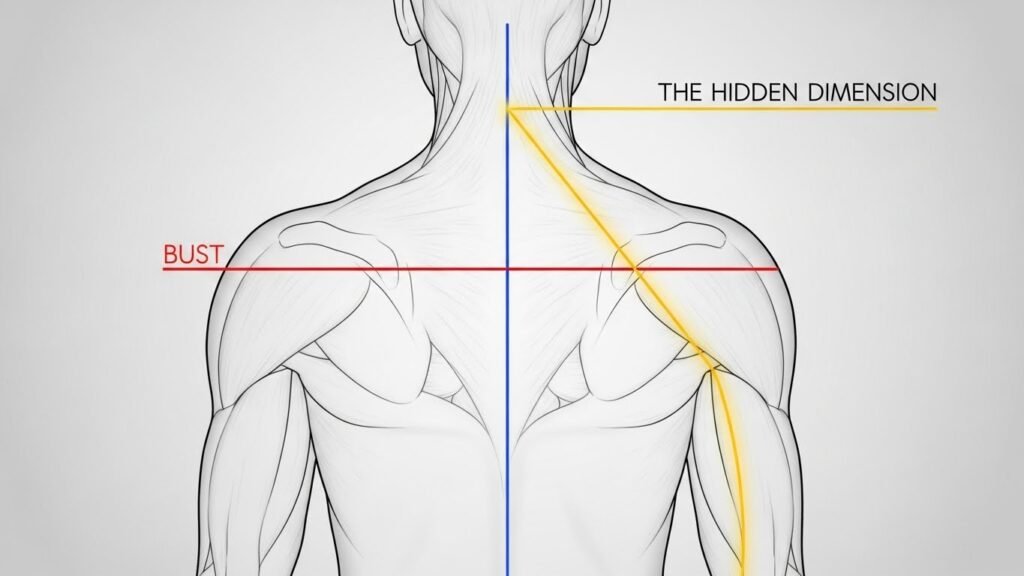
While most patterns tell you the “Armscye Depth” (the vertical line from the shoulder to the armpit), they completely ignore the diagonal volume required to wrap around the actual ball-and-socket joint of your shoulder. Without this hidden diagonal, your sweater will always feel like it’s pulling against you. Do you want to wear your clothes, or do you want to fight them?
The Anatomy of a Perfect Fit
To understand the Hidden Dimension, we have to look at how a sweater actually hangs. Gravity is the silent partner in every garment you make. When a sweater hangs from your body, it doesn’t hang from your bust or your waist—it hangs from your shoulders.
The shoulders are the “hanger” of the human body. If the hanger is crooked, the whole dress looks wrong. Most makers measure their bust and choose a size based on that number. But if you have a 40-inch bust and narrow shoulders, a “Large” will hang off you like a tent. Conversely, if you have broad shoulders and a small bust, a “Small” will choke your armpits.
The Myth of “Standard Sizing”
Pattern designers use “Craft Yarn Council” standards. These are averages of averages. They assume that everyone with a 36-inch bust has the exact same neck-to-shoulder ratio. But have you ever looked at a crowd of people? One person has sloping shoulders; another has squared shoulders. One has a forward-leaning neck from years of looking at a smartphone; another has a broad upper back from swimming.
The Hidden Dimension rule allows you to bypass these averages. It forces you to measure the Diagonal Cross-Back Volume. This is the measurement from the base of your neck, across the shoulder blade, to the opposite armpit. It accounts for the “meat” of your back—the part that actually moves when you reach for a cup of coffee.
How to Measure the Hidden Dimension (And Why It Changes Everything)
If you want to try this right now, grab a measuring tape and a friend (it’s nearly impossible to do this alone). Stand in your natural posture—don’t “stand up straight” if you usually slouch, or you’ll design a sweater for a person who doesn’t exist.
Measure from the point where your neck meets your shoulder (the HPS). Now, run the tape diagonally across your shoulder blade to the very center of your armpit on the same side. This is your True Armhole Diagonal.
The Math of the “Underarm Gap”
Now, look at your pattern. Most patterns have you knit a straight vertical armhole. But your body is a cylinder. When you knit a straight line and then try to wrap it around a cylinder, you get “fabric stress.” This manifests as those weird diagonal lines that point from your bust toward your armpit.
When you apply the Hidden Dimension rule, you realize that you need more “short-row” shaping in the back than in the front. You need to create a “pocket” for your shoulder blade. Have you ever wondered why high-end Italian suits look so crisp? It’s not the fabric; it’s the diagonal shaping in the back. Why shouldn’t your hand-knit wool sweater have the same level of sophistication?
The “Sleeve Cap” Conspiracy
The second part of the Hidden Dimension rule involves the sleeve cap. Most makers treat the sleeve like a tube that just gets sewn onto the body. This is why you can’t raise your arms without the whole sweater riding up to your chin.
The Hidden Dimension tells us that the height of the sleeve cap must be inversely proportional to the width of the shoulder. If you have a “dropped shoulder” design, your sleeve cap should be nearly flat. If you have a “set-in” sleeve, it needs to be a tall, elegant curve.

Why Patterns Don’t Teach You This
Why isn’t this in every “How to Knit” book? Because it’s hard to write a pattern for it. It requires the maker to do a little bit of thinking. It’s much easier for a designer to tell you “Knit for 8 inches” than to say “Knit until your diagonal measurement matches your personal HPS-to-Underarm ratio.”
But you aren’t a mindless loop-maker, are you? You are a creator. And once you see the Hidden Dimension, you can never un-see it. You will start looking at store-bought clothes and realizing why they feel “cheap”—they are ignoring the diagonal.
The “Ease” Trap: Why “Oversized” Isn’t an Excuse
In 2026, the trend is still heavily skewed toward “Oversized” and “Positive Ease.” People think, “If it’s big, it doesn’t need to fit perfectly.”
This is the most dangerous lie in the fiber arts. An oversized sweater actually requires more precise engineering than a fitted one. If an oversized sweater isn’t anchored correctly at the High Point Shoulder (the Hidden Dimension again!), it will slide backward, causing the front neck to hit your throat.
Have you ever spent the whole day pulling your sweater forward because it keeps sliding off your shoulders? That is a Hidden Dimension failure. You didn’t account for the “Back Neck Depth” relative to the “Shoulder Slope.”
The “Vertical Ease” Secret
Most people understand “Horizontal Ease” (how much wider the sweater is than your body). But almost no one talks about “Vertical Ease.”
When you sit down, your torso shortens. When you reach up, it lengthens. If you don’t incorporate the diagonal measurement into your side-shaping, your sweater will become a “crop top” the moment you move your arms. By using the Hidden Dimension, you ensure that the garment has enough “swing” to accommodate the 3D movement of a human life.
The 3-Point Checklist Before Your Next Cast-On
Before you pick up your needles for that next big project, I want you to perform a “Hidden Dimension Audit” on your pattern.
-
Compare the Front and Back: Is the back of the sweater exactly the same as the front? If yes, the pattern is flawed. Your back is broader and has different curves than your front. You need more height in the back to account for the curve of the spine and the reach of the arms.
-
Check the Armhole Shape: Does the armhole look like a straight rectangle or a slight “L” shape? A straight rectangle will always bunch. You want a “scooped” armhole that respects the Hidden Dimension.
-
The Mirror Test: Take a sweater you already own and love—one that fits perfectly. Lay it flat. Measure the diagonal from the neck-shoulder point to the armpit. Does it match the pattern you’re about to start? If not, you need to adjust.

The “Aha!” Moment: Transforming Your Craft
When you finally apply the Hidden Dimension rule, something magical happens. The “homemade” look disappears. People stop asking “Did you make that?” and start asking “Where did you buy that?”
It’s the difference between a garment that sits on you and a garment that belongs to you. It’s the difference between a hobby and a craft. Are you willing to do the ten minutes of extra math required to ensure the next 100 hours of your labor aren’t wasted?
The Psychology of Fit and Self-Worth
There is a deeper reason why we need to learn this. Every time we make something that doesn’t fit, we internalize a small sense of failure. We blame our bodies. We think, “Maybe I’m too tall,” or “Maybe my arms are too weird.”
Stop. Your body is not the problem. The pattern’s lack of a “Hidden Dimension” is the problem. When you learn to measure for your unique diagonal volume, you are honoring your body exactly as it is. You are saying that your body deserves a garment that was built for its specific, beautiful geometry.
The Future of Fiber Arts: 2026 and Beyond
As we move further into a world of AI-generated fast fashion and mass-produced disposability, the “Handmade” movement is our sanctuary. But for it to remain a sanctuary, it must produce quality. We cannot settle for “good enough for handmade.”
The Hidden Dimension rule is part of a larger movement toward “Slow Fashion Engineering.” It’s about merging the traditional skills of knitting and crochet with the precision of 19th-century tailoring. It is about becoming a master of your medium.
Can you imagine a world where every sweater you make is your favorite sweater? Where you never have to “tuck it in” or “roll the sleeves” to hide a bad fit? That world exists on the other side of this one measurement.
A Rhetorical Parting Gift
The next time you are tempted to skip the “boring” measurement part and dive straight into the beautiful yarn, ask yourself this:
If you were building a house, would you start laying bricks before you knew the angle of the hill it was sitting on? If you were flying a plane, would you ignore the wind speed?
Your body is the hill. Your movement is the wind. The Hidden Dimension is the only thing keeping your project from crashing.
So, put down the needles. Pick up the tape. Measure the diagonal. And only then—only when you have mapped the “Hidden Dimension” of your own magnificent shape—should you allow yourself the joy of the first stitch.
Your future self, standing in front of that mirror in a perfectly fitted, couture-level masterpiece, will thank you.

My name is Sarah Clark, I’m 42 years old and I live in the United States. I created Nova Insightly out of my love for crochet and handmade creativity. Crochet has always been a calming and meaningful part of my life, and over the years it became something I wanted to share with others. Through this blog, I aim to help beginners and enthusiasts feel confident, inspired, and supported as they explore crochet at their own pace. For me, crochet is more than a craft — it’s a way to slow down, create with intention, and enjoy the beauty of handmade work.