
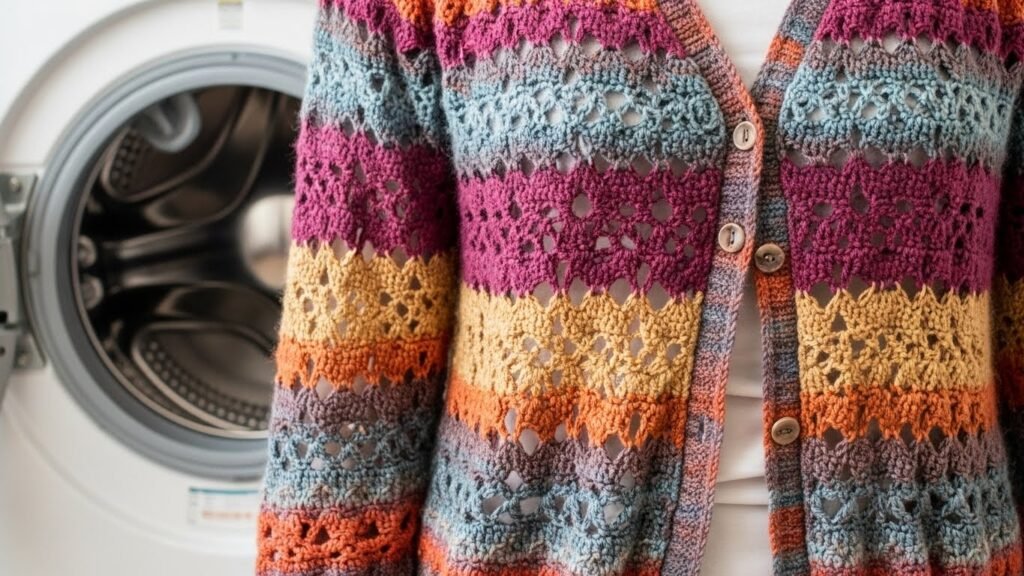
You spent three months on it. You meticulously selected the hand-dyed silk blend, you fought through the complicated cables of the sleeves, and you finally wove in the last stubborn end. It was your masterpiece. Then, it got a little dirty. Maybe a drop of coffee, maybe just the natural oils of your skin after a night out. So, you did what any modern human does: you tossed it in the washing machine on the “delicate” cycle, thinking you were being responsible. An hour later, you pulled out a soggy, shrunken, matted lump of fiber that wouldn’t fit a toddler, let alone a grown adult.
Welcome to the “Gentle Sin.” We are living in a culture of convenience that is diametrically opposed to the soul of the fiber arts. We treat our handmade heirlooms with the same clinical indifference we show our mass-produced denim, and it is a recipe for creative suicide. Why do we put hundreds of hours into a project only to subject it to the equivalent of a high-speed car crash in a drum of soapy water? Are you really willing to let a machine dictate the lifespan of your art? Or are you ready to admit that your laundry habits are the primary reason your “best work” never survives past the first season?
The Physics of Destruction: Why Machines Hate Your Stitches
To understand why your washing machine is a death trap for crochet, you have to understand the physics of a stitch. Unlike woven fabric, which is a tight grid of interlocking threads, crochet is a series of interconnected loops. These loops rely on “structural tension” to stay beautiful. When you toss a crochet item into a machine, you are subjecting those loops to three violent forces: agitation, heat, and centrifugal force.
Agitation is the silent killer. As the machine twists and turns, the fibers of the yarn rub against each other. If you are using animal fibers like wool or alpaca, this friction causes the microscopic scales on the hair to lock together. This is “felting,” and it is irreversible. Once those scales lock, your soft, breathable sweater becomes a stiff sheet of armor. Heat acts as a catalyst, speeding up this chemical and physical bonding. Finally, the spin cycle—the centrifugal force—stretches your stitches to the breaking point. Have you ever noticed how a machine-washed sweater always looks “limp”? You’ve literally beaten the life out of the yarn.
The “Delicate Cycle” Myth
“But I used the delicate cycle!” I hear you screaming at the screen. Let’s be clear: the “delicate” cycle on a modern washing machine was designed for polyester bras and nylon stockings, not for 500 grams of hand-crocheted mohair. To a washing machine, “delicate” just means it hits your clothes with a slightly slower hammer.
The machine cannot sense the tension of your stitches. It doesn’t know that the lace section of your shawl is held together by a single strand of silk. It treats every square inch of the drum with the same mechanical indifference. By trusting the “delicate” button, you are playing Russian Roulette with your creativity. Why are you outsourcing the care of your most precious possessions to a computer chip that doesn’t know the difference between a dishrag and an heirloom?
The Chemistry of Sabotage: Detergents and the Fiber’s Soul
It isn’t just the movement of the machine; it’s the “poison” we put in the water. Most standard laundry detergents are formulated to be aggressive. They are designed to “attack” organic matter—which is exactly what your wool, cotton, or silk yarn is.
Standard detergents often have a high pH level and contain enzymes that are literally designed to eat proteins (like food stains). Do you know what else is a protein? Wool. When you wash your crochet with regular detergent, you are effectively giving it a slow-acting acid bath. Over time, these chemicals strip the natural lanolin and oils from the fiber, leaving it brittle, scratchy, and prone to “pilling.” Have you ever wondered why your favorite scarf suddenly feels like sandpaper against your neck? You’ve chemically stripped away its soul.
The Fabric Softener Trap
If detergent is the acid, fabric softener is the “chokehold.” Most people think fabric softener is a gift to their clothes, but for crochet, it is a disaster. Fabric softeners work by coating the fibers in a thin layer of wax or silicone to make them feel “slippery.”
This coating fills in the tiny gaps between the fibers that allow the yarn to breathe. It adds weight to the project, causing it to “sag” under its own bulk. Even worse, it makes the fibers so slippery that your carefully woven-in ends start to slide out. Your project isn’t just getting soft; it’s literally coming apart at the seams. Why are you paying extra to “suffocate” your yarn?
The Sacred Ritual: The “Human” Way to Wash Crochet
If we are going to stop the “Gentle Sin,” we have to return to the sink. Hand-washing is not a “chore”—it is the final step of the creative process. It is the moment where you commune with the fiber and ensure its longevity for the next generation.
The process is simple, yet most people are terrified of it. You need a basin of lukewarm water (not hot!) and a dedicated “no-rinse” wool wash. These specialized soaps are pH-balanced and contain lanolin to replenish what the environment takes away. You don’t “scrub” the crochet; you “submerge” it. You gently squeeze the soapy water through the stitches, like you’re giving a massage to a tired friend.
The “Towel Burrito” Technique
The most dangerous moment for a wet crochet item is when you pick it up. Water is heavy. If you lift a soaking wet sweater by the shoulders, gravity will stretch it by six inches in three seconds.
Instead, you must support the weight. Lift it as a bundle. To dry it, you use the “Towel Burrito.” Lay the wet item on a clean, white towel. Roll the towel up into a tight cylinder with the crochet inside. Now, step on the towel. Use your body weight to squeeze the moisture out into the towel. Your crochet never feels the violence of a spin cycle, and it emerges damp but structurally sound. Does this take more time than pushing a button? Yes. Is your work worth the ten minutes of extra effort?

The Horror of the Hanger: A Slow Death in the Closet
The “sin” doesn’t end when the project is dry. Many crafters finish their beautiful work, wash it correctly, and then commit the ultimate crime: they hang it on a coat hanger in the closet.
Gravity is the enemy of the crochet stitch. Because crochet is made of interconnected loops, the weight of the garment at the bottom pulls on the stitches at the top. Over months, the “shoulders” of your sweater will grow “points,” and the entire garment will become longer and narrower. It will lose its shape forever.
Crochet must be stored flat. It must be folded gently and placed in a drawer or a breathable cotton bag. When you hang your crochet, you are essentially puting it on a “rack” to be stretched until it dies. Are you really going to let your closet be a torture chamber for your art? Why do we spend so much time on “tension” while making the project if we’re just going to let gravity ruin it later?
The Moths are Watching: The Hidden Danger of the Drawer
While we’re talking about storage, we have to talk about the predators. If you are using natural animal fibers, you are essentially providing a five-star buffet for clothes moths. They don’t want your jeans; they want your hand-spun, hand-crocheted alpaca shawl.
Storing your work in plastic bins might seem safe, but it traps moisture and can lead to mildew. The “Pro” way is to use cedar blocks or lavender sachets and store items in “breathable” containers. Most importantly, you should “air out” your crochet once or twice a year. Moths hate light and movement. By simply taking your projects out and looking at them, you are protecting them. Is your “masterpiece” currently being eaten while you read this? When was the last time you checked the “vulnerable” corners of your stash?
The “Blocked” Look: Bringing the Magic Back
Sometimes, a project looks “ruined” because it has lost its “block.” Blocking is the process of shaping the wet garment to its final dimensions and letting it dry in that position.
If your crochet looks “crunchy” or “shrivelled” after a wash, it’s likely because the fibers have dried in a “contracted” state. A gentle soak and a proper blocking—pinning it out to the correct measurements on a foam mat—can make a five-year-old sweater look brand new. It resets the “memory” of the yarn. It opens up the lace. It levels out the stitches. Why are you ready to throw away a “deformed” sweater when it just needs a little bit of “spatial realignment”?

The “No-Iron” Rule: A Warning
While we’re on the subject of heat, never, ever touch a dry iron to your crochet. Especially if it’s acrylic. Acrylic is plastic. If you hit it with a hot iron, you will “kill” the yarn. “Killing” yarn is a technical term for melting the plastic fibers until they lose all elasticity and become a shiny, limp, lifeless rag.
If you must use heat, use a steamer. Hold the steamer two inches away from the fabric and let the steam do the work. The steam relaxes the fibers without crushing them. Are you trying to “press” your crochet into submission, or are you trying to let it breathe?
Why “Hand-Wash Only” is a Badge of Honor
We have been conditioned to see “Hand-Wash Only” as a warning or a burden. I want you to start seeing it as a certificate of quality. “Hand-Wash Only” means that the item is made of real, living fibers. It means the item has a “hand” and a “drape” that no machine-made polyester garment can ever replicate.
When you tell someone, “I have to hand-wash this,” you are telling them that this item is valuable. You are telling them that it requires a relationship. It is an act of rebellion against the “Fast Fashion” machine that treats clothes as disposable tissues. By hand-washing, you are opting out of the “Gentle Sin” and into a more conscious, beautiful way of living. Can you handle the responsibility of owning something truly great?
The Legacy of the Stitch
Think about the crochet lace from the 1800s that we see in museums. Do you think those pieces survived because they were tossed in a high-efficiency front-loader with some Tide pods? No. They survived because they were treated with a level of reverence that we have almost forgotten.
They were washed with gentle soaps, dried in the shade, and stored with care. When we wash our crochet like our jeans, we are cutting the thread that connects us to those past masters. We are saying that our time doesn’t matter, and our work is temporary. But crochet isn’t temporary. It’s a series of thousands of knots that can last for a century if you just stop “cleaning” them to death.
Final Thoughts: The Cleanliness Myth
Finally, we need to ask ourselves: how often do we really need to wash our crochet? Unlike socks or t-shirts, which sit against the sweatiest parts of our bodies, a crochet cardigan or shawl rarely needs a full “bath.”
Often, a “Spot Clean” is enough. If you get a stain, treat only that spot. If the item smells a bit like a “closet,” hang it in a breezy, shaded spot outdoors for an afternoon. The fresh air and natural UV light (in small doses) will do more for the fiber than a gallon of chemical-laden water ever will.
Stop the cycle of “Obsessive Washing.” Your crochet doesn’t want to be “clean” by the standards of a detergent commercial; it wants to be “healthy” by the standards of a living fiber. Stop the Gentle Sin. Save your masterpiece. Reclaim the basin.
The next time you reach for that washing machine dial, stop. Look at the stitches. Remember the hours. And then, turn around, walk to the sink, and show your work the respect it deserves. Your hands made it; let your hands keep it alive. Are you ready to become a protector of your craft, or are you just another “Gentle Sinner”? The future of your wardrobe is literally in your hands.

My name is Sarah Clark, I’m 42 years old and I live in the United States. I created Nova Insightly out of my love for crochet and handmade creativity. Crochet has always been a calming and meaningful part of my life, and over the years it became something I wanted to share with others. Through this blog, I aim to help beginners and enthusiasts feel confident, inspired, and supported as they explore crochet at their own pace. For me, crochet is more than a craft — it’s a way to slow down, create with intention, and enjoy the beauty of handmade work.