
Have you ever finished a shawl, held it up with trembling hands of pride, and then realized with a sinking heart that it drapes with the grace of a frozen bath mat? You spent forty hours on those stitches, you bought the “soft” yarn the store clerk recommended, and yet, when you drape it over your shoulders, it stands out in stiff, awkward angles like a piece of structural cardboard. It doesn’t “flow.” It doesn’t “dance.” It certainly doesn’t look like those $2,000 designer wraps you see gliding down the runways of Paris or Milan.
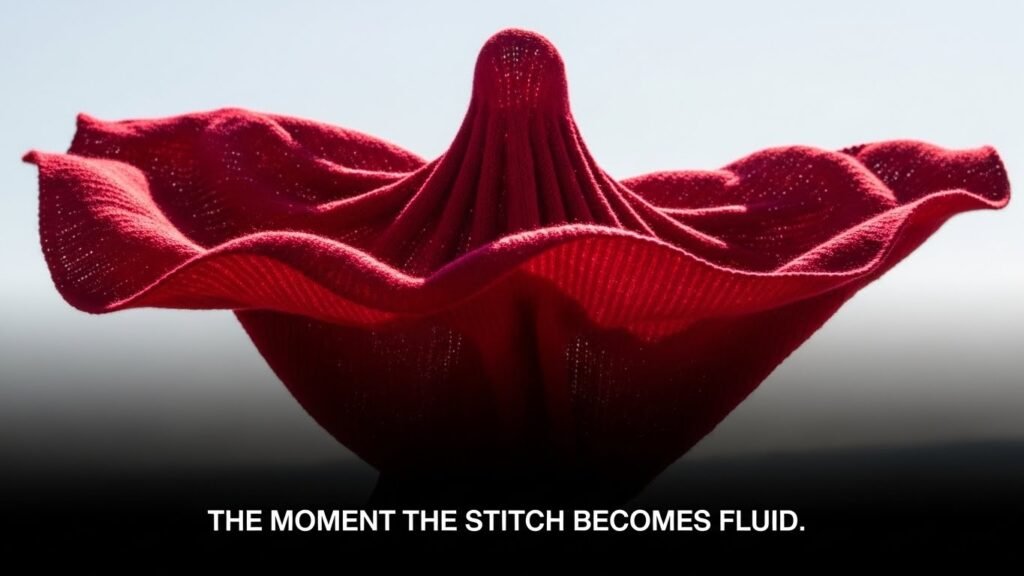
Why does your crochet feel like a heavy blanket while the pros make it look like liquid light? Is it a secret stitch? Is it a magic ritual performed under a full moon? Or have we all been fundamentally lied to about how yarn and hooks actually interact with the laws of gravity? The “Anti-Gravity” Shawl is not just a pattern; it is a psychological and mechanical shift in how we build fabric. It is the art of manipulating tension and fiber molecularity to force crochet—the historically “chunky” cousin of knitting—to behave like expensive, high-end silk. Are you ready to stop making “mats” and start making “movement”? Or are you too comfortable in your stiff, fiber-enclosed cage?
The Rigidity Trap: Why Your Crochet is Fighting You
The primary enemy of drape is friction. In knitting, each stitch is a single loop held in a delicate line. In crochet, we are essentially tying thousands of tiny, complex knots. These knots have “bulk.” They have “body.” And most importantly, they have a stubborn refusal to bend. When you use a hook that is “recommended” by the yarn label, you are almost always setting yourself up for failure. Those recommendations are for structural integrity—great for a basket, terrible for a garment that needs to hug a human curve.
When your stitches are too tight, they lock together like a phalanx of Roman shields. They resist the pull of gravity. To achieve an anti-gravity drape, we must introduce “controlled instability” into the fabric. We have to create a structure that is constantly trying to collapse under its own weight. Does that sound counterintuitive? Good. True art usually is. Why are we so obsessed with “sturdy” when we should be obsessed with “supple”?
The Hook-to-Fiber Paradox
The first secret to the Anti-Gravity Shawl is the “Upsize Hack.” If the yarn label suggests a 4mm hook, you should be reaching for a 6mm or even a 7mm. This is the moment most beginners panic. “But the stitches will be loose!” they cry. “I’ll see holes!”
Exactly. You need those holes. On a microscopic level, those gaps are the “joints” of your fabric. They allow the individual stitches to slide past one another instead of grinding against each other. When you upsize the hook, you are giving the fiber room to breathe, to stretch, and to succumb to the downward pull of the Earth. If your shawl doesn’t feel slightly “wrong” and floppy while you are making it, it will never look “right” when you wear it. Have you been strangling your yarn for years, wondering why it won’t sing?

Fiber Alchemy: Beyond the Acrylic Ceiling
We need to talk about the “Silk Lie.” Many crafters buy “Silk-Effect” acrylic or bamboo blends and wonder why the drape is still off. The problem is weight-to-volume ratio. Acrylic is light and bouncy. It wants to stay “puffed up.” Silk, on the other hand, is deceptively heavy. It is dense. It has “kinetic momentum.”
To get that anti-gravity look, you need a fiber that has “sink.” High-twist merino, mulberry silk, and certain high-end rayons have a gravitational pull that pulls the stitch downward, stretching out the knots and turning them into long, elegant lines. When you use a fiber that is too “springy,” it will always fight the drape. You aren’t looking for “softness” alone; you are looking for “heft.” Are you choosing your yarn based on how it feels in the skein, or how it behaves under the crushing weight of its own beauty?
The Drape Test: The “Water” Method
If you want to know if a yarn will work for an Anti-Gravity Shawl, don’t just rub it on your cheek. Hold a strand of it and let it hang. Does it coil back up like a spring? Trash it. Does it hang limp and straight like a wet string? That is your gold. We are looking for “lifeless” fibers that come to life only when transformed into a grid. Why do we value “bounce” in a garment that is supposed to flow?
The Anatomy of the Vertical Stitch
Not all stitches are created equal in the eyes of gravity. The standard “Single Crochet” is the enemy of drape; it is a short, squat brick that builds a wall. To create a shawl that glides, you must utilize “Tall Stitches”—Trebles, Double-Trebles, and the legendary “Extended” stitches.
A tall stitch has a long “stem.” This stem acts as a pivot point. When you move, these stems tilt and sway, allowing the fabric to ripple. A shawl made of thousands of treble stitches will always out-drape a shawl of double crochets. Furthermore, when you work into the “back loop only” or the “third loop,” you create a hinge. You are literally engineering a mechanical joint into your textile. Are you building a barricade, or are you building a pendulum?

The “Wet-Blocking” Miracle: Setting the Gravity
You could follow every rule of hook size and fiber choice, but if you don’t perform a “Violent Block,” your shawl will never reach its potential. Most people are too gentle with their blocking. For an Anti-Gravity Shawl, you need to soak that piece until it is heavy with water, then stretch it—hard.
You are essentially “training” the fibers to stay in their elongated state. You are forcing the knots to tighten and the stems to stretch. When the shawl dries, it retains that “memory” of being pulled downward. It loses its “fuzzy” memory and gains a “sleek” memory. Have you ever seen a professional “before and after” blocking photo and thought it was a different project? It wasn’t. It was just the moment the maker stopped being afraid of the water.
The Bias Secret: Crocheting on the Slant
If you want your shawl to drape like a bias-cut Hollywood gown from the 1930s, you have to stop crocheting in straight lines. Working “on the bias”—where you increase on one side and decrease on the other—changes the orientation of the “V” of the stitch.
Instead of the stitches sitting like a brick wall (stable), they sit like a diamond grid (unstable). This instability is the key to the anti-gravity flow. The fabric will naturally stretch and contour to the body in a way that horizontal rows never can. Why are we so wedded to the grid when the diagonal is where the magic lives? Is your fear of “losing your place” in a bias pattern keeping you from the most flattering silhouette of your life?
The Psychological Weight of Luxury
There is a reason we associate drape with “expensive.” Stiff fabric looks “protective” (cheap, mass-produced, utilitarian), while draping fabric looks “vulnerable” (luxury, delicate, artistic). When you wear a shawl that moves with you, you aren’t just wearing an accessory; you are wearing a second, more elegant skin.
The Anti-Gravity Shawl communicates a level of mastery. It tells the world that you have conquered the inherent stubbornness of the yarn. It suggests that you understand the hidden physics of the world. Why do we make things by hand if they aren’t going to look better than the machine-made alternative? A machine can make a stiff blanket in seconds. Only a human with an eye for tension can make an Anti-Gravity Shawl.
The “Sleeve-Weight” Hack: Using Gravity to Your Advantage
In the highest tiers of couture crochet, designers sometimes hide “micro-weights” in the hem of a shawl. Small glass beads or even a slightly heavier border can provide the “tug” needed to keep the shawl from riding up.
By adding a row of heavy beads or a dense “Picot” border in a heavier-weight yarn at the very bottom, you give the shawl a “gravity anchor.” This ensures that the drape stays perfect even when you are moving. It’s a secret used by theater costumers for centuries—why aren’t we using it in our craft rooms? Are you willing to “cheat” the physics of the yarn to achieve a perfect visual result?
The Ethics of the Drape: Sustainability and Quality
In an era of “fast-fashion” crochet (yes, it has unfortunately arrived), we see a lot of bulky, low-quality acrylic pieces that look “big” but have zero life. The Anti-Gravity Shawl is the antithesis of this. It requires high-quality materials and a deep time investment.
By choosing to make one perfect, draping shawl instead of ten stiff, bulky ones, you are practicing a form of radical environmentalism. You are creating a “Lifetime Piece.” A shawl that drapes like silk will never go out of style. It will never look “dated” because the silhouette of a falling fabric is as old as the world itself. Are you making “fashion,” or are you making “forever”?
Final Thoughts: Reclaiming the Fluidity of Fiber
The “Anti-Gravity” Shawl is more than just a technique; it’s a manifesto. It’s a refusal to accept that crochet must be clunky. It’s a challenge to the idea that we are limited by the tools in our hands.
When you pick up that oversized hook, when you choose that heavy, shimmering silk, and when you allow your stitches to “fall” instead of “stand,” you are performing a miracle. You are turning a solid into a liquid. You are taking a craft that was born in the cottages of the poor and giving it the elegance of a palace.
So, I ask you: The next time you sit down to start a project, will you build another wall? Or will you build a waterfall? Will you keep your yarn in a state of tension, or will you let it succumb to the beautiful, inevitable pull of the Earth?
The secret is out. The hook is in your hand. The gravity is waiting. It’s time to make your masterpiece “fall” into place.

My name is Sarah Clark, I’m 42 years old and I live in the United States. I created Nova Insightly out of my love for crochet and handmade creativity. Crochet has always been a calming and meaningful part of my life, and over the years it became something I wanted to share with others. Through this blog, I aim to help beginners and enthusiasts feel confident, inspired, and supported as they explore crochet at their own pace. For me, crochet is more than a craft — it’s a way to slow down, create with intention, and enjoy the beauty of handmade work.