
You have just handed over a masterpiece. It took three months, four different dye lots, and approximately fourteen episodes of that true-crime documentary to finish this blanket. You’ve even gone the extra mile: you printed a beautiful, custom card with “Hand Wash Cold” and “Lay Flat to Dry” written in elegant calligraphy. You hug your friend, they gush over the soft alpaca blend, and you walk away feeling like the Ultimate Gift Giver.
But there is a dark, churning reality waiting just a few weeks down the line. That beautiful care label you spent so much time on? It’s currently at the bottom of a trash can or being used as a bookmark for a magazine they’ll never finish. To you, that blanket is a legacy; to them, it is a piece of laundry. And in the world of non-crafters, laundry has one destination: the high-heat, aggressive-agitation, “heavy duty” cycle of a top-loading washing machine. Why do we keep lying to ourselves? Why do we trust the people we love with the fibers we worship, knowing full well they don’t know the difference between “Superwash” and “Satan’s Heat”? Are you ready to admit that your gift is essentially on death row the moment it leaves your house?
The Psychology of the “Laundry Ignorant”
We have to understand the mind of the “Muggle”—the non-crafter. To a normal person, clothes are made of “fabric.” Fabric is something you throw in a basket until the basket is full, and then you dump the basket into a machine. They aren’t thinking about the microscopic scales on your merino wool that will lock together and “felt” when exposed to heat and friction. They aren’t thinking about the way cotton “grows” when it’s hung on a wire hanger while wet.
To them, your “Hand Wash” instruction isn’t a technical requirement; it’s a suggestion. It’s like the “Recommended” speed limit on a highway. They think, “Well, I have a ‘delicate’ cycle on my machine, surely that’s the same thing?” It isn’t. But why should they know that? We are the ones who have spent years studying fiber science. They are the ones who just want a warm blanket while they eat popcorn. Why are we placing the burden of textile preservation on people who consider “separating whites and darks” to be the pinnacle of clothing care?
The “Aha!” Moment of Destruction
The tragedy usually happens on a Sunday afternoon. A spill occurs—maybe wine, maybe coffee. Your friend, panicked and wanting to be “helpful,” decides to clean it immediately. They don’t look for the label. They don’t call you. They toss it in the wash on “Hot” because “hot water kills stains.”
Thirty minutes later, the “Silent Murder” is complete. What was once a flowing, $300 luxury throw is now a stiff, shrunken mat of felted wool that could stop a bullet. This is the “Care Label Lie.” The lie isn’t on the label; the lie is the belief that the label will be read. Have you ever considered that by giving a high-maintenance gift to a low-maintenance person, you are actually giving them a future burden of guilt?
The Science of the “Felted Corpse”
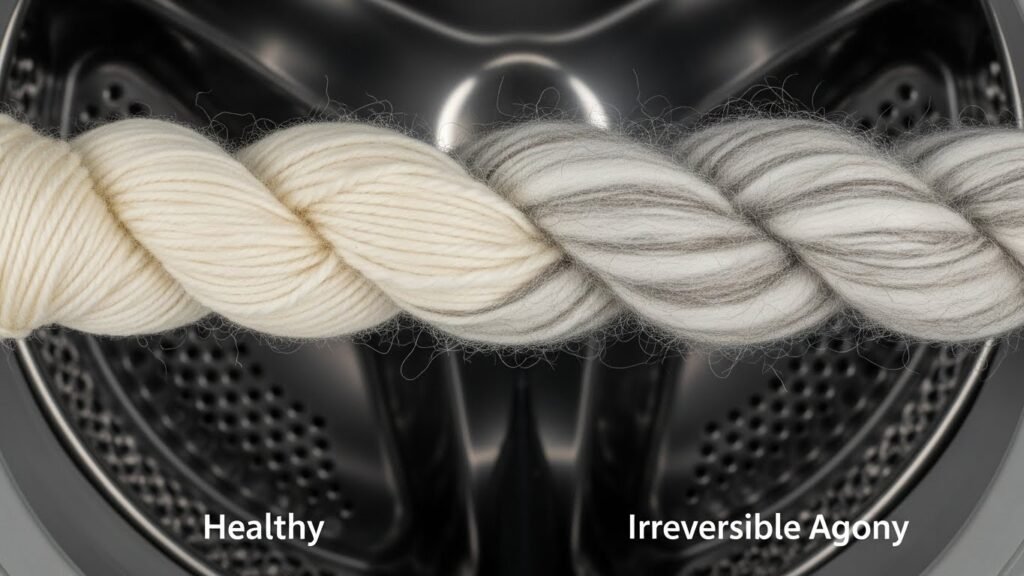
When animal fibers like wool, alpaca, or mohair are exposed to the “Triple Threat”—moisture, heat, and agitation—the microscopic scales on the hair shafts open up and hook into one another. It is a one-way street. Once those fibers have locked together, they cannot be unlocked. This is “felting,” and in the world of intentional art, it’s a technique; in the world of gift-giving, it’s a catastrophe.
The agitation of a washing machine is the primary catalyst. It’s like a thousand tiny hands rubbing the yarn together at high speed. Even if your friend uses cold water, the mechanical force of the spin cycle can be enough to ruin the drape of a delicate lace project. Why are we handing over objects that require “surgical care” to people who operate with “industrial tools”? Is the aesthetic of the fiber more important than the survival of the gift?
The “Superwash” Delusion: A False Sense of Security
“But I use Superwash wool for my gifts!” you cry. Superwash is wool that has been treated with a chemical polymer or an acid bath to remove the scales, supposedly making it machine-washable. But here is the “Superwash Secret” the yarn companies don’t emphasize: Superwash wool is notorious for “growing.”
When you wash Superwash wool in a machine, the fibers relax so much that the garment can grow two or three sizes larger. Your “Medium” sweater becomes an “Extra-Large” dress. To fix this, Superwash usually needs a trip through the dryer on low heat to “snap” the fibers back into place. But does your friend know that? No. They’ll either wash it and hang it up (making it grow even more) or they’ll dry it on high heat and melt the chemical coating. You’ve traded “felting” for “stretching,” but the end result is the same: a gift that no longer fits. Why are we trusting “chemistry” to solve a problem that is actually about “behavior”?
The “Acrylic” Compromise: A Bitter Pill
This leads us to the most controversial conversation in the craft world: Should we only give gifts made of 100% high-quality acrylic? For many “fiber snobs,” this feels like a betrayal. We want our friends to feel the luxury of natural wool. We want them to experience the “breathability” of cotton.
But acrylic is the “Bulletproof Vest” of the yarn world. You can wash it, dry it, throw it in a trunk, and leave it in the sun, and it will—mostly—look the same. It is the only fiber that truly respects the lifestyle of a non-crafter. Are you making the gift for your own ego (“Look at this expensive wool I used!”) or are you making it for their enjoyment? If the gift is destroyed in six months, was the “luxury” fiber really worth it?
The “Care Package” Strategy: Taking Responsibility
If you refuse to use acrylic (and I don’t blame you), you must stop relying on a piece of paper. You need a “Strategic Defense Initiative” for your gifts. This means providing the tools for success, not just the instructions.
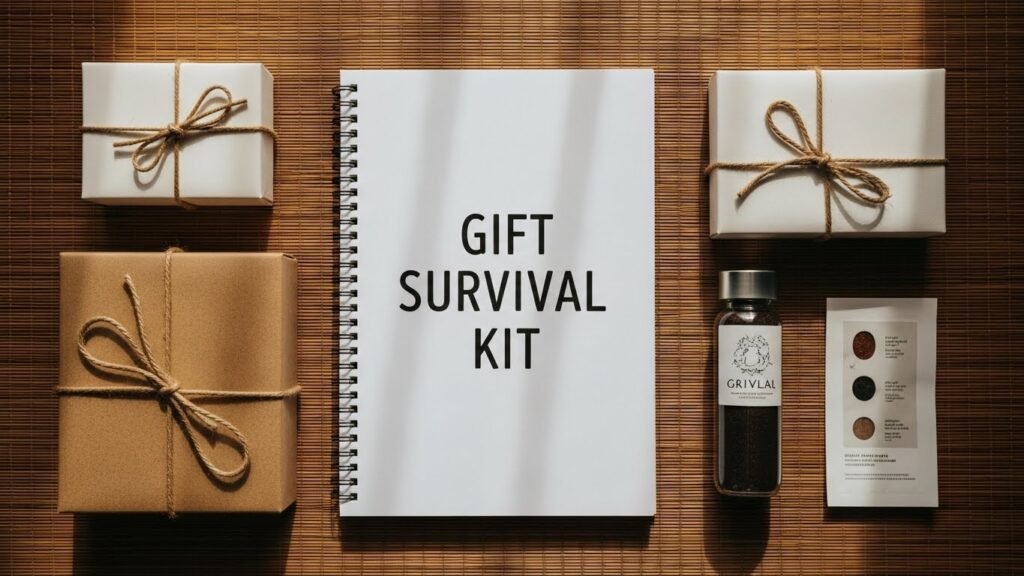
When you give a wool gift, give it with a bottle of high-end, “no-rinse” wool wash. Give it with a “blocking bag” for the laundry. Give it with a promise: “If this gets dirty, please do not wash it. Bring it to me. I will wash it for you.” This is the only way to ensure its survival. You aren’t just giving a blanket; you are offering a “Laundry Concierge” service. Why are we so afraid to tell our friends that they aren’t qualified to clean our art? Isn’t it more honest than pretending a care label works?
The “Gift-Receiver’s Guilt”
We also have to consider the emotional fallout. When a friend accidentally ruins a handmade gift, they feel terrible. They feel a weight of guilt every time they see you, knowing they “killed” the thing you spent hours on. Often, they won’t even tell you. The gift simply disappears. It “gets lost” or stays in the back of the closet because they are too ashamed to show you the shrunken remains.
By giving a high-maintenance gift, you are accidentally setting a trap for your friendship. You are creating a scenario where a simple laundry mistake becomes a moral failure. Is that what you want your craft to represent? Or do you want your work to be a source of uncomplicated comfort? Why are we setting our loved ones up for a “guilt trip” they didn’t ask for?
The “Rugged” Design Philosophy
Another way to fight the Care Label Lie is through “Design for Disaster.” This means choosing patterns and textures that actually look better as they age and get slightly beat up.
Dense, tight stitches (like those in amigurumi or certain types of moss stitch) hold up much better in a washing machine than loose, airy lace. Darker, variegated colors hide the “pilling” and “fuzzing” that occurs during machine washing. If you know the recipient has three kids and a dog, why are you making them a delicate, white, lace-weight mohair shawl? You are literally designing for failure. Why not design for the “Real World” instead of the “Pinterest World”?
The “Wash Test” Torture Chamber
Before you give a gift, you should perform a “Torture Test” on your swatch. Throw that swatch in the machine. Dry it on high heat. See what happens. If the swatch survives, the gift has a chance. If the swatch turns into a piece of cardboard, you need to change your yarn or your recipient.
This is the “Scientific Method” of gift-giving. It removes the guesswork and the hope. It gives you the “Data of Destruction.” If you aren’t willing to sacrifice a swatch to the machine, why are you willing to sacrifice a whole sweater? Are you a “Gambler” with your time, or are you a “Guardian” of your labor?

The “Intervention”: When to Stop Giving
Sometimes, the most loving thing you can do is stop giving handmade gifts to certain people. We all have that one friend—the one who loses their keys, forgets their phone, and lives in a state of beautiful, chaotic disarray. They are wonderful people, but they are “Fiber Assassins.”
Stop giving them crochet. Give them a gift card. Give them a store-bought item. Save your 100% cashmere, hand-painted, lace-weight masterpieces for yourself, or for your fellow crafters who understand the “Secret Language of the Label.” There is no shame in this. It is an act of “Stash Preservation.” Why are you “casting your pearls before swine”—or rather, your “silk before the spin cycle”?
The “Educational” Gift
If you have a friend who truly wants to learn, make the gift a lesson. Spend an afternoon “washing” a project together. Show them how to gently squeeze the water out with a towel. Show them how to “shape” the garment on a flat surface.
Turn the “Care Label” from a piece of paper into a shared experience. This is the only way to bridge the gap between the Maker and the User. You are teaching them to value the “Slow” in a “Fast” world. But remember: not everyone wants to be a student. Some people just want to be warm. Are you a “Teacher” or a “Provider”? Know the difference before you pick up the hook.
Final Thoughts: Reclaiming the Joy of Giving
The “Care Label” Lie is a symptom of our desire for our work to be loved without being a burden. We want our gifts to be perfect, but we also want them to be practical. In the tension between those two desires, the fiber usually loses.
But it doesn’t have to be this way. When you stop trusting the label and start trusting your own strategy, the joy returns. You stop worrying about the “Washing Machine of Doom” because you’ve either used indestructible yarn, designed a rugged project, or committed to being the “Laundry Concierge.”
Your work is an expression of love. Don’t let that love be shrunken, felted, or stretched out of existence by a lack of realism. Be the maker who understands that the “Real World” is messy, hot, and aggressive. Make for the world as it is, not as you wish it to be.
The next time you’re at the craft store, look at the yarn not just for its color, but for its “Survival Quotient.” Think of your friend’s laundry room as the “Ultimate Boss” your project has to defeat.
Are you ready to stop being a victim of the “Care Label Lie”? Your hooks are ready. The “Rugged” yarns are waiting. Let’s make something that actually lasts.

My name is Sarah Clark, I’m 42 years old and I live in the United States. I created Nova Insightly out of my love for crochet and handmade creativity. Crochet has always been a calming and meaningful part of my life, and over the years it became something I wanted to share with others. Through this blog, I aim to help beginners and enthusiasts feel confident, inspired, and supported as they explore crochet at their own pace. For me, crochet is more than a craft — it’s a way to slow down, create with intention, and enjoy the beauty of handmade work.