
It starts as a faint tingle, a ghostly “pins and needles” sensation in your thumb and index finger that you laughingly shake off after a three-hour marathon of making granny squares. Then, it evolves into a dull ache in your wrist that lingers long after you’ve put the hook down for the night. Eventually, you wake up at 3:00 AM with a hand that feels like it’s being crushed in a cold vise, fingers stiff and unyielding. You’ve heard the jokes about “old lady hands,” but this isn’t a joke. This is the “Crochet Claw,” and it is the silent predator of the fiber arts world.
We spend hundreds of dollars on premium hand-dyed wool and thousands of hours on intricate patterns, yet we treat our most essential tools—our hands—with a level of neglect that would be considered criminal in any other profession. Why are we so willing to sacrifice our physical autonomy for the sake of one more row? Is a handmade blanket worth the permanent loss of sensation in your dominant hand? We have been conditioned to believe that “suffering for your art” is a badge of honor, but I am here to tell you that the Crochet Claw is an avoidable tragedy. Are you ready to look past the cozy aesthetic and face the biological reality of what you are doing to your nerves?
The Anatomy of the Attack: What Happens Inside the Tunnel
To understand the Crochet Claw, you have to understand the claustrophobic reality of the human wrist. Your carpal tunnel is a narrow, rigid passageway of ligament and bone at the base of your hand. Through this tiny tunnel pass nine tendons and the median nerve. When you crochet, you are performing a “repetitive micro-motion.” You are asking those tendons to slide back and forth, thousands of times an hour, often under significant tension.
As you work, those tendons can become inflamed. They swell, and because the carpal tunnel is rigid, there is nowhere for that swelling to go. The result? The median nerve—the “high-speed internet cable” for your hand—gets squashed. When you compress a nerve, it doesn’t just hurt; it dies. Slowly. This is the physiological origin of the “Claw.” Your fingers curl because the signals telling them to relax are being choked off at the wrist. Why are you treating your nervous system like a disposable commodity? Do you think your body has a “reset” button that you can just hit once the project is finished?
The “Death Grip” Syndrome
The biggest contributor to nerve damage isn’t the crochet itself; it’s the “Death Grip.” Watch yourself the next time you tackle a difficult stitch. Are your knuckles white? Is your hook held so tightly that your hand looks like a taloned bird of prey?
This intense isometric contraction shuts down blood flow to the small muscles in your hand. Without blood, your muscles produce lactic acid, leading to cramping. But more dangerously, the sheer force of the grip increases the pressure inside the carpal tunnel exponentially. You aren’t just making a stitch; you are performing a slow-motion hydraulic press on your own anatomy. Is your tension so important that it’s worth crushing your median nerve into submission?
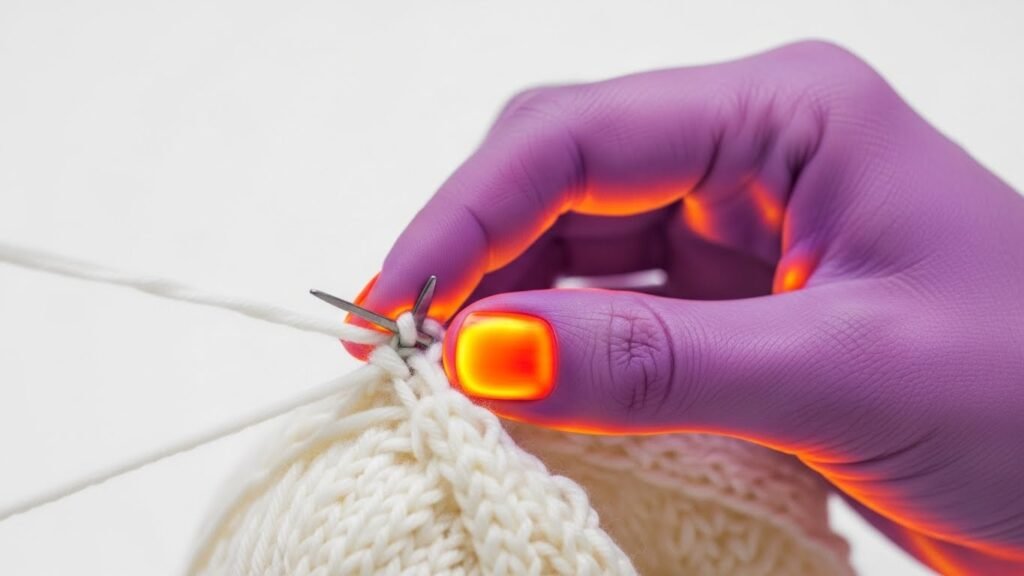
The Myth of the “Standard” Hook: Ergonomic Lies
For decades, the crochet world was dominated by “pencil” hooks—thin, cold, aluminum sticks that offer zero support to the palm. These hooks are a design nightmare. They force the hand into a “pinch grip,” which is the most taxing position for the human hand to maintain.
Many crafters resist switching to ergonomic hooks because they “don’t like how they feel” or they find them “clunky.” But here is the brutal truth: your hand wasn’t designed to pinch a 3mm aluminum rod for five hours a day. Ergonomic hooks aren’t a luxury; they are medical equipment. By using a handle that fills the palm, you allow the larger muscles of the hand to take the load, bypassing the delicate structures of the wrist. Why are you still using 19th-century tool technology in a 21st-century world? Are you waiting for a doctor to hand you a wrist brace before you admit that your “pretty” hooks are hurting you?
The “Pencil” vs. “Knife” Grip Debate
There is an eternal war in the crochet community between “Pencil Grippers” and “Knife Grippers.” While both have their pros and cons, the “Pencil” grip generally places more strain on the thumb’s saddle joint—the most common site for osteoarthritis in crocheters. The “Knife” grip involves the whole arm more, which can save the wrist but can lead to “Tennis Elbow.”
The secret isn’t picking one; it’s being “Ambidextrous in Technique.” The most successful, long-term crafters learn to switch their grip style based on the project. They keep their nervous system guessing. They refuse to let a single set of tendons bear the entire burden of their creativity. Have you become so rigid in your “style” that you’ve become the architect of your own injury?
The “Micro-Break” Revolution: The 20-20-20 Rule for Crafters
We have all been there: you are “in the zone,” the pattern is finally making sense, and you don’t want to stop. You tell yourself, “Just one more row.” Three hours later, you can’t uncurl your fingers.
This “binge-crafting” is a biological assault. Nerves need oxygen and blood flow, and both are restricted during long sessions of repetitive motion. The “20-20-20 Rule” (borrowed from eye health but adapted for hands) is your only defense. Every 20 minutes, put the hook down for 20 seconds, and look 20 feet away while gently stretching your hands.
This isn’t just about “resting”; it’s about “re-perfusing.” It’s about letting the blood wash back into the tissues and flushing out the toxins of contraction. Why do you treat your phone’s battery life with more concern than your own hand’s circulation? Are you really so “busy” making a scarf that you can’t spare twenty seconds to save your career?
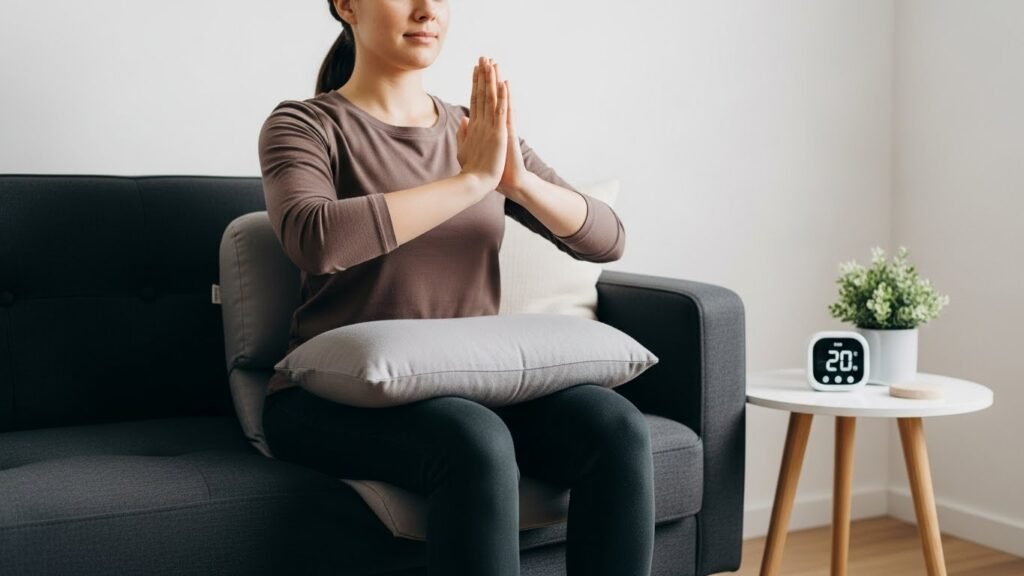
The “Prayer Stretch” and the “Tendon Glide”
If you want to beat the Crochet Claw, you need a pharmaceutical-grade stretching routine. The “Prayer Stretch” (palms together, moving downward toward the waist) and “Tendon Glides” (a series of specific hand shapes—fist, hook, flat hand) are the “antivirus software” for your carpal tunnel.
These movements manually “pull” the tendons through the tunnel, breaking up minor adhesions and encouraging the drainage of inflammatory fluid. If you aren’t doing these daily, you aren’t a serious crafter; you’re just a hobbyist on a collision course with a surgeon. When was the last time you gave your hands the same “blocking and grooming” treatment you give your finished wool projects?
The Hidden Danger of “Social Media Pressure”
We live in the era of the “WIP” (Work in Progress) reveal. We see influencers churning out three cardigans a week, and we feel a subconscious pressure to keep up. This “Production Anxiety” leads us to ignore the warning signs our bodies are sending.
We see the “Crochet Claw” forming, but we hide it under a beautiful filter. We take ibuprofen like it’s candy just to finish a “release” by Friday. We have turned a slow, meditative craft into a high-speed manufacturing job, but without the OSHA protections. Why are you competing in a race that has no finish line? Is the validation of a “heart” icon on a screen worth the loss of your ability to hold a fork?
Reclaiming the “Slow” in Slow Fashion
Crochet is one of the few things in the world that cannot be replicated by a machine. Every stitch must be made by human hands. This makes it inherently slow. When we try to force it to be fast, we are violating the very nature of the craft—and our bodies pay the price.
The Crochet Claw is a symptom of a “Fast Fashion” mindset applied to a “Slow Fashion” skill. By embracing the slow, by accepting that a sweater might take six months instead of six days, you are protecting your nervous system. You are choosing longevity over “likes.” Are you a creator of heirlooms, or are you a factory worker in a one-person sweatshop?
The “Cold Hand” Warning: Raynaud’s and Crochet
Many crafters notice that their hands get cold while they work. They think it’s just the drafty room, but it’s often a sign of “Vasoconstriction.” When you hold a hook and yarn, you are potentially compressing the ulnar or radial arteries.
Cold hands are less flexible, and cold nerves are more prone to injury. If your hands are cold, your risk of developing the Crochet Claw triples. The solution? Fingerless gloves. They keep the wrists and palms warm, encouraging blood flow, while leaving the fingertips free to feel the yarn. Why are you working in a “refrigerated” state when warmth is the ultimate lubricant for your joints
The “Yoga for Hands” Mentality
We need a cultural shift in the fiber community. We need to stop talking about “stitches per minute” and start talking about “years of hand health.” We need to treat our crafting sessions like an athletic event.
Warm up before you start. Hydrate. Check your posture. If you are slouching on a soft sofa, you are “pinching” the nerves in your neck and shoulders that lead all the way down to your fingertips. The Crochet Claw often starts in the spine. Why are you focusing on the “loop” when the “root” of the problem is in your posture?
The Surgeon’s Room: The Final Destination
If you ignore the tingling, if you push through the “Claw,” you will eventually find yourself in a sterile room with a surgeon. Carpal tunnel release surgery is common, but it is not a “magic fix.” There is scar tissue. There is a long recovery. And for many, their “tension” is never the same again.
I have seen masters of the craft lose their ability to crochet because they thought they were “tougher” than their anatomy. They thought the “Claw” was a myth until their hand became a permanent stranger to them. Do you want your legacy to be a pile of finished blankets, or do you want it to be a lifetime of being able to create?
The “Pain is Not a Goal” Manifesto
Let’s be clear: Crochet should never hurt. Not a little. Not “just at the end.” Pain is your body’s emergency broadcast system. If you feel pain, you have already gone too far.
We need to de-stigmatize the “break.” We need to celebrate the crafter who says, “I only did two rows today because my hands felt tight.” That is the sign of a professional. That is the sign of someone who respects their medium—and their medium is their own flesh and blood.
Final Thoughts: The Gift of the Hand
Your hands are a miracle of biological engineering. They contain 27 bones, 34 muscles, and thousands of nerve endings. They allow you to turn a simple string into a complex geometric masterpiece. They are the bridge between your imagination and the physical world.
The “Crochet Claw” is what happens when we forget that this bridge needs maintenance. It happens when we treat our hands like machines instead of living tissue.
Stop the “Death Grip.” Throw away the thin aluminum sticks. Set your timer. Do your tendon glides. Look at your hands right now. Open them wide. Close them slowly. Feel the miraculous fluidity of your movement. That fluidity is a gift. Don’t let it be stolen by a “WIP” deadline or a stubborn pattern.
You only get one pair of hands. If you break them, the music stops. The hooks go silent. The yarn stays in the bin. Treat your hands with the same love, softness, and care that you put into every stitch of that baby blanket. Reclaim your health from the “Claw.” Your future self—the one who still wants to be crocheting at eighty—will thank you for every 20-second break you take today. Are you ready to put down the hook and breathe? The next row can wait. Your nerves cannot.

My name is Sarah Clark, I’m 42 years old and I live in the United States. I created Nova Insightly out of my love for crochet and handmade creativity. Crochet has always been a calming and meaningful part of my life, and over the years it became something I wanted to share with others. Through this blog, I aim to help beginners and enthusiasts feel confident, inspired, and supported as they explore crochet at their own pace. For me, crochet is more than a craft — it’s a way to slow down, create with intention, and enjoy the beauty of handmade work.