
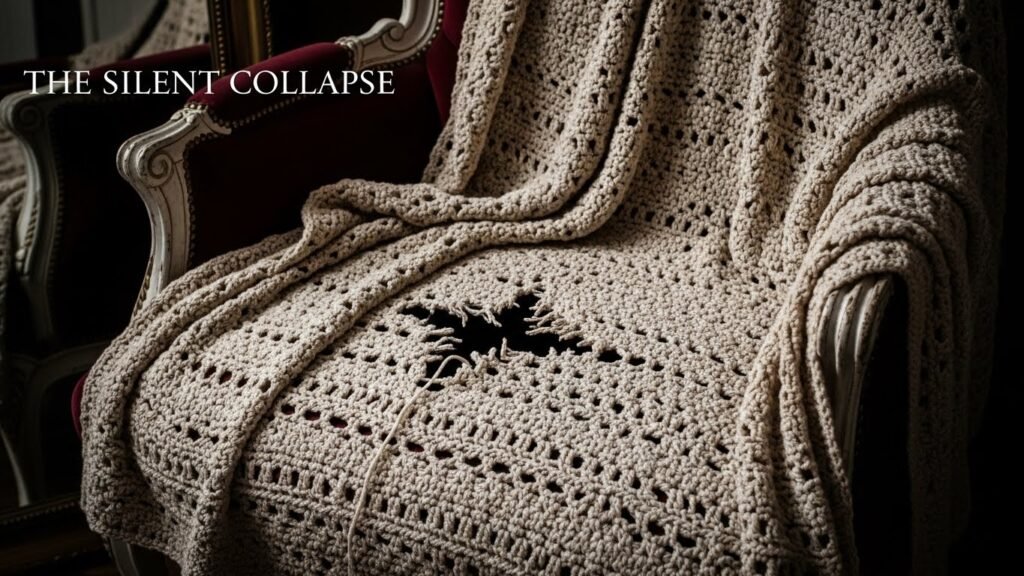
You spent six months on it. Thousands of stitches, hundreds of hours, and a small fortune in hand-dyed wool. It was meant to be the “Grandmother Blanket”—the one your grandchildren would wrap themselves in fifty years from now. You finished it, wove in the ends, and felt that triumphant surge of completion. But as you sit there, feeling the weight of the fabric, a terrifying truth is lurking within the fibers. Right now, in the very heart of your masterpiece, a knot is failing. It’s not a loud failure. There is no snap of yarn or sudden rip. It is a slow, stealthy, microscopic slippage. One day, three years from now, you’ll pull it out of the closet and find a hole the size of a dinner plate.
Welcome to the reality of the “Heartbreak Knot.” We live in a world of “quick fixes” and “magic tricks,” and in the crochet community, this has manifested as a dangerous obsession with speed over structural integrity. We have been taught techniques that look great on a ten-second video but are architecturally unsound. We are building cathedrals on foundations of sand. Why are we so willing to gamble our legacy on a knot that was never designed to last? Are you truly a creator of heirlooms, or are you just making temporary decorations that will eventually dissolve into a pile of expensive string?
The Illusion of the Magic Ring: A Structural Time Bomb
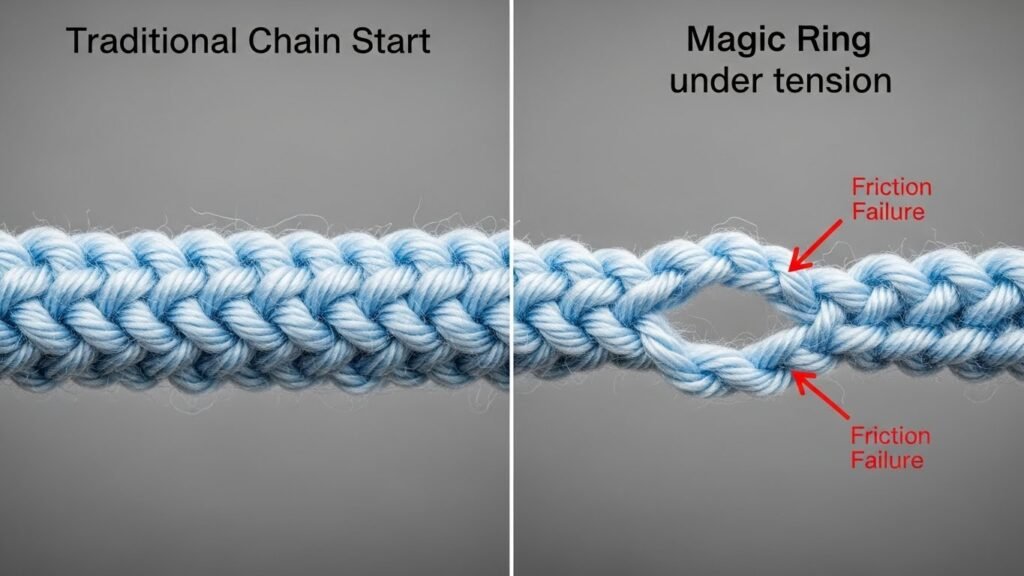
If you’ve ever made a granny square or a piece of amigurumi, you’ve probably used the “Magic Ring” (or Magic Circle). It’s the darling of the crochet world because it allows you to pull the center of your work tight, leaving no hole. It’s elegant, it’s satisfying, and it is a mechanical disaster waiting to happen.
The Magic Ring relies entirely on friction to stay closed. Unlike a traditional foundation chain where the stitches are anchored into a physical loop, the Magic Ring is a “floating” structure. If the yarn is slippery—like silk, bamboo, or even mercerized cotton—there is nothing stopping that tail from eventually sliding back through the loops. Every time you wash the blanket, every time someone sits on it, every time the fibers expand and contract with the humidity, the knot moves a fraction of a millimeter. It is a slow-motion unraveling that you cannot stop once it begins. Why are we sacrificing the next fifty years for five seconds of convenience at the start of a project?
The “Slippery Slope” of Modern Fibers
In the past, our grandmothers used scratchy, “toothy” wool. These fibers had microscopic scales that would hook into each other, creating a natural velcro. You could almost get away with a bad knot because the yarn would “felt” itself into place over time.
But today, we love luxury. We use “Superwash” wools (which have the scales chemically removed) and silky synthetics. These yarns are as smooth as glass. A Magic Ring in a silk-blend yarn has the structural integrity of a knot tied in a wet noodle. Have you ever considered that your choice of “luxury” yarn is actually making your “Heartbreak Knot” even more likely to fail? Are you choosing beauty over existence?
The “Weaving In” Lie: Why Two Inches Isn’t Enough
We’ve all seen the tutorials. “Just weave your end in for two inches and snip it close to the work.” This is the second great lie of the modern crafter. When you weave in an end for only two inches, you are assuming the blanket will never be moved.
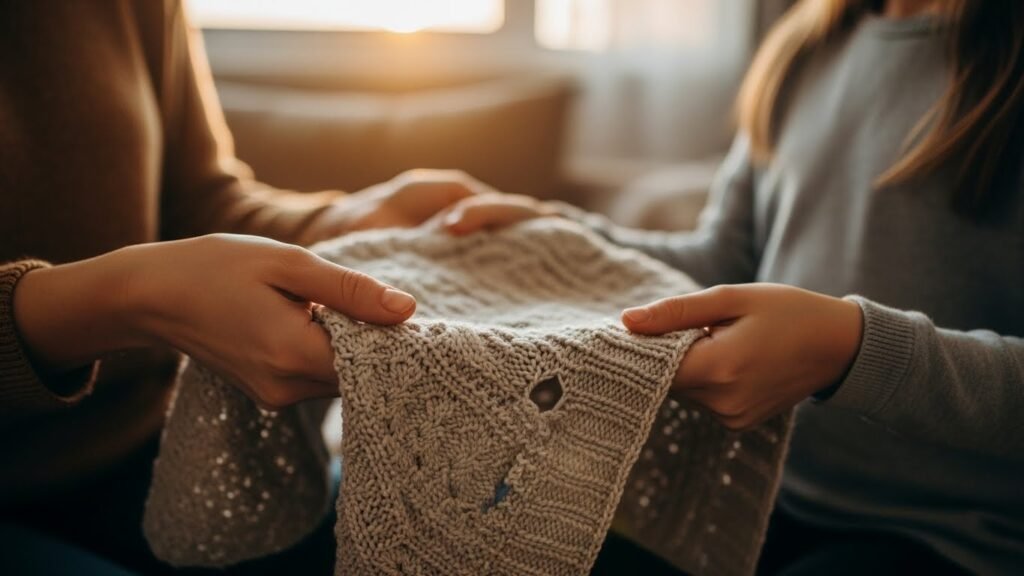
A blanket is a living thing. It is pulled, sat upon, dragged across beds, and stuffed into washing machines. These actions create “mechanical stress.” If your tail is only two inches long, that stress will eventually work the end out of the fabric. Once the tail pops out, the friction is gone. The “Heartbreak Knot” at the center of your square opens up, and because crochet is a continuous chain of loops, the entire square begins to unzip.
The “Three-Direction” Rule You’re Ignoring
If you want an end to stay put, it needs to change direction at least three times. It needs to go up, down, and then back up again. This creates a “mechanical lock.” But even this isn’t enough for the center of a heavy blanket.
Expert restorers—the people who fix 100-year-old textiles—know that a knot is only as good as its “anchor.” If you aren’t splitting the yarn with your needle when you weave in your ends, you aren’t creating a lock; you’re just hiding a string. Why are you spending $200 on yarn but refusing to spend an extra ten minutes on the one part of the project that ensures its survival? Is your time really that much more valuable than your legacy?
The “Knot” That Isn’t a Knot: The Myth of the Double Knot
Sometimes, crafters get nervous and decide to tie a traditional “double knot” to secure their yarn. They pull it tight, snip the ends, and feel safe. But in the world of fiber, a hard knot is a point of failure.
A hard knot creates a “stress concentration.” Because the knot is rigid and the rest of the yarn is flexible, the yarn will eventually break at the point where it enters the knot. It’s like a wire that is bent back and forth until it snaps. Furthermore, knots eventually work their way to the front of the work, creating unsightly “pimples” on your beautiful fabric. You are trading a structural failure for an aesthetic one. Why are you trying to solve a flexible problem with a rigid solution?
The “Russian Join” vs. The “Magic Knot”
Many people use the “Magic Knot” to join new balls of yarn. Again, the name is a marketing trick. The Magic Knot is just two overhand knots tied against each other. It works for a while, but it can slip if the yarn is thin or slippery.
The “Russian Join,” however, involves weaving the yarn back into itself using a needle. It creates a seamless, knot-less join that is actually stronger than the yarn itself. It takes three minutes longer to do. But those three minutes are the difference between a blanket that lasts for a decade and one that lasts for a century. Why are we so allergic to the “slow way” when the slow way is the only way that works?
The “Washing Machine” Massacre: Where Failure Becomes Visible
The moment of truth for the “Heartbreak Knot” usually happens in the laundry. Even on the “delicate” cycle, the centrifugal force of the spin cycle pulls the fabric in every direction.
If your Magic Ring isn’t secured with a needle and thread (yes, actual sewing thread), the water acts as a lubricant. The tail slides out, the center expands, and by the time you open the lid, you have a “spiderweb” of unraveled stitches. This is why you see so many “vintage” blankets in thrift stores with holes in the centers of the squares. Those were the victims of the Heartbreak Knot. Are you making a thrift-store tragedy, or are you making a museum piece?
The “Security Stitch” Hack
If you absolutely must use a Magic Ring, there is a way to save it. After you pull it tight, you must take a sharp tapestry needle and “sew” the tail through the base of the stitches, then turn around and sew back the other way, literally “knotting” the fiber to itself.
Better yet, use a needle and a strand of matching sewing thread to tack the tail down. This is the “secret” of professional designers. It’s not “crochet,” strictly speaking—it’s tailoring. But it’s the only way to guarantee that your center will hold. Are you a “purist” who lets their work fall apart, or are you a “realist” who wants their work to live?
The Psychological Impact of the “Unravel”
There is a specific kind of grief that comes with seeing a handmade item fall apart. It feels like a waste of life. When that “Heartbreak Knot” fails, it doesn’t just ruin the blanket; it ruins your motivation to ever make another one.
You think, “Why bother? It’s just going to break.” This is how hobbies die. We fail because we weren’t taught the “boring” parts of the craft. We were taught how to make pretty loops, but we weren’t taught how to build a lasting structure. We are a generation of makers who know how to “decorate” but don’t know how to “construct.”
Reclaiming the “Foundation Chain”
Maybe it’s time to stop the “Magic” and return to the “Chain.” A foundation chain of 4, joined with a slip stitch, creates a physical circle of yarn that cannot unravel from the inside. Yes, it leaves a tiny hole in the center. But that hole is a sign of honesty. It is a sign of a structure that will still be there in 2125.
Why are we so obsessed with “no hole” that we are willing to risk the entire existence of the project? Is your vanity more important than the blanket’s survival? Let the hole be there. It’s a breathing room for the fiber. It’s a mark of a maker who knows their history.
The Heirloom Manifesto
An heirloom is not just an object; it is a contract. It is a promise from the maker to the future. It says, “I cared enough about you to make this correctly.”
When you use the “Heartbreak Knot,” you are breaking that contract. You are giving the future a burden—the burden of a failing object. If we want our craft to be respected as “art,” we have to treat the construction as seriously as a carpenter treats a house. A carpenter doesn’t use “magic glue” to hold up a roof; they use nails and joints.
The “Stress Test” Your Work Needs
I want you to take your current project and do something terrifying. I want you to grab it by the center and pull. Hard.
If you are afraid to pull your work, it’s because you don’t trust your knots. And if you don’t trust them now, how can you trust them to survive fifty years of life? A well-made crochet project should be able to withstand a tug-of-war. If yours can’t, it’s time to stop the row and fix the foundation.
Final Thoughts: The Integrity of the End
We spend so much time worrying about the “right” hook, the “right” colorway, and the “right” stitch count. But the most important part of any project is the part that no one ever sees: the ends.
The “Heartbreak Knot” is a symptom of a culture that values the “look” over the “substance.” But as fiber artists, we have the power to change that. We can choose the “slow weave.” We can choose the “Russian Join.” We can choose to sew our centers shut with the precision of a surgeon.
Don’t let your masterpiece become a “Heartbreak” story. Don’t let your legacy unravel from the inside out. Be the maker who builds for the centuries. Secure your rings, weave your ends until your fingers ache, and sleep soundly knowing that your “Grandmother Blanket” will actually be there to meet the grandchildren.
The future is made of thousands of tiny, invisible decisions. Make the decision to be secure. The “Magic” is in the effort, not the shortcut. Are you ready to stop the “Heartbreak” and start the “Heritage”? Your hook is the tool, but your integrity is the thread. Make it count.

My name is Sarah Clark, I’m 42 years old and I live in the United States. I created Nova Insightly out of my love for crochet and handmade creativity. Crochet has always been a calming and meaningful part of my life, and over the years it became something I wanted to share with others. Through this blog, I aim to help beginners and enthusiasts feel confident, inspired, and supported as they explore crochet at their own pace. For me, crochet is more than a craft — it’s a way to slow down, create with intention, and enjoy the beauty of handmade work.