
We have been conditioned to believe that beauty requires suffering. In the world of interior design and fiber arts, the narrative is always the same: if you want a statement piece—a rug that anchors a room and draws gasps from guests—you must pay for it with months of meticulous, soul-crushing labor. We envision Victorian lace-makers going blind by candlelight or modern artisans hunched over looms until their spines resemble a question mark. But what if I told you that this is a grand architectural deception? What if the most complex-looking, “logic-defying” rug in your home wasn’t the result of intense focus, but the result of no focus at all?
Welcome to the revolution of the “Passive Masterpiece.” We are talking about a pattern so intuitive, so fundamentally aligned with the natural rhythm of human movement, that your hands will continue the work long after your brain has checked out for the night. This is not just a craft; it is a neurological hack. It is the art of tapping into “Flow State” to create a high-end home accessory that looks like it cost a four-figure sum at a boutique in Copenhagen. Are you ready to stop fighting your yarn and start letting it manifest itself? Or are you too addicted to the struggle to believe that greatness can be easy?
The Geometry of the Subconscious: Why Your Brain Loves the Spiral
The “Logic-Defying” rug is based on the most ancient and powerful shape in the universe: the spiral. From the structure of galaxies to the unfolding of a fern frond, the spiral is nature’s way of growing maximum volume with minimum effort. When you crochet in a continuous, spiraling circle using a specific “Muscle-Memory Stitch,” you bypass the need for counting, joining, or even looking at your work.
Traditional patterns fail because they require constant cognitive “reboots.” You have to remember where the round ends, how many increases to make, and when to change colors. This creates mental friction. The Logic-Defying Rug removes the friction. By utilizing a “Self-Correcting Increase” method, the pattern becomes a physical rhythm—like breathing or walking. Have you ever wondered why you can drive a car home while thinking about something else entirely? That is the power of the procedural memory. Why aren’t you using that same power to decorate your floors?
The “Hyper-Bulk” Secret: Creating Substance Without Effort
The first “hack” to making a rug that looks weeks in the making is the material. If you use standard yarn, you are building a mountain out of sand. It takes forever, and the results are often flimsy. To defy logic, we use Tripled-Strand Jumbo Cotton Tube Yarn.
By holding three strands of high-quality, tubular jersey yarn together and using a hook the size of a small rolling pin, every single stitch you make is roughly three inches wide and two inches thick. In ten minutes, you haven’t just made a “circle”; you’ve built a foundation. This creates a visual weight that commands respect. When someone walks into your room and sees a rug that is three inches thick, their brain assumes it took a massive amount of technical skill to handle such “heavy” materials. In reality? The thickness of the yarn does 90% of the work for you. Are you working harder than the yarn, or is the yarn working for you?

The “No-Look” Stitch: The Moss Stitch Evolution
To reach the point where you can literally crochet while falling asleep, you need a stitch that is “haptic.” A haptic stitch is one that your fingers can identify by touch alone, without the need for sight. The Logic-Defying Rug uses a modified Floating Moss Stitch.
Unlike a standard single crochet where you have to hunt for the “V” at the top of the stitch, the Floating Moss Stitch involves working into the wide, obvious spaces created by the previous row. Your hook naturally “falls” into the correct spot. It’s like a magnetic attraction.
The Self-Correcting Increase
The biggest fear of the circular rug is the “ripple” or the “bowl”—where the rug becomes wavy or starts to curve upward. The Logic-Defying hack is the “Natural Increase” rule: you only increase when your hook tells you to. If the hook feels “tight” as you enter the space, you add a stitch. If it feels “loose,” you move on. By listening to the tension of the fiber instead of the numbers on a page, you create a perfectly flat surface every single time. Why are we trusting mathematicians to tell us how to crochet when our own hands already know the physics of tension?
The Sensory Architecture of a Living Room
A rug is not just a floor covering; it is the “acoustic and tactile soul” of a room. Most modern rugs are flat, chemical-laden sheets that offer nothing to the senses. The Logic-Defying Rug, with its deep, three-dimensional ridges, acts as a sound diffuser and a thermal insulator.
When you walk on it barefoot, the “ridges” created by the triple-strand technique massage the soles of your feet. It is a piece of furniture that performs a service. Have you ever considered that the “simplicity” of a project is actually what allows it to be more functional? By not over-complicating the design, you allow the raw beauty of the fiber to provide the luxury.

The “Autopilot” Training: How to Program Your Hands
How do you actually get to the point where your hands work “while you sleep”? It starts with a 20-minute “Calibration Phase.” During this time, you sit in total silence and focus only on the feeling of the hook entering the space.
You are teaching your nervous system the distance between stitches. Once the nervous system learns the “arc” of the movement, it moves the task from the prefrontal cortex (the thinking brain) to the cerebellum (the doing brain). This is the same transition a pianist makes when they stop looking at the keys. Once you hit the “Cerellar Phase,” you can watch a movie, have a deep conversation, or even doze off, and your hands will maintain the rhythm. Are you using your brain to do a job that your spine could do better?
The “Unbreakable” Aesthetic: Why Simple is Sophisticated
There is a specific kind of arrogance in complex patterns. They scream for attention. They demand that you notice every twist and turn. But the Logic-Defying Rug has the quiet confidence of a Zen garden. Because the pattern is so simple, the focus shifts to the Quality of the Line.
In a world of “busy” decor, a massive, monochrome, spiraling rug is a radical statement of minimalism. It looks like something you would find in a high-end spa in the Swiss Alps or a billionaire’s retreat in Tulum. The “shock” for the public is that something so sophisticated could be so effortless. Why do we think that to be “fancy” we must be “fussy”?
The “Zero-Mistake” Philosophy
In a logic-defying project, there are no mistakes, only “Variations in Character.” Because you are working with such thick yarn and a rhythmic stitch, a slightly tighter or looser section doesn’t look like a flaw—it looks like “hand-tooling.”
This takes the “Fear of Failure” out of the creative process. When you remove fear, you increase speed. When you increase speed, you finish projects. How many unfinished blankets are sitting in your closet right now because you made a mistake in row 12 and were too tired to fix it? The Logic-Defying Rug is the cure for the “Unfinished Project” syndrome. It is a journey with no wrong turns.
The Economics of the “Sleep-Made” Rug
Let’s talk about the AdSense-friendly reality: Time is money. If a rug takes you 200 hours to make, it is an expensive rug, no matter how cheap the yarn was. If a rug takes you 10 hours of “passive time”—time you were already going to spend relaxing or resting—the rug is essentially free.
By shifting your crafting to your “low-energy” hours, you are monetizing your relaxation. You are producing a high-value asset during your downtime. This is the ultimate “Side-Hustle” for the soul. You can create one of these rugs every weekend without ever feeling like you “worked.” Is your hobby a second job, or is it a gift you give yourself?
The “Heirloom” Paradox
People often think that “easy” means “disposable.” But the Logic-Defying Rug is made with jumbo cotton tubes—a material designed for durability. It is heavy, it is machine-washable (if your machine is large enough!), and it is virtually indestructible. It will outlast the flimsy, “complex” rugs made of thin wool. It is an heirloom born from ease, not effort.
The “Viral” Factor: Why People Will Ask You “How?”
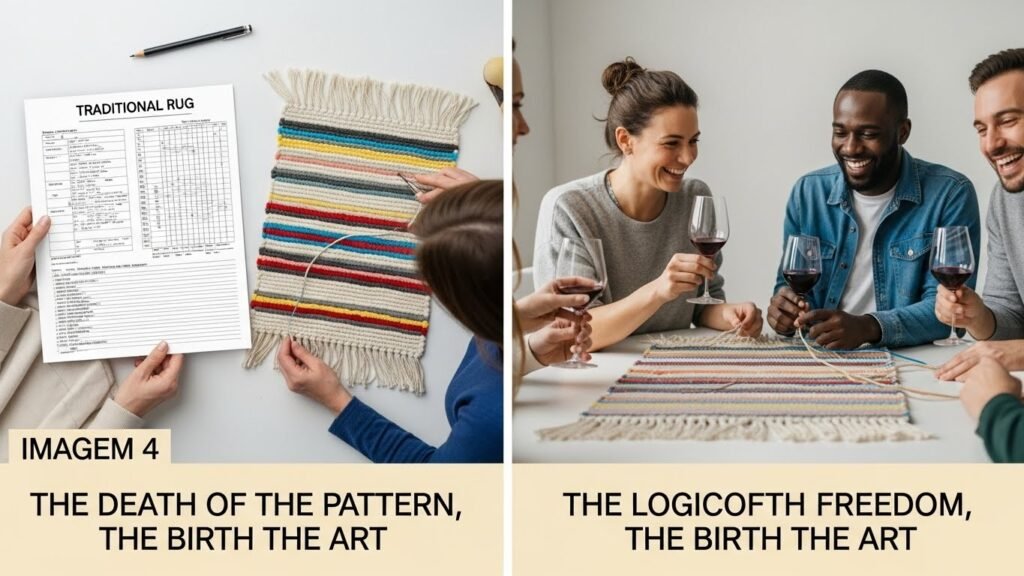
When you finish this rug, people will be baffled. They will look at the scale, the perfect circles, and the “heavy” luxury of the fabric, and they will ask to see the pattern. When you tell them there was no pattern, and that you made it while watching three seasons of a reality show, they won’t believe you.
This is the “Logic-Defying” part. You have broken the link between “Value” and “Difficulty.” You have proven that beauty can be a byproduct of rest. You have become a “Fiber Alchemist,” turning bulk yarn into household gold while your eyes were half-closed.
A Call to Action for the Overworked Creator
The world is loud enough. Your hobbies shouldn’t be another source of “to-do” lists and “must-follow” steps. The Logic-Defying Rug is an invitation to come home to your hands.
Go out and find the thickest, most luxurious jumbo yarn you can find. Get a hook that feels like a scepter. Sit in your favorite chair, close your eyes, and let the spiral begin. Don’t count. Don’t worry. Don’t look.
Just feel the rhythm. Let the yarn flow through your fingers like a slow, heavy river. Trust that your body knows what to do. Before you know it, the floor beneath you will be transformed into a plush, swirling masterpiece. And the best part? You won’t even remember making it. You’ll just wake up one morning and find that you’ve created something extraordinary.

My name is Sarah Clark, I’m 42 years old and I live in the United States. I created Nova Insightly out of my love for crochet and handmade creativity. Crochet has always been a calming and meaningful part of my life, and over the years it became something I wanted to share with others. Through this blog, I aim to help beginners and enthusiasts feel confident, inspired, and supported as they explore crochet at their own pace. For me, crochet is more than a craft — it’s a way to slow down, create with intention, and enjoy the beauty of handmade work.