
The Great Lace Deception
Have you ever stood in a museum, nose pressed against glass, staring at a piece of 17th-century Venetian lace and felt a mixture of awe and absolute terror? You look at those thousands of microscopic loops, likely made by someone losing their eyesight under candlelight with a needle as thin as a whisker, and you think: “I could never.”
We’ve been conditioned to believe that “lace” is synonymous with “pain.” We’ve been told that to achieve that level of intricate, high-end sophistication, we must surrender our sanity to the #000 steel hook—the kind that looks more like a surgical instrument than a craft tool. We associate the “Million-Stitch” look with cramped hands, neck strain, and a project that takes three years to grow ten inches.
But what if I told you that the most breathtaking lace appearing on the runways of 2026 isn’t made with tiny hooks at all? What if the “Million-Stitch” effect is actually a massive architectural illusion?
Are you ready to stop squinting at invisible stitches and start using “Visual Physics” to create couture-level lace while using a hook you can actually hold without a cramp? Why are we still suffering for our art when we could be outsmarting it?
The Architecture of the Void
The fundamental mistake most makers make is thinking that lace is about the yarn. It isn’t. Lace is the art of the hole.
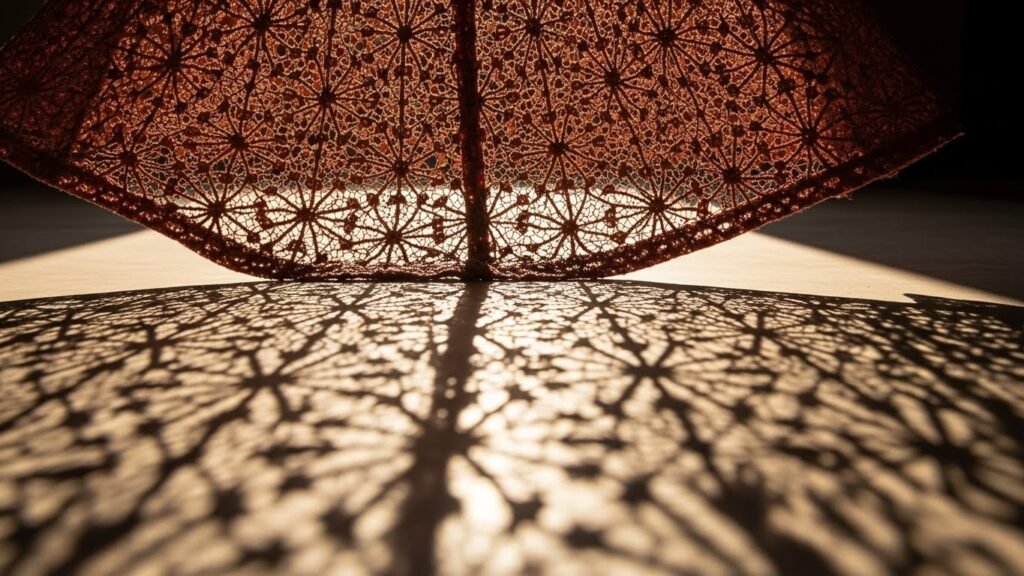
When you look at high-end lace, your eye isn’t actually counting the stitches. Your brain is processing the ratio of “solid” to “void.” The “Million-Stitch” illusion works by manipulating the negative space so effectively that the eye assumes a level of complexity that isn’t physically there.
By using larger hooks with specific fiber combinations, we can create “Expanded Geometry.” This is the secret hack that designers use to create massive, intricate capes and gowns in a fraction of the time. We aren’t making small stitches; we are making elegant ones.
The “Halo” Hack: Using Fiber to Fill the Gaps
The first step in creating the illusion of microscopic lace with a large hook is the “Fiber bloom.” If you use a smooth, mercerized cotton with a 5.0mm hook, you’ll just get a net that looks like something used to hold oranges at the grocery store. That is not lace; that is utility.
To achieve the “Million-Stitch” look, you must use a “Halo Fiber”—specifically, a high-ratio Mohair or Suri Alpaca blend held with a lace-weight silk.
When you work these fibers with a large hook, the physical stitch is large and easy to see. However, once the garment is finished and blocked, the “halo” (the tiny, fuzzy fibers) migrates into the negative space. It creates a “filigree” effect that blurs the edges of the stitches. The result? The viewer sees a solid, intricate web where the “holes” look like intentional, microscopic patterns rather than just big gaps.

Why Your Brain Craves the Blur
Why does the mohair “halo” trick the brain into thinking there are more stitches? It’s because the human eye struggles to find the “anchor point” of the loop. When the edges of a stitch are crisp, the brain can count them. When the edges are blurred by a halo, the brain stops counting and starts “feeling” the texture. It assumes that if it can’t see the individual loops, they must be too small to perceive.
Are you working harder to make small stitches, or are you letting the biology of the fiber do the heavy lifting for you?
The “Double-Lace” Weight Strategy
The second pillar of the illusion is the “Dual-Strand Tension” rule. In 2026, the most sophisticated lace projects aren’t using one thread; they are using two threads of vastly different weights worked as one.
Imagine holding a strand of sturdy, matte linen alongside a strand of gossamer-thin, shimmering metallic thread. When you work them together with a large, 4.5mm or 5.0mm hook, the linen provides the “bone structure,” while the metallic thread provides a “ghost stitch.”
The eye sees the shimmer of the thin thread and assumes it’s a separate, finer layer of lace. This creates a “3D Depth” that mimics the complexity of multi-layered Victorian garments. You are making one stitch, but the eye is seeing two distinct “levels” of reality.
The Illusion of “Density without Weight”
The beauty of this hack is that it produces a garment that looks heavy and ornate but feels like wearing a cloud. Have you ever worn a traditional cotton lace shawl? It’s heavy. It pulls at the neck. It feels like a burden.
By using the “Large Hook, Dual Strand” method, you create “Volumetric Lace.” It takes up space, it commands the room, but it doesn’t weigh you down. Why are we still knitting lead when we could be crocheting light?
The “Elongated Loop” and the Physics of Drape
Traditional lace is often quite “stiff” because the tiny stitches are packed tightly together. To get the “Million-Stitch” illusion, we must embrace the “Elongated Loop”—specifically the Solomon’s Knot (or Lover’s Knot) and the Extended Treble.
When worked with a large hook, these stitches create a “Diamond Lattice” that is incredibly reactive to movement. In 2026, fashion is about kineticism. We want clothes that move when we breathe.

The “Gravity” Block: The Secret Finishing Move
If you use a large hook for lace, the project will look like a “scrumpled mess” when it first comes off the hook. This is where most makers give up and go back to their tiny steel hooks. They don’t realize that the “Million-Stitch” look is created in the blocking stage, not the hooking stage.
You must “Wet-Block” with extreme tension. By stretching a large-hook project to its absolute limit, you thin out the yarn and “lock” the stitches into an open, crystalline structure. The yarn becomes “structural,” and the large loops turn into elegant, sharp-edged polygons.
Do you have the patience to wait for the block? Or are you so addicted to the “instant gratification” of small stitches that you’re missing the architectural beauty of the stretch?
The “Macro-Lace” Aesthetic: A New Designer Language
In the high-end boutiques of 2026, “Micro-Lace” is being replaced by “Macro-Lace.” There is something incredibly modern and “punk-rock” about a lace pattern that is clearly made with large loops but maintains the elegance of a classic doily.
By scaling up the pattern, you make the design the star, not the effort. When you use a tiny hook, you are showing off your labor. When you use a large hook to create a “Million-Stitch” illusion, you are showing off your taste.
Is Your Craft a “Job” or a “Design”?
We have a martyr complex in the fiber arts. We think that if it didn’t hurt our eyes and take six months, it isn’t “real” lace. But luxury isn’t defined by how much the maker suffered. Luxury is defined by the visual impact of the result.
A large-hook lace shawl, worked in a silk-mohair blend and blocked to the size of a twin bed, has more “Visual Gravity” than a tiny cotton handkerchief that took the same amount of time. Which one are you going to reach for when you want to feel like a queen?
The “Negative Space” Masterclass: Why Patterns Fail You
Most patterns for lace are written for specific, tiny gauges. If you want to use the “Large Hook Hack,” you have to stop following patterns and start following shapes.
The “Million-Stitch” illusion works best with “Repetitive Geometry.” Instead of complex flower motifs that get lost in a large hook, use “V-stitches,” “Shells,” and “Chain-Loops.” By repeating a simple geometric unit a thousand times with a large hook, you create a “Fractal” effect.
The eye sees the repetition and assumes complexity. It’s the same way a forest looks complex from a distance, even though it’s just the same tree repeated over and over. Are you over-complicating your patterns when you should be simplifying your shapes?
The “Stitch-to-Air” Ratio
The golden rule for the 2026 Large-Hook Lace is a 1:4 ratio. For every one part of yarn, you should have four parts of air. This is almost impossible to achieve with a tiny hook without the fabric feeling like a net. But with a 5.5mm hook and a lace-weight yarn, that 1:4 ratio creates a fabric that is essentially “captured wind.”
The Economic Rebellion: Luxury for the Rest of Us
Let’s talk about the “Million-Stitch” illusion as an act of economic defiance. High-end lace is prohibitively expensive because of the labor hours involved. By mastering the large-hook illusion, you are producing a $2,000 aesthetic for the cost of two skeins of mohair and a weekend of your time.
This isn’t “cheating.” This is “Efficiency Engineering.” In 2026, the most valuable thing we own is our time. If you can create a masterpiece in 20 hours that looks like it took 200, you have just “hacked” the luxury market.
Why the “Tiny Hook” is a Fossil of the Past
Tiny hooks were necessary when yarn was inconsistent and industrial machines couldn’t produce the “Halo” fibers we have today. We are no longer limited by the materials of the 1800s. We have yarns that can “stretch” across a void and look beautiful. Why are we still using tools designed for a world before mohair-silk blends existed?
A Rhetorical Challenge to the “Purists”
To the makers who say, “That isn’t real lace”:
If a woman walks into a room and the light catches the shimmer of her shawl, and the fabric moves like liquid, and the pattern looks like the frost on a windowpane… does it matter if the hook was 1mm or 6mm?
If the result is beauty, and the process was a joy rather than a chore, hasn’t the “Large Hook” won the argument?
The “Million-Stitch” illusion is an invitation. It’s an invitation to take up space. It’s an invitation to work big, to dream in “voids,” and to stop squinting at the world. Your hook is a wand, not a needle. It’s time to start acting like it.
Your First “Illusion” Project: The 3-Step Start
If you’re ready to abandon the tiny hooks, start here:
-
The Yarn: Buy the most expensive, fluffiest Lace-Weight Mohair/Silk blend you can find. (You only need 400 meters).
-
The Tool: Grab a 5.5mm or 6.0mm hook. Yes, really.
-
The Pattern: Crochet a simple “V-stitch” mesh. Just V-stitches for 60 inches.
When you’re done, it will look like a mess. Then, wash it. Pin it out until it’s double its size. Let it dry.
When you unpin it, you won’t see a “V-stitch mesh.” You will see a “Million-Stitch” masterpiece that looks like it was woven by a faerie queen. And when people ask how you had the patience to make all those tiny loops, you can just smile.
The illusion is yours to keep. The pain is someone else’s problem.
Are you ready to stop being a “Stitcher” and start being an “Illusionist”? The “Million-Stitch” world is waiting, and it’s much larger than you ever imagined.

My name is Sarah Clark, I’m 42 years old and I live in the United States. I created Nova Insightly out of my love for crochet and handmade creativity. Crochet has always been a calming and meaningful part of my life, and over the years it became something I wanted to share with others. Through this blog, I aim to help beginners and enthusiasts feel confident, inspired, and supported as they explore crochet at their own pace. For me, crochet is more than a craft — it’s a way to slow down, create with intention, and enjoy the beauty of handmade work.