
How many miles of “lost potential” are currently sitting in your trash can? Every time you finish a row, snip a tail, or prune a stray fringe, you are making a choice. Most of us have been conditioned by a consumerist culture to view these tiny fragments—the “scraps,” the “tails,” the “barf”—as mere waste. We sweep them off our laps and into the bin without a second thought. But what if I told you that you are literally throwing away money? What if those six-inch strands of silk, wool, and acrylic are not garbage, but the secret ingredients to a high-end, textured alchemy that most crafters are too blind to see?
We are living in an era of “fiber guilt.” We worry about the sustainability of our hobby, the ethics of our wool, and the rising cost of luxury skeins. Yet, we ignore the goldmine sitting in our scrap baskets. The “Scrap-to-Gold” method isn’t just a clever way to tidy up your studio; it is a fundamental shift in the psychology of making. It is an act of rebellion against the idea that “new” is better than “reclaimed.” Are you ready to stop being a consumer of skeins and start being a curator of fibers? Or will you continue to pay a premium for the privilege of creating more landfill?
The Hidden Economy of the Scrap Basket
Let’s talk about the math that the big yarn companies don’t want you to do. On average, 5% to 8% of every skein ends up as waste during the “weaving in ends” process or due to small mistakes. If you spend $1,000 a year on yarn, you are effectively tossing $80 directly into the trash. Over a decade, that’s nearly a thousand dollars of premium fiber discarded because you didn’t have a plan for it.
But the value of a scrap isn’t just in its cost; it’s in its rarity. A scrap is a memory. It’s the leftover bit of the sweater you made for your daughter, the fringe from the scarf you gave your best friend, and the variegated wool from that one-of-a-kind local dyer. When you throw those away, you aren’t just losing yarn; you are losing the DNA of your creative history. Why would you throw away the building blocks of a masterpiece?
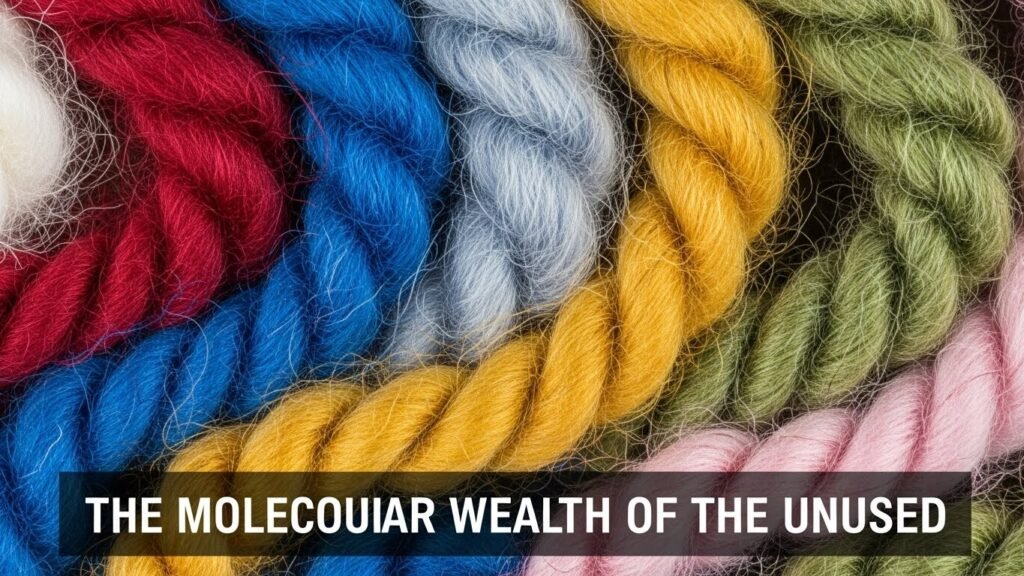
The “Franken-Yarn” Revolution: Creating Your Own Luxury Blends
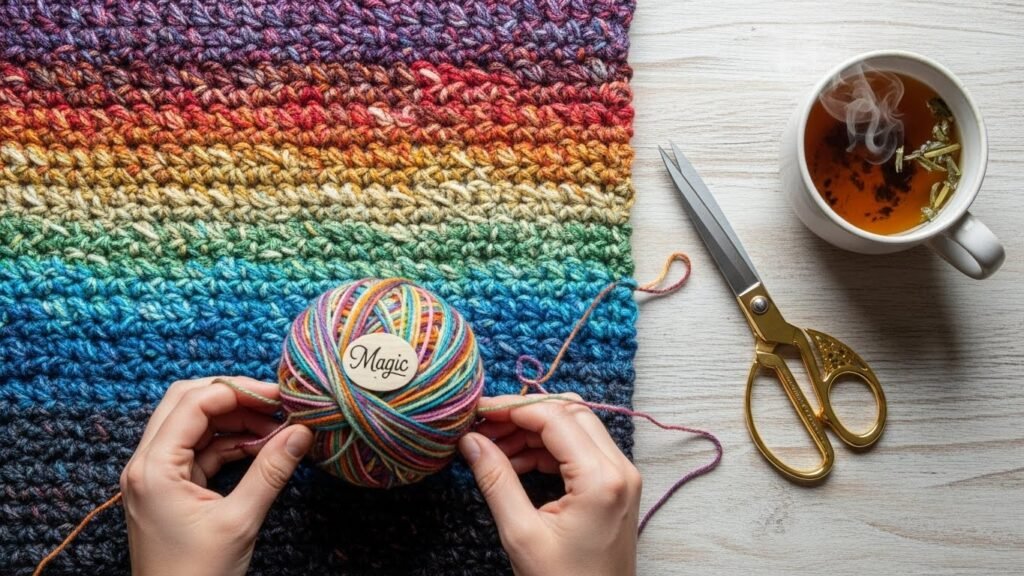
The most sophisticated way to turn scrap into gold is through the creation of “Franken-Yarn” or “Magic Balls.” This is not about tied-together knots that look like a mess. This is about structural engineering. By using techniques like the Russian Join or the Spit Splicing method (for animal fibers), you can create a continuous, knot-less strand that features unpredictable color shifts and texture changes.
Imagine a yarn that transitions from a sleek silk to a fuzzy mohair, then into a sturdy tweed, all within one foot of length. This is something you cannot buy in a store. High-end designers pay thousands of dollars for “art yarns” that attempt to mimic this exact level of complexity. You have the power to create it for free. Have you ever wondered why your projects look a bit “flat” compared to runway pieces? It’s because commercial yarn is designed for uniformity. Beauty, real beauty, lives in the chaos of the scrap.
The Science of Stuffing: Why Poly-Fill is a Lie
If you are a fan of amigurumi or home decor, you probably spend a fortune on bags of polyester stuffing. Stop. Polyester stuffing is a petroleum product—it’s plastic, it’s flat, and it’s environmentally disastrous.
The “Scrap-to-Gold” method utilizes your smallest “orts” (the tiny, dust-like snips of yarn) as the ultimate premium stuffing. Unlike poly-fill, which compresses over time and loses its shape, yarn scraps create a dense, weighted, and high-quality feel to your plushies. It makes them feel substantial, like a luxury heirloom rather than a cheap carnival prize. Are you really going to keep buying plastic fluff when you have a biodegradable, high-density alternative currently clogging your vacuum cleaner?
The Weighted Blanket Secret
If you save enough scraps, you can create something truly magnificent: a weighted therapy item. By filling a quilted inner lining with cleaned, chopped yarn scraps, you create a weight that is distributed perfectly and provides a sensory “grounding” experience. In the medical market, these items cost hundreds of dollars. In your studio, they cost nothing but time. Is your waste bin really worth more than your mental health?
Textured Alchemy: The “Free-Form” Aesthetic
The modern “Scrap-to-Gold” method has found its home in the world of Free-Form Crochet and Knitting. This is a style where there are no patterns, no rules, and no boundaries. It is the jazz of the fiber world. Scraps are the primary currency here.
Because you aren’t worried about “running out” of a specific dye lot, you are free to experiment with radical texture changes. You can use a three-inch scrap of neon orange to highlight a stitch in a sea of navy blue. This “intentional imperfection” is the hallmark of luxury. Think about brands like Missoni—their entire empire is built on the interplay of disparate colors and textures. Why are you waiting for a pattern to tell you what to do when your scrap basket is already whispering the answers?
The “Orphan” Project: A Lesson in Bravery
Many crafters have “orphaned” skeins—that one ball of expensive yarn that isn’t enough for a sweater but too much for a hat. This is the king of scraps. The Scrap-to-Gold method teaches us to use these orphans as “bridging fibers.” By mixing them with smaller scraps, you create a cohesive color story. It forces you to be brave. It forces you to learn about color theory in a hands-on, high-stakes way. Are you a “recipe follower,” or are you ready to become a “chef” of the fiber world?
Environmental Confessions: The Ethics of the Bin
We need to have a serious conversation about the impact of the textile industry. We know that the production of yarn is resource-heavy. Whether it’s the water used for cotton or the carbon footprint of shipping wool across the globe, every inch of yarn has an environmental cost.
When you throw away your scraps, you are increasing the “footprint per project.” By salvaging every inch, you are practicing a form of radical conservation. In the professional textile world, this is called “circularity.” In your home, it’s just good ethics. How can we call ourselves “lovers of nature” when we are so quick to discard the very materials nature provided? The bin is a graveyard of wasted resources. It’s time to start a resurrection.
The Organization of Gold: From Chaos to Curation
The reason most people throw away scraps isn’t because they don’t want them—it’s because they don’t know how to organize them. The Scrap-to-Gold method requires a system.
-
Sort by Weight: Keep your lace weights away from your chunkies.
-
Sort by Fiber: Don’t mix your “melty” acrylics with your “feltable” wools unless you want a disaster in the wash.
-
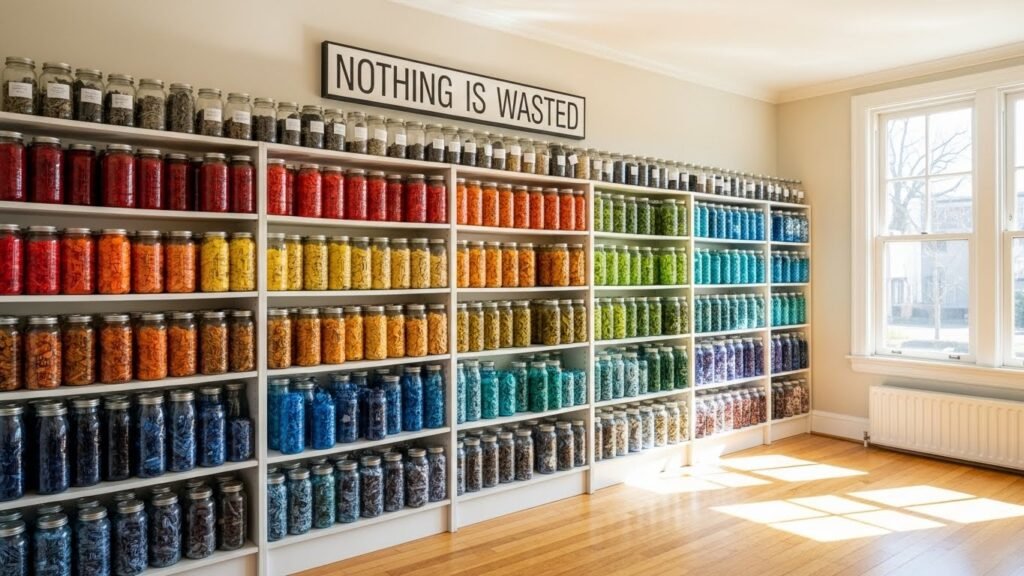
The Color Jar: Store your scraps in clear glass jars. This isn’t just for organization; it’s for inspiration. Seeing the colors interact in the jar will spark your next “Magic Ball” project.
Why do we hide our scraps in dark bags in the back of the closet? If they are gold, shouldn’t they be displayed as such?
The “Scrap-Along” Movement: Community Wealth
One of the most exciting aspects of the Scrap-to-Gold method is its social potential. Scrap swaps have become a burgeoning trend in the fiber community. What is “boring” to you—that leftover beige linen—might be exactly what someone else needs to finish a landscape-inspired tapestry.
By trading scraps, we create a community economy that doesn’t rely on the corporate yarn cycle. We are sharing our history, our materials, and our creativity. Why buy a new skein when you can trade your “trash” for someone else’s “treasure”? Is the future of yarn retail actually… us?
Advanced Techniques: Beyond the Stitch
If you really want to take the Scrap-to-Gold method to the professional level, you have to think outside the hook and needle.
1. Fiber Art Postcards and Paper-Making
Tiny yarn ends can be blended with recycled paper pulp to create incredible, textured stationery. The yarn provides structural strength and a “maker” aesthetic that is highly sought after in the boutique paper market.
2. The “Thrumming” Secret
If you live in a cold climate, your scraps are your best friends. “Thrumming” is the process of knitting unspun roving into mittens or socks to create a thick, fleecy lining. You can do this with yarn scraps too. By “stuffing” your stitches with leftover bits, you create a garment that is twice as warm and infinitely more interesting.
3. Surface Embellishment: The Painterly Approach
Think of your scraps as paint. You can use a needle and thread to “draw” with your yarn scraps on top of finished projects. This is called “Sashiko-style” embellishment or “Drunken Embroidery.” It covers holes, strengthens weak spots, and adds a layer of artisanal detail that says, “A human made this.”
The Psychological Reward of the Reclaimed
There is a specific kind of dopamine hit that comes from finishing a project made entirely of scraps. It feels like getting away with something. You’ve bypassed the economy, you’ve saved the planet, and you’ve created something beautiful out of “nothing.”
This is the true “Gold” in the Scrap-to-Gold method. It’s the feeling of total creative autonomy. When you aren’t beholden to the store, when you aren’t limited by your budget, you become a truly free artist. Can you imagine a world where your creativity is fueled by your own resourcefulness rather than your credit card?
The Challenge: The 30-Day Scrap Challenge
I want to challenge you. For the next 30 days, do not let a single inch of yarn touch the trash can. Not one. Keep a small “treasure jar” on your crafting table. At the end of the month, empty that jar and look at what you’ve saved.
You will see a palette of colors you didn’t know you had. You will see textures that spark new ideas. You will see the “Gold” that has been hiding in plain sight.
Will you go back to the mindless “snip and flip” into the bin? Or will you join the ranks of the fiber alchemists who know that the only difference between waste and wealth is perspective? The choice is in your hands, and those hands are currently holding the potential for a masterpiece.
Final Thoughts: The Legacy of the Leftover
In the end, our projects are more than just clothes or blankets; they are the artifacts of our lives. By incorporating our scraps, we are weaving a tapestry of our own journey. We are saying that every part of the process—even the small, seemingly insignificant ends—matters.
The Scrap-to-Gold method is a philosophy of abundance. It teaches us that we already have everything we need to be brilliant. It’s time to stop looking at the store and start looking at the floor. Your next golden project is right there, waiting to be picked up.
Are you ready to stop throwing away your creative future? The bin is empty, the jar is waiting, and the gold is yours for the taking.

My name is Sarah Clark, I’m 42 years old and I live in the United States. I created Nova Insightly out of my love for crochet and handmade creativity. Crochet has always been a calming and meaningful part of my life, and over the years it became something I wanted to share with others. Through this blog, I aim to help beginners and enthusiasts feel confident, inspired, and supported as they explore crochet at their own pace. For me, crochet is more than a craft — it’s a way to slow down, create with intention, and enjoy the beauty of handmade work.