
The yarn aisle of your local craft store is a masterpiece of psychological warfare. You walk in, surrounded by soft pastels, squishy textures, and the promise of a peaceful afternoon spent knitting by the window. You pick up a skein, glance at the label, check the yardage, and assume you know what you’re buying. But have you ever felt that nagging suspicion that the numbers don’t quite add up? Why does a “Size 4” worsted weight from one brand feel like a shoelace, while another brand’s “Size 4” feels like a bulky rope? Is it possible that the industry standards we rely on are less like “laws” and more like “gentle suggestions” designed to keep you buying more than you actually need?
The truth is, yarn labels are written in a dialect of half-truths and industry shortcuts. Manufacturers have mastered the art of telling you exactly what you want to hear while burying the technical reality in fine print and ambiguous symbols. We are told that knitting is an act of rebellion against fast fashion, but are we just fueling a different kind of corporate machine—one that thrives on your confusion and “stash-building” addiction?
The Great Gauge Illusion: Why Your Swatch is Lying to You
We have all been there. You spend forty minutes meticulously knitting a 4×4 inch gauge swatch, only to wash your finished sweater and watch it grow three sizes or shrink into a doll’s garment. Was it your tension? Was it the needles? Or was it the fact that the gauge suggested on the yarn label was calculated under laboratory conditions that no human being could ever replicate?
Manufacturers often calculate gauge using high-speed industrial knitting machines that apply perfectly consistent tension—tension that a human hand, influenced by coffee, stress, or the rhythm of a Netflix show, cannot mimic. When the label says “18 stitches = 4 inches,” they aren’t telling you that this was achieved on a static frame in a humidity-controlled room. They are giving you a mathematical ideal, not a domestic reality.
Why don’t they provide a range of gauges? Because a range implies uncertainty, and uncertainty kills sales. They want you to believe that their product is a precision instrument. Have you ever wondered why some labels omit the “after washing” gauge entirely? It’s because the chemical finishes applied to the yarn—the “sizing” that makes it look shiny on the shelf—are designed to vanish the moment they hit water, fundamentally changing the structure of the fiber. You aren’t buying the yarn you see; you’re buying a temporary version of it that is destined to transform the moment it leaves your needles.
The Mystery of the “Dye Lot” Ghost
We are taught to fear the different dye lot. We hunt through the bins, tossing skeins aside to find matching numbers. But here is the secret the big mills don’t want you to realize: the “dye lot” is often a convenient scapegoat for poor quality control. In modern industrial dyeing, computer-controlled vats ensure that chemical ratios are nearly identical.
So why do the colors still vary? It’s rarely the dye; it’s the “uptake.” Fiber is a biological material. One batch of wool from a sheep in New Zealand will absorb pigment differently than a batch from a sheep in Uruguay, even if they are processed in the same factory. By labeling them as “Dye Lots,” the manufacturer shifts the responsibility of color matching onto you, the consumer. If your sweater has a visible line where you changed balls, they can simply say, “Well, you should have checked the lot numbers,” effectively masking the fact that their raw material sourcing is inconsistent.

The Weight Class Conspiracy: The “Worsted” Lie
If you ask ten different knitters to define “Worsted weight,” you will get ten different answers, and the manufacturers are perfectly happy with that. The Craft Yarn Council (CYC) attempted to standardize yarn weights with those little numbered icons we see on every label, but these categories are so broad they are practically useless.
A “Category 4” (Medium) yarn can technically span anywhere from 16 to 20 stitches per 4 inches. That is a massive margin of error! Imagine if shoes were sold in “Category Medium” instead of specific sizes. You might end up with a size 7 or a size 10, but hey, they’re both “medium,” right? This ambiguity serves the manufacturer’s bottom line. It allows them to market a thinner yarn as a “worsted” to save on raw material costs, knowing that the average crafter will just “adjust their tension” to make it work.
Are we being gaslit by our own supplies? When you have to go up two needle sizes to meet a pattern’s gauge, you aren’t “knitting loosely”—you are compensating for a manufacturer that skimped on the ply. This creates a ripple effect: thinner yarn means you need more yardage to finish a project, which means you’re back at the store buying that extra “security skein” that you probably won’t use, but were too afraid not to buy.
Yardage vs. Weight: The Gravity Trap
Have you ever noticed that yarn is often sold by weight (e.g., 100 grams) rather than length? This is one of the most brilliant deceptions in the industry. Fiber is sold on the global commodity market by the ton. Therefore, it’s easier for a factory to bag yarn by weight.
However, weight is a variable influenced by moisture. Wool is hygroscopic; it can hold up to 30% of its weight in water without feeling wet. Yarn stored in a humid warehouse in a coastal city will weigh significantly more than the same yarn stored in a dry desert climate. When you buy a “100g skein,” you might be paying for 90g of wool and 10g of trapped humidity.
The real measurement that matters is yardage. If the manufacturer gives you a “weight estimate” but a “guaranteed yardage,” they are being honest. If they prioritize the weight on the front of the label, they are playing a game of gravitational hide-and-seek. Why do we accept “plus or minus 5%” as an acceptable margin for yardage? In a 400-yard skein, that’s a 20-yard discrepancy. In a sweater, that’s the difference between a finished sleeve and a frantic trip to the yarn shop to find a discontinued dye lot.
The Fiber Content Fairy Tale
“Luxury Blend” is a phrase that should immediately trigger your internal alarm bells. Have you ever seen a label that proudly proclaims “Cashmere Blend” in huge, elegant script, only to turn it over and find that it contains 5% cashmere and 95% acrylic? This is a marketing tactic known as “angel dusting.”
Manufacturers add a microscopic amount of a high-end fiber just so they can put the name on the label and jack up the price. They know that the word “Cashmere” or “Silk” bypasses the logical part of your brain and goes straight to the “treat yourself” center. But 5% of a luxury fiber does absolutely nothing for the drape, warmth, or longevity of the garment. It is a ghost ingredient, there only to haunt your wallet.
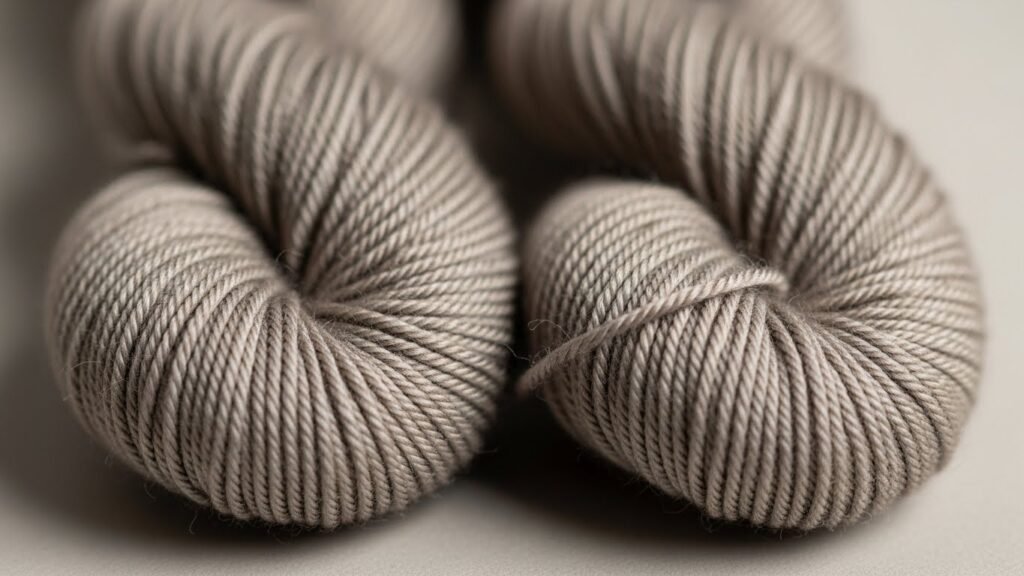
Furthermore, let’s talk about the “Superwash” deception. We love superwash wool because it doesn’t felt in the machine. But what is the label not telling you about the process? To make wool machine-washable, it is either doused in a chlorine bath to strip away the natural scales of the fiber or coated in a micro-plastic polymer (essentially a thin layer of plastic wrap for every strand).
Does the label mention that this process removes the natural breathability and “memory” of the wool? Does it tell you that your superwash socks will eventually stretch out and never return to their original shape? No, because “Plastic-Coated Chemically Stripped Wool” doesn’t sound quite as cozy as “Superwash Merino.” We are sacrificing the soul of the fiber for the convenience of the laundry room, and the manufacturers are laughing all the way to the bank while we wonder why our “wool” sweaters feel like polyester.
The “Made In” Myth: Chasing the Origin
Where was your yarn born? If a label says “Distributed by a company in England,” where do you think the wool came from? The global supply chain for yarn is as tangled as a drawer full of scrap ends. Wool can be grown in Australia, shipped to China for scouring, sent to Italy for spinning, dyed in Turkey, and packaged in the USA.
The label usually only lists the final point of significant transformation. This lack of transparency allows brands to hide unethical labor practices and devastating environmental footprints behind a “premium” European or American brand name. When you see “Hand-Dyed,” do you picture a small-batch artist in a sunlit studio? Sometimes that’s true. But often, “hand-dyed” is a term used by large companies to describe yarn that was dunked in a vat by a worker in a factory with minimal safety protections.
If the manufacturer isn’t telling you the specific farm or the specific mill, there is a reason. Are you comfortable with your “zen” hobby being built on a foundation of industrial secrecy? Why aren’t we demanding to know the name of the sheep, or at least the province where the water used for dyeing was filtered and returned to the earth?
The Secret Language of Symbols: Decoding the Icons
Those little laundry icons are not just instructions; they are legal disclaimers. When a manufacturer puts a “Do Not Iron” or “Dry Flat Only” symbol on a label, they are protecting themselves from liability. If you follow their instructions and the garment still ruins, you have a case. But the symbols are often chosen to be as conservative as possible to prevent returns.
Have you noticed the “S” and “Z” twist symbols appearing on more high-end labels? This is one of the few pieces of honest information being provided, yet most knitters ignore it. The direction of the yarn’s twist (S-twist or Z-twist) interacts with the way you wrap your yarn (Eastern vs. Western knitting). If you use a yarn with a twist that fights your knitting style, your yarn will constantly split or feel “wirey.”
Manufacturers know this, but they don’t explain it because they want you to think that when a yarn splits, it’s your lack of skill, not a fundamental mechanical mismatch between the tool and the technique. By keeping the consumer feeling slightly incompetent, the industry ensures we keep buying “better” (more expensive) needles and “easier” yarns to fix a problem they created in the factory.
The “Softness” Trap: The Conditioner Cover-up
Why does the yarn in the store feel so much softer than the yarn in your finished project? Because yarn manufacturers use “softening agents”—essentially heavy-duty fabric softeners—to coat the fibers before they are balled. This is the “new car smell” of the fiber world. It’s designed to trigger a tactile response that leads to an impulse buy.
The problem? These softeners are temporary. After the first wash, the coating disappears, revealing the true nature of the fiber. That “heavenly soft” acrylic might actually be scratchy and stiff. That “silky” bamboo might become limp and lifeless. You aren’t being sold a texture; you’re being sold a first impression. Why don’t they sell yarn in its “true” state? Because the truth doesn’t feel as good against your cheek in the aisle of a craft store.
Reclaiming the Craft: Beyond the Label
So, where does this leave us? Are we doomed to be puppets of the big-yarn conglomerates? Not necessarily. The “secret language” of yarn labels is only powerful if you don’t know how to translate it.
To truly master your craft, you must look past the glossy branding and the “luxury” buzzwords. You must become a fiber detective. Start by ignoring the weight category and looking at the “grist”—the relationship between weight and length (meters per 100g). This is the only number that cannot be faked. If two yarns are both “worsted,” but one has 200 meters per 100g and the other has 240, they are not the same yarn, no matter what the little icon says.
Burn tests, spit-felting, and true “wet blocking” of swatches are your weapons against industry deception. We must stop treating the label as a holy text and start treating it as a marketing brochure. When we demand transparency—when we ask about the sheep, the chemicals, and the “real” gauge—we shift the power back to the makers.
Is your hobby a way to escape the consumerist trap, or have you just moved into a fluffier corner of it? The next time you pick up a skein of yarn, look at the label and ask yourself: what is this not telling me? The answer is usually found in the stitches, the drape, and the way the garment ages over time. Don’t let the manufacturers tell your story. Knit it yourself, with your eyes wide open.

My name is Sarah Clark, I’m 42 years old and I live in the United States. I created Nova Insightly out of my love for crochet and handmade creativity. Crochet has always been a calming and meaningful part of my life, and over the years it became something I wanted to share with others. Through this blog, I aim to help beginners and enthusiasts feel confident, inspired, and supported as they explore crochet at their own pace. For me, crochet is more than a craft — it’s a way to slow down, create with intention, and enjoy the beauty of handmade work.