
You are halfway through the most beautiful project of your life. The yarn is a luxurious, hand-spun wool that cost more than your first car. But then, you reach the end of the skein. You stare at the tail of the old yarn and the beginning of the new one. What do you do? If you are like ninety percent of the crafting population, you do the unthinkable: you tie a knot.
Let’s be brutally honest—a knot in a crochet or knit project is a structural failure disguised as a solution. It is a hard, unsightly lump that will inevitably migrate to the front of your work. It is a “ticking time bomb” that can come undone in the wash, leaving your masterpiece to unravel into a pile of expensive trash. Why are you treating your high-end fiber like a shoelace? Are you a master of your craft, or are you just a person tying strings together in the dark? What if I told you that you could join those two yarns so perfectly that even a forensic textile expert couldn’t find the seam? Welcome to the “Spit-Splice”—the ancient, slightly “gross,” and utterly brilliant secret that the industry doesn’t want you to know.
The Molecular Alchemy of the Spit-Splice
To understand the magic of the spit-splice, we have to look at the biology of the sheep. Most natural fibers, particularly wool and alpaca, are covered in microscopic scales. Under a microscope, a strand of wool looks like a jagged mountain range or a piece of barbed wire. These scales are the key to everything.
When you perform a spit-splice, you are using three specific elements: moisture, heat, and friction. These are the exact ingredients required for “felting.” By overlapping the two ends of yarn, wetting them (yes, with saliva—more on that in a moment), and rubbing them vigorously between your palms, you are forcing those microscopic scales to open up and interlock. You aren’t “tying” the yarn; you are physically merging two separate entities into one continuous strand. Why are you still using nineteenth-century knots when you could be using the biological properties of the fiber itself? Are you ready to stop “fixing” yarn and start “fusing” it?
Why “Spit” Is the Secret Ingredient
Now, let’s address the elephant in the room. Why saliva? Why not just use a bowl of lukewarm water? While you can use water, saliva contains specific enzymes and proteins that act as a mild, natural adhesive and surfactant.
Saliva breaks down the surface tension of the fibers faster than plain water, allowing the moisture to penetrate the core of the yarn instantly. It’s a biological hack that has been used by weavers and shepherds for thousands of years. It’s primal, it’s effective, and it’s free. Do you value your “refined” sensibilities more than the structural integrity of your $200 sweater? Or are you brave enough to get a little “primordial” for the sake of perfection?
The “Feltability” Test: Is Your Yarn a Candidate?
Before you go licking your yarn, we need to talk about the “Superwash” betrayal. Not every yarn can be spit-spliced. If you try this with acrylic, cotton, or “Superwash” wool, you will fail.
Superwash wool has been chemically treated or coated in plastic to remove the scales so it won’t felt in the washing machine. Since the spit-splice is a localized felting process, it requires those scales to be present and active. To test your yarn, try to “felt” a small scrap between your fingers with a little water. If it remains two separate strings no matter how much you rub, it’s a “Non-Felter.” Are you choosing your yarn based on “easy care” labels, or are you choosing fibers that allow for the “God-Tier” joins of the ancients?
The “No-Go” Fibers: Acrylic and Plant Cellulose
Plant fibers like cotton, linen, and bamboo are essentially smooth tubes. They have no scales to grab onto. Acrylic is plastic; it doesn’t felt, it only melts.
If you are working with these fibers, you are stuck with the Russian Join or weaving in ends (another “Tail of Terror”). But for those who work with “living” fibers—unprocessed wool, mohair, alpaca—the spit-splice is the only join that truly respects the medium. Why would you spend your life working with “dead” plastic fibers when you could be working with a material that literally “heals” itself when you ask it to?
Step-by-Step: How to Perform the Perfect Fusion
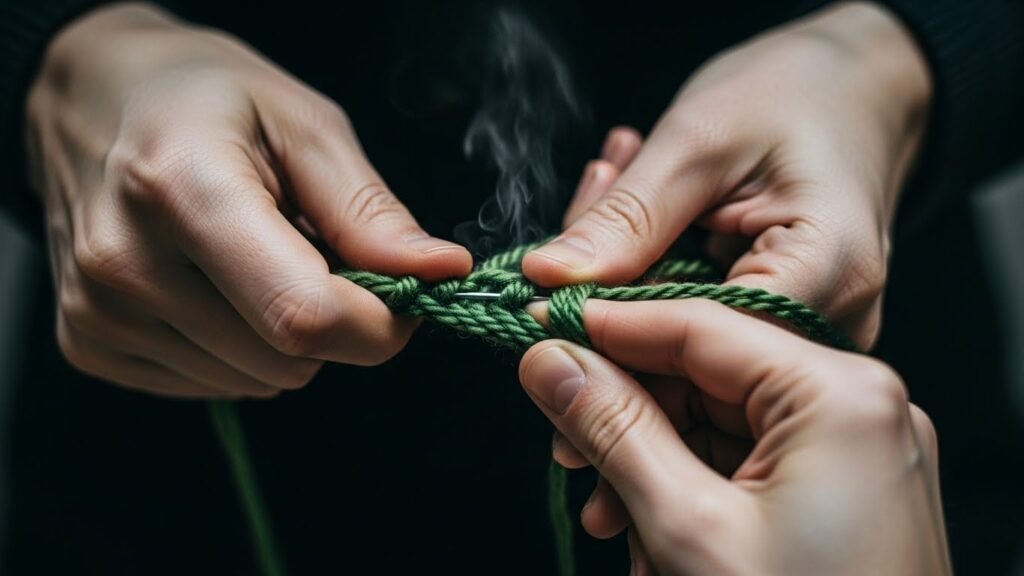
The process of the spit-splice is a dance of the hands. First, you must “feather” the ends. You don’t just lay two blunt ends together; that would create a thick, lumpy section. Instead, you untwist about two inches of each end and gently pull away about half of the fibers.
This is called “tapering.” By thinning the ends, when you lay them over each other, the combined thickness equals the thickness of the original yarn. It’s architectural genius. Why aren’t they teaching this in schools? Is a “blunt” join the reason your projects always have “thick spots”?
The “Hand-Drill” Motion
Once the ends are tapered and overlapped, you apply the moisture. Now comes the friction. You place the yarn in the palm of one hand and use the other palm to rub back and forth in a “hand-drill” motion—the same motion you would use to start a fire with a stick.
The heat from the friction and the moisture from the saliva cause the fibers to expand and lock. You keep rubbing until the yarn feels dry and the two strands have become one. You pull on it. It doesn’t budge. It’s a miracle. You’ve just created a “No-Knot” reality. Have you ever felt the sheer power of creating a continuous line out of a broken one?

The Invisible Seam: Why Designers Demand It
In professional garment design, especially for high-end lace or “cobweb” knits, a knot is a death sentence. It changes the “drape” of the fabric. It creates a point of tension that can distort the surrounding stitches.
The spit-splice, however, is invisible. It has the same flexibility, the same weight, and the same color as the rest of the yarn. It is a “Ghost Join.” When you wear a garment joined with spit-splices, you aren’t wearing a series of tied strings; you are wearing a single, unified piece of fabric. Why settle for a “functional” garment when you can have a “seamless” one? Are you okay with your “homemade” look, or are you ready for the “hand-crafted” look?
The “Wash-and-Wear” Integrity
Knots are notorious for coming undone during the agitation of a washing machine. The spit-splice, however, gets stronger in the wash. Because it is a felted join, the heat and soap of the laundry process only serve to lock the fibers tighter.
You can toss a spit-spliced sweater into the machine (if it’s made of feltable wool) and never worry about a hole appearing at the join. It is the most durable join in the textile world. Why would you trust a “double-knot” that is destined to fail when you can trust a “molecular bond” that is destined to last forever?
The “Eew” Factor: Overcoming Your Modern Germaphobia
We live in a sterilized world. We use hand sanitizer every five minutes and fear the “dirty” nature of our own bodies. But for the fiber artist, saliva is a tool, not a biohazard.
If you are truly squeamish, you can use a small spray bottle of water, but you will find it takes twice as long and the join isn’t quite as “sticky.” There is a deep, psychological connection that happens when you use your own body to finish your work. You are literally putting yourself into the stitches. Is your “cleanliness” worth the loss of this ancient, intimate connection to your art?
The “Public Crochet” Dilemma
“I can’t just lick my yarn in the middle of a coffee shop!” some might say. Why not? It’s your yarn. It’s your mouth. And most people won’t even notice what you’re doing—they’ll just see you rubbing your hands together like you’re plotting a brilliant scheme (which you are).
Embrace the eccentricity. Being a “Yarn Alchemist” means doing things that look strange to the “Muggles” who buy their clothes at the mall. Are you a follower of social norms, or a leader of the “Fiber Revolution”?

The “No-Tail” Freedom: Saving Your Sanity
The greatest gift of the spit-splice isn’t just the lack of knots—it’s the lack of ends to weave in. When you spit-splice, there are no tails. The join happens during the process.
Imagine finishing a ten-color striped blanket and having zero ends to weave in at the finish line. No “Tails of Terror” popping out later. No “weaving in” sessions that take three days. You finish the last stitch, and you are done. How much of your life have you wasted with a tapestry needle, trying to hide the evidence of your knots? Isn’t your time worth more than that?
The “Infinite Skein” Philosophy
The spit-splice allows you to treat your entire stash as one “Infinite Skein.” You can join scrap yarns together, change colors mid-row without a break, and create “scrappy” masterpieces that look like they were dyed that way.
It opens up a level of creative freedom that knots simply cannot provide. You stop being limited by the length of a ball of yarn. You are no longer a “consumer of skeins”; you are a “weaver of continuous lines.” Why are you letting the manufacturer decide where your yarn ends?
A Final Call to the “Palms”
The next time you reach the end of a skein of wool, I want you to stop. Don’t reach for the scissors. Don’t start tying that clumsy knot.
Look at your hands. Look at the “Living Fiber” in your lap.
Untwist the ends. Feather them out. Apply a little bit of your own biological magic. And rub. Rub until you feel the heat. Rub until you feel the “click” of the scales interlocking. Pull on the join. Experience the shock of a bond that is stronger than the yarn itself.
You are a creator. You are an alchemist. You are the master of the “Spit-Splice Secret.” The days of the “Lumpy Knot” are over. The era of the “Seamless Masterpiece” has begun. Are you ready to spit on your problems and turn them into your greatest strength? The yarn is waiting. Your palms are ready. Make the connection.

My name is Sarah Clark, I’m 42 years old and I live in the United States. I created Nova Insightly out of my love for crochet and handmade creativity. Crochet has always been a calming and meaningful part of my life, and over the years it became something I wanted to share with others. Through this blog, I aim to help beginners and enthusiasts feel confident, inspired, and supported as they explore crochet at their own pace. For me, crochet is more than a craft — it’s a way to slow down, create with intention, and enjoy the beauty of handmade work.