
You have just spent eighty hours—two full work weeks of your life—hunched over a hook, meticulously crafting a lace shawl that looks like a spiderweb woven by an angel. It is beautiful, but it’s a bit “scrunchy.” The edges are curling, and the stitches look tight. You’ve seen the tutorials. You’ve heard the “experts” in the Facebook groups shouting from the digital rooftops: “Just steam it! Steam fixes everything!” So, you grab your iron, press the burst button, and blast your masterpiece with a cloud of 212°F vapor.
In that single, satisfying hiss of steam, you have just committed “fiber homicide.” While you think you are “relaxing” the stitches, you are actually performing a high-heat chemical and structural alteration that your yarn never asked for. You are witnessing the “Steam-and-Scream” phenomenon—where the fiber screams in structural agony before collapsing into a lifeless, shiny, and permanently deformed ghost of its former self. Why are we so obsessed with the “instant gratification” of steam that we are willing to gamble the molecular integrity of our work? Are you a creator of art, or are you just a person with an iron and a death wish for your yarn?
The Molecular Meltdown: What Steam Actually Does
To understand why steam is a “sledgehammer” rather than a “scalpel,” we have to look at the biology and chemistry of the fiber. Whether you are working with natural animal proteins like wool and alpaca, or synthetic polymers like acrylic, steam is a radical environmental stressor.
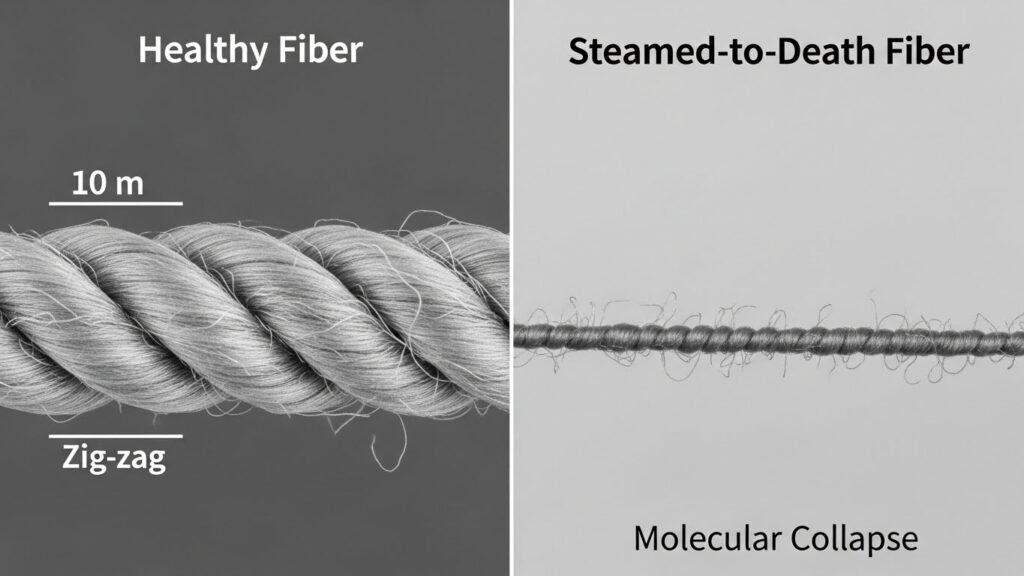
When you “steam block,” you are using heat and moisture to force the fiber to change shape. In natural fibers, the heat breaks the hydrogen bonds that hold the “crimp” (the natural springiness) of the wool. Once those bonds are broken and the yarn is stretched, they reset in a flat, dead position. You aren’t “opening the lace”; you are “killing the bounce.” In synthetics like acrylic, the situation is even more dire. Acrylic is essentially a form of plastic. When you apply high-heat steam, you are “plasticizing” the yarn—melting the microscopic outer layers just enough that they fuse together. Have you ever noticed your acrylic projects becoming unnaturally shiny and limp after steaming? That’s not “drape,” that’s “structural liquefaction.” Why are you treating your handmade lace like a piece of industrial PVC piping?
The “Permanent Press” Trap
The most seductive part of steam blocking is the immediacy. The shawl goes from a crumpled mess to a flat, wide piece of fabric in seconds. But this is a “Permanent Press” trap. Once you have over-steamed a fiber, there is no going back. You cannot “un-steam” a shawl. You have fundamentally changed the “hand” of the fabric.
A beautiful crochet piece should have “memory.” It should feel like it has life and spring. Over-blocking with steam removes that memory. It makes the garment feel “thin” and “tired.” Have you ever touched a vintage crochet piece in a thrift store that felt like a damp rag even though it was dry? That is the legacy of the Steam-and-Scream myth. Are you making heirlooms that will stand the test of time, or are you making temporary decorations that will lose their soul after the first blast of heat?
The “Drape” Delusion: When Softness Is Actually Weakness
One of the biggest arguments in favor of heavy steaming is that it “improves the drape.” We all want that liquid-like flow in our cardigans and shawls. But there is a massive difference between “drape” and “structural failure.”
True drape comes from a combination of the right hook size and the natural weight of the fiber. When you use steam to achieve drape, you are essentially “breaking” the yarn’s ability to hold its own weight. This is why over-steamed sweaters eventually start to sag and grow longer every time you wear them. The steam has removed the “skeleton” of the stitch. You’ve traded the long-term shape of your garment for a few hours of artificial softness. Is the “look” of a single photo on Instagram worth the “life” of the garment? Why are we so afraid of a little texture that we’re willing to sacrifice the very bones of our work?
The “Shiny Acrylic” Scandal
If you work with acrylic—and let’s be honest, most of the world does—steam is your most dangerous tool. Because acrylic is a polymer, it has a “glass transition temperature.” Once you hit that temperature with your iron, the plastic relaxes permanently.
This is often called “killing” the acrylic. While some patterns actually call for this (usually for specific types of fringe or very limp shawls), most people do it by accident. Once acrylic is killed, it loses its “squish.” It becomes shiny, it loses its stitch definition, and it feels “greasy” to the touch. You have effectively turned a cozy yarn into a thin sheet of plastic. Have you ever wondered why your “budget” yarn looks even cheaper after you “finish” it? It’s because you’ve literally melted the high-end potential right out of it.
The Cold-Water Sanctuary: A Better Way
If steam is the “Steam-and-Scream” nightmare, then Wet Blocking is the quiet sanctuary. Wet blocking—submerging the item in cool water and a gentle wool wash, then pinning it out to dry—is the gold standard for a reason.
Wet blocking uses the natural properties of the fiber without the trauma of heat. Water allows the fibers to swell and the stitches to “migrate” into their natural, most comfortable positions. When the water evaporates, the fibers “reset” into that new, beautiful shape without losing their internal structure. It takes twenty-four hours instead of twenty seconds. But those twenty-four hours are the difference between a professional finish and a DIY disaster. Why are we in such a rush to finish the “last mile” of a project that took weeks to build? Are you a “Fast Fashion” maker, or are you a “Slow Craft” artisan?
The “Pin-and-Pray” vs. The “Pin-and-Precision”
Many people hate wet blocking because they think it’s “fussy.” They don’t want to deal with towels and mats and 400 rust-proof pins. But blocking is where the “magic” happens. It is the moment you transition from “crafting” to “tailoring.”
When you wet-block, you have total control. You can gently stretch the points of your lace, straighten your hemline, and ensure your sleeves are identical. Steam is chaotic; it’s hard to control exactly where the heat is going and how much the fiber is reacting. Wet blocking is architectural. It is a slow, methodical refinement. Why would you spend $100 on yarn but refuse to spend $20 on a set of proper blocking mats?

The “Scream” of the Color-Bleed
There is another hidden danger to the “Steam-and-Scream” myth: thermal color migration. Many modern hand-dyed yarns use “acid dyes” that are set with heat. However, a sudden, intense blast of steam can sometimes “re-set” or “un-set” the dye, especially in high-contrast projects (like a white shawl with red roses).
The steam creates a “moisture bridge” combined with high heat, allowing the dye to travel from one fiber to another in a split second. I have seen countless “Masterpieces” ruined in an instant because the red dye “screamed” its way across the white lace. Wet blocking in cool water with a “color catcher” sheet is the only way to safely finish a multi-colored project. Why are you playing “Russian Roulette” with your color palette? Do you really trust your iron more than the basic laws of fluid dynamics?
The “Hand” of the Maker
Specialists in the textile industry talk about the “hand” of a fabric—the way it feels when you run it through your fingers. A properly wet-blocked piece has a “hand” that feels rich, substantial, and expensive. An over-steamed piece has a “hand” that feels thin, papery, and artificial.
If you are making something to be worn against the skin, the “hand” is everything. The Steam-and-Scream myth robs the wearer of that luxury. It turns your labor of love into a piece of disposable “mall clothing.” Are you ready to admit that your iron is a weapon of mass destruction in the closet?
The “Mist-and-Walk-Away” Compromise
If you absolutely must use steam—perhaps you are in a time crunch for a gift or the yarn is particularly stubborn—there is a “Safe Zone,” but it requires discipline. You should never, ever let the iron touch the yarn. You should hover the iron at least three inches above the fabric.
But even better than an iron is the “Mist-and-Walk-Away” method. Pin your item out dry, then use a fine-mist spray bottle to dampen it. Let it air dry. This provides the “set” of wet blocking with a bit more speed and less mess. It’s the “Adult in the Room” version of blocking. Why use a “flamethrower” (steam iron) when a “gentle rain” (spray bottle) will do the job better?

The Psychological Need for the “Hiss”
Why is the “Steam-and-Scream” myth so pervasive? Because it’s satisfying. There is something psychologically rewarding about seeing a crumpled piece of work “obey” the steam. It feels like power. It feels like “finishing.”
But we have to ask ourselves: who are we finishing for? Are we finishing for the “instant click” of a photo, or are we finishing for the person who will wear this shawl ten years from now? Real craft requires the maturity to delay gratification. It requires the wisdom to know when to put the iron down and pick up the spray bottle. Are you a “power-tripping” crafter, or are you a “steward” of the fiber?
Final Thoughts: The Integrity of the End
The end of a project is just as important as the beginning. You wouldn’t use a rusty hook to start your shawl, so why would you use a “Fiber-Killing” iron to finish it?
The “Steam-and-Scream” myth is a relic of a time when we didn’t understand the long-term effects of heat on synthetic and treated fibers. Today, we know better. We know that “over-blocking” is a form of structural vandalism. We know that the “Scream” of the fiber is real, and it’s the sound of our hard work being erased.
Reclaim the “Slow Finish.” Invest in a good set of mats and a spray bottle. Give your yarn the respect of a “Cool-Water Sanctuary.” Let your stitches breathe, let them spring, and let them live. The next time you feel the urge to “blast” your work with steam, stop. Listen to the yarn. It doesn’t want to be melted; it wants to be shaped.
Your work is a testament to your patience and your skill. Don’t let a thirty-second “Steam-and-Scream” session be the thing that devalues eighty hours of your life. Be the artisan who knows the difference between “relaxing” a fiber and “destroying” it. Your shawls will be crisper, your sweaters will fit longer, and your “hand” will be legendary. Are you ready to put the iron back in the laundry room where it belongs?

My name is Sarah Clark, I’m 42 years old and I live in the United States. I created Nova Insightly out of my love for crochet and handmade creativity. Crochet has always been a calming and meaningful part of my life, and over the years it became something I wanted to share with others. Through this blog, I aim to help beginners and enthusiasts feel confident, inspired, and supported as they explore crochet at their own pace. For me, crochet is more than a craft — it’s a way to slow down, create with intention, and enjoy the beauty of handmade work.