
The Silent Erosion of the Maker’s Soul
Have you ever looked at your sprawling stash of luxury wool—the hand-dyed merinos, the $80 mohairs, the rare yak blends—and felt absolutely nothing but a hollow sense of dread? Have you sat in your “craft room,” surrounded by thousands of dollars of equipment and half-finished masterpieces, only to find that your hands won’t move?
This is the maker’s burnout. It is a specific, modern malady that hits hardest in 2026, an era where we are forced to perform our hobbies for an invisible audience. We don’t just knit; we “content-create.” We don’t just crochet; we “brand-build.” We have turned our sanctuary into a second job, and in the process, the spark has been smothered by the weight of expectation.
But what if I told you that the cure isn’t a month-long vacation or a $500 therapeutic retreat? What if the cure is a $2 ball of basic, unmercerized cotton twine from the hardware store? It sounds insulting, doesn’t it? After years of refining your taste, I’m telling you to go back to the mud. But there is a biological, neurological, and psychological reason why this $2 project is the only scientific way to reset your brain.
Are you ready to stop being an “artist” for five minutes so you can remember how to be a human being?
The Dopamine Trap: Why Luxury is Killing Your Joy
In the neurobiology of creativity, there is a concept known as “The Reward-to-Effort Ratio.” When you start a high-stakes project—say, a complex lace-weight sweater—your brain is gambling. It expects a massive hit of dopamine at the end. But because the project takes 200 hours, the brain gets tired of waiting. It begins to view the hobby as a “high-cost” activity.
When you add the “Content Pressure” of 2026, where you feel the need to document every row for social validation, the cortisol levels rise. You are no longer crafting; you are performing under duress.
The $2 project—the humble, 15-minute cotton dishcloth or the single-stitch coaster—acts as a “Dopamine Reset.” It provides an immediate “loop closure.” Your brain sees the start, the middle, and the end in a single sitting. It’s the neurological equivalent of drinking a glass of cold water after wandering in a desert of unfinished WIPs (Works in Progress).
The Sensory Grounding of the “Cheap” Fiber
Luxury fibers are designed to be soft, ethereal, and forgiving. But when you are in the depths of burnout, your nervous system is often overstimulated. You don’t need “ethereal.” You need “tactile reality.”
The $2 cotton twine is abrasive. It has a specific, grippy resistance. It makes a sound against the hook—a rhythmic, grounding “scritch-scratch.” This is a form of Sensory Integration Therapy. The friction of the fiber against your fingers forces your brain to leave the “cloud” of its anxieties and return to the physical tips of your fingers.
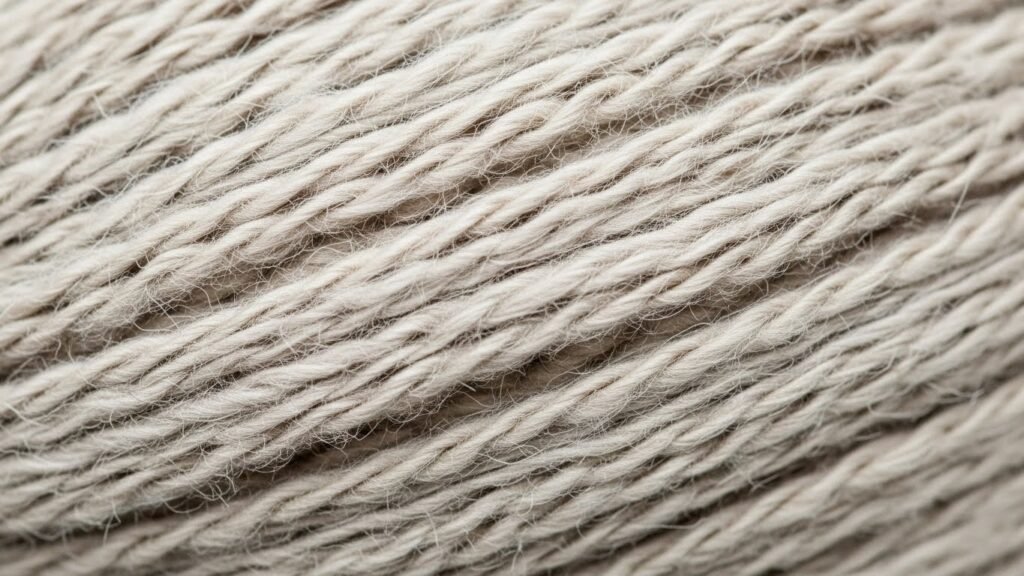
Can you feel the difference? Can you hear the sound of a fiber that doesn’t care about your aesthetic? The $2 project is the only place where you are allowed to be “ugly.” And in that ugliness, your nervous system finally finds a place to rest.
The Science of the “Low-Stakes” Environment
In 2026, we are obsessed with “Optimization.” We want the best yarn, the best hooks, the best patterns. But “The Best” is a high-pressure environment. If you mess up a $2 project, you’ve lost the price of a candy bar. If you mess up a $200 project, you’ve failed an investment.
Burnout thrives on the fear of failure. To cure it, you must enter a “Zero-Stakes Zone.” The $2 dishcloth is scientifically the perfect laboratory. You can try a stitch you’ve never done. You can make it lopsided. You can drop five stitches and keep going.
The “Default Mode Network” and the Crochet Hook
When we engage in repetitive, low-stakes movement—like the rhythmic motion of a basic double crochet—our brain enters what scientists call the “Default Mode Network” (DMN). This is the state where the brain is at rest but active, similar to daydreaming or light meditation.
High-stakes projects keep us in the “Task-Positive Network,” which is exhausting. By forcing yourself to do a $2 “boring” project, you are giving your DMN permission to take over. This is where creative breakthroughs actually happen. Have you ever noticed that your best ideas come in the shower? The $2 project is a “shower for your hands.”
The “Micro-Win” Strategy: Rebuilding the Identity
Burnout isn’t just being tired; it’s an identity crisis. You start to think, “I am no longer a maker. I am just a person with a pile of yarn.”
The $2 project rebuilds the “Maker Identity” through “Micro-Wins.” When you finish that tiny, $2 coaster, you are telling your subconscious: I can still finish things. I can still create utility from string. I am still a master of my tools.
Why do we scoff at the small things? We think that if it isn’t “grand,” it isn’t “art.” But a marathon runner doesn’t recover by running a slightly slower marathon; they recover by walking. The $2 project is your creative walk.
The “Aesthetic Fast”: Cleansing Your Creative Palate
In the world of professional tasting, experts use plain crackers to cleanse their palate between expensive wines. The $2 project is your creative palate cleanser.
We are overstimulated by “Beautiful Content.” Our eyes are exhausted by the saturated colors and the perfect lighting of the fiber community. By working with a neutral, raw, “boring” cotton, you are going on an “Aesthetic Fast.” You are stripping away the ego of the project.
Have you ever wondered why the most famous chefs go home and eat a simple bowl of rice? Because the soul cannot live on truffles alone. Your creativity cannot live on “Hand-Painted Silk” alone. It needs the “Rice” of the $2 project to remember what “Full” feels like.
The Paradox of Choice: Why “One Ball, One Hook” is Freedom
One of the leading causes of creative burnout is “Decision Fatigue.” You have 500 patterns in your Ravelry library. You have 200 skeins of yarn. The sheer number of permutations is paralyzing.
The $2 project eliminates choice. It is usually one ball of yarn. It is usually one basic hook. The pattern is often a simple geometric repeat.
By removing the “What,” the “How,” and the “Why,” you are left with only the “Do.” This “Simplified Action” is the bridge back to your passion. It’s not about the dishcloth; it’s about the fact that you stopped thinking and started moving. When was the last time you just moved without a plan?
The “Utility” Factor: Why It Must Be Useful
There is a specific satisfaction in making something that will be “destroyed” by use. A $2 dishcloth will be used to scrub pots. It will be stained by tomato sauce. It will eventually be thrown away.
This is incredibly liberating for a burnt-out mind. High-end garments are “Precious.” They must be protected. They must be washed by hand in unicorn tears.
The $2 project is “Sacrificial Art.” Making something intended for destruction removes the “Gilded Cage” of the masterpiece. It reminds you that the value is in the process, not the object. Do you have the courage to make something that is meant to be ruined?

Moving from “Performative” to “Private” Craft
The most insidious part of 2026 burnout is the “Invisible Audience.” Even when we are alone, we are thinking about how we will “share” our work.
The $2 project is “Private Craft.” No one posts a photo of a basic beige dishcloth and expects 10,000 likes. It is a secret between you and the hook. This privacy is the only place where true healing happens. It allows you to make mistakes without the shadow of judgment. It allows you to be “slow” without the pressure of a deadline.
Can you keep a secret from your followers? Can you make something just for your kitchen sink? If the answer is no, you are deeper in burnout than you realize. The $2 ball of yarn is your “NDA” with your own soul.
The Neurological “Reset” Timeline
How long does it take for the $2 cure to work? It’s not a one-and-done deal. It’s a “Dosage.”
-
The First 15 Minutes: Your brain will resist. It will tell you this is a waste of time. It will crave the “High” of the luxury project.
-
The First Hour: The DMN kicks in. Your heart rate slows. The “Scritch-scratch” of the cotton becomes a metronome.
-
The Third Project: You start to feel a flicker of curiosity. You wonder what would happen if you changed the stitch. This is the first sign that your burnout is breaking.
Why do we rush the healing? You didn’t get burnt out in a day; you won’t recover in an hour. But for $2, you can afford to take your time.
The $2 Project as a “Buffer” Against the World
In 2026, the world is loud. The news is constant. The demands on our attention are predatory. Our craft used to be our shield, but when we turned it into a “High-End” pursuit, we let the world inside the shield.
The $2 project is a “Low-Tech” sanctuary. It doesn’t require an app. It doesn’t require a battery. It doesn’t even require a lamp if you know the stitches well enough.
It is a “Luddite” rebellion. By choosing the cheapest, most basic material possible, you are saying “No” to the consumerist engine of the fiber industry. You are saying that your talent is not dependent on your bank account. You are saying that you are a maker even in the absence of luxury.
Rhetorical Check-In: What Are You Protecting?
Are you protecting your stash, or are you protecting your spirit?
We often treat our expensive yarn as the “Real” craft and the $2 projects as “Filler.” But in the economy of the soul, the filler is often the foundation. You cannot build a skyscraper on a foundation of silk ribbons; you need concrete and rebar. The $2 cotton twine is your creative rebar.
If you are currently staring at a wall of yarn and feeling like a failure, I want you to walk away from it. Go to the grocery store. Go to the hardware aisle. Buy the twine. Buy the cotton. Spend the $2.
The Return of the Spark
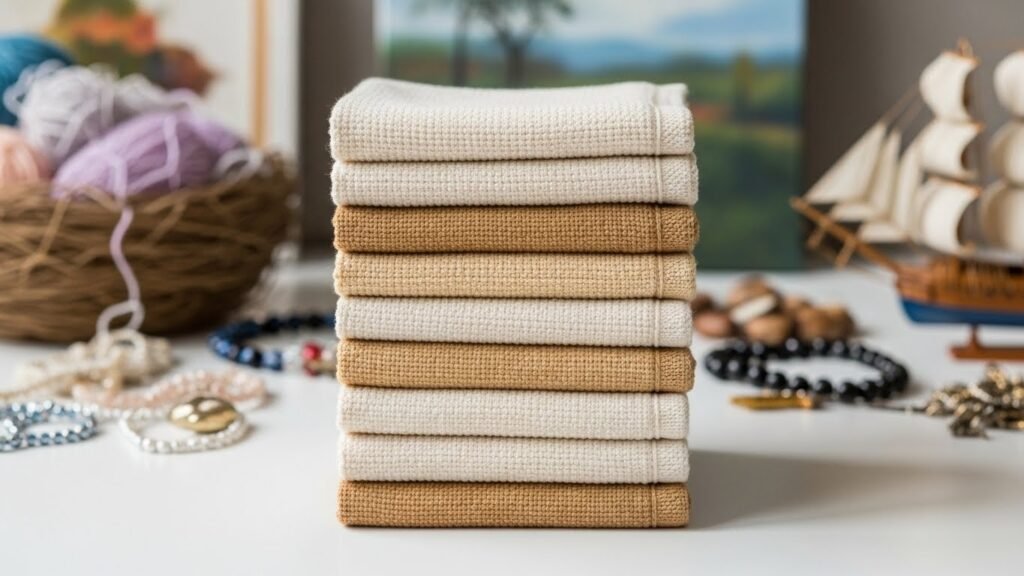
Something happens when you finish your fifth or sixth $2 project. You’ll be sitting there, folding a stack of clean, rugged dishcloths, and you’ll suddenly see it. You’ll look at that “Ugly” neon mohair or that “Intimidating” silk lace in your stash, and you won’t feel dread. You’ll feel a tiny, sharp spark of “What if?”
That “What if?” is the sound of your burnout ending. It’s the sound of your brain having enough “Dopamine Reserves” to take a risk again.
The $2 project didn’t “give” you back your creativity. It cleared away the debris of perfectionism so your creativity could find its way home.
Final Thoughts: The Luxury of Simplicity
We spend our lives chasing the “High-End.” We want the designer look, the luxury feel, the elite status. But the ultimate luxury in 2026 isn’t a $500 sweater. The ultimate luxury is a quiet mind.
The $2 project is the only scientific cure for your burnout because it is the only thing that asks nothing of you. It doesn’t ask you to be pretty. It doesn’t ask you to be fast. It doesn’t ask you to be “Designer.”
It just asks you to loop a string through a loop.
So, I dare you. Stop “Creating.” Stop “Designing.” Stop “Building a Brand.”
Go spend $2. Make something “Ugly.” Make something “Boring.” Make something “Uselessly Useful.”
The science is clear: your brain is waiting for the reset. Will you give it the $2 it needs to save your soul?

My name is Sarah Clark, I’m 42 years old and I live in the United States. I created Nova Insightly out of my love for crochet and handmade creativity. Crochet has always been a calming and meaningful part of my life, and over the years it became something I wanted to share with others. Through this blog, I aim to help beginners and enthusiasts feel confident, inspired, and supported as they explore crochet at their own pace. For me, crochet is more than a craft — it’s a way to slow down, create with intention, and enjoy the beauty of handmade work.