
You’ve spent hundreds, perhaps thousands, of dollars on your stash. You’ve curated a collection of hand-dyed merinos, rare alpaca blends, and shimmering silks that represent not just money, but years of creative potential. You tuck them away in beautiful baskets or organized bins, believing they are safe in the sanctuary of your craft room. But while you sleep, a silent, microscopic war is being waged. In the dark crevices of your shelves, a tiny predator is eyeing your investment, ready to turn your “someday” projects into a pile of expensive, frayed dust.
Why are we so relaxed about the biological security of our yarn? Why do we treat our fiber like inert objects when they are, in fact, organic banquets for the natural world? The shocking truth is that the “traditional” methods of protection—the lavender sachets, the cedar blocks, the “airtight” plastic bins—are often nothing more than security theater. If you want to truly save your yarn from the inevitable march of the clothes moth, you need to stop playing nice. You need to open your freezer. Are you ready to subject your most precious fibers to a sub-zero execution? Or are you willing to watch your legacy unravel from the inside out?
The Invisible Invader: Why Your Eyes Are Lying to You
The first mistake every crafter makes is assuming that if they don’t see moths flying around, their yarn is safe. This is a dangerous delusion. The adult clothes moth—the one you occasionally see fluttering near a lamp—doesn’t even have a mouth. It cannot eat your yarn. The real villain is the larva, a tiny, translucent caterpillar that can hide inside a skein for months, eating its way through the core of the fiber.
By the time you see a moth, the damage is already done. The eggs have been laid, the larvae have feasted, and the structural integrity of your yarn has been compromised. Have you ever pulled a strand of yarn only to have it snap effortlessly in your hand? That wasn’t a “weak spot” in the dye lot; that was a crime scene. Why are we waiting for a visual confirmation of a disaster that has already happened? Why are we not treating every new skein of yarn that enters our home as a potential Trojan Horse?
The Freezer Strategy: Biological Warfare in the Kitchen
This is where the radical shift happens. Freezing your yarn is not about storage; it is about absolute sterilization. When you bring new yarn into your house, you are bringing in a history you don’t know. It sat in a warehouse, it sat on a store shelf, it was touched by hands that might have touched infested wool. The “Freezer Hack” is the only way to ensure that any eggs or larvae hiding in the fibers are eliminated before they can spread to your entire collection.
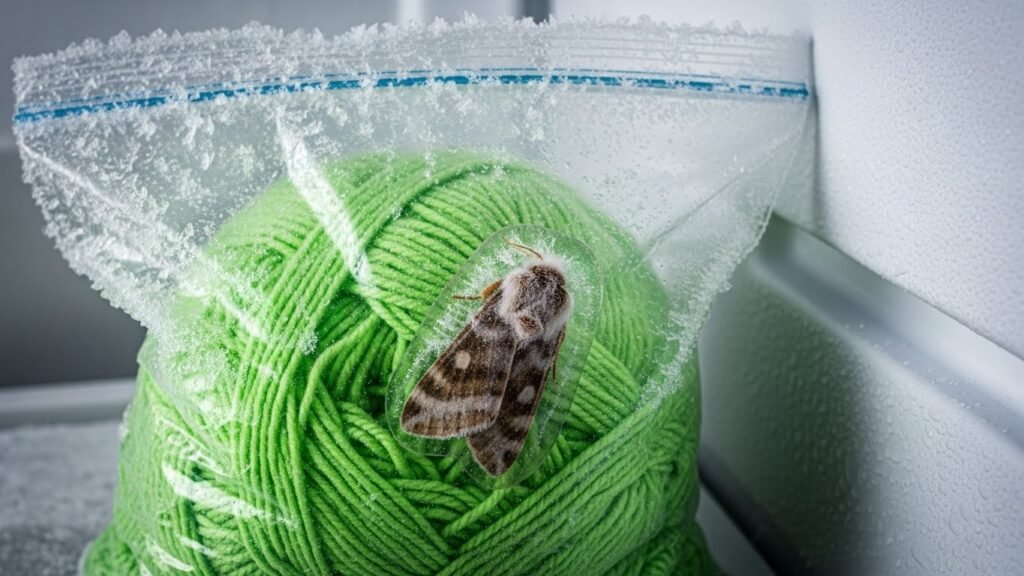
But this isn’t just a quick “toss it in for an hour” situation. This is biological warfare. To be effective, the freezer must be set to at least $0^\circ\text{F}$ ($-18^\circ\text{C}$). The yarn should be sealed in a heavy-duty plastic bag with as much air removed as possible to prevent condensation. The shock of the cold is what kills the living organisms, but the real secret lies in the cycle. To ensure total victory, many experts recommend the “Freeze-Thaw-Freeze” method: 48 hours in the freezer, 24 hours at room temperature (to encourage any remaining eggs to hatch), and another 48 hours in the sub-zero darkness. Is a little extra space between the frozen peas and the ice cream too much to ask for the survival of your $200 alpaca stash?
The “Airtight” Plastic Bin Trap
Many crafters believe that snapping a lid on a plastic bin is enough. “If I can’t see them, they can’t get in.” But this ignores the most terrifying part of the moth life cycle: the eggs are often already there. When you seal a skein of yarn into an airtight bin without freezing it first, you aren’t keeping the moths out; you are keeping them in.
You have created a perfectly climate-controlled, predator-free incubator. In a breathable environment, the larvae might be disturbed by light or air movement. In a plastic bin, they have a silent, dark feast. You won’t know there is a problem until you open that bin three years later to find a graveyard of empty cocoons and “yarn sand.” Why are we providing our enemies with a luxury private dining room? Why are we trusting a plastic hinge with the creative work of a lifetime?
The Science of the “Stagnant Microclimate”
Beyond the moth threat, plastic bins create another hidden danger: the stagnant microclimate. Natural fibers like wool and silk are hygroscopic, meaning they absorb and release moisture from the air. When you seal them in plastic, that moisture has nowhere to go. If the temperature in your craft room fluctuates, that trapped moisture can condense on the inside of the bin, leading to a “musty” smell or, in extreme cases, actual mold growth.
Freezing the yarn before storage doesn’t just kill pests; it resets the “biological clock” of the fiber. By sealing the yarn in a bag and freezing it, you are effectively “vacuum-sealing” the health of the fiber. Once the yarn has been sterilized, it can be stored in breathable cotton bags or cedar chests where air can circulate. Have you ever considered that your “protection” method might be the very thing suffocating the life out of your yarn?
The Vinegar Miracle: A Chemical Equalizer
If the freezer is the “sword” in your battle against decay, white vinegar is the “shield.” Most industrial yarns, and even some hand-dyed ones, are coated in spinning oils or “milling grease” that can actually attract pests. These residues are organic signals to the moth world that “dinner is served.”
A simple soak in a solution of cool water and white vinegar (after the freezing process) does two things: it strips away those attractive residues and it “sets” the pH of the fiber. Moths prefer a neutral or slightly alkaline environment; they hate the acidity of vinegar. Furthermore, the vinegar soak helps to soften the “scratchy” texture of budget wools by closing the microscopic scales of the fiber. You aren’t just cleaning the yarn; you are chemically re-engineering it to be less delicious to your enemies. Why wouldn’t you take ten minutes to make your yarn taste like a nightmare to a larva?

The “Scent” of Safety: Lavender vs. Logic
We love the smell of lavender. We love the tradition of cedar. We want to believe that a little sachet of dried flowers can protect our $500 sweater. But the truth is that while these scents might repel a searching adult moth, they do absolutely nothing to kill the larvae that are already there.
If a larva is hungry, it will eat through a lavender sachet to get to your cashmere. Relying on scent alone is like trying to stop a burglar by spraying perfume on your front door. It might smell nice, but the door is still unlocked. The freezer is the lock. The vinegar is the alarm system. The lavender? That’s just for you. Are you a crafter who relies on “voodoo and flowers,” or are you a technician who relies on biological facts?
The “Stash Audit” Ritual: A Moral Obligation
The final piece of the preservation puzzle is the “Stash Audit.” Every six months, you have a moral obligation to your craft to take everything out of its storage. You must touch every skein. You must look for the “glitter” (the tiny, silk-like trails left by larvae) and the “sand” (their droppings).
This is the most effective way to catch an infestation before it becomes a catastrophe. It also serves a psychological purpose: it reminds you of why you bought the yarn in the first place. We often hoard yarn because we are afraid of losing it, but in our fear, we forget to enjoy it. By auditing your stash, you are reclaiming your creative power. You are saying, “I know what I have, and I am keeping it safe.” When was the last time you looked at the “vulnerable” corners of your collection?
The Economics of the Deep Freeze
Let’s look at the AdSense-friendly reality of this situation: yarn is an asset. A serious hobbyist might have a stash valued at $5,000 to $10,000. If a moth infestation takes hold, that asset can lose 90% of its value in a single season. The “cost” of freezing your yarn—a few cents in electricity and a $5 box of heavy-duty bags—is the highest return-on-investment activity you can perform in your craft.
Think of the freezer not as an appliance, but as an insurance policy. Every time you bring home a new “souvenir” skein from a trip, it goes into the cold. Every time you buy a “mystery bag” from a thrift store, it goes into the cold. It is a non-negotiable step in the workflow of a modern maker. Can you really afford NOT to use your freezer?
The “Second-Hand” Warning
Thrift stores and estate sales are a gold mine for the savvy crafter, but they are also the primary “vectors” for moth infestations. People often donate yarn because they found a hole in a sweater and got scared. That “bargain” bag of vintage wool could be a biological bomb.
If you buy second-hand yarn, the freezer is not an option; it is a requirement. Do not even bring the bag into your craft room. Take it straight to the freezer. Seal it. Cycle it. Only then can it join the “clean” population of your stash. Is the $10 you saved on that vintage wool worth the $1,000 of damage it could do to your closet?
Final Thoughts: The Cleanliness of the Cold
We have been sold the idea that crochet and knitting are “gentle” hobbies. We use soft words like “cozy” and “warm.” But the reality of fiber preservation is cold and clinical. To protect the soft things, we must use the hard methods.
The “Shocking Truth” about moths is that they aren’t some rare act of God; they are an inevitable part of living in an organic world. They are just doing their job—breaking down dead protein. Your job is to stop them. Stop the “Gentle Sin” of passive storage. Reclaim the basin for your vinegar soaks. Clear out the ice cube trays to make room for your merino.
The next time you look at your beautiful, vibrant stash, don’t just see the colors. See the vulnerability. Remember the “Heartbreak Knot” that can be caused by a single hungry larva. Then, go to your kitchen, open that freezer door, and start the cycle of preservation. Your future self—the one who will be wearing that perfect, hole-free sweater ten years from now—will thank you for the cold, hard logic you used today. Are you ready to be the protector of your art, or are you just waiting for the unraveling to begin?

My name is Sarah Clark, I’m 42 years old and I live in the United States. I created Nova Insightly out of my love for crochet and handmade creativity. Crochet has always been a calming and meaningful part of my life, and over the years it became something I wanted to share with others. Through this blog, I aim to help beginners and enthusiasts feel confident, inspired, and supported as they explore crochet at their own pace. For me, crochet is more than a craft — it’s a way to slow down, create with intention, and enjoy the beauty of handmade work.