
You see it across the aisle of the craft store—a deep, mysterious navy, a sophisticated charcoal, or a sleek, midnight black. It looks elegant. It looks professional. It looks like the perfect color for that chic beanie or that slimming cardigan you’ve been dreaming of making. You buy three skeins, rush home, grab your favorite hook, and settle into your cozy chair. But thirty minutes later, the dream has turned into a nightmare. You are squinting. You are holding your work three inches from your face. You are using your phone’s flashlight like a surgical lamp. And still, you can’t find a single place to insert your hook. Does this sound familiar? Does it make you want to hurl your project across the room and swear off crochet forever?
If you are a beginner, I am going to give you the most controversial, shocking, and life-saving piece of advice you will ever receive: Get up right now, grab that dark yarn, and get it out of your sight. Throw it in a drawer, hide it in the back of a closet, or—if you’re feeling particularly brave—toss it in the bin. If you actually want to learn how to crochet without losing your mind or your eyesight, your dark yarn is your greatest enemy. It is a silent thief of joy, a master of deception, and the number one reason why thousands of aspiring crafters quit before they’ve even finished their first row. Why are you making a difficult skill ten times harder for the sake of a color choice?
The Optical Illusion of the “Black Hole”
To understand why dark yarn is a death sentence for a beginner’s progress, we have to talk about the physics of light and the anatomy of a stitch. Crochet is not a flat medium; it is a three-dimensional architecture of loops, ridges, and “posts.” To successfully complete a stitch, your eye must be able to distinguish the “V” shape at the top of the row and the “legs” of the stitch below it. In light-colored yarn—think cream, soft pink, or sky blue—the shadows created by the yarn’s texture act as a map. They tell your brain exactly where the “hole” is.
But black yarn? Black yarn doesn’t have shadows. Black yarn is a shadow. When you look at a row of black stitches, you aren’t seeing a series of defined loops; you are looking into a literal void. The light is absorbed by the dark pigment rather than bouncing off the fibers. This means that instead of a clear path for your hook, you are greeted by a solid wall of darkness. Have you ever tried to drive a car through a thick fog at midnight with your headlights off? That is exactly what you are doing to your brain when you try to learn crochet with dark yarn. Is it any wonder you feel exhausted after only ten minutes?
The Psychological Cost of Squinting
When you struggle to see your stitches, you aren’t just straining your eyes; you are draining your cognitive “battery.” As a beginner, your brain is already working overtime to master the coordination between your left and right hands. You are trying to remember how to yarn over, how to maintain tension, and how to count. When you add the “visual stress” of dark yarn to the mix, your brain hits a breaking point.
This is where the frustration sets in. You start to think you’re “bad” at crochet. You assume you don’t have the “eye” for it. But the truth is, no one—not even a master with fifty years of experience—enjoys working with black yarn in low light. By choosing a dark color, you are setting a trap for your own self-esteem. You are taking a relaxing, meditative hobby and turning it into a high-stakes visual exam. Why are you being so mean to yourself?
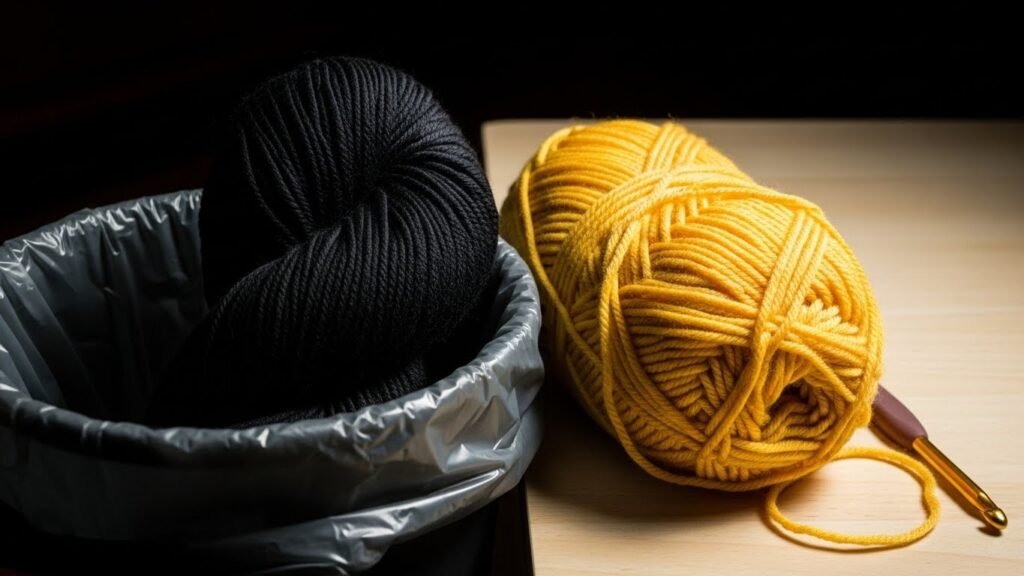
The “Blind Hooking” Trap: Why You Aren’t Learning
There is a dangerous habit that develops when beginners use dark yarn: “Blind Hooking.” This is when you stop looking for the actual stitch and start feeling around with the tip of your hook, hoping it slides into a gap. You’re essentially guessing. And while you might get lucky 80% of the time, that other 20% is where the disaster happens.
When you “guess” where to put your hook, you start accidentally splitting the yarn. You insert the hook into the middle of a fiber instead of under the loops. You miss the last stitch of the row because it’s invisible against the dark background. You add extra stitches because you can’t tell the difference between a turning chain and a double crochet. By the time you’ve finished five rows, your “square” looks like a wavy, mangled mess.
If you were working with a light, “naked” yarn, you would see these mistakes the second they happened. You would learn from them. But with dark yarn, the mistakes are hidden in the shadows. You don’t realize you’ve messed up until the project is so far gone that you have to rip the whole thing out. This “delayed failure” is the ultimate motivation killer. Wouldn’t you rather see your mistakes instantly and fix them in two seconds?
The Myth of the “Cool” Midnight Project
We’ve all been seduced by the aesthetic. We see a photo of a moody, gothic-inspired crochet shawl or a sleek black crop top on Pinterest, and we want that. We want the “cool” project. But as a beginner, you have to earn your way to the dark side.
Think of it like learning to play the piano. You start with simple scales on the white keys. You don’t start by trying to play a complex concerto in a pitch-black room on a piano where all the keys are the same color. Crochet is a visual language. If you can’t read the words (the stitches), you can’t write the story (the project). Dark yarn is a “final boss” level challenge. Why are you trying to fight the boss before you’ve even learned how to walk?
The Secret Advantage of “Ugly” Yarn
This brings us to a revolutionary concept: The power of “Ugly” yarn. I’m talking about that bright, neon orange, that obnoxious lime green, or that plain, boring cream. These colors are the secret weapons of the world’s most successful crochet teachers.
Why? Because they have high visibility. When you work with a bright, solid, light color, the “anatomy” of the stitch is screaming at you. You can see the “front loop” and the “back loop” from across the room. You can see exactly how the yarn wraps around the hook. This visual feedback loop is what builds muscle memory. It’s what teaches your brain to recognize the “V” shape instinctively.
Once your brain has learned the “geometry” of the stitch on light yarn, it can eventually perform those movements on dark yarn through a combination of sight and touch. But you must build that visual map first. If you start with dark yarn, you are trying to build a map in a room with no lights. It is a recipe for a “triangular” scarf and a ruined evening.
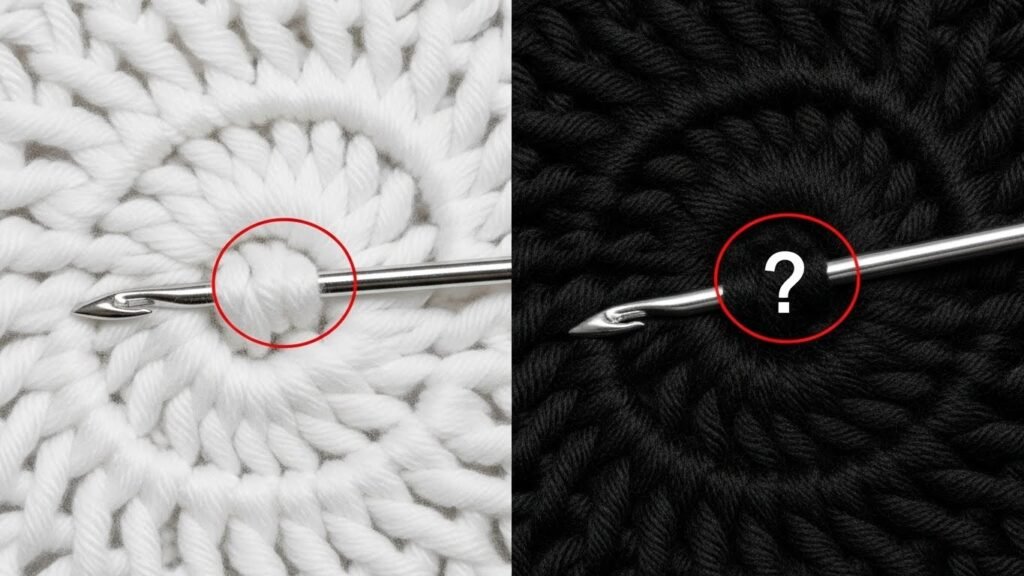
Your Eyesight Is an Investment, Not a Sacrifice
Let’s get real for a second: Eye strain is a legitimate health concern. When you force your eyes to focus on dark, featureless objects for hours, you are causing significant fatigue to the ciliary muscles. This can lead to headaches, blurred vision, and a general sense of “brain fog.”
Is a charcoal-colored hat really worth a migraine? Is a navy blue scarf worth waking up with tired eyes the next morning? When you choose light yarn, you are choosing your own well-being. You are allowing your eyes to work in their natural comfort zone. Professional crafters often have “daytime yarn” (the dark stuff they only work on in bright sunlight) and “evening yarn” (the light stuff they work on while watching TV). As a beginner, you don’t have that luxury yet. Every hour is “learning hour,” which means every hour should be “light yarn hour.”
The “Frogging” Nightmare: Why Dark Yarn Is Harder to Fix
In the crochet world, “frogging” is when you rip out your work (rip-it, rip-it… like a frog). It’s an inevitable part of the learning process. But frogging dark yarn is a special kind of hell.
Because dark yarn absorbs light, it also hides the “fuzz” and the “twist” of the fibers. When you try to rip out a mistake in dark wool or mohair, the fibers often get snagged on each other. Because you can’t see where the snag is, you end up pulling too hard and snapping the yarn. Or worse, you accidentally “felt” the yarn together through friction, making it impossible to undo.
When you use light-colored, smooth yarn, frogging is a breeze. The stitches come apart cleanly, and you can clearly see the “V” of the row below, making it easy to put your hook back in and start over. Dark yarn makes the “fixing” process just as miserable as the “making” process. Are you ready to double your frustration for the sake of a color choice?
The “No-Dark-Yarn” Challenge
I want you to try an experiment. Take that dark project you’ve been struggling with—the one that’s been sitting in your basket for three weeks—and set it aside. Go to the store and buy a skein of the most “boring,” light-colored, smooth cotton or acrylic you can find. A pale yellow, a mint green, or a classic off-white.
Now, try the same pattern again.
The difference will shock you. It will feel like someone finally turned the lights on in a dark house. You’ll find yourself moving faster. You’ll find yourself catching mistakes before they happen. You’ll find that “flow” state that everyone talks about but you haven’t felt yet. That “click” in your brain—the moment where you finally get it—only happens when your eyes and hands are working in harmony. Dark yarn disrupts that harmony.
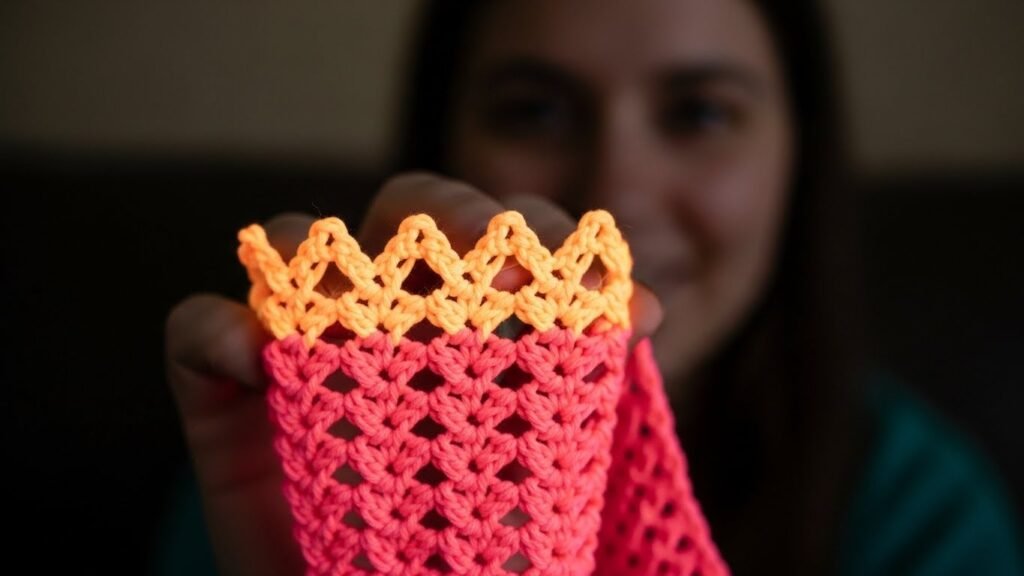
When Can You Go Back to the Dark Side?
I’m not saying you can never use black yarn. A black crochet dress is a timeless masterpiece. A navy blue afghan is a classic. But there is a time and a place. You can go back to dark yarn when:
-
You can crochet a perfect square without looking at your hands 50% of the time.
-
You can identify the “top loops” of a stitch by feel alone.
-
You have invested in a high-quality, neck-mounted craft light.
-
You are prepared for the fact that you will work 30% slower than usual.
Until then, treat dark yarn like a hazardous material. It is for the experts. It is for the masochists. It is not for the person who is trying to find peace and creativity at the end of a long workday.
The Industry’s Dirty Little Secret
Why do yarn companies sell so much dark yarn to beginners? Because it looks great on the shelf! They know that “Midnight Sparkle” sells better than “Old Porridge.” They aren’t interested in your learning curve; they’re interested in their bottom line. They won’t tell you that the yarn you just bought is going to make you want to quit the hobby.
But I’m telling you. Consider this your “Intervention.” Your dark yarn is gaslighting you. It’s making you think you’re not talented, when in reality, you’re just blind. You wouldn’t try to learn to read in a room with no candles, so why are you trying to learn to crochet in a yarn with no light?
The Freedom of Light and Clarity
Imagine a world where you never have to wonder where the next stitch is. Imagine the confidence of knowing that every time you insert your hook, it’s exactly where it’s supposed to be. This is the world of light yarn. It is a world of clarity, speed, and rapid improvement.
By “throwing away” (or hiding) your dark yarn today, you are clearing the path for your own success. you are removing the single biggest obstacle between you and the beautiful projects you want to create. Crochet is supposed to be a gift to yourself, not a punishment. Stop punishing your eyes. Stop punishing your brain. And stop punishing your creativity.
Go out and buy the “brightest” yarn you can find. Let it be “ugly.” Let it be loud. Let it be the teacher you actually deserve. Once you’ve mastered the art, the darkness will be there waiting for you. But for now? Follow the light. Your future “Pro” self will thank you for it. Are you ready to finally see what you’ve been doing? The “V” is waiting for you—don’t let the shadows hide it anymore.

My name is Sarah Clark, I’m 42 years old and I live in the United States. I created Nova Insightly out of my love for crochet and handmade creativity. Crochet has always been a calming and meaningful part of my life, and over the years it became something I wanted to share with others. Through this blog, I aim to help beginners and enthusiasts feel confident, inspired, and supported as they explore crochet at their own pace. For me, crochet is more than a craft — it’s a way to slow down, create with intention, and enjoy the beauty of handmade work.