
You think you are protecting them. You spent hours organizing your stash by color, weight, and fiber content. You bought those heavy-duty, “airtight” plastic bins from the big-box store, snapped the lids shut with a satisfying click, and tucked them away in a closet or under the bed. You feel a sense of accomplishment, a “Marie Kondo” level of organization that makes you feel like a responsible adult. But while you sleep, your yarn is screaming. Inside those airtight sarcophagi, a silent, chemical, and biological war is being waged.
Your plastic bin is not a sanctuary; it is a death trap. We have been conditioned by a consumerist culture to believe that plastic is the ultimate protector, the shield against the chaos of the world. But for natural fibers—the wools, the alpacas, the silks, and the cottons—plastic is a slow-motion executioner. We are suffocating our most precious investments in a tomb of petroleum-based polymers. Why are we treating our “living” fibers like they are inert pieces of Tupperware? Are you truly preserving your stash, or are you just facilitating its quiet, expensive rot?
The Science of the “Stagnant Microclimate”
To understand why plastic is the enemy, we have to understand what yarn actually is. Natural fibers are biological materials. They are porous, they are reactive, and they are—in a very real sense—still “breathing.” Wool, for instance, is hygroscopic. It has a natural relationship with moisture in the air. Even when it is spun into a skein, it continues to absorb and release water vapor to maintain equilibrium with its environment.
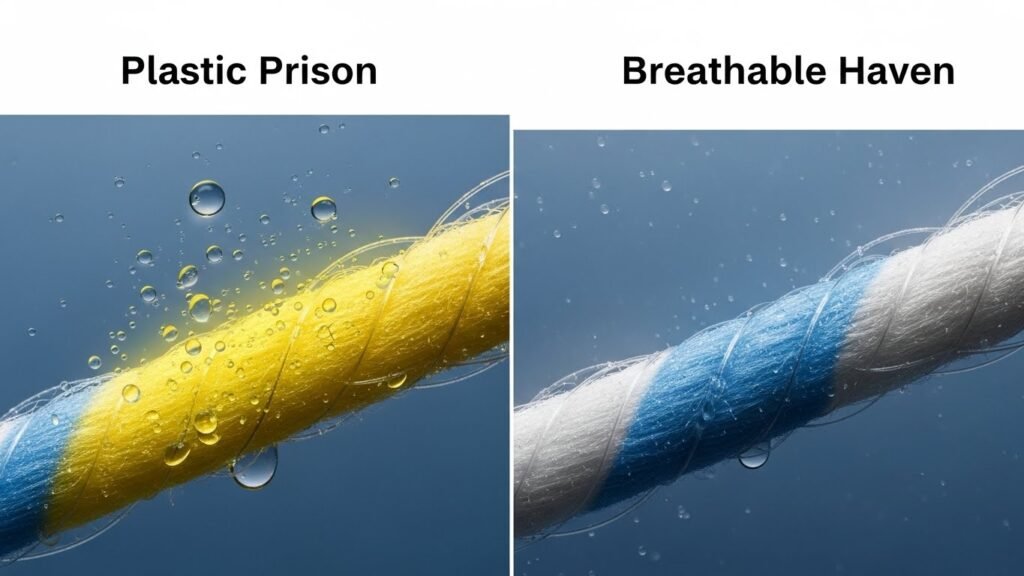
When you seal a natural fiber inside an airtight plastic bin, you are creating a closed microclimate. If there is even a trace of humidity in the yarn or the air when you close the lid, that moisture has nowhere to go. As temperatures fluctuate in your home, that moisture condenses on the cold plastic walls of the bin and drips back onto the yarn. This creates a “stagnant swamp” effect. You aren’t just storing yarn; you are running a high-stakes experiment in fungal cultivation. Have you ever opened a bin and noticed a faint, “musty” smell? That isn’t the smell of age; it’s the smell of your investment being eaten by microscopic organisms.
The “Off-Gassing” Nightmare
It’s not just the biology that’s killing your yarn; it’s the chemistry. Plastic bins, especially the cheaper ones, “off-gas” volatile organic compounds (VOCs) over time. These are the chemicals used to make the plastic flexible and durable. In a sealed environment, these gases become concentrated.
These chemicals can react with the delicate dyes and natural proteins in your yarn. Have you ever noticed a skein that has inexplicably changed color or become brittle while in storage? You might blame the manufacturer, but the culprit is often the bin itself. You are essentially bathing your yarn in a slow-acting chemical solvent. Why do we spend fifty dollars on a single skein of hand-painted merino only to let it rot in a five-dollar bucket of chemicals?
The “Moth Myth”: Why Airtight Isn’t Safe
The number one reason people use plastic bins is the fear of moths. We think that if the lid is snapped tight, the larvae can’t get in. And while that is technically true for a newly hatched larva, it ignores a terrifying reality: the eggs might already be there.
If a moth has even landed on your yarn while it was in the store, on your table, or in your project bag, the eggs could be tucked deep within the center of the skein. When you put that skein into an airtight plastic bin, you aren’t keeping the moths out; you are keeping them in. You have created a perfectly temperature-controlled, predator-free buffet for the larvae. In a breathable environment, the movement of air and light can actually discourage infestation or make it visible before it’s too late. In a bin, you won’t know there’s a problem until you open the lid to find a pile of “yarn dust” and a hundred empty cocoons. Are you protecting your yarn from the world, or are you handing it over to the enemy on a silver platter?
The False Sense of Security
The greatest danger of the plastic bin is the “False Sense of Security.” Because you think the yarn is safe, you don’t check on it. You leave it for three, five, ten years. When you finally open it, the damage is catastrophic and irreversible. Breathable storage forces a different relationship with your stash. It requires you to engage with it, to touch it, and to notice changes. Storage shouldn’t be “set it and forget it.” It should be an ongoing act of stewardship. When was the last time you actually looked at the bottom of your storage pile?
The Breathable Revolution: Reclaiming the Fiber’s Health
If plastic is the death trap, what is the sanctuary? The secret lies in materials that evolved alongside the fibers themselves: natural textiles. Cotton, linen, and even specialized archival-grade paper are the gold standards for yarn storage. These materials allow for “gas exchange.” They allow moisture to move out of the yarn and into the room, preventing the condensation that leads to mold. Today, we are seeing a return to the “old ways”—the linen sacks and cedar chests of our ancestors—not because of nostalgia, but because of biological necessity.
The Cotton Bag Strategy
The most effective, affordable way to store yarn for decades is the “Pillowcase Method” or dedicated cotton storage bags. Cotton is a “buffer” material. It absorbs excess moisture and provides a dark, cool, and—most importantly—ventilated environment.
When you store your yarn in cotton bags, you can stack them in a closet or on a shelf. The air circulates between the bags, the fibers stay at a consistent “breathing” rate, and the yarn retains its “loft” and elasticity. Have you ever touched a skein that felt “dead” or flat? That’s what happens when yarn is crushed in a plastic bin. In a cotton bag, the yarn stays “alive.” It keeps its spring, its bounce, and its joy.

The “Cedar and Lavender” Defense
If we abandon the “airtight” defense against moths, we must replace it with a “biological” defense. This is where the wisdom of the past becomes our greatest tool.
Cedarwood and lavender aren’t just “nice smells.” They are sophisticated chemical deterrents. Cedar contains natural oils that interfere with the respiratory systems of larvae. Lavender contains linalool, which acts as a powerful repellent to adult moths looking for a place to lay eggs.
However, there is a catch: these scents must be “recharged.” A cedar block from 1994 isn’t doing anything but taking up space. You must lightly sand the cedar every few months to release the oils, or use high-quality essential oils to keep the barrier strong. Are you willing to do the small, rhythmic work of maintaining a “living defense,” or are you too addicted to the “lazy” (and dangerous) plastic lid?
The Light and Air Factor
Moths are “lucifugous”—they flee from light. They thrive in the dark, stagnant corners of a basement or an attic. By using breathable storage and placing your yarn in a closet that is opened regularly, you are creating an environment that is hostile to pests.
The simple act of opening your closet door and letting in a little light and a fresh breeze is more effective than a hundred plastic bins. It’s about creating a “disturbed” environment. Pests want stability and stagnation. Give them the opposite. Give your yarn the movement it needs to stay healthy. Why are we hiding our beauty in the dark when light is the very thing that protects it?
The “Hanging” Hazard: Another Stash Sin
While we are dismantling the “Plastic Bin” myth, we must also address the “Hanging Basket” or “Pegboard” trend. While these are great for Instagram photos, they are another form of slow-motion damage.
When yarn is hung on a peg or placed in a hanging mesh basket, gravity is constantly pulling on the fibers. This is especially dangerous for heavy hanks of wool. Over time, the weight of the yarn itself will stretch the fibers at the top, leading to inconsistent tension when you finally go to use it.
Yarn should always be stored “flat” or in a way that its weight is evenly distributed. A cotton bag on a shelf is the perfect “weightless” environment. Your yarn should be resting, not working. Why are you putting your stash through a “stress test” before you’ve even cast on?

Archival Paper: The Secret of Museums
If you have truly “once-in-a-lifetime” yarn—perhaps a rare breed of wool or a vintage silk that can never be replaced—you should look to the museum world. Museums don’t use plastic bins to store 200-year-old textiles. They use acid-free archival tissue paper and breathable blue-board boxes.
Wrapping each skein in acid-free tissue paper provides an extra layer of protection against light and dust while still allowing for complete gas exchange. It prevents “color transfer” between different skeins and creates a buffer against temperature changes. It feels like an indulgence, but for a stash that is worth thousands of dollars, it is common sense. Is your yarn a “disposable commodity,” or is it a “collection” that deserves archival respect?
The “Stash Audit” Ritual
Regardless of how you store it, the most important “Breathable Secret” is the Stash Audit. Every six months, you should take everything out. Touch every skein. Look for the tell-tale “glitter” of moth tracks or the “sand” of their droppings. Smell the yarn.
This ritual isn’t just about protection; it’s about inspiration. We often buy yarn and then forget why we fell in love with it. By handling your stash twice a year, you are keeping the creative fire alive. You are reconnecting with your goals. The plastic bin makes it easy to forget. Breathable storage makes it impossible to ignore. Are you ready to stop “hoarding” and start “curating”?
Final Thoughts: The Cost of Convenience
We have been sold the idea that plastic is the “safe” choice. It’s cheap, it’s stackable, and it’s transparent. But the “cost” of that convenience is the slow degradation of our creative materials.
When we choose breathable storage, we are making a statement. We are saying that our craft is worth the extra effort. We are saying that we understand the biology of the fibers we love. We are moving away from a “disposable” mindset and into a “legacy” mindset.
Your yarn is a bridge between the natural world and your creative spirit. It came from a living animal or a growing plant. It has a life cycle. By putting it in a plastic bin, you are cutting that cycle short. By giving it a breathable home, you are allowing it to wait for you—for years, or even decades—in perfect condition.
A Call to Action for the Weekend
I challenge you: this weekend, open one of those plastic bins. Take out a skein from the bottom. Really look at it. Smell it. Feel it. Does it feel “vibrant,” or does it feel “stale”?
Then, go get some cotton pillowcases or order some drawstring cotton bags. Transfer your most precious yarns into their new, breathable homes. Add a fresh piece of cedar. Feel the relief of knowing that your “Living Stash” can finally take a breath.
Don’t let your closet be a graveyard of plastic tombs. Let it be a sanctuary of soft, breathing possibilities. The yarn didn’t ask to be trapped in a petroleum-based box; it asked to be turned into something beautiful. Until you are ready to make that happen, the least you can do is let it breathe. Are you a jailer, or are you a guardian? The choice—and the life of your yarn—is in your hands.

My name is Sarah Clark, I’m 42 years old and I live in the United States. I created Nova Insightly out of my love for crochet and handmade creativity. Crochet has always been a calming and meaningful part of my life, and over the years it became something I wanted to share with others. Through this blog, I aim to help beginners and enthusiasts feel confident, inspired, and supported as they explore crochet at their own pace. For me, crochet is more than a craft — it’s a way to slow down, create with intention, and enjoy the beauty of handmade work.