
If you have ever bought a beautiful bag of specialty beans, taken them home to your espresso machine, and pulled a shot that tasted like a battery or a piece of charcoal, you are not alone. Espresso is the most demanding brewing method in the world. In a pour-over, you have minutes to fix a mistake; in espresso, everything happens in less than 30 seconds, under 9 bars of pressure.
In the industry, we call the act of finding the perfect settings for a specific coffee “dialing-in.”
It is a calibration process that bridges the gap between the roaster’s intent and the liquid in your cup. You see, coffee is a natural product. Even the same bean will behave differently on a rainy Tuesday than it did on a dry Monday. Changes in humidity, the age of the beans, and even the temperature of your kitchen can throw your espresso out of alignment.
To master your machine, you need to stop guessing and start measuring. Dialing-in is not about “following a recipe” found on the back of a bag—it is about reacting to what you taste and using science to steer the flavor back to the sweet spot.
1. The Variables: Your Control Knobs
When you stand in front of your espresso machine, you have four main variables you can manipulate. Think of these as your control knobs for flavor:
-
Dose: The amount of dry coffee grounds you put in the basket (measured in grams).
-
Yield: The amount of liquid espresso that ends up in your cup (measured in grams).
-
Time: How long it takes for the water to pass through the coffee (measured in seconds).
-
Grind Size: How fine or coarse the coffee is ground.
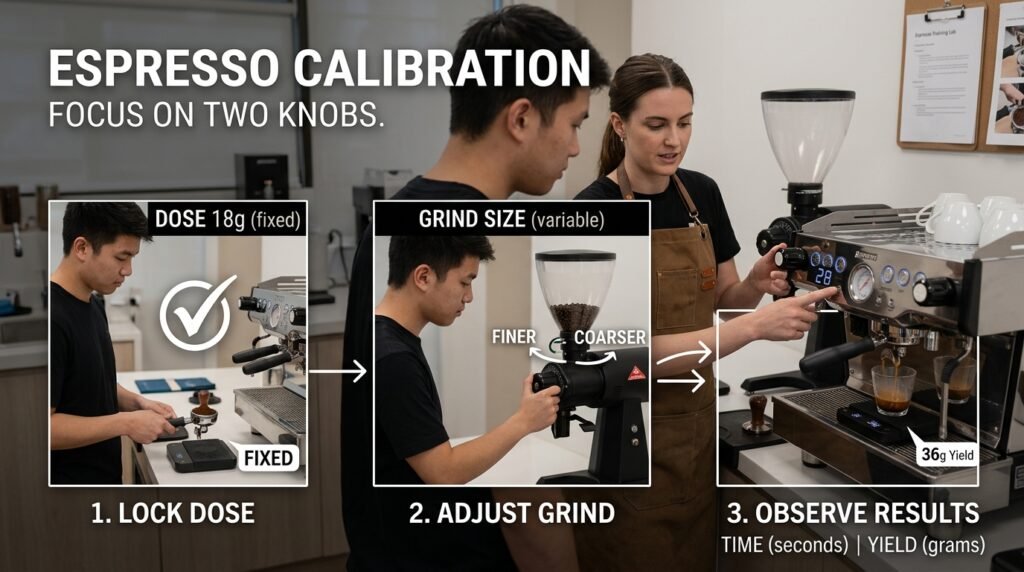
Most beginners make the mistake of changing all four at once. This is the fastest way to get lost. The first rule of calibration is to lock your dose. Choose a weight that fits your basket (usually 18g or 20g) and do not change it. This allows you to focus entirely on the relationship between grind size and time.
2. The Relationship Between Grind and Resistance
Espresso is a game of resistance. The water in your machine is being pushed by a pump at high pressure. The only thing slowing that water down is the “puck” of coffee in your portafilter.
If your grind is too coarse, the water will find gaps between the large particles and rush through far too quickly. This results in under-extraction—a thin, sour, and watery shot. On the other hand, if your grind is too fine, the particles are so packed together that the water struggles to pass. This leads to over-extraction—a bitter, harsh, and “burnt” tasting shot.
This is why your equipment choice is non-negotiable. As we have explored in The Grinder Manifesto: Why Your Grinder is More Important Than Your Brewer, an espresso-capable burr grinder is the only tool that can provide the microscopic adjustments needed to “dial in” a shot. A difference of just a few microns can be the difference between a masterpiece and a mess.
3. The 1:2 Ratio: Your Starting Point
Every calibration needs a baseline. In the specialty coffee world, the standard starting point is a 1:2 ratio. This means that if you put 18g of coffee in, you are aiming for 36g of liquid espresso out.
Why 36g? This ratio generally provides enough water to move through the coffee and extract the sugars without pulling out too many of the heavy bitters.
However, remember that this is just a starting point. If you are working with high-altitude beans, which are much denser, you might need a longer ratio (like 1:2.5) to fully “open up” the flavor. As we noted in The Secrets of High Altitude: Why Mountains Make Better Coffee, these mountain-grown beans are stubborn—they require more work from the water to give up their sweetness.
4. The “Holy Grail” Time Window
While you are aiming for your 36g yield, you must also watch the clock. Most specialty espressos taste best when that 1:2 ratio is achieved in 25 to 30 seconds.
-
If it takes 15 seconds: Your grind is too coarse. The water is “galloping” through the coffee. It will taste sour and salty.
-
If it takes 45 seconds: Your grind is too fine. The water is “choking.” It will taste bitter, dry, and over-concentrated.
The “Dialing-In” dance involves making small adjustments to your grinder until you hit that 25–30 second window. Once you are in that window, you can stop looking at the clock and start using your tongue to make the final “micro-adjustments.”
5. Dialing by Taste: The Final Polish
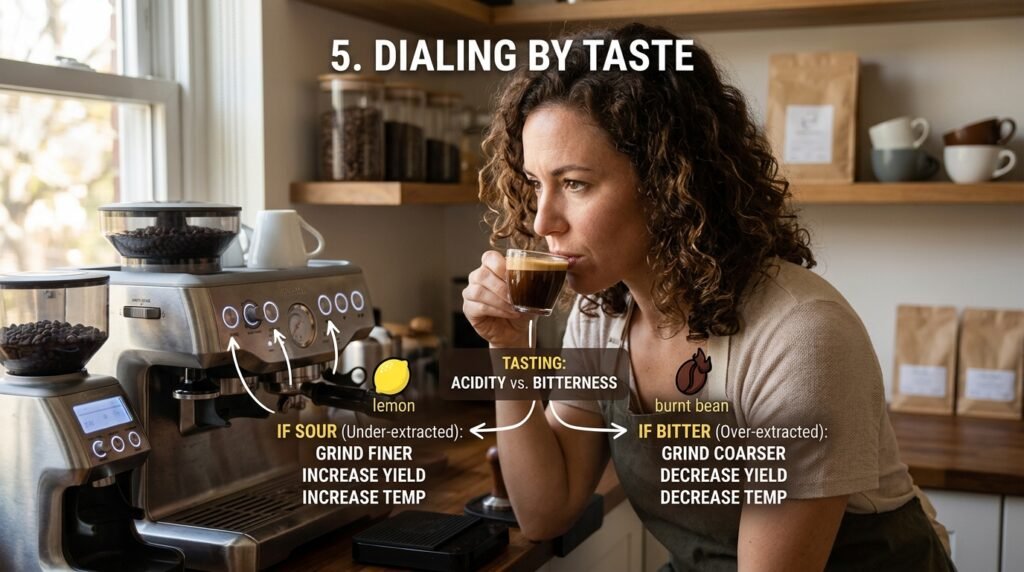
Once you have a shot that looks good on the scale and hits the right time, you have to taste it. This is where you apply the lessons from How to Host a Coffee Cupping at Home: A Step-by-Step Guide—you are looking for the balance between acidity, sweetness, and bitterness.
If it’s too Sour (Under-extracted):
Even if your time was 28 seconds, it might still be sour. You can fix this by:
-
Grinding slightly finer (increasing resistance).
-
Increasing the yield (letting more water run through to pull out more sugar).
-
Increasing the temperature (if your machine allows).
If it’s too Bitter (Over-extracted):
-
Grinding slightly coarser.
-
Decreasing the yield (cutting the shot shorter to avoid the “Phase 3” bitters).
-
Decreasing the temperature.
6. The “Invisible” Variable: Puck Prep
You can have the best grinder and the best machine, but if your “puck prep” is messy, your calibration will fail. This is the human element of dialing in.
When you put the coffee in the portafilter, it needs to be perfectly level and evenly distributed. If there are clumps or gaps, the water will find them. This creates a “channel”—a hole where all the water rushes through, leaving the rest of the coffee dry.
Channeling is the barista’s nightmare. It makes a shot taste both sour (from the dry parts) and bitter (from the over-worked channel). Using a distribution tool and a consistent, level tamp is the only way to ensure the physics of the machine work for you, not against you.
7. The Freshness Factor
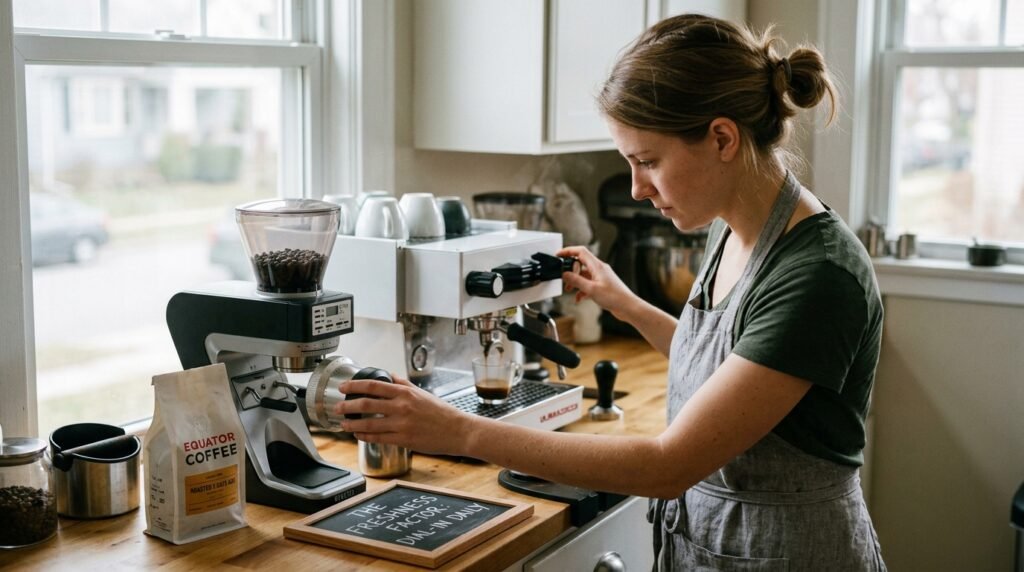
Espresso is a living thing. As coffee ages, it loses CO2. Since CO2 provides resistance during the brewing process, an “old” coffee will flow faster than a “fresh” coffee, even at the same grind setting.
This means you will likely have to “dial in” your coffee every single morning. Professional baristas start their shifts by pulling 5 or 6 “dial-in” shots to adjust for the changes in the beans from the day before. For the home barista, this means you should expect to make a small adjustment to your grinder every 2 or 3 days as your bag of beans ages.
8. Water Chemistry and Espresso
Finally, we have to talk about what is actually in your boiler. Espresso is 90% water, but because it is so concentrated, the mineral content of your water is critical.
High-pressure extraction is very sensitive to alkalinity. If your water has too much buffer, it will kill the sparkling acidity of a light roast. If it’s too soft, the espresso will taste sharp and aggressive. This is why Water Quality: The Invisible Ingredient in Your Coffee is the foundation of a good espresso setup. You cannot “dial in” a shot if your water is chemically incapable of holding the flavor.
Summary: The Dialing-In Workflow
| Goal | The Action | The Result |
| Set the Foundation | Weigh 18g Dose. | Consistency across all tests. |
| Check the Flow | Aim for 1:2 ratio (36g out). | Balanced concentration. |
| Monitor Time | Aim for 25–30 seconds. | Indicates correct grind resistance. |
| Taste: Sour? | Grind Finer / Increase Yield. | Extracts more sweetness. |
| Taste: Bitter? | Grind Coarser / Decrease Yield. | Cuts out the harsh tail-end. |
Final Thoughts
Dialing in espresso is a meditative practice. It teaches you to pay attention to the small details—the sound of the grinder, the color of the “tiger stripes” in the crema, and the weight of the liquid.
It can be frustrating when the first shot of the day is a failure, but that failure is just data. Every bad shot tells you exactly what to change for the next one. When you finally hit that “god shot”—the one where the acidity is bright like a ripe cherry and the body is as thick as melted chocolate—you will realize that the 15 minutes of calibration were entirely worth it.
Espresso is not a button you press; it is a relationship you manage. By understanding the science of extraction and the physics of resistance, you turn your kitchen into a laboratory of flavor.
Happy dialing, and may your shots always run golden!

Marcelo Clark combines professional industry experience with a passion for democratizing coffee knowledge. Specialist in extraction techniques and an advocate for single-origin beans, Marcelo uses this space to teach beginners how to appreciate the subtle notes of a well-crafted brew. His goal is to make learning about methods and origins simple, relevant, and inspiring for every reader’s daily routine.