
If you’ve been following the specialty coffee scene for the last decade, you’ve likely noticed a buzzword appearing on bags from the most prestigious roasters: Honey Process. At first, it sounds like someone is adding actual honey to the coffee beans. But in the world of specialty coffee, “Honey” has nothing to do with bees and everything to do with the sticky, sweet mucilage that surrounds the coffee seed.
This processing method is a relatively recent innovation, popularized by the “Micro-mill Revolution” in Costa Rica. It was born out of a desire to create coffees that have the clarity of a washed process but the sweetness and body of a natural process. Today, Costa Rica and its neighbor Panama are the undisputed masters of this craft, producing “gems” that fetch some of the highest prices at global auctions.
In this guide, we are going to travel to the lush mountains of Central America to understand the science behind the honey process and why these beans are considered the pinnacle of balance in the coffee world.
1. What is the Honey Process? The Sticky Science
To understand the honey process, we first have to remember the anatomy of a coffee cherry. Inside the skin is a layer of pulp, and beneath that is a sticky, sugary layer called mucilage.
In a Washed Process, this mucilage is scrubbed off completely before drying. In a Natural Process, the fruit is left entirely intact.
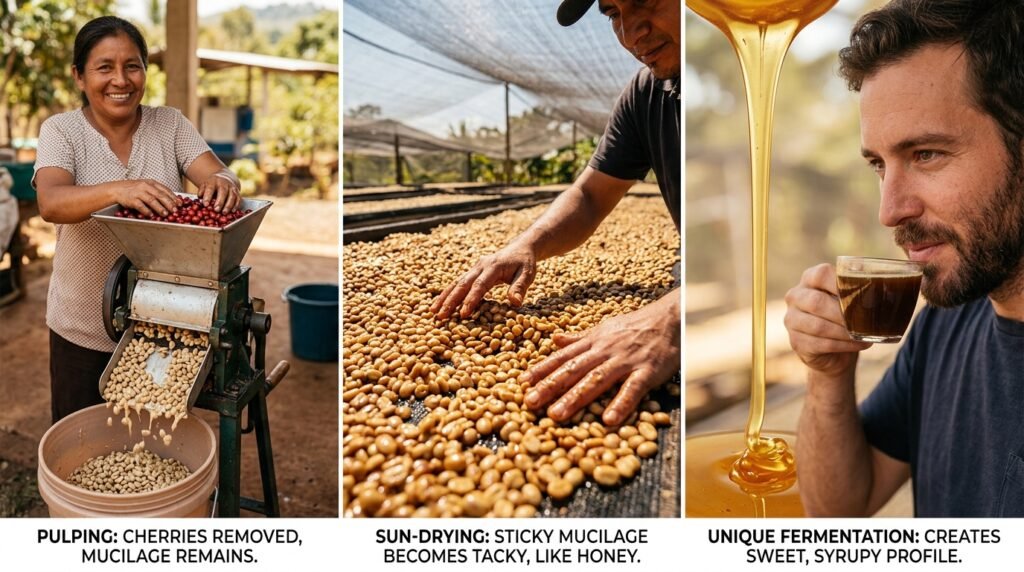
The Honey Process is the hybrid. The skin and most of the pulp are removed, but a specific amount of that sticky mucilage is left on the bean while it dries in the sun. As the beans dry, this sticky layer darkens and becomes tacky—resembling honey.
The sugar in the mucilage doesn’t actually penetrate the bean, but it changes the way the bean ferments during the drying phase. This creates a flavor profile that is uniquely sweet, with a heavy, syrupy mouthfeel that reminds many people of—you guessed it—honey.
2. The Rainbow of Honey: White, Yellow, Red, and Black
Costa Rican farmers are famous for their precision. They don’t just do “honey” coffee; they categorize it by how much mucilage is left and how much sunlight the beans receive.
-
White and Yellow Honey: Most of the mucilage is removed. The beans are dried quickly in full sun. These have a profile closest to a washed coffee—clean, bright, and floral.
-
Red Honey: About 50% to 75% of the mucilage is left on. They are often dried in partial shade or on cloudy days to slow down the process. This results in a fruitier, sweeter cup.
-
Black Honey: The most “extreme” version. Nearly all the mucilage is left on, and the beans are dried very slowly in deep shade or under covers. This allows for a much longer fermentation time. Black honey coffees are incredibly sweet, funky, and complex, often tasting like dark chocolate and raisins.
Because the fermentation is so controlled, these coffees require immense attention. If the farmer gets it wrong, the coffee can rot. This level of risk is why these beans are so precious and why Decoding Labels to Find Your Perfect Beans is essential—you need to know which “color” of honey fits your specific preference.
3. Costa Rica: The Birthplace of the Micro-mill
Costa Rica changed the game by moving away from “Co-operatives” and toward “Micro-mills.” In the past, small farmers would sell their cherries to a massive central mill, where everyone’s coffee was mixed together.
In the early 2000s, farmers began installing their own small processing equipment (micro-mills). This gave them total control over the honey process. They could experiment with different drying times and mucilage levels for every single lot.
This focus on the individual farmer is why Costa Rican coffee is so diverse. One farm in the West Valley might produce a crisp Yellow Honey, while a farm just a few miles away in Tarrazú produces a boozy Black Honey. This terroir-driven approach is a perfect example of The Secrets of High Altitude: Why Mountains Make Better Coffee, as the cool mountain air allows for the slow, stable drying required for high-quality honey processing.
4. Panama: The Land of the Gesha and Innovation
While Costa Rica perfected the honey process, Panama took it to the luxury market. Panama is home to the most famous coffee variety in the world: the Gesha (or Geisha).
When you combine the floral, tea-like genetics of the Gesha plant with the syrupy sweetness of a honey process, you get a “super-coffee.” Panamanian producers like Hacienda La Esmeralda and Elida Estate have used honey processing to push the boundaries of flavor, creating coffees that taste like jasmine, stone fruits, and bergamot all at once.
Panama’s unique geography—with the Atlantic and Pacific oceans providing constant cool breezes—creates a perfect “dryer” for honey coffees. This stable climate prevents the mold issues that plague other regions trying to copy this method.
5. The Mouthfeel Factor: Why Honey is Different
The biggest reason to seek out a honey-processed coffee is the texture.
In The Chemistry of Extraction: Balancing Acid, Sweet, and Bitter, we talk about “body” or “mouthfeel.” Honey coffees have a unique tactile quality. Because of the long contact with the sugars in the mucilage, the beans develop a higher concentration of solids.
When you brew a Costa Rican Red Honey, it feels “heavy” and “coating” on the tongue. It lacks the sharp, sometimes aggressive acidity of an African coffee, making it the perfect choice for people who want a smooth, dessert-like experience. It’s a cup that feels luxurious from the first sip to the last.

6. Brewing the Gems: How to Handle Honey Beans
Honey-processed beans can be tricky to brew because they are “sticky” inside the roaster. They often have a slightly uneven color, with the chaff (the skin) still clinging to the center line of the bean.
Grind Size:
Because these beans are quite sugary and often roasted to a “Medium-Light” level, they can produce more “fines” (tiny dust particles) when ground. You may need to grind slightly coarser than you would for a washed coffee to prevent the filter from clogging.
Water Temperature:
I recommend using slightly lower water temperatures (around 91°C to 92°C). Since the sugars are already so prominent, using boiling water can sometimes push the flavor toward a “bitter-sweet” caramel rather than the delicate “fruit-honey” notes we are looking for.
The Bloom:
Don’t skip the bloom! These beans have a lot of organic activity. Give them a full 45 seconds to “exhale” before finishing your pour.
7. Sustainability and the Environment
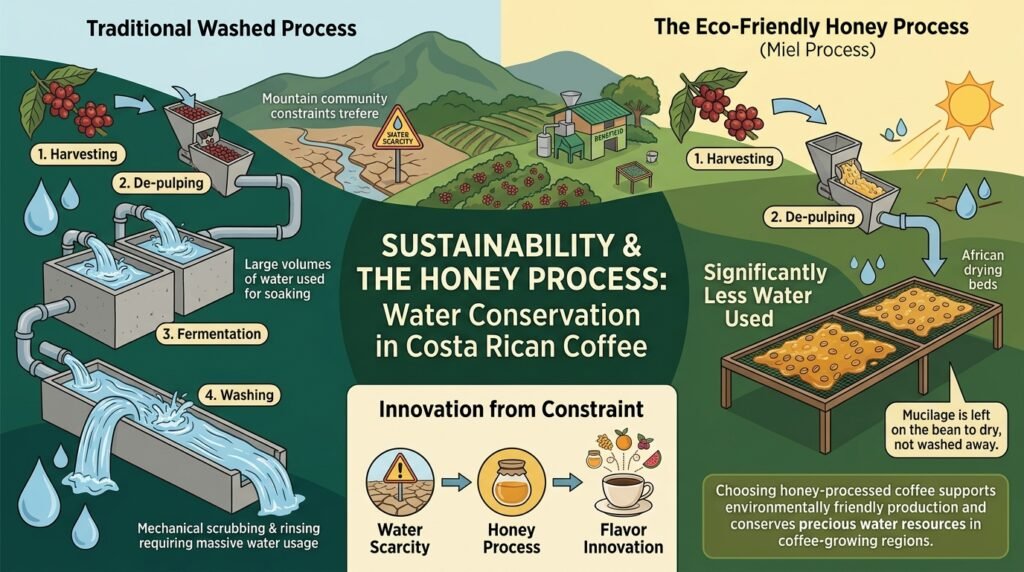
One of the “hidden” reasons the honey process became so popular in Costa Rica is water conservation.
The traditional Washed Process uses a massive amount of water to transport and scrub the beans. In many mountain communities, water is a precious resource. The Honey Process (and the Natural Process) uses significantly less water because the mucilage is left on the bean to dry rather than being washed away.
By choosing a honey-processed coffee, you are often supporting a more environmentally friendly method of production. It is a beautiful example of how a technical constraint (less water) led to a flavor innovation that the whole world now craves.
8. The Future: Experimental Honeys and Anaerobics
Central American producers aren’t stopping at White and Black Honey. They are now experimenting with Anaerobic Honey Process. In this method, the honey-covered beans are placed in sealed, oxygen-free tanks for 24 to 72 hours before being put out to dry. This creates wild, intense flavors like cinnamon, bubblegum, and tropical fruits.
Costa Rica is currently at the forefront of this movement. It is a reminder that coffee is not a stagnant industry. It is a field of constant research and development, driven by the passion of the “Micro-millers” who refuse to settle for ordinary flavor.
Summary: The Honey Process Guide
| Honey Type | Mucilage Removed | Drying Style | Profile |
| White Honey | 80% – 90% | Full Sun | Clean, Crisp, Floral. |
| Yellow Honey | 50% – 75% | Full Sun | Sweet, Balanced, Nutty. |
| Red Honey | 25% – 50% | Partial Shade | Syrupy, Stone Fruit, Honey. |
| Black Honey | 0% – 25% | Deep Shade | Boozy, Jammy, Dark Chocolate. |
Final Thoughts
Central America, and specifically Costa Rica and Panama, have given the coffee world a gift in the form of the honey process. It is a method that demands respect—respect for the farmer’s time, respect for the delicate chemistry of fermentation, and respect for the environment.
The next time you brew a cup of Costa Rican honey coffee, pay attention to that lingering sweetness. It is the result of a bean that spent weeks drying in the mountain air, wrapped in its own natural sugars. It is a “gem” of the coffee world that proves you don’t need additives to make a drink taste like honey; you just need a little bit of Central American sunshine and a whole lot of patience.
Happy brewing, and may your cup always be as sweet as a Costa Rican morning!

Marcelo Clark combines professional industry experience with a passion for democratizing coffee knowledge. Specialist in extraction techniques and an advocate for single-origin beans, Marcelo uses this space to teach beginners how to appreciate the subtle notes of a well-crafted brew. His goal is to make learning about methods and origins simple, relevant, and inspiring for every reader’s daily routine.