
We have all been there: you take a sip of a truly exceptional coffee, swallow, and then… nothing. Or rather, something. A phantom flavor begins to bloom on the back of your tongue. It might taste like toasted caramel, a hint of dried apricot, or a soft floral note that wasn’t there when the liquid was actually in your mouth.
In the specialty world, we call this the finish or the aftertaste. For a professional taster, the aftertaste is often more important than the first sip. It is the moment of truth. A coffee can be loud and impressive upfront, but if the finish is short, metallic, or dry, the quality isn’t there. Conversely, a coffee that has a “long finish” is like a great piece of music where the final chord resonates in the room long after the orchestra has stopped playing.
But what is actually happening in our mouths? Why does the flavor stay behind, and what determines whether that lingering sensation is a blessing or a curse? To understand the aftertaste, we have to look at the intersection of organic chemistry, human anatomy, and the physics of “volatile” molecules.
1. The Anatomy of the Finish: Retro-nasal Olfaction
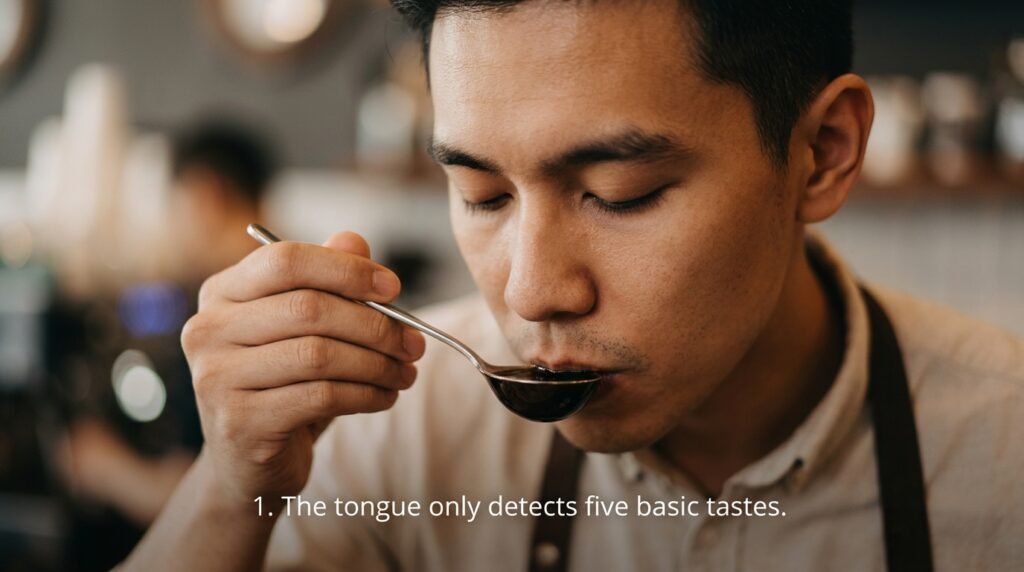
To understand aftertaste, we first have to admit a hard truth: your tongue is actually quite boring. Your tongue can only detect five basic tastes: sweet, sour, salty, bitter, and umami. Everything else—the “blueberries,” the “jasmine,” the “chocolate”—is actually a smell.
When you have coffee in your mouth, you are experiencing “ortho-nasal” olfaction (smelling through your nose). But when you swallow, a puff of air is pushed from the back of your throat up into your nasal cavity. This is called retro-nasal olfaction.
The aftertaste is the result of heavy, oily molecules that didn’t evaporate immediately. They cling to the soft tissues of your throat and the back of your tongue. As you breathe out after swallowing, your breath picks up the aromas of these lingering oils and carries them to your olfactory sensors. This is why a coffee with high lipid (oil) content often has a much more persistent aftertaste than a thin, watery one.
2. Lipids and Colloids: The “Sticky” Carriers
Why do some flavors “stick” better than others? It comes down to the microscopic structure of the brewed coffee.
Coffee is a complex suspension of oils and tiny particles called colloids. When you brew coffee, you are extracting these lipids from the bean. As we discussed in The Chemistry of Extraction: Balancing Acid, Sweet, and Bitter, the goal is to pull out enough of these oils to carry flavor without over-extracting the heavy, bitter fibers.
These oils act as a “time-release” capsule. Because oil and water don’t mix, the oils form a thin film over your palate. Trapped inside that film are the aromatic compounds. As the film slowly breaks down over several minutes, it releases those aromatics into your breath. If a coffee is “under-extracted,” it lacks the oil structure to hold onto these flavors, resulting in a “short” finish where the taste vanishes the moment you swallow.
3. The Difference Between “Bitter” and “Astringent”
One of the most important things to identify in an aftertaste is the difference between a flavor and a physical sensation.
-
Bitterness: This is a taste detected by your receptors. A pleasant bitterness (like dark chocolate) can be a great part of a long finish.
-
Astringency: This is a tactile sensation. It is that “sandpaper” feeling on your tongue that makes you want to drink water immediately.
Astringency in the aftertaste is usually a sign of over-extraction or poor water quality. When you over-extract, you pull out polyphenols—the same compounds found in over-steeped tea or unripe fruit. These molecules bind to the proteins in your saliva, causing your mouth to feel dry. This is why Water Quality: The Invisible Ingredient in Your Coffee is so vital; if your water is too hard, it can’t properly buffer these polyphenols, leaving you with a harsh, drying finish.
4. The “Sweet” Finish: Why Some Coffees Taste Better Minutes Later
Have you ever noticed that a great Ethiopian or Kenyan coffee seems to get sweeter after you swallow? This isn’t your imagination.
As the coffee film on your tongue interacts with your saliva, an enzyme called amylase begins to break down any complex carbohydrates (sugars) remaining in the coffee. Furthermore, as the temperature of your mouth stabilizes, your sweet receptors become more sensitive.
In The Rise of African Coffees: Ethiopia and Kenya Profiles, we highlighted how these high-altitude beans have a unique density of sugars. In the aftertaste, these sugars often manifest as a “shimmering” sweetness—a sensation that feels like a clean, sugary glaze on the palate. This is the hallmark of a world-class bean.
5. How Roast Profile Affects Longevity
The roaster has a massive influence on the aftertaste.
-
Light Roasts: These tend to have a “cleaner” and “shorter” finish. The flavors are vibrant and floral, but they don’t always have the heavy oils to stick around. The finish is often “effervescent”—it pops and then disappears.
-
Medium Roasts: This is usually the sweet spot for aftertaste. The roasting process has gone far enough to develop the oils and caramelize the sugars, but not so far that it creates “burnt” carbon notes. The finish is often long, sweet, and nutty.
-
Dark Roasts: These provide the longest aftertaste, but not always a pleasant one. The heavy oils are fully developed, but they are often accompanied by “ashy” or “smoky” notes. If a dark roast is done poorly, the aftertaste can stay with you for an hour, but it will feel like you’ve been chewing on a piece of charcoal.

6. The Impact of Brewing Equipment
How you brew your coffee changes the “mesh” of the flavor carrier.
If you use a paper filter (like in a V60 or Chemex), you are trapping most of the oils in the paper. This results in a very clear cup but a slightly shorter finish.
If you use a metal filter or an immersion method like the French Press or a Moka Pot, you are allowing all those oils and “fines” (microscopic particles) into the cup. This creates a massive, coating aftertaste. This is a key reason why many people love the Moka Pot Ritual; the intensity and the “lingering” weight of the brew are almost unmatched in the home kitchen.
7. Troubleshooting a “Bad” Aftertaste
If your coffee leaves a bad taste in your mouth, you can use the aftertaste as a diagnostic tool for your next brew:
-
If the finish is “Salty” or “Metallic”: You are likely under-extracting. The acids are hitting your tongue but haven’t been balanced by the sugars yet. Grind finer or use hotter water.
-
If the finish is “Dry” or “Ashy”: You are over-extracting. You’ve pulled out the wood fibers of the bean. Grind coarser or lower your water temperature.
-
If the finish is “Muddled” or “Dirty”: This is often a sign of dirty equipment. Old oils from previous brews are going rancid and tainting the finish of your fresh cup. Clean everything!

8. The Mindfulness of the Finish
The aftertaste is the part of the coffee experience that requires the most patience. We live in a world of “gulp and go,” but specialty coffee is designed to be contemplated.
The next time you drink a cup, try this: swallow, close your eyes, and keep your mouth slightly open. Breathe out slowly through your nose. Don’t take another sip immediately. Give the molecules 30 seconds to settle.
You will start to notice the “secondary” notes. Maybe a hint of tobacco, a touch of cocoa, or a lingering floral scent. This is the “hidden” part of the coffee—the part that only reveals itself to those who wait.
Summary: The Aftertaste Cheat Sheet
| Finish Type | Chemical Cause | Quality Indicator |
| Long & Sweet | High sugar and lipid concentration. | Top Tier (High Altitude / Specialty). |
| Clean & Short | Light roast / Paper filtration. | Good Quality (Focus on Clarity). |
| Dry & Astringent | Over-extracted polyphenols. | Technical Error (Grind or Temp). |
| Ashy / Smoky | Carbonization from dark roasting. | Style Choice (Traditional / Commercial). |
| Metallic / Sour | Organic acids without sugar balance. | Under-extraction (Need more heat/time). |
Final Thoughts
The aftertaste is the “echo” of the coffee bean. It is a chemical memory of the soil the tree grew in, the altitude of the mountain, and the skill of the roaster. When we talk about “great coffee,” we are really talking about a coffee that doesn’t want to leave.
By understanding the science of lipids, retro-nasal olfaction, and extraction balance, you can start to curate your own coffee experience. You’ll stop looking for the “hit” of the first sip and start looking for the “resonance” of the final one.
Coffee is one of the few things in life where the ending is just as important as the beginning. So, don’t rush. Let the flavor linger. Because in the world of specialty coffee, the best part is often the part that stays behind.
Happy brewing, and may your finish always be sweet!

Marcelo Clark combines professional industry experience with a passion for democratizing coffee knowledge. Specialist in extraction techniques and an advocate for single-origin beans, Marcelo uses this space to teach beginners how to appreciate the subtle notes of a well-crafted brew. His goal is to make learning about methods and origins simple, relevant, and inspiring for every reader’s daily routine.