
Imagine spending $50 on a bag of rare, high-altitude Panamanian Gesha beans. You have the perfect burr grinder, a temperature-controlled kettle, and a precision scale. You follow every step of the recipe to the milligram, but the result is… flat. It’s dull, lacks that “sparkle” you tasted at the cafe, and has a strange, chalky finish.
What went wrong? The answer is likely coming straight from your kitchen faucet.
Coffee is approximately 98% to 99% water. When we brew, water acts as a solvent. Its job is to reach into the coffee grounds and pull out the sugars, acids, and oils. However, if that water is already “full” of chlorine, heavy minerals, or organic impurities, it simply doesn’t have the “room” to carry the coffee’s flavor.
Choosing a water filtration system isn’t just about safety or removing the taste of chlorine; it’s about chemistry. It is about creating a liquid that is hungry for coffee flavor. In this guide, we will break down the science of H2O and help you find the filtration system that will finally unlock the potential of your beans.
1. The Chemistry of the Solvent: Why Tap Water Fails
To understand why we need filtration, we have to look at what is hiding in your tap water. Most municipal water supplies are treated with chlorine or chloramine to kill bacteria. While this makes the water safe to drink, even tiny traces of chlorine can react with coffee phenols to create a “medicinal” or “plastic” taste.
Beyond chemicals, there is the issue of Hardness. Hard water is packed with Calcium and Magnesium. In small amounts, these minerals are actually good—they act as “hooks” that help pull flavor out of the coffee. But too much of them will cause “scale” buildup in your machines and lead to a chalky, muted flavor. On the other hand, “soft” water lacks these hooks, often resulting in a sharp, overly acidic, and thin-bodied cup.
This balance is exactly why Water Quality: The Invisible Ingredient in Your Coffee is the literal foundation of your morning ritual. If your solvent is broken, your extraction will be broken.

2. Option 1: The Entry Point – Activated Carbon Pitchers
For many home brewers, the journey starts with a simple pitcher filter (like Brita or Pur). These systems use activated carbon to “adsorb” impurities.
How it works:
The carbon acts like a chemical sponge. As water passes through, the carbon attracts and holds onto chlorine, pesticides, and organic compounds that cause bad odors and tastes.
The Pros:
-
Extremely affordable and easy to use.
-
Excellent at removing that “swimming pool” chlorine smell.
-
Requires zero installation.
The Cons:
-
Most basic carbon filters do very little to change the mineral hardness. If you have very hard water, a pitcher won’t protect your espresso machine from limescale.
-
The flow rate is slow, which can be annoying when you’re trying to fill a large kettle for a morning brew.
If you are using a basic pitcher, you still need to be mindful of Maintenance Matters: How to Clean Your Coffee Equipment, as mineral deposits will still accumulate over time.
3. Option 2: Ion Exchange – The Scale Protectors
If you live in an area with “hard water,” you need more than just carbon. You need Ion Exchange.
This technology is often found in higher-end pitchers (like Peak Water) or in the specialized filters you find inside the water tanks of espresso machines (like the Breville or Sage Claris filters).
How it works:
Inside the filter are tiny resin beads. As water passes through, the resin “swaps” the heavy Calcium and Magnesium ions for something else—usually Sodium or Hydrogen. This effectively “softens” the water.
Why it matters for coffee:
Softening the water prevents limescale from forming inside the delicate heating elements of your machine. Furthermore, by reducing the buffer (bicarbonate) in the water, Ion Exchange allows the natural acidity of high-altitude beans to shine through. As we discussed in The Secrets of High Altitude: Why Mountains Make Better Coffee, those delicate acids are easily masked by “hard” water.
4. Option 3: Reverse Osmosis (RO) – The Blank Slate
Reverse Osmosis is the “nuclear option” of water filtration. It is the system used by almost every high-end specialty coffee shop in the world.
How it works:
Water is forced through a semi-permeable membrane that is so fine it strips away almost everything. It removes 99% of minerals, chemicals, and salts. It leaves you with “Pure” water—a blank slate.
The Catch:
Pure water (0 TDS – Total Dissolved Solids) actually tastes terrible. It’s “aggressive” and will leach minerals out of your metal pipes and your coffee equipment. Most importantly, it lacks the mineral “hooks” needed to extract flavor, resulting in a flat, sour, and unappealing brew.
The Solution:
Modern RO systems for coffee include a “re-mineralization” stage or a “bypass” valve. This allows you to add back a precise amount of Magnesium and Calcium to create the “perfect” brewing water. If you are a gear enthusiast with a pro-sumer espresso machine, a small under-sink RO system is the gold standard.
5. Option 4: The “Scientific” Hack – Third-Wave Water
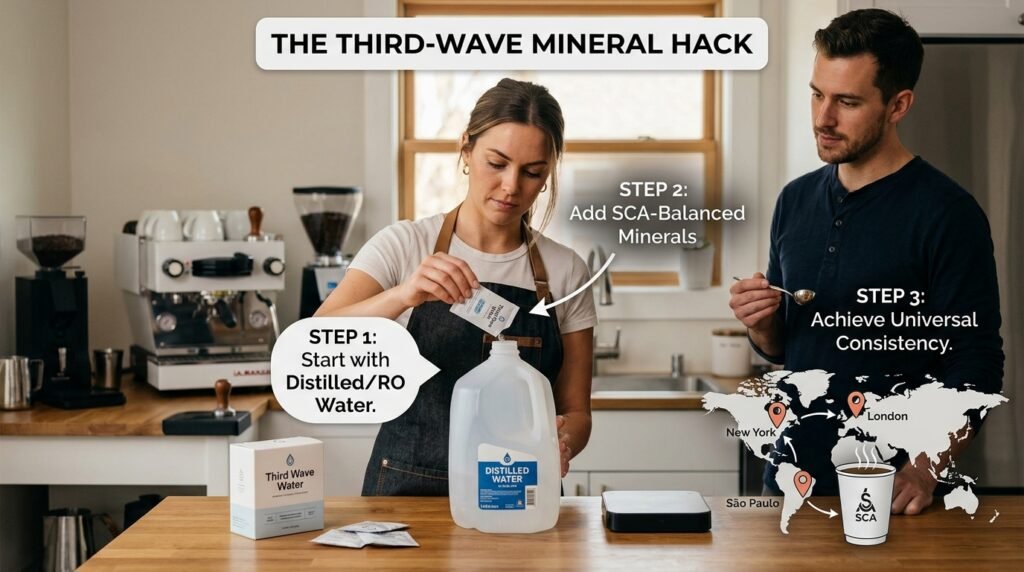
What if you don’t want to install a plumbing system? There is a modern “hack” used by many home baristas: start with distilled or RO water and add your own minerals.
Products like “Third Wave Water” are small packets of minerals specifically balanced to meet the SCA (Specialty Coffee Association) water standards. You simply drop a packet into a gallon of distilled water, shake it, and you have the exact water profile used by champion baristas.
The benefit:
This provides absolute consistency. Whether you are brewing in São Paulo, London, or New York, your coffee will taste exactly the same because the water chemistry is identical. It removes the “guesswork” from your setup.
6. How to Test Your Water at Home
Before you buy a system, you need to know what you’re fighting. You can’t see minerals or chemicals, so you have to test for them.
-
TDS Meter: This cheap handheld device measures Total Dissolved Solids. It doesn’t tell you what is in the water, but it tells you how much stuff is there. For coffee, the sweet spot is usually between 75ppm and 150ppm.
-
Liquid Titration Kits: These involve dropping a chemical into a vial of water and watching the color change. This is the only way to accurately measure “General Hardness” (GH) and “Carbonate Hardness” (KH).
-
Your Local Water Report: Most cities publish a yearly report. Look for “Hardness” and “Total Chlorine” to get a baseline.
7. The Impact of Filtration on Different Roasts
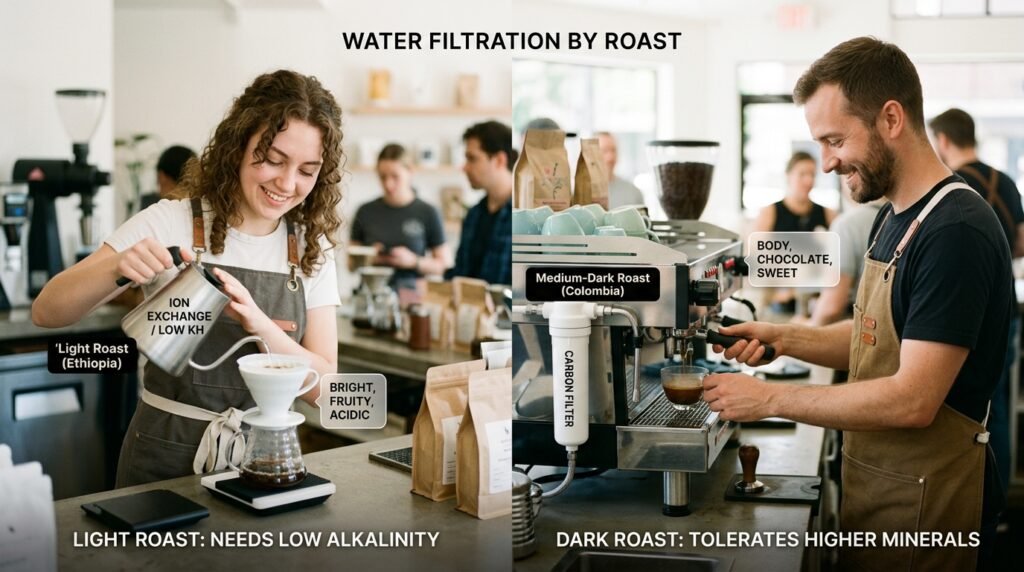
Your filtration needs actually change depending on the coffee you drink.
-
Light Roasts (African/High Altitude): These beans are acidic and delicate. They require water with low alkalinity (low KH) to let the fruit notes pop. An Ion Exchange pitcher or a remineralized RO system is best here.
-
Medium/Dark Roasts (Brazilian/Colombian): These beans rely on body and sweetness. They can actually benefit from slightly higher mineral content (harder water), which helps pull out those heavy chocolate and caramel notes. A simple carbon filter might be all you need.
8. Installation and Maintenance: Don’t Forget the Filter!
The biggest mistake people make with filtration systems is forgetting to change the cartridges.
A “clogged” or expired filter is worse than no filter at all. Carbon filters can eventually start “dumping” the toxins they’ve collected back into the water, and Ion Exchange resins will eventually lose their ability to swap ions, leading to a sudden spike in limescale.
-
Pitcher Filters: Change every 1–2 months.
-
Under-Sink Systems: Change the carbon blocks every 6 months and the RO membrane every 2 years.
-
Espresso Machine Filters: Follow the machine’s internal alert system religiously.
Summary: The Filtration Comparison Table
| System Type | Best For | Chlorine Removal | Scale Protection | Cost |
| Basic Pitcher | Casual brewers; city water with chlorine taste. | High | Low | $ |
| Ion Exchange Pitcher | Pour-over enthusiasts; light roasts. | High | Medium | $$ |
| Under-Sink RO | Serious home baristas; espresso machines. | Excellent | Excellent | $$$ |
| Mineral Packets | Perfectionists; consistency across locations. | N/A (Uses Distilled) | High | $$ |
Final Thoughts
Water is the “canvas” upon which your coffee is painted. If the canvas is dirty or textured, the painting will never look right.
Investing in a water filtration system is often the single most significant upgrade you can make to your coffee quality—surpassing even a more expensive machine. By removing the chemicals that mask flavor and balancing the minerals that extract it, you are finally giving your beans a fair chance to speak.
The next time you fill your kettle, ask yourself: Is this water ready to work? Or is it already too full? Take control of your solvent, and you will find that the “sparkle” you’ve been chasing has been there in the beans all along—it just needed the right liquid to bring it to light.
Happy brewing, and may your water always be as clear as your palate!

Marcelo Clark combines professional industry experience with a passion for democratizing coffee knowledge. Specialist in extraction techniques and an advocate for single-origin beans, Marcelo uses this space to teach beginners how to appreciate the subtle notes of a well-crafted brew. His goal is to make learning about methods and origins simple, relevant, and inspiring for every reader’s daily routine.