
Imagine you’ve just invested in an exclusive micro-lot, harvested in the mountains and roasted with artisanal precision. You open the bag, inhale that intoxicating aroma of fruit and chocolate, and brew the perfect cup. But ten days later, that same coffee feels “tired.” The brightness has vanished, the aroma is just a memory, and the flavor has tilted toward a dull woodiness.
What happened wasn’t magic; it was chemistry. Roasted coffee is one of the most complex and unstable organic products in existence. It possesses hundreds of volatile aromatic compounds that begin to escape the second they leave the roaster.
Understanding the science of coffee storage is the only way to protect your investment. It’s not just about “where to put the bag,” but how to manage the four forces of nature that conspire to destroy flavor: oxygen, moisture, light, and heat. If you want your Monday coffee to taste the same the following Sunday (or the following month), you need to understand the molecular battlefield inside your bean.
In this guide, we will explore the physics of degassing and the scientific strategies for maintaining absolute freshness.
1. The Four Horsemen of the Coffee Apocalypse
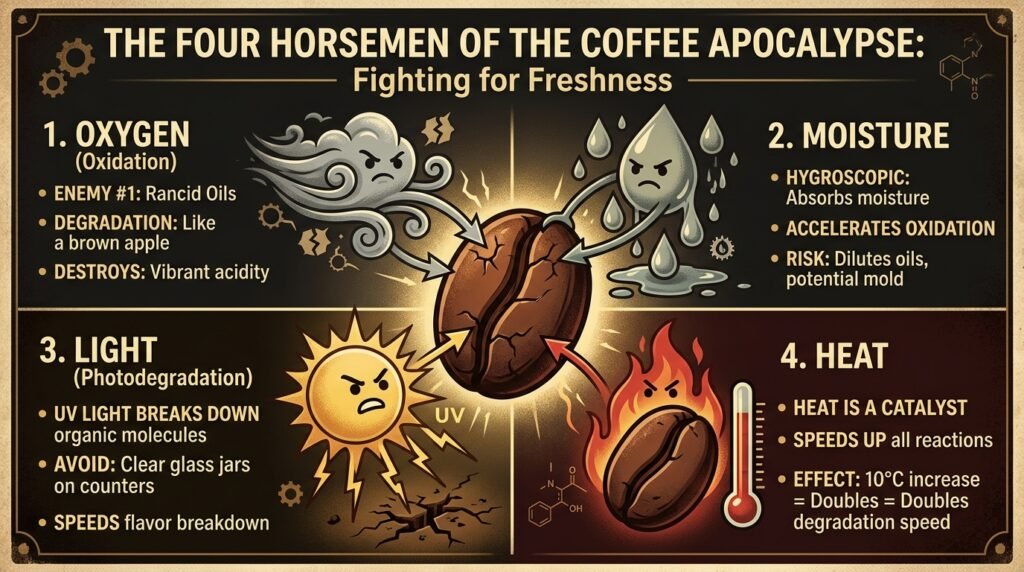
To keep coffee fresh, you must fight against four specific elements. Each one attacks the structure of the bean in a different way.
A. Oxygen (Oxidation):
This is enemy number one. As soon as coffee comes into contact with air, oxidation occurs. The delicate oils (lipids) that carry flavor begin to go rancid. Think of a sliced apple turning brown; the same degradation process happens to coffee cells, destroying the vibrant acidity we discussed in The Chemistry of Extraction: Balancing Acid, Sweet, and Bitter.
B. Moisture:
Coffee is hygroscopic, meaning it absorbs moisture from the environment. Humidity accelerates oxidation and can even lead to mold growth in extreme cases. More importantly, it dilutes the aromatic oils before you even start brewing.
C. Light (Photodegradation):
UV light breaks down organic molecules. If you store your coffee in clear glass jars on the kitchen counter, you are accelerating the breakdown of flavor compounds through light energy.
D. Heat:
Heat is a catalyst. It speeds up all the chemical reactions mentioned above. For every 10°C increase in room temperature, the speed of coffee degradation practically doubles.
2. The Science of Degassing and the One-Way Valve
Why do coffee bags have that little “hole” with a plastic seal? That is a one-way valve, and it is one of the greatest inventions in coffee science.
During roasting, carbon dioxide (CO2) is created inside the cellular structure of the bean. After roasting, the coffee begins to “breathe,” releasing this gas. This process is what creates the magical foam we explored in The Science of the Bloom: Why Bubbles are the Key to Flavor Extraction.
If you sealed coffee in a bag without a valve, it would explode due to CO2 pressure. The valve allows the gas to escape without allowing oxygen to enter. Therefore, the first rule of scientific storage is: never transfer your coffee to a regular container if the original bag has a good valve and a sealable zipper.
3. Whole Bean vs. Ground Coffee: The Surface Area
The science is relentless here: ground coffee oxidizes exponentially faster than whole beans.
This is due to surface area. When you grind coffee, you break the bean’s protective barrier and expose a surface area hundreds of times larger to oxygen. The CO2 escapes almost instantly. This is why we always emphasize in The Grinder Manifesto that grinding on demand is the most important step for freshness.
If you buy pre-ground coffee, your “freshness window” isn’t weeks—it’s hours. For whole beans, we have a much larger window of maneuver.
4. The Freezing Debate: To Freeze or Not to Freeze?
For years, the standard advice was: “Never put coffee in the freezer.” Recently, science proved that the standard advice was… incomplete.
Freezing can be a powerful tool for long-term preservation, provided it is done correctly. When you freeze coffee, you drastically reduce the kinetic energy of the molecules, slowing oxidation to near zero.
The Golden Rules of Freezing:
-
Vacuum Seal: You can’t just throw the bag in the freezer. Humidity and freezer smells (like that chopped onion) will penetrate the coffee. Use vacuum-sealed bags.
-
Single Doses: The biggest mistake is taking the coffee out of the freezer, opening it, taking a portion, and putting it back. This creates instant condensation on the cold beans, destroying the flavor. Freeze in individual portions that you will use all at once.
-
Don’t Thaw: Modern science suggests that grinding frozen beans produces a more uniform particle distribution, which improves extraction.
5. Vacuum Containers and Air Displacement
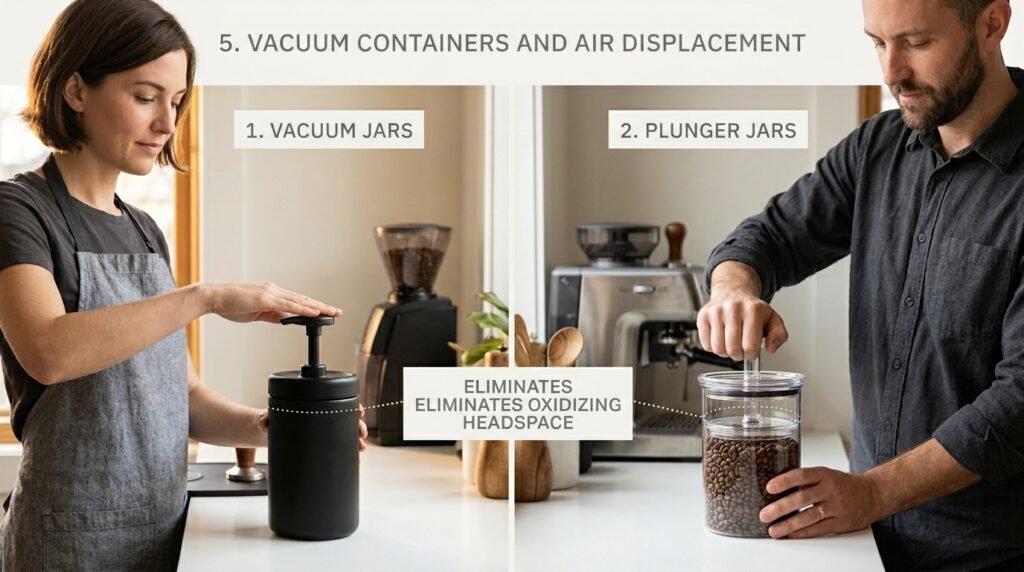
If you don’t want to freeze your coffee, the best option is specialized storage containers that focus on air displacement.
There are two main types:
-
Vacuum Jars: Use a pump to pull the air out. These are excellent but require you to “pump” every time you close them.
-
Plunger Jars: Like the Airscape, where an internal lid descends until it touches the beans, physically forcing the air out.
These containers are superior to standard ceramic jars because they eliminate the “headspace.” If you have a large jar with only a little coffee at the bottom, that space is full of oxygen attacking your beans. Physical air displacement is the logical solution.
6. The Role of Roast Level in Shelf Life
Not all coffee ages the same way. The roast level changes the porosity of the bean.
-
Dark Roasts: These are more porous. The cell walls were more disrupted by heat, allowing oils to rise to the surface (that shiny appearance). These exposed oils oxidize very quickly. Dark roast coffee must be consumed faster.
-
Light Roasts: These are denser and less porous. They retain CO2 longer and are more resistant to oxidation. It is common for high-altitude coffees, as discussed in The Secrets of High Altitude, to need more “rest” time after roasting to reach peak flavor.
7. Where NOT to Store Your Coffee
To keep things practical, let’s list the “flavor graveyards”:
-
On top of the refrigerator: The fridge vibrates and generates constant heat from the back, slowly “cooking” your beans.
-
Near the stove: Fluctuations in temperature and kitchen steam are fatal.
-
In the spice cabinet: Coffee absorbs odors. If it lives near cumin or garlic powder, it will end up having sensory notes of… dinner.
-
On the windowsill: The sun is a relentless enemy of coffee’s organic chemistry.
The ideal location? A dark, cool cabinet, away from heat and moisture. The famous “cool, dry place” is not just a suggestion; it is a technical requirement.

8. Signs That Your Coffee Has “Died”
How do you know if your storage failed? Use your senses:
-
Aroma: If you open the jar and don’t feel that aromatic “punch,” and the smell reminds you of cardboard or dust, the volatile compounds are gone.
-
Static: Fresh beans usually have less static during grinding due to internal moisture and CO2. If the coffee flies everywhere like dry dust, it’s old.
-
The Bloom: If you pour hot water and the coffee doesn’t “bubble” or expand, there is no more gas. Without gas, there is no protection against oxidation.
Summary: Scientific Storage Protocol
| Method | Effectiveness | Ideal For |
| Original Bag (with valve) | High | Daily consumption (up to 3 weeks). |
| Plunger Jar (Airscape) | Very High | Frequent use of specialty beans. |
| Vacuum Bag in Freezer | Maximum | Long-term stock (months). |
| Clear Glass Jar | Low | Only if kept inside a dark cabinet. |
| Refrigerator (No Vacuum) | Disastrous | Never do this (moisture and odors). |
Final Thoughts
Storing coffee is not just a matter of organization; it is the final act of quality preservation. The producer took months to grow the bean, the roast master used science to extract the best profile, and it would be a tragedy to let a little oxygen destroy that work in just a few days.
Treat your coffee as the fresh and delicate product it is. Protect it from the elements, respect the bean’s biology, and above all, buy quantities that you can consume within the freshness window.
Science gives us the tools, but your palate is what reaps the rewards. Well-preserved coffee is the difference between a functional drink and a transcendental experience that lingers on the palate, as we learned in The Science of Aftertaste: Why Great Coffee Lingers.
Happy storing, and may your cups always be vibrant!

Marcelo Clark combines professional industry experience with a passion for democratizing coffee knowledge. Specialist in extraction techniques and an advocate for single-origin beans, Marcelo uses this space to teach beginners how to appreciate the subtle notes of a well-crafted brew. His goal is to make learning about methods and origins simple, relevant, and inspiring for every reader’s daily routine.