
Close your eyes and think about the smell of fresh coffee. For many of us, that scent is more powerful than the drink itself. It’s a smell that can wake you up before you’ve even taken a sip, triggering memories of rainy mornings, bustling cafes, or quiet moments of reflection.
But have you ever stopped to ask why coffee smells the way it does? Or why a coffee that smells like a floral garden can sometimes taste like a piece of dark chocolate?
The answer lies in the fascinating world of volatile organic compounds (VOCs) and the unique way our brains process information. In the world of sensory science, “taste” is a small player. Your tongue can only detect five basic sensations: sweet, sour, salty, bitter, and umami. Everything else—the notes of jasmine, the hint of toasted marshmallow, the burst of red currant—is actually an aroma.
In this guide, we are going to dive into the chemistry of coffee scents, the difference between “smelling” and “tasting,” and how you can train your nose to unlock the hidden layers of your favorite brew.
1. The Chemistry of the Scent: 800+ Compounds
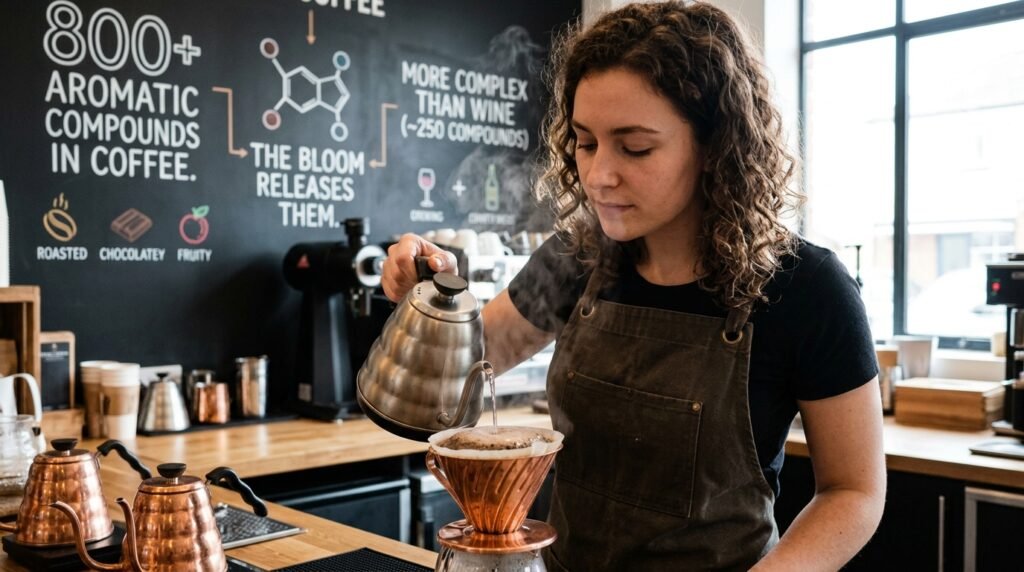
Coffee is one of the most chemically complex substances we consume. While wine usually contains around 200 to 300 aromatic compounds, roasted coffee has been found to have over 800.
These compounds are created during the roasting process, where heat transforms the raw, “grassy” green beans into the aromatic powerhouses we love. This transformation is driven by the Maillard reaction and caramelization, which break down sugars and proteins into complex molecules.
Some of the key chemical families include:
-
Sulfur compounds: Responsible for the roasted, “meaty” or nutty notes.
-
Pyrazines: These provide the earthy, chocolatey, and toasted scents.
-
Esters: The source of the fruity and floral aromas found in high-altitude coffees.
Understanding this chemistry is why The Science of the Bloom: Why Bubbles are the Key to Flavor Extraction is so vital. When you pour hot water over fresh grounds, the releasing Co2carries these 800+ compounds directly to your nose. If you skip the bloom, you are literally letting the best part of the coffee’s chemistry escape before you can experience it.
2. Orthonasal vs. Retronasal Olfaction
Did you know you “smell” coffee twice?
The first time is Orthonasal olfaction. This is when you put your nose to the bag or the cup and inhale. This tells your brain what to expect.
The second, and more important time, is Retronasal olfaction. This happens after you take a sip. As you swallow, aromatic vapors travel from the back of your throat up into your nasal cavity. This is when your brain combines the basic “bitter” or “acidic” signals from your tongue with the complex aromas in your nose to create the perception of “flavor.”
This is why, if you have a cold and your nose is blocked, coffee tastes like hot, bitter water. The tongue is doing its job, but the “flavor” is missing because the retronasal path is closed. Mastering this path is a key skill when Calibrating Your Espresso: The Dialing-In Process, as the intensity of espresso can often overwhelm the tongue, requiring you to rely on your nose to find the sweetness.
3. The “Fragrance” vs. “Aroma” Distinction
In professional coffee cupping, we use two different terms for the scent:
-
Fragrance: The smell of the dry grounds. This is the “purest” expression of the roast.
-
Aroma: The smell of the wet coffee after water has been added.
The hot water acts as a solvent, releasing heavier molecules that don’t escape when the coffee is dry. This is why a coffee might smell like nuts when dry, but reveal notes of berry once brewed. Paying attention to this transition is one of the easiest ways to start “calibrating” your nose to recognize different origins.
4. Terroir and the Olfactory Map
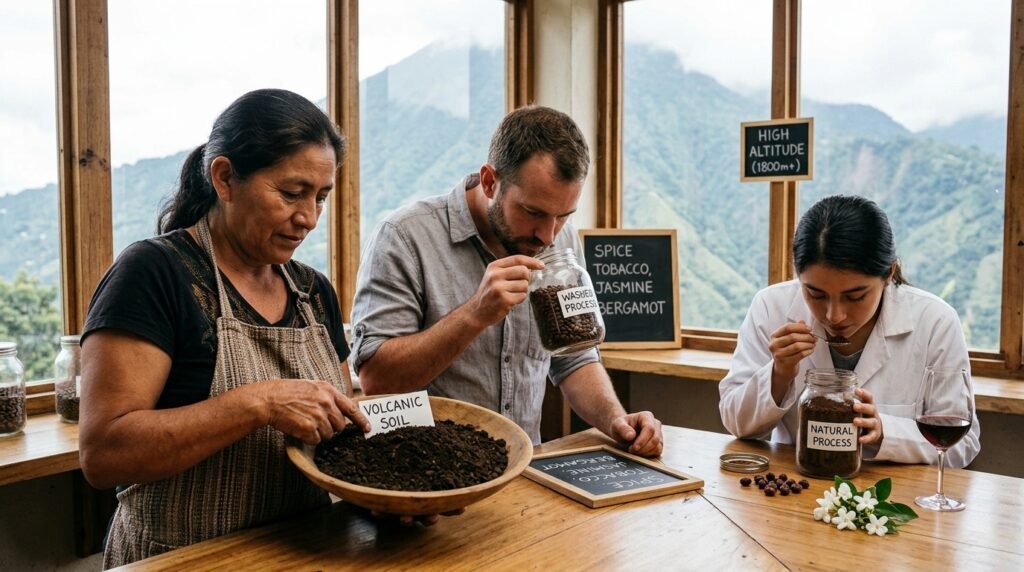
Just as we explored in The Volcanic Soul of Central America: Guatemala and El Salvador Profiles, the environment where a coffee grows dictates its chemical makeup.
-
Volcanic Soils: Often produce coffees with “heavier” aromas like spice, tobacco, and dark cocoa.
-
High Altitudes: The cold nights slow down the plant’s metabolism, allowing for the development of delicate esters that smell like jasmine or bergamot.
-
Processing Methods: A “Natural” process coffee will have a heavy, fermented aroma (like wine or dried fruit), while a “Washed” coffee will have a cleaner, more floral scent.
Your nose is essentially a biological GPS. With enough practice, it can tell you the altitude, the country of origin, and even the processing method before you ever take a sip.
5. The Role of Temperature in Aroma Release
Aroma is a game of energy. Volatile compounds need heat to turn from a liquid/solid into a gas so they can reach your olfactory sensors.
This is why “hot” coffee has a much more intense smell than iced coffee. However, there is a catch. If the coffee is too hot (above 70°C), the heat can actually numb your sensors and mask the more delicate aromas.
The “sweet spot” for olfactory appreciation is usually between 50°C and 60°C. As the coffee cools, different compounds become prominent. The heavy “roasty” scents fade, and the delicate “fruity” acids begin to shine. This is why a great cup of coffee actually tastes better as it approaches room temperature—your nose is finally able to detect the most complex molecules.
6. Training Your Nose: The Sensory Lexicon
You might hear a barista say a coffee has “notes of stone fruit and honeysuckle” and think they are making it up. They aren’t; they’ve just trained their brain to recognize those specific chemical signals.
The best way to train your nose is to use a “Sensory Lexicon” or the Coffee Taster’s Flavor Wheel.
-
Smell everything: When you’re at the grocery store, smell the lemons, the peaches, the toasted almonds.
-
Anchor the scent: When you smell something in your coffee, try to link it to a real-world object. “This smells like the zest of an orange,” rather than just “fruity.”
-
Use the “Whiff” Technique: Don’t take one long inhale. Take several short, sharp “bunny sniffs.” This keeps the air moving over the olfactory bulb and prevents “sensory fatigue.”
7. Why Some Smells Are Repulsive: The Science of Defects
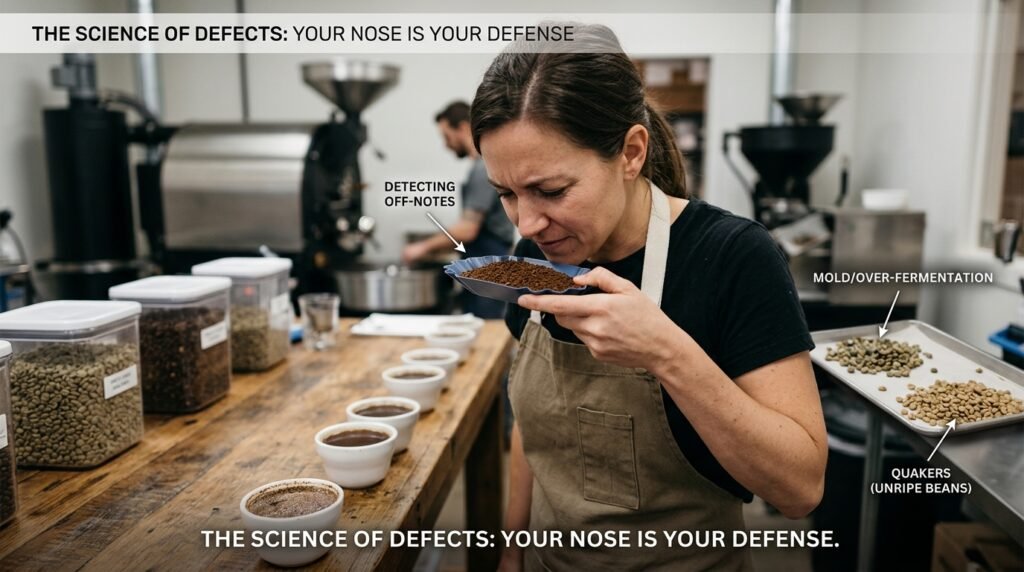
Your nose is also your primary defense mechanism. It is designed to detect “off” scents that indicate danger or decay.
In coffee, “defects” like moldy beans, over-fermentation, or “quakers” (unripe beans) produce specific chemicals that our noses find instinctively unpleasant.
-
Tricloroanisole (TCA): The same compound that causes “cork taint” in wine, giving coffee a basement-like, musty smell.
-
Acetic Acid: Over-fermented beans smell like vinegar or harsh sweat.
-
Lipid Oxidation: If your coffee is old, the oils turn into peroxides, which smell like rancid nuts or old paint.
This is why The Science of Coffee Storage: How to Keep Your Beans Fresh for Months is so important—it’s not just about keeping the “good” smells in; it’s about preventing the “bad” ones from forming.
8. The Psychological Impact: Aroma and Emotion
Finally, we have to talk about the limbic system. The olfactory bulb is directly connected to the parts of the brain that handle emotion and memory. This is why coffee aromas are so evocative.
For many, the smell of coffee is associated with the “reward” of caffeine. Over time, your brain creates a Pavlovian response: you smell the coffee, and your brain starts producing dopamine before the caffeine even hits your blood. It is a psychological hug in a mug.
By taking the time to truly smell your coffee, you are engaging with your brain’s deepest emotional centers, turning a simple caffeine fix into a moment of genuine mindfulness.
Summary: Olfactory Quick Facts
| Term | Definition | Impact on Experience |
| Volatiles | Compounds that evaporate easily. | These are the “smellable” parts of coffee. |
| Orthonasal | Inhaling through the nostrils. | Sets expectations and triggers initial memory. |
| Retronasal | Aroma traveling from mouth to nose. | Defines 80% of what we perceive as “flavor.” |
| Maillard Reaction | Chemical reaction between sugar/protein. | Creates the toasted, nutty, and savory scents. |
| Anosmia | Loss of smell. | Renders specialty coffee indistinguishable from water. |
Final Thoughts
We spend a lot of time talking about the “tongue” of coffee—the bitterness, the body, the acidity. But if we want to truly understand what we are drinking, we have to look up.
Your nose is the most sophisticated analytical tool in your kitchen. It is capable of detecting parts-per-billion of specific molecules, telling you stories about soil, weather, and the hands that picked the fruit.
The next time you brew a cup, don’t rush the process. Stop at the bloom. Take those “bunny sniffs” of the dry grounds. Notice how the scent changes as the water hits the beans and as the cup cools. You aren’t just drinking a beverage; you are experiencing a 1,000-piece chemical puzzle.
Happy smelling, and may your nose always lead you to the best beans!

Marcelo Clark combines professional industry experience with a passion for democratizing coffee knowledge. Specialist in extraction techniques and an advocate for single-origin beans, Marcelo uses this space to teach beginners how to appreciate the subtle notes of a well-crafted brew. His goal is to make learning about methods and origins simple, relevant, and inspiring for every reader’s daily routine.