
Every coffee bean you have ever brewed, whether it was a dark-roasted Brazilian or a spicy Monsoon Malabar, shares a single common ancestor. That ancestor didn’t come from a lab or a commercial plantation. It came from the cool, shaded highlands of Ethiopia.
In Ethiopia, coffee isn’t just a crop. It is a member of the family. It is a spiritual bridge. It is the center of the social fabric. While the rest of the world views coffee through the lens of industry and “yield,” Ethiopia views it through the lens of heritage.
This is the only place on Earth where Coffea arabica grows natively in the wild. If you walk into the forests of Kaffa or Jimma, you aren’t just looking at trees; you are looking at thousands of years of biological history. It is a place where the legend of Kaldi and his dancing goats—the story that launched a global obsession—still feels entirely plausible.
In this guide, we are going to journey into the heart of the Ethiopian highlands. We will explore the “Heirloom” mystery, the distinct profiles of Yirgacheffe and Sidamo, and why the Ethiopian Coffee Ceremony remains the ultimate expression of hospitality and respect.
1. The Heirloom Mystery: A Genetic Goldmine
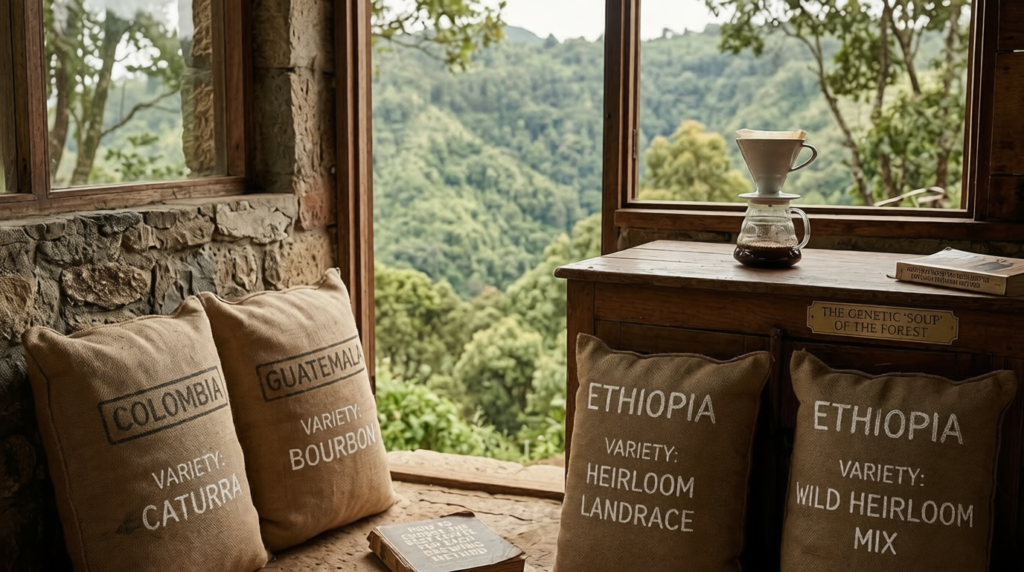
If you look at a bag of coffee from Colombia or Guatemala, it will often list the specific variety: “Caturra,” “Bourbon,” or “Typica.” But look at a bag of high-quality Ethiopian coffee, and it will almost always say: “Landrace” or “Heirloom.”
This isn’t because the farmers are lazy. It’s because the genetic diversity in Ethiopia is so vast that it is nearly impossible to categorize. There are estimated to be thousands of undiscovered varieties growing in the wild forests.
When we talk about “Heirloom” Ethiopian coffee, we are talking about a mix of these wild and semi-wild varieties that have adapted to their specific hillside over centuries. This genetic “soup” is what gives Ethiopian coffee its unparalleled complexity. This diversity is a major factor in why How to Choose the Best Coffee for Each Brewing Method often suggests Ethiopian beans for filter brewing; there are so many layers of flavor that you need a clean paper filter to see them all.
2. The Legend of Kaldi: More Than Just a Story
We’ve all heard the myth. Around 850 AD, a young goat herder named Kaldi noticed his flock acting strangely. They were frolicking, jumping, and dancing after eating small red berries from a green shrub. Kaldi tried the berries himself, felt a rush of energy, and the rest is history.
While the story is likely a charming folk tale, it points to a deeper truth: humans have been interacting with coffee in Ethiopia for over a millennium. Long before it was a beverage, Ethiopian ancestors were mixing ground coffee cherries with animal fat to create “energy balls” for long journeys.
Coffee wasn’t “invented” in a cafe in Venice or London; it was discovered in the forest. This primal connection to the plant is what allows for the incredible flavor persistence we see in The Science of Aftertaste: Why Great Coffee Lingers. The natural oils and acids developed in these ancient forests are designed by nature to leave a lasting impression.
3. The Region of Yirgacheffe: The Floral King
If coffee had a “Perfume District,” it would be Yirgacheffe. Located within the larger Sidamo region, Yirgacheffe has become so famous that it is often treated as its own origin.
The coffee here is grown at staggering altitudes—often above 2,000 meters. This thin air slows down the maturation of the fruit, concentrating the sugars and developing a chemical profile that is unlike anything else in the world.
-
The Profile: Intense floral aromas (jasmine, honeysuckle, bergamot) and a “sparkling” acidity that tastes like lemon zest or Earl Grey tea.
-
The Experience: It is light-bodied, elegant, and tea-like. If you are someone who thinks coffee only tastes like “roasted beans,” a washed Yirgacheffe will change your life. It is the quintessential example of why The Science of Coffee Aromas: How Your Nose Determines Flavor is so important; the pleasure of a Yirgacheffe is 80% fragrance.
4. Sidamo and Guji: The Berry Bombs
While Yirgacheffe is known for its floral delicacy, the surrounding regions of Sidamo and the high-altitude forests of Guji are known for their fruit intensity.
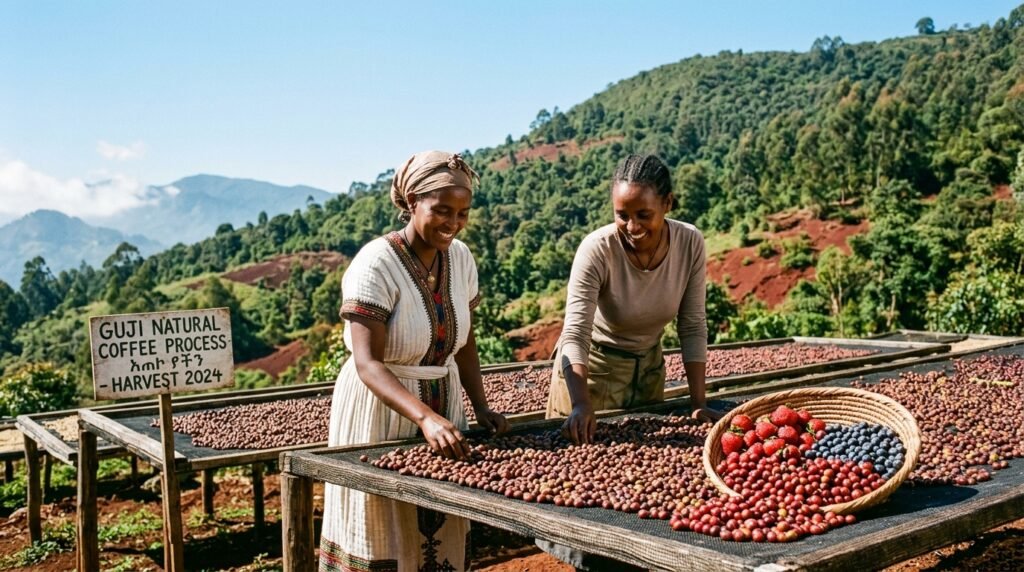
In Guji, the landscape is a mix of lush forest and volcanic soil. This combination produces coffees with a “heavier” fruit profile—think sun-ripened strawberries, blueberries, and even stone fruits like peach.
These regions are where the “Natural Process” (drying the bean inside the fruit) truly shines. When an Ethiopian Guji is naturally processed, the bean absorbs the concentrated fruit sugars of the pulp, resulting in a cup that can literally taste like a bowl of mixed berries and cream.
5. The Ethiopian Coffee Ceremony: Abol, Tona, Baraka
In the West, coffee is a “grab and go” habit. In Ethiopia, it is a slow, sacred ritual known as the “Buna” ceremony. It can last for several hours and is a fundamental part of daily life.
-
Preparation: The woman of the household spreads fresh grass and flowers on the floor. She roasts the green coffee beans by hand in a flat pan over an open charcoal fire.
-
The Aroma: Once the beans reach a dark, oily sheen, the pan is carried around the room so guests can inhale the smoke—this is considered a blessing.
-
The Brew: The beans are ground with a mortar and pestle and brewed in a traditional clay pot called a Jebena.
-
The Three Rounds: The coffee is served in three distinct rounds. The first is Abol (the strongest), the second is Tona, and the third is Baraka (the blessing).
To be invited to a coffee ceremony is a mark of high respect. It is a reminder that coffee is meant to be shared, discussed, and savored. It is the antithesis of the “pod” machine; it is the ultimate expression of the “breathing room” philosophy.
6. The Science of the “Washed” vs. “Natural” Profile
Ethiopia is the best place to learn the difference between processing methods because the contrast is so dramatic.
-
Washed Ethiopian: These are the “clean” coffees. The fruit is stripped away immediately. The result is a cup that highlights the acidity and the floral notes. It feels like a high-end tea.
-
Natural Ethiopian: The fruit is left on the bean while it dries in the sun on “raised beds.” This allows for a slight fermentation. The result is a cup that highlights the body and the fruit sweetness. It feels like a rich, jammy dessert.
If you are a home barista, try buying one of each from the same region. It is the most effective way to calibrate your palate to the impact of processing.

7. The Challenge of the Future: Climate Change in the Forest
The coffee forests of Ethiopia are under threat. As global temperatures rise, the “cool” zone where Arabica thrives is moving higher up the mountains. For wild coffee, there is only so much higher they can go before they run out of mountain.
Furthermore, deforestation for timber and other crops is shrinking the genetic reservoir. This is why supporting Ethiopian coffee isn’t just about taste; it’s about conservation. Organizations are working to map these wild forests and protect the “Mother Trees” that hold the genetic keys to coffee’s survival.
By buying specialty Ethiopian coffee, you are supporting a supply chain that values these forests over clear-cutting. You are ensuring that the “Legend” continues for another thousand years.
8. Brewing Ethiopia: A Guide to Clarity
Because Ethiopian coffee is so complex, it can be easy to “muddle” the flavors if you aren’t careful.
-
The Grind: For washed Ethiopians, go slightly coarser than you think. You want to avoid over-extraction, which can turn those delicate floral notes into something that tastes like “dried grass.”
-
The Water: This is vital. Ethiopian coffee’s high acidity is very sensitive to water pH. Use filtered water to ensure the citrus and floral notes aren’t neutralized by hard-water minerals.
-
The Temperature: Don’t use boiling water. Aim for around 92°C to 94°C. This is the “Goldilocks” zone for preserving those volatile aromatics we discussed in our science guides.
Summary: Ethiopian Regional Comparison
| Region | Flavor Profile | Common Processing | Best For… |
| Yirgacheffe | Jasmine, Lemon, Bergamot | Washed | Pour-over (V60) / AeroPress |
| Sidamo | Berry, Citrus, Earthy | Washed / Natural | All-purpose brewing |
| Guji | Strawberry, Peach, Floral | Natural | Heavy-bodied espresso / Filter |
| Harrar | Blueberry, Winey, Wild | Natural | Moka Pot / Syrupy French Press |
| Limu | Spiced, Winey, Balanced | Washed | Daily drinking / Consistent body |
Final Thoughts
Ethiopia is the “Old Soul” of the coffee world. Every time you brew a cup of Ethiopian coffee, you are participating in a tradition that predates modern civilization. You are tasting the wild, untamed chemistry of the African highlands.
Whether you prefer the tea-like elegance of a washed Yirgacheffe or the berry-heavy “funk” of a natural Guji, Ethiopia offers a range of flavors that no other country can match. It is a reminder that coffee is, at its heart, a gift from the forest.
The next time you open a bag of Ethiopian beans, take a moment to breathe in the dry fragrance. Think of the ancient forests, the volcanic soil, and the thousands of years of human hands that have tended to these trees. You aren’t just drinking coffee; you are drinking the source.
Happy brewing, and may your cup be as vibrant as an Ethiopian sunrise!

Marcelo Clark combines professional industry experience with a passion for democratizing coffee knowledge. Specialist in extraction techniques and an advocate for single-origin beans, Marcelo uses this space to teach beginners how to appreciate the subtle notes of a well-crafted brew. His goal is to make learning about methods and origins simple, relevant, and inspiring for every reader’s daily routine.