
For decades, decaf coffee was the punchline of every joke in the specialty coffee world. It was often viewed as a “lesser” drink—a dusty bag sitting on the back shelf, reserved for those who couldn’t handle the “real stuff.” In the past, the flavor reflected this neglect: it was often bitter, metallic, or simply flat.
But times have changed. We are currently witnessing a “Decaf Renaissance.“
Whether for health reasons, a desire to sleep better, or simply wanting to enjoy the flavor of a high-end roast at 10:00 PM, modern coffee drinkers are demanding more from their caffeine-free options. Thankfully, science has caught up. We now have decaf coffees that are winning blind taste tests against regular beans.
But how do you target a single molecule—caffeine—and pull it out of a complex organic matrix without destroying the thousands of sugars, acids, and oils that make coffee taste good? It is a feat of precision chemistry that involves high-tech filters, organic solvents, and even compressed gases like CO2.
In this guide, we are going to break down the invisible world of decaffeination. We will explore the different processing methods, the chemistry of the “Swiss Water” miracle, and why decaf might just be the most difficult coffee for a barista to master.
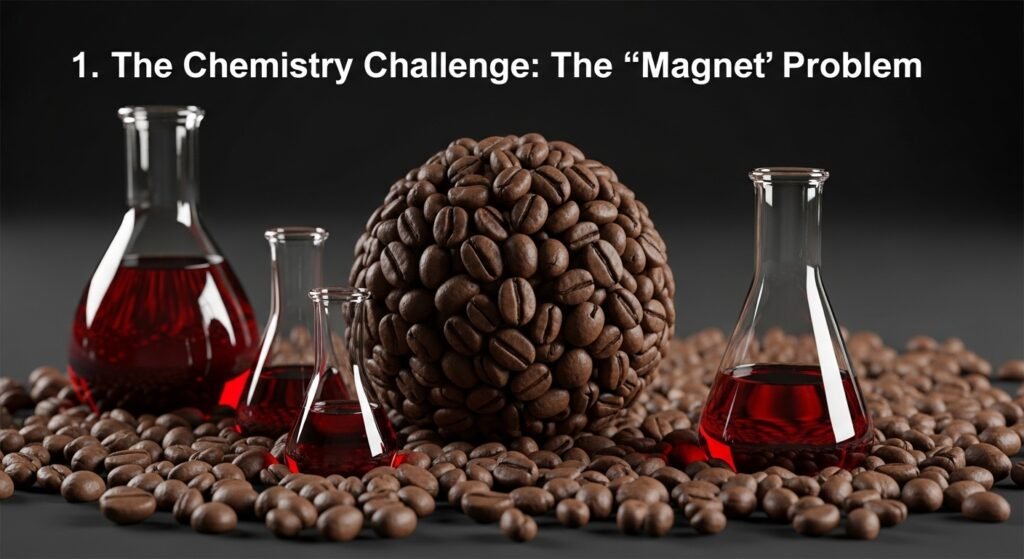
1. The Chemistry Challenge: The “Magnet” Problem
To understand why decaffeinating coffee is so hard, we have to look at what is inside a coffee bean. A green coffee bean is a dense structure of cellulose containing over 1,000 different chemical compounds. These include:
-
Lipids (Oils): These provide the mouthfeel and texture.
-
Carbohydrates (Sugars): These caramelize during the roast for sweetness.
-
Acids: These provide the “brightness” and floral notes.
-
Caffeine: A natural pesticide produced by the plant.
The problem is that caffeine is water-soluble. However, so are almost all the other things we like. If you simply soak a bean in water, the caffeine leaves—but the flavor leaves with it. The goal of modern science is to find a “selective solvent”—a substance that acts like a magnet for caffeine but ignores the rest.
This delicate balance is why The Chemistry of Extraction: Balancing Acid, Sweet, and Bitter is a different game when dealing with decaf. The bean’s internal structure has been “opened up” by the process, changing how we must handle it in the final cup.
2. The Direct and Indirect Solvent Methods
These are the most traditional methods, often referred to as the “European Process.” They rely on chemical solvents—usually Methylene Chloride or Ethyl Acetate—to do the heavy lifting.
The Indirect Method: In this version, the beans are soaked in near-boiling water to extract everything. The beans are then removed, and the solvent is added to the water. The solvent binds only to the caffeine. This mixture is then heated to evaporate the solvent and caffeine together. Finally, the beans are put back into the “flavor water” to reabsorb the oils and sugars they lost.
The Direct Method: Here, the beans are steamed to open their pores and then rinsed directly with the solvent. While this is efficient, it often results in a loss of complexity. Because the solvent touches the bean directly, it can sometimes strip away the delicate volatile aromatics that we discussed in The Science of Coffee Aromas: How Your Nose Determines Flavor.
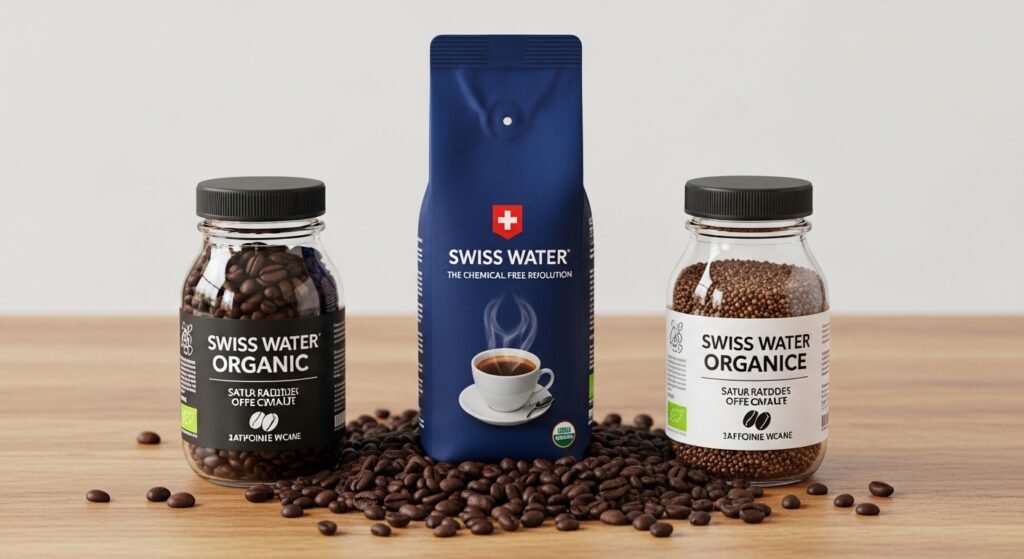
3. The Swiss Water Process: The Chemical-Free Revolution
If you are a fan of organic products, you have likely seen the “Swiss Water” logo. This process is a favorite in the specialty world because it uses absolutely no added chemical solvents. Instead, it uses the laws of physics—specifically Saturation and Osmosis.
The process uses something called Green Coffee Extract (GCE). GCE is water that has been saturated with all the flavor solids of green coffee but has had the caffeine filtered out through charcoal.
When fresh green beans are soaked in this GCE, the flavors don’t leave the bean because the water is already “full” of flavor. However, because the GCE has no caffeine, the caffeine molecules naturally migrate from the bean into the water. It is a brilliant, clean, and highly effective way to keep the “soul” of the coffee intact.
4. The Supercritical CO2 Method
This is the “high-tech” approach. It uses Carbon Dioxide (CO2) in a very specific state. When CO2 is put under immense pressure and heat, it becomes “supercritical”—it behaves like a gas (filling a space) but has the density of a liquid.
In this state, CO2 is a perfect solvent for caffeine. It is pumped through the green beans in a high-pressure chamber. It zips into the pores of the coffee, grabs the caffeine, and zips back out. Because CO2 is so selective, it leaves the sugars and proteins virtually untouched.
This process is incredibly clean, but it requires massive, expensive machinery. This is why you mostly see CO2 decaf in larger specialty batches. Because it preserves the bean’s structure so well, it is often the preferred choice for those who care about The Science of Coffee Body: What Creates That Syrupy Mouthfeel?, as the lipids remain largely undisturbed.
5. The Sugar Cane Process (Ethyl Acetate)
In coffee-growing regions like Colombia, the “Sugar Cane” process has become a major success. It uses Ethyl Acetate (EA), which is a natural byproduct of fermenting sugar cane.
Because EA is naturally occurring, it is often marketed as “Natural Decaf.” The beans are steamed and then bathed in EA, which dissolves the caffeine. A unique side effect of this process is that it often adds a slight, pleasant sweetness to the bean.
For many drinkers, an EA-processed coffee from Colombia can be almost indistinguishable from a regular cup, sometimes even showing enhanced fruity notes due to the natural fermentation of the solvent.
6. Why Decaf is Harder to Roast
Even with the best processing, decaf beans are a nightmare for the person behind the roasting drum. The decaffeination process changes the bean’s physical properties in two major ways:
-
Color Changes: Decaf green beans are often brown or tan rather than green. This means the roaster cannot use “color” as a visual cue to tell when the coffee is finishing.
-
Cellular Structure: The beans are more porous and lose their moisture faster. They tend to roast much quicker and can easily become “scorched” if the roaster isn’t paying close attention.
Roasting decaf is like driving a car with a much more sensitive gas pedal. You have to be gentle. This is why Calibrating Your Espresso: The Dialing-In Process is often more frustrating with decaf—the beans respond differently to heat and pressure than regular beans.
7. Brewing Decaf: The Solubility Trap
If you have ever brewed decaf at home and found it tasted bitter or “ashy,” you likely fell into the Solubility Trap.
Because decaf beans have been steamed and soaked during processing, their cell walls are already broken down. They are much more “soluble” than regular coffee. This means that hot water can extract the flavor (and the bitterness) much faster than usual.
How to adjust your home brew for decaf:
-
Coarsen the Grind: If you normally use a “medium” grind, go slightly coarser. This slows down the extraction rate.
-
Lower the Water Temp: If you brew regular coffee at 95°C, try brewing your decaf at 90°C.
-
Shorten the Time: If your pour-over usually takes 3 minutes, aim for 2 minutes and 30 seconds.
By adjusting these variables, you prevent the water from pulling out the “dry” and “woody” flavors that occur when decaf is over-extracted.
8. The Future: Genetically Caffeine-Free Trees?
Is there a world where we don’t need CO2 or water baths at all?
Scientists are currently researching a variety called Coffea charrieriana, a naturally caffeine-free coffee plant found in Central Africa. There are also efforts to use CRISPR gene-editing technology to “turn off” the caffeine-producing gene in high-quality Arabica trees.
If these efforts succeed, we could have “Natural Decaf” that is grown in the forest, harvested, and roasted exactly like regular coffee. Until then, the science of the Swiss Water and CO2 processes remains our best way to enjoy a delicious, late-night cup.
Summary: Decaf Process Comparison
| Method | Key Agent | Flavor Retention | Ideal For… |
| Swiss Water | Water / Charcoal | High | Organic lovers & Single Origin |
| Supercritical CO2 | Compressed CO2 | High | Consistency & Large batches |
| Sugar Cane (EA) | Ethyl Acetate | Medium-High | Sweetness & Colombian beans |
| Methylene Chloride | Chemical Solvent | Medium | Budget-friendly commercial coffee |
Final Thoughts
Decaf is no longer a compromise. It is a triumph of food science. We have moved from using harsh chemicals to using the natural properties of sugar cane, water, and air (CO2) to tailor our coffee experience to our lifestyles.
Whether you choose decaf for your health or just so you can enjoy the ritual of a cup without the jitters, you are participating in a highly technical and fascinating corner of the coffee world. The next time you drink a high-quality decaf, remember the journey that bean took—from the high-pressure CO2 chambers to the careful hands of a roaster who had to “re-learn” how to handle the heat.
The “black sheep” of coffee has finally come home, and it tastes better than ever.
Happy (restful) brewing!

Marcelo Clark combines professional industry experience with a passion for democratizing coffee knowledge. Specialist in extraction techniques and an advocate for single-origin beans, Marcelo uses this space to teach beginners how to appreciate the subtle notes of a well-crafted brew. His goal is to make learning about methods and origins simple, relevant, and inspiring for every reader’s daily routine.