
We have all been there. You are standing in the middle of a brightly lit supermarket aisle, surrounded by dozens of different coffee brands, each one promising the “richest aroma” or the “boldest flavor.” You pick up a bag, look at the price, look at the beautiful packaging, and wonder: Is this actually fresh, or has it been sitting on this shelf since last Christmas?
For a long time, I thought that as long as the bag was sealed, the coffee inside was “new.” I couldn’t have been more wrong.
After years of living in the U.S. and exploring everything from massive wholesale clubs to tiny local roasters in New England, I discovered that freshness isn’t a mystery—it’s a science. And more importantly, there is one specific trick I use every single time I shop that has completely changed my relationship with my morning cup.
The Problem with “Best By” Dates
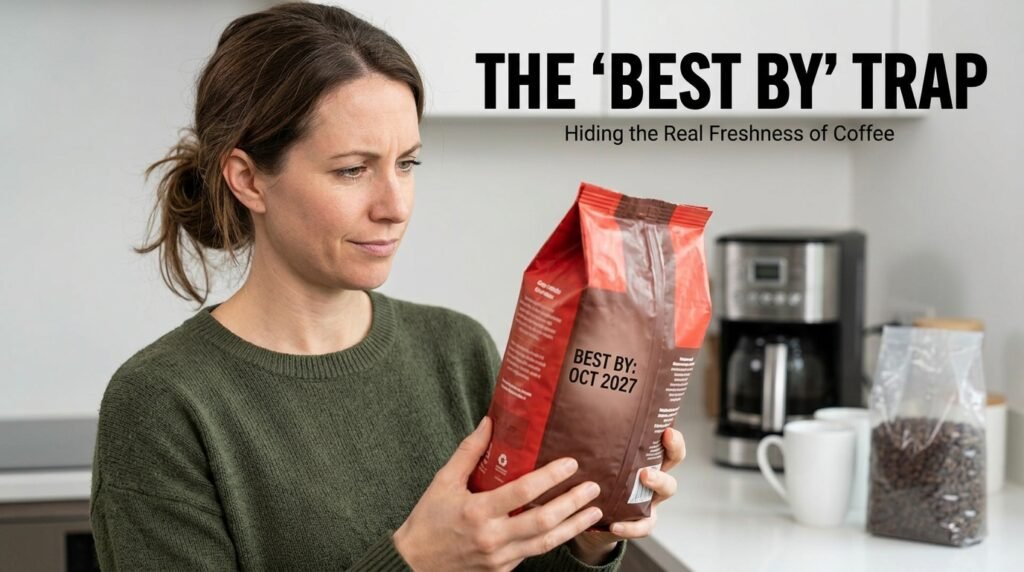
Before I reveal my go-to trick, we need to address the elephant in the room: the expiration date. Most commercial coffee companies are experts at hiding the age of their product. They will stamp a “Best By” date that is usually 12 to 18 months into the future.
If you see a bag that says “Best By: October 2027,” that doesn’t tell you when the coffee was roasted. It only tells you when the company thinks it will become legally “undrinkable.” In reality, coffee starts losing its aromatic complexity within 30 days of roasting.
I learned this through trial and error, and it was a major part of What I Wish I Knew Before Buying My First Specialty Coffee, where I realized I had been drinking stale beans for years thinking they were premium just because of the price tag.
The Simple Trick: The “CO2 Squeeze”
So, how do you tell if coffee is fresh without opening the bag? It’s all about the gas.
When coffee beans are roasted, they undergo a chemical reaction that produces a significant amount of carbon dioxide (CO2). For the first few weeks after roasting, the beans slowly release this gas. This process is called “degassing.”
Here is my trick: The Squeeze Test.
Most high-quality coffee bags in the U.S. come with a one-way degassing valve (that little plastic circle with tiny holes). These valves are designed to let CO2 out so the bag doesn’t explode, while preventing oxygen from getting in.
-
Pick up the bag and find the valve.
-
Give the bag a firm but gentle squeeze near the valve.
-
Put your nose near the valve as you squeeze.
If a puff of air comes out and it smells like a concentrated explosion of fragrance—sharp, intense, and distinct—the beans are likely fresh. If you squeeze the bag and very little air comes out, or if the aroma is faint, dusty, or smells like old cardboard, those beans have already finished degassing. They are stale.
This simple physical interaction with the product is one of The Mistakes I Made When Buying Coffee (And How You Can Avoid Them), as I used to just grab the first bag I saw without checking for these vital signs of life.
Why Does Freshness Actually Matter?
You might be thinking, “It’s just coffee, does it really need to be that fresh?”
To answer that, you have to understand that coffee is essentially a seed inside a fruit. It contains delicate oils and volatile organic compounds that create the flavors we love—notes of chocolate, berry, citrus, or caramel.
The moment the roasting process ends, oxygen starts attacking those oils. This is called oxidation. It’s the same process that makes an apple turn brown or crackers go soft. In coffee, oxidation turns those beautiful fruity notes into a sour, metallic, or “flat” flavor.
When you use the squeeze trick, you are essentially checking for the presence of CO2, which acts as a protective blanket for the beans. As long as the beans are still “breathing” out CO2, oxygen has a harder time getting in. Once the breathing stops, the flavor starts to die.
The “Valve-less” Trap
Sometimes you will find bags that don’t have a valve at all. These are usually the brick-style vacuum-sealed packs or the very cheap paper bags.
If a coffee is vacuum-sealed into a hard “brick,” it means the company had to wait for the coffee to completely degas before packing it. If they packed it fresh, the gas would break the seal. This means that by the time you buy a vacuum-sealed brick, the coffee is already several days or weeks past its flavor peak.
It might be “shelf-stable,” but it’s not fresh. Understanding this distinction is key to How I Tell the Difference Between Cheap Coffee and Quality Coffee, because true quality starts with how the product is handled immediately after it leaves the roaster.
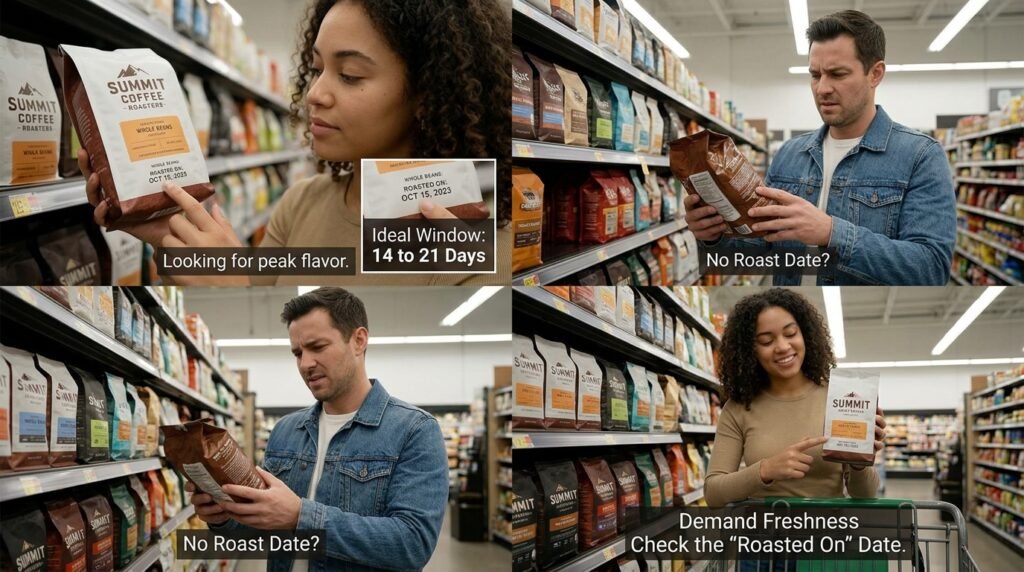
Looking for the “Roasted On” Date
While the squeeze test is my favorite physical trick, the most reliable “visual” trick is looking for a specific “Roasted On” date.
In many American grocery stores, specialty brands are starting to include this. If you can find a bag that was roasted within the last 14 to 21 days, you have found the “sweet spot.” Coffee usually needs about 3 to 7 days to degas enough to taste balanced, and it stays at its peak for about a month.
If a brand refuses to put a roast date on the bag, they are hiding something. It usually means their supply chain is too slow to guarantee freshness, and the bag you are holding might be six months old.
What to Do if You Can’t Find a Date
If you are at a store that doesn’t carry local specialty brands and there are no roast dates, don’t panic. You can still use a bit of logic.
Look for the bags that are tucked way in the back of the shelf. Supermarket employees are trained to practice “FIFO” (First In, First Out). They put the oldest stock at the front so people grab it first. Reach for the bag at the very back—it’s often from a newer shipment.
Then, apply the squeeze test. If the bag at the back feels “puffy” or tight, it’s a great sign. It means the CO2 is building up inside and the valve hasn’t let it all out yet. A puffy bag is almost always a sign of a very fresh roast.
The Role of Whole Beans in Freshness
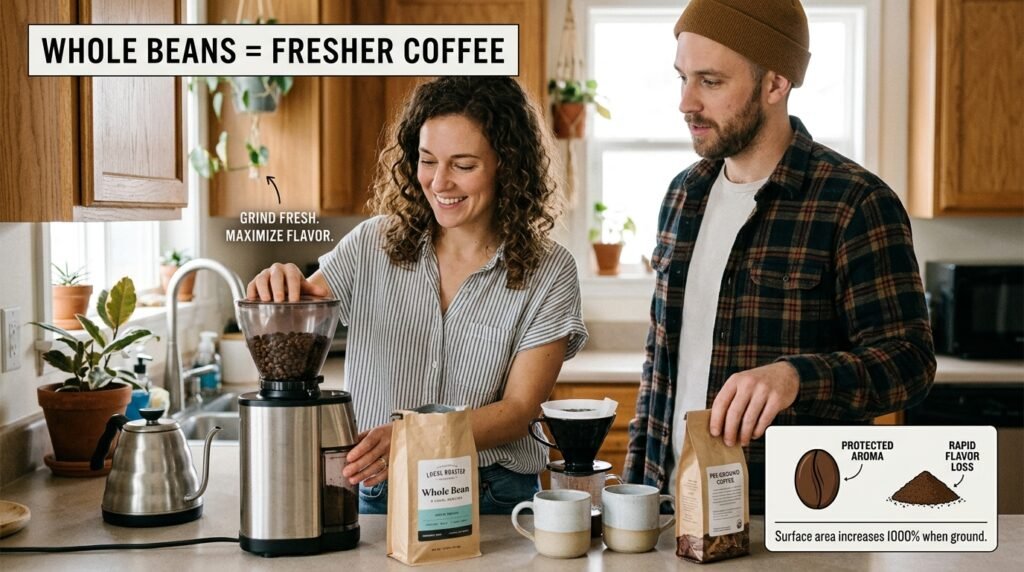
I cannot talk about freshness without mentioning the form of the coffee. If you are buying pre-ground coffee, the squeeze test still works for the aroma, but the “freshness window” is much smaller.
Once a bean is ground, its surface area increases by thousands of percent. Instead of one protective shell, you have thousands of tiny particles exposed to the air. Even with the best valve and the best bag, ground coffee loses its “magic” in a matter of days.
If you really want to make the most of your supermarket finds, I highly recommend buying whole beans. Grinding them right before you brew ensures that the freshness you identified at the store actually makes it into your cup.
My Personal Shopping Routine
Whenever I go to my local supermarket here in Contagem or when I’m traveling through the U.S., I follow a very specific path to the coffee aisle. I don’t look at the prices first. I don’t look at the “Organic” or “Fair Trade” seals first (though those are important).
I look for the valve. I squeeze. I smell.
If I find a bag that smells like vibrant, freshly roasted berries or dark cocoa, I know I’ve won. It doesn’t matter if it’s a famous national brand or a local roaster I’ve never heard of. The science of the gas doesn’t lie.
Summary Checklist for Your Next Trip
To make it easy for you, here is the summary of how to never buy stale coffee again:
-
Avoid the Bricks: Vacuum-sealed coffee is convenient but rarely fresh.
-
The Squeeze Test: Find the valve, squeeze gently, and look for a strong, clear aroma.
-
Check the Tension: A bag that feels slightly pressurized or puffy is usually fresher than a limp, flat bag.
-
Ignore the “Best By”: Look for the “Roasted On” date instead.
-
Reach to the Back: The freshest bags are usually hiding behind the older stock.
Final Thoughts
We spend so much money on coffee makers, filters, and fancy mugs, but we often neglect the most important ingredient: the bean itself. A $500 coffee machine cannot make stale beans taste good, but a $15 simple pour-over can make fresh beans taste like heaven.
The next time you are at the store, take an extra thirty seconds. Squeeze the bag. Listen to what the beans are telling you. It’s a small habit that will completely transform your mornings. You deserve a cup of coffee that actually tastes like the description on the bag, and now you have the “secret weapon” to find it every single time.
Coffee is one of life’s simple pleasures, and there is no reason to settle for a cup that is anything less than vibrant. Happy hunting!
Marcelo Clark combines professional industry experience with a passion for democratizing coffee knowledge. Specialist in extraction techniques and an advocate for single-origin beans, Marcelo uses this space to teach beginners how to appreciate the subtle notes of a well-crafted brew. His goal is to make learning about methods and origins simple, relevant, and inspiring for every reader’s daily routine.