There was a time when I thought buying coffee online was a bit “too much.” Why would I wait three to five days for a bag of beans to arrive in the mail when I could just grab one during my weekly run to the supermarket? It seemed like an unnecessary luxury.
But then, my curiosity got the better of me. I realized that while my local store had a decent selection, it was nothing compared to the vast, global library of flavors available on the internet.
Buying coffee online changed everything for me. It opened doors to roasters in Portland, Brooklyn, and even small towns in the Midwest that I would never have visited otherwise. However, shopping for coffee through a screen has its own set of challenges. You can’t smell the beans, you can’t squeeze the bag, and you can’t see the roast color.
To avoid wasting money on bad shipments, I had to develop a specific vetting process. Here is exactly what I look for before I hit that “Checkout” button.
1. The Roasting Schedule: The Most Important Tab
The first thing I do when I land on a roaster’s website isn’t looking at the coffee; it’s looking for their shipping and roasting policy.
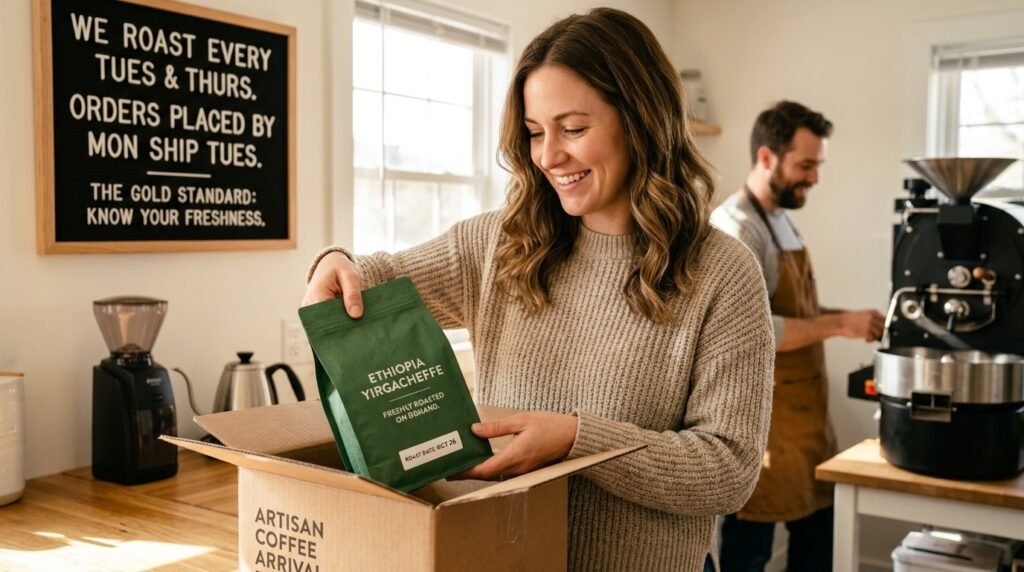
Top-tier online roasters are very transparent about this. They will usually have a note saying something like: “We roast every Tuesday and Thursday. Orders placed by Monday will ship on Tuesday.” This is the gold standard. When you buy from a place like this, you know the beans are being roasted to order. This is a massive contrast to buying from a giant online marketplace where the beans might have been sitting in a fulfillment center for months.
I’ve learned that How I Read Coffee Labels to Understand What I’m Really Buying is just as important online as it is in person. If a website doesn’t explicitly state that they roast to order, I assume the coffee is already sitting on a shelf, losing its magic.
2. A Deep Dive into the “Story” of the Bean
When I shop online, I expect more information than what fits on a physical bag. A good online coffee listing should be like a mini-documentary.
I look for:
-
The Producer’s Name: Not just the country, but the actual human being or cooperative that grew the coffee.
-
The Harvest Period: Coffee is seasonal. If I’m buying a bean in mid-2026, I want to see that it’s from the most recent harvest.
-
Detailed Tasting Notes: Instead of just “fruity,” I want to see “notes of dried apricot, honey, and black tea.”
The more detail the roaster provides, the more I trust their quality control. This level of detail is a huge part of How I Tell the Difference Between Cheap Coffee and Quality Coffee, because transparency is the ultimate sign of a premium product.
3. The Variety and Processing Method
Since I can’t use my senses, I rely on my knowledge of coffee chemistry. I look for the specific variety (like Geisha, Bourbon, or Caturra) and how it was processed.
If I want a clean, bright cup for my morning pour-over, I search for “Washed” process. If I’m in the mood for something thick, sweet, and berry-like, I look for “Natural” or “Honey” process.
A roaster that doesn’t list the process is like a car dealer that won’t tell you if a car is automatic or manual—it’s a fundamental piece of information that changes the entire experience.
4. Roast Level Clarity (Beyond “Light” and “Dark”)
Online, the term “Medium Roast” can mean wildly different things to different people. One roaster’s medium is another roaster’s dark.
I look for roasters who describe the roast philosophy. Do they roast for “clarity and acidity”? Or do they roast for “body and sweetness”? Some of the best sites even provide a “Roast Scale” or a photograph of the actual beans.
If I see a photo of oily, black beans on a “Medium” listing, I know that roaster isn’t for me. This visual verification is one of The Simple Trick I Use to Identify Fresh Coffee Beans at the Store, and while it’s harder to do online, a good website will try to give you that same confidence through high-quality photography and honest descriptions.
5. User Reviews (But with a Grain of Salt)
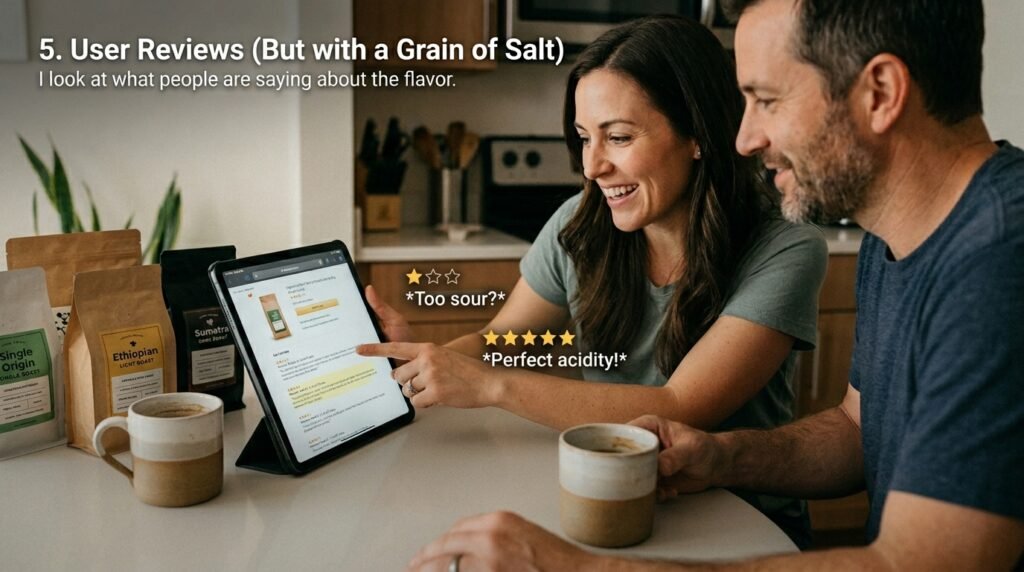
I always check the reviews, but I don’t look at the star rating first. I look at what people are saying about the flavor.
If a reviewer says, “This was too sour for me,” and I know it’s a light-roast Ethiopian bean, that actually tells me the roaster did a good job! The reviewer just didn’t understand the profile. I look for consistency in the comments. If everyone says the coffee is “smooth and chocolatey,” I can be fairly certain that’s what I’m going to get.
6. Shipping Speed and Packaging
Coffee’s greatest enemy is time. When buying online, I check the shipping options. If the only option is a 10-day ground shipping method that costs $15, I usually look elsewhere.
Ideally, I want the coffee to arrive at my door within 3 to 5 days of the roast date. This gives the coffee enough time to “rest” and degas during transit, so it’s perfectly ready to brew the moment I open the box.
I also look for roasters who use eco-friendly or high-tech packaging. Bags with resealable zippers and one-way valves are non-negotiable for me when ordering 12oz or 2lb bags.
7. The “About Us” Page: The Philosophy Check
I like to know who I’m giving my money to. I always spend a minute on the roaster’s “About” page.
-
Do they talk about sustainability?
-
Do they mention “Direct Trade”?
-
Do they seem like people who are obsessed with the craft, or does it feel like a generic drop-shipping operation?
Online coffee shopping is an opportunity to support passionate individuals. I prefer to buy from people who treat coffee as an art form rather than just a commodity.
8. Subscription Options (The Loyalty Perk)
Once I find a roaster I love, I check for subscription deals. Most online roasters offer a 10% to 15% discount if you sign up for a recurring delivery.
This is a great way to ensure you never run out of fresh beans and usually saves you enough money to cover the cost of shipping. It’s also a fun way to try “Roaster’s Choice” selections, where they send you their favorite new arrival every month.
9. Grind Options (Even Though You Should Buy Whole Bean)
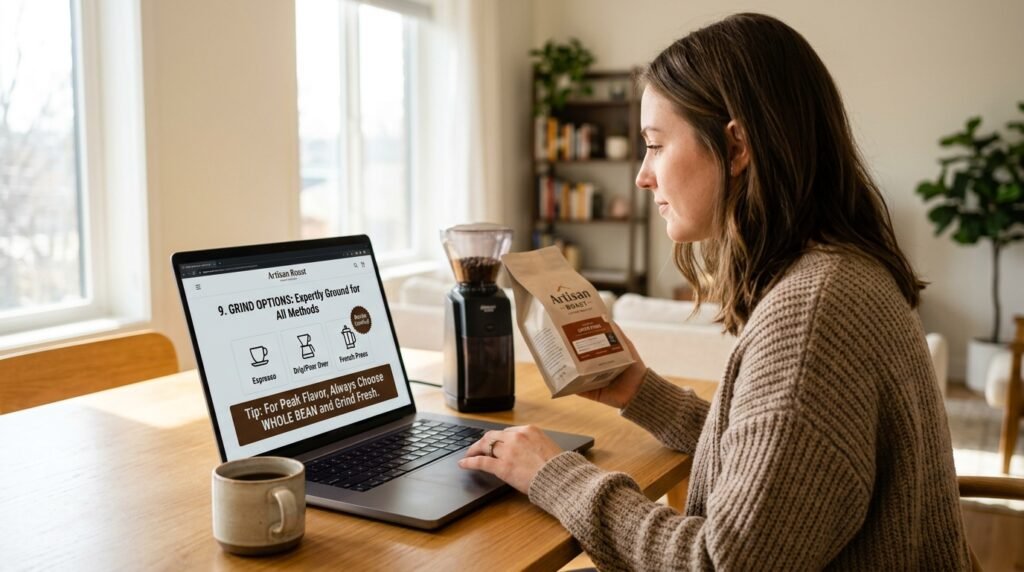
Even though I’m a firm believer in grinding at home, I check if the roaster offers different grind settings (Drip, French Press, Espresso).
While I don’t use this service, a roaster that offers specific grinds for different methods shows they understand the science of extraction. It’s a sign that they are catering to a knowledgeable audience. However, if you really want the best experience from your online purchase, always select Whole Bean.
10. The Price Point: Reality vs. Fantasy
If a website is selling “Rare Jamaican Blue Mountain” for $10 a bag, I know it’s a scam or extremely low quality.
Quality specialty coffee has a “floor” price. Between the cost of ethical sourcing, small-batch roasting, and specialized shipping, you should expect to pay between $18 and $25 for a high-quality 12oz bag. If the price is too good to be true, the coffee probably is too.
My Final Checklist for Your First Online Order
If you are about to place your first order from a new roaster, run through this quick mental list:
-
Roast Date: Does the site guarantee a roast date or roast-to-order?
-
Flavor Profile: Do the tasting notes match what you enjoy (Chocolatey vs. Fruity)?
-
Process: Is it Washed, Natural, or something experimental?
-
Transparency: Can you see the farm name or the producer?
-
Shipping: Will it arrive within a week of being roasted?
Final Thoughts
Buying coffee beans online is like being a kid in a candy store, but for adults. It allows you to taste the terroir of a specific hillside in Kenya or a shaded forest in Sumatra without leaving your kitchen.
Yes, it takes a little bit of research and a little bit of waiting, but the reward is a level of flavor that you simply cannot find on a standard supermarket shelf. By looking for transparency, roasting schedules, and specific origin data, you can turn your mail carrier into your personal barista.
Take the leap. Find a roaster that speaks to you, order a bag that sounds interesting, and experience the world through your coffee cup. Your morning routine will thank you for it.
Marcelo Clark combines professional industry experience with a passion for democratizing coffee knowledge. Specialist in extraction techniques and an advocate for single-origin beans, Marcelo uses this space to teach beginners how to appreciate the subtle notes of a well-crafted brew. His goal is to make learning about methods and origins simple, relevant, and inspiring for every reader’s daily routine.