
Think about your last cup of coffee. You probably spent a good amount of time picking out the beans. Maybe you even researched the farm, checked the roast date, and adjusted your grinder to the perfect setting. You poured the water, waited for the brew to finish, and took a sip.
But let me ask you: how much thought did you give to the water itself?
If you are like most people, the answer is “not much.” We tend to think of water as a neutral stage where the coffee beans perform their magic. But scientifically, that couldn’t be further from the truth. Your cup of coffee is approximately 98% to 99% water. If that 98% is mediocre, your 2% of expensive, artisan beans never stands a chance.
Living and brewing in different places has taught me that water isn’t just a solvent; it’s an active ingredient. It’s the “invisible hand” that either extracts the beautiful sweetness of the bean or leaves you with a cup that tastes like metallic ash. Here is the deep dive into the science of water and why your tap might be the reason your coffee doesn’t taste like it does at the café.
The Chemistry of Extraction: Why Pure Water isn’t Best
One of the most common mistakes beginners make is thinking that “Pure Water” (like Distilled or Reverse Osmosis water) is the ultimate goal for coffee. It sounds logical—pure water should yield the purest flavor, right?
Actually, no.
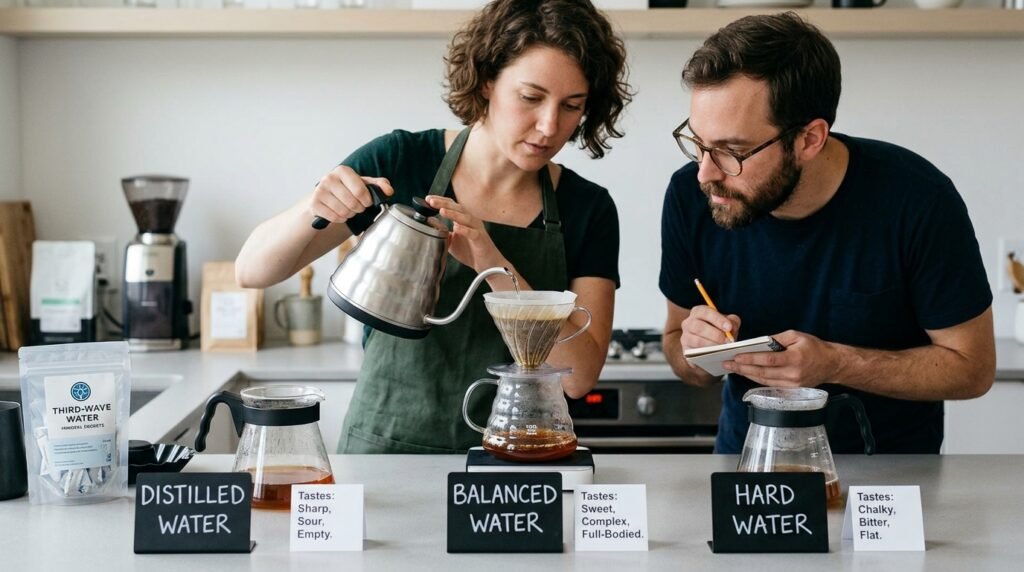
Coffee extraction is a chemical tug-of-war. The water needs certain minerals to “grab” the flavor compounds from the coffee grounds. If the water is too pure (distilled), it lacks the “hooks” necessary to pull out the sugars and oils. The result? A cup that tastes sharp, intensely sour, and strangely “empty.”
On the flip side, if your water is too “hard” (full of minerals like calcium and magnesium), the water is already “full.” It doesn’t have enough room to hold the coffee compounds, leading to a flat, chalky, and bitter brew. Finding that middle ground is exactly How I Tell the Difference Between Cheap Coffee and Quality Coffee, as quality isn’t just in the bean—it’s in the chemistry of the extraction.
The Roles of Magnesium and Calcium
In the specialty coffee world, two minerals are the superstars: Magnesium ($Mg^{2+}$) and Calcium ($Ca^{2+}$).
Magnesium is particularly good at extracting complex, fruity flavors. It has a high “charge density,” which means it acts like a powerful magnet for the delicate acids found in light-roasted African coffees. If your water is rich in the right amount of magnesium, your coffee will pop with sweetness.
Calcium, on the other hand, is great at pulling out the heavier, creamier notes like chocolate and nuts. However, too much calcium is the enemy of your equipment. It creates “limescale” buildup inside your kettle and espresso machine, which can eventually kill your gear.
This balance of minerals is why What I Wish I Knew Before Buying My First Specialty Coffee usually includes a lesson on water—you can buy the best beans in the world, but if your water is mineral-dead or mineral-heavy, you’ll never taste what the roaster intended.
The Problem with Chlorine and Chloramine
If you are brewing with straight tap water in most American cities, you are likely dealing with chlorine. Cities add it to keep water safe from bacteria, which is great for health but terrible for coffee.
Chlorine reacts with the phenols in coffee to create “chlorophenols,” which have a very distinct, medicinal, or plastic-like taste. If you’ve ever had a cup that tasted slightly like a swimming pool, that’s why.
Even if you use a basic pitcher filter, you might still have an issue. Many cities are switching to “chloramine,” which is more stable than chlorine and much harder to remove. This is why a simple charcoal filter is often the most important “coffee tool” you can own, even more than a fancy kettle.
Alkalinity: The “Flavor Buffer”
Beyond the minerals that pull flavor out, we have to talk about Alkalinity (not to be confused with pH).
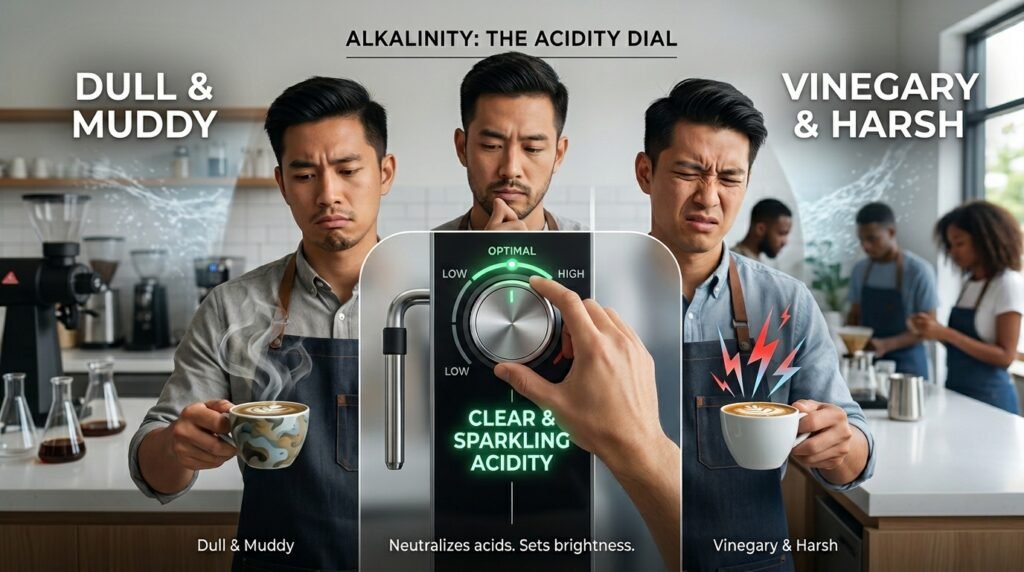
Alkalinity acts as a buffer. It neutralizes acids. If your water has high alkalinity, it will “eat” the beautiful, sparkling acidity of a Kenyan or Ethiopian coffee, making it taste dull and muddy. If your alkalinity is too low, the coffee will taste “vinegary” and harsh.
Think of alkalinity like the “volume knob” for the brightness of your coffee. When the knob is in the right place, the acidity is clear and pleasant. When it’s turned too high, the music stops.
How to Test Your Water at Home
You don’t need a lab coat to figure out what’s coming out of your faucet. Here are three ways to get a handle on your “Invisible Ingredient”:
-
The Taste Test: Pour a glass of your tap water and let it reach room temperature. Sip it. Does it taste like chlorine? Does it leave a dry, chalky feeling in your mouth? If you don’t enjoy drinking the water plain, you won’t enjoy it in your coffee.
-
The Kettle Test: Look inside your electric kettle. Is there a white, crusty buildup on the bottom? That’s “Scale.” If you see a lot of it, your water is very hard and is likely muting your coffee’s flavor.
-
TDS Meter: You can buy a cheap TDS (Total Dissolved Solids) meter online for about $15. It will give you a number. For coffee, the “sweet spot” is usually between 75ppm and 150ppm (parts per million). If your tap water is 400ppm, it’s far too “crowded” to make good coffee.
Solutions for the Home Barista
So, your tap water is terrible. What do you do? You have a few options, ranging from “cheap and easy” to “mad scientist”:
-
The Filter Pitcher: A standard Brita or Pur pitcher will remove chlorine and some heavy metals. It’s a great first step and will significantly improve the “cleanness” of your coffee.
-
Third Wave Water: This is a brilliant product for coffee nerds. It’s a small sachet of minerals that you add to a gallon of distilled water. It gives you the “perfect” mineral balance for coffee extraction every single time.
-
The “Barista Hustle” Recipes: If you really want to dive deep, you can buy Epsom salts and baking soda and mix your own mineral concentrates. It sounds crazy, but once you taste the difference, it’s hard to go back.
This quest for the perfect water is part of The Mistakes I Made When Buying Coffee (And How You Can Avoid Them)—I used to blame the roaster for a “bitter” bag, when in reality, it was just my hard tap water over-extracting the beans.
The “Bottled Water” Trap
Many people think, “I’ll just buy bottled water for my coffee.” Be careful!
Many bottled waters are “Spring Water,” which can actually be higher in minerals than your tap water. Others are “Purified Water” with added minerals for taste, which might not be the right minerals for coffee. If you go the bottled route, look for water that has a relatively low mineral content, or stick to the “distilled + minerals” method mentioned above.
Temperature: The Final Variable
Water quality isn’t just about what’s in the water; it’s about how that water behaves.
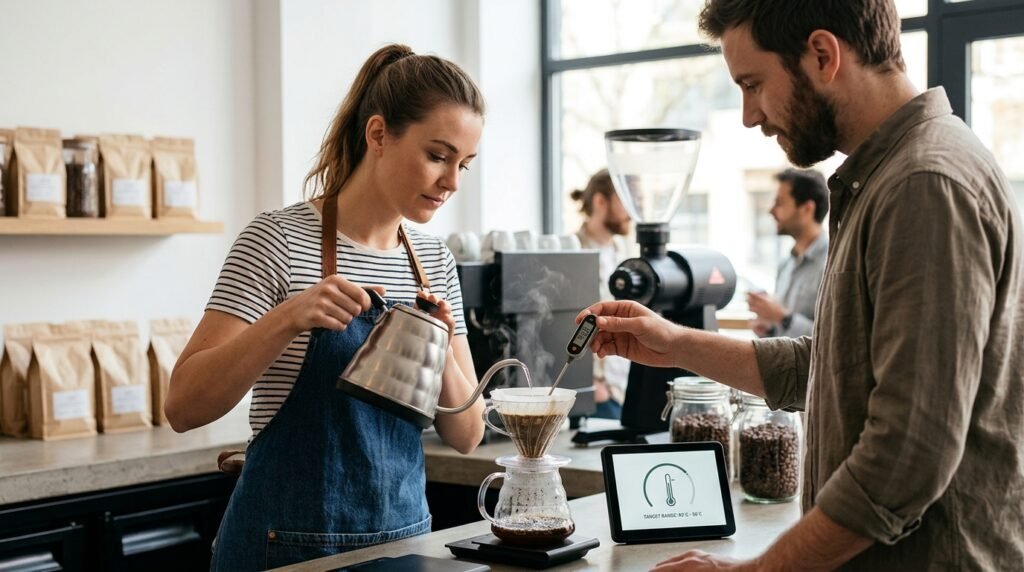
Hard water actually changes the boiling point slightly, but more importantly, minerals affect how the water holds heat. When you are brewing, remember that your water should usually be between $90^\circ C$ and $96^\circ C$. If your water is too hard, you might find that you need to lower your temperature to avoid pulling out too much bitterness.
Summary: Your Water Checklist
To stop your water from ruining your beans, follow these steps:
-
Filter for Chlorine: At the very least, use a charcoal filter.
-
Avoid Distilled Water Alone: You need some minerals for the “tug-of-war.”
-
Watch for Scale: If your kettle is white inside, your water is too hard.
-
Consistency is Key: Try using the same water every day so you can accurately adjust your grind and brew time.
Final Thoughts
We spend so much time obsessing over the beans, the grinders, and the brewers, but we often forget the medium that makes it all possible. Water is the silent partner in your morning ritual. It carries the flavor from the grounds to your tongue.
When you start paying attention to water quality, you’ll find that those “tasting notes” on the bag suddenly start to appear in your cup. The “blueberry” notes in that Ethiopian bean aren’t a myth—they were just being drowned by your tap water.
Treat your water with the same respect you treat your beans. It’s a small change that yields a massive reward. Your palate, your equipment, and your morning mood will thank you for it. After all, why spend $20 on a bag of artisanal beans if you’re going to brew them with water that tastes like a swimming pool?
The science of coffee is beautiful, complex, and sometimes a little frustrating. But mastering the water is the moment you stop being a “coffee maker” and start being a “coffee brewer.”
Happy (and clean) brewing!

Marcelo Clark combines professional industry experience with a passion for democratizing coffee knowledge. Specialist in extraction techniques and an advocate for single-origin beans, Marcelo uses this space to teach beginners how to appreciate the subtle notes of a well-crafted brew. His goal is to make learning about methods and origins simple, relevant, and inspiring for every reader’s daily routine.