
For a long time, I viewed the coffee roaster as a kind of magician. I would see these green, hard, grass-smelling seeds go into a giant rotating drum, and fifteen minutes later, they would emerge as chocolate-brown, aromatic beans that smelled like heaven. It felt like alchemy—turning lead into gold.
But as I began to study the science behind my morning cup, I realized that roasting isn’t magic; it’s one of the most complex chemical journeys in the culinary world. Inside that roasting drum, thousands of chemical reactions are happening simultaneously. Sugars are breaking down, acids are being created (and destroyed), and the very cellular structure of the bean is being blown apart by steam.
Understanding what happens during the roast changed the way I buy coffee. It stopped being about “Light vs. Dark” and started being about “How much of the bean’s soul survived the fire?” Here is the story of what happens inside the bean during those critical minutes in the roaster.
Phase 1: The Drying Phase (The Calm Before the Storm)
When green coffee beans enter the roaster, they contain about 10% to 12% water. You can’t start “cooking” the bean until that water is gone. For the first few minutes, the bean is simply absorbing heat. It turns from a pale, bluish-green to a yellowish-tan.
At this stage, it smells like wet hay or toasted bread. Nothing “coffee-like” has happened yet. But this phase is crucial. If the roaster applies too much heat too fast, the outside of the bean burns while the inside stays raw. If they go too slow, the coffee becomes “baked” and loses its vibrant potential.
I’ve learned that What I Look for in Coffee Beans After Visiting Several Coffee Shops often comes down to the uniformity of this early stage. If the beans look uneven, the roaster likely rushed the drying phase.

Phase 2: The Maillard Reaction (The Architect of Flavor)
Around 150°C (302°F), the real magic begins. This is called the Maillard Reaction. You’ve seen this reaction in action every time you sear a steak or toast a marshmallow. It’s a chemical reaction between amino acids and reducing sugars.
In coffee, the Maillard Reaction is responsible for creating hundreds of flavor compounds. This is where the savory, toasted, and malty notes are born. The bean begins to turn brown, and the aroma starts to shift from “bread” to “caramel.”
This is the most critical window for a roaster. By slowing down or speeding up the Maillard Reaction, a roaster can emphasize different notes. Want more body and chocolate? Slow it down. Want more clarity and fruit? Speed it up. Understanding this balance is a huge part of How I Tell the Difference Between Cheap Coffee and Quality Coffee, as quality roasting is about precision during this reaction.
Phase 3: Caramelization (The Birth of Sweetness)
As the heat continues to rise, the sugars in the coffee begin to break down through Caramelization. This is a different process than Maillard; it’s the thermal decomposition of sugar molecules.
Caramelization creates that deep, complex sweetness we love in a good medium roast. However, there is a catch: as caramelization continues, the sugars eventually turn bitter. It’s a bell curve. If you stop too early, the coffee is thin and sour. If you go too long, it tastes like burnt sugar and carbon.
The “First Crack”: The Bean’s Declaration
At some point, usually around 196°C (385°F), you will hear a distinct POP. It sounds exactly like popcorn. This is known as the First Crack.
Inside the bean, the water has turned to steam, and the pressure has become so intense that the cellular structure of the bean literally fractures. The bean doubles in size and begins to release a significant amount of CO2.
For specialty coffee lovers, this is the “Golden Zone.” A Light Roast is usually stopped just as the first crack finishes. At this point, the bean’s original “terroir”—the flavor of the soil, the altitude, and the variety—is at its most vibrant. If I’m brewing a high-altitude bean, I want to stop here to preserve those delicate mountain notes. This is a secret The Secrets of High Altitude: Why Mountains Make Better Coffee taught me: the best coffee is often the one that was least interfered with by the fire.
Phase 4: The Development Phase (The Roaster’s Signature)
The time between the First Crack and the end of the roast is called “Development.” This is where the roaster “finishes” the flavor.
If they leave the beans in for another 30 seconds, they might get more chocolate notes. Another 60 seconds, and they move into Medium Roast territory, where the acidity begins to drop and the body increases. The “brightness” of the fruit notes starts to transform into “dried fruit” or “caramel” notes.
The “Second Crack”: Entering the Dark Side
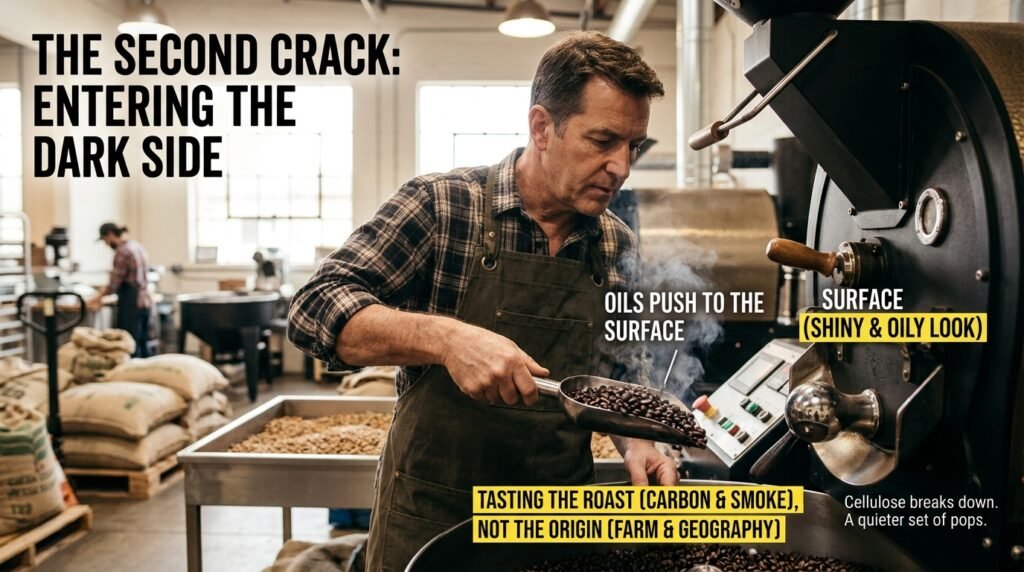
If the roaster continues to apply heat, they will eventually hear a second, quieter set of pops. This is the Second Crack. This isn’t steam—it’s the physical structure of the bean’s cellulose breaking down.
At this stage, the oils inside the bean are pushed to the surface. This is why dark roasted beans look shiny and oily. The flavor profile now shifts entirely from the “bean” to the “roast.” You are no longer tasting the farm in Ethiopia or the mountains in Colombia; you are tasting the carbon and the smoke of the roaster.
While some people love this “bold” flavor, the specialty coffee community generally avoids going too far into the second crack because it erases the hard work of the farmer and the unique geography of the origin.
Why Freshness is Actually a Chemical Clock
The roasting process creates a massive amount of CO2 that gets trapped inside the bean’s structure. This gas is actually what protects the delicate flavor oils from oxygen.
This is why “Freshly Roasted” coffee is so important. As that gas leaks out over 14 to 30 days, oxygen moves in. Oxygen is the great destroyer of flavor. It turns those beautiful oils rancid, leading to that “stale” or “cardboard” taste you find in supermarket coffee.
When you see a “Roasted On” date, you aren’t just looking at a calendar—you are looking at a chemical countdown.
The Role of Acids (The Hidden Vibrancy)
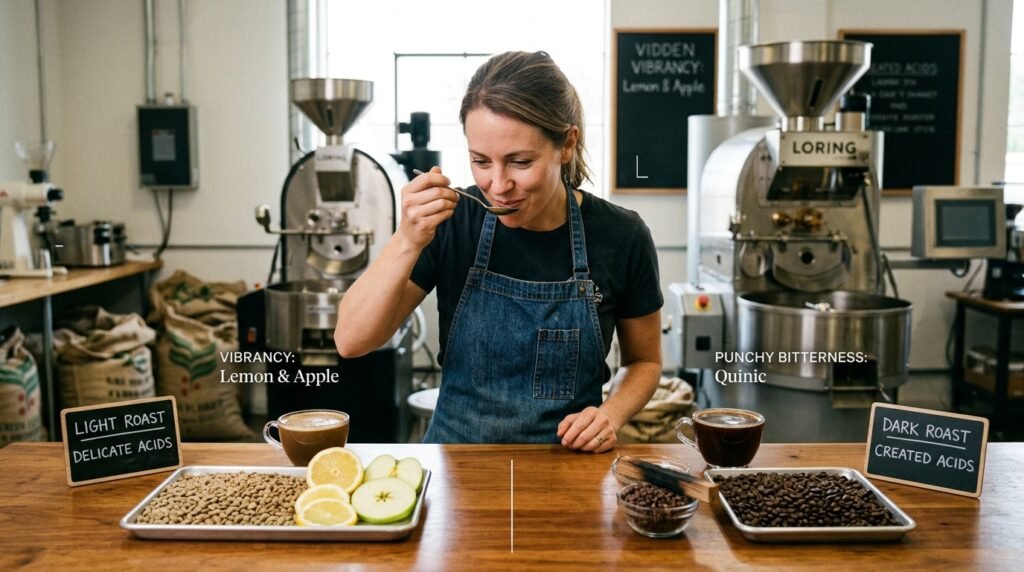
Coffee contains dozens of acids: Citric, Malic, Tartaric, and Quinic, to name a few.
-
Citric and Malic acids (which taste like lemons and apples) are very delicate. They are destroyed as the roast gets darker.
-
Quinic acid is actually created during the roast. It’s what gives dark coffee its “punchy” bitterness.
By understanding the chemistry, a roaster can “sculpt” the acidity of a cup, much like a chef balances a sauce.
Summary: What the Roast Level Tells Your Brain
-
Light Roast: High acidity, low body, maximum origin flavor. Think tea, flowers, and berries.
-
Medium Roast: Balanced acidity, medium body, high sweetness. Think chocolate, nuts, and caramel.
-
Dark Roast: Low acidity, heavy body, smoky/bitter flavors. Think charcoal, dark cocoa, and spice.
Final Thoughts
The next time you take a sip of coffee, try to visualize the journey that bean took. Imagine the millions of Maillard reactions that occurred to give you that chocolatey finish. Think about the pressure that built up inside the bean until it finally “cracked” to release its potential.
Roasting is the bridge between the farm and your kitchen. It is a delicate dance between heat and time, chemistry and intuition. When you find a roaster who knows how to respect the chemistry of the bean, you aren’t just buying coffee—you are buying the culmination of a scientific masterpiece.
Respect the roast, look for the date, and always remember: the best flavor is the one that was coaxed out with care, not forced out with fire.
Happy brewing, and stay curious about the science in your cup!

Marcelo Clark combines professional industry experience with a passion for democratizing coffee knowledge. Specialist in extraction techniques and an advocate for single-origin beans, Marcelo uses this space to teach beginners how to appreciate the subtle notes of a well-crafted brew. His goal is to make learning about methods and origins simple, relevant, and inspiring for every reader’s daily routine.