
If you have ever spent more than five minutes in a high-end specialty coffee shop, you have likely heard the names “Ethiopia” and “Kenya” whispered with a certain level of reverence. To the uninitiated, coffee is just coffee—maybe it comes from Brazil, maybe from Colombia. But to the coffee lover, Africa is the birthplace, the laboratory, and the ultimate peak of what a coffee bean can achieve.
I remember the first time I tasted a washed Ethiopian coffee. I was sitting in a quiet café, and when the barista handed me the cup, the smell alone made me stop. It didn’t smell like the roasted nuts or chocolate I was used to. It smelled like jasmine tea and freshly cut lemons. I took a sip, and my brain struggled to process it. “Is this actually coffee?” I asked myself.
That is the power of African coffees. They challenge everything you think you know about the beverage. While South American coffees are often comforting and reliable, African coffees are exciting, vibrant, and sometimes even a little confusing.
But why are these two countries so different from the rest of the world? And why does a bean from a Kenyan hillside taste so distinct from one grown in an Ethiopian forest? To understand this, we have to look at the history, the landscape, and the unique ways these regions handle their liquid gold.
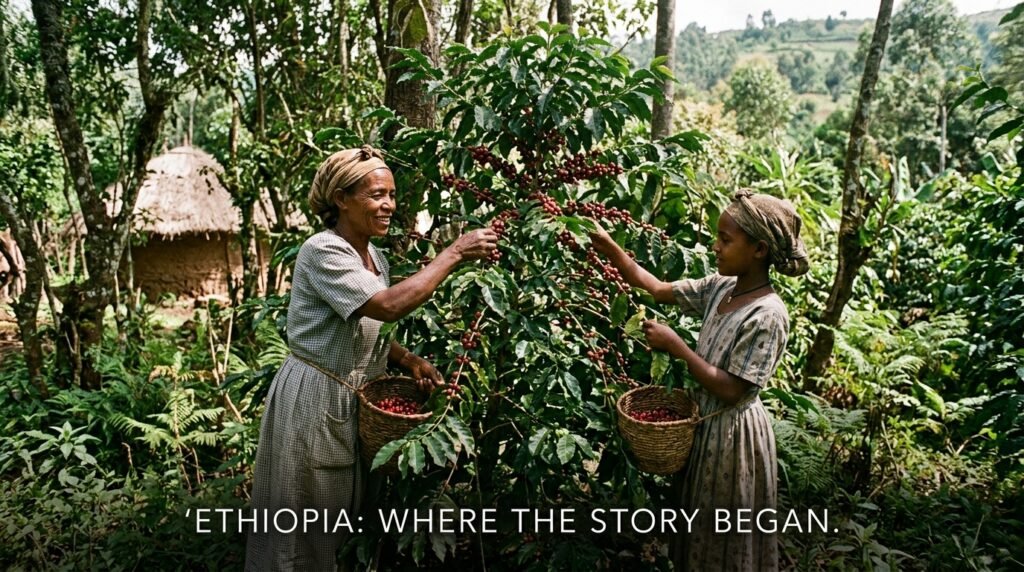
Ethiopia: Where the Story Began
Every coffee bean on the planet can trace its DNA back to the wild forests of Ethiopia. Legend tells of a goat herder named Kaldi who noticed his goats acting particularly energetic after eating some mysterious red berries. Whether or not Kaldi actually existed, the truth is that Ethiopia is the only place in the world where coffee grows natively.
In almost every other country, coffee is a “crop”—something brought in from somewhere else and planted in neat rows. In Ethiopia, coffee is part of the ecosystem. It grows in backyards, in wild forests, and on small communal plots. This genetic diversity is staggering. While the rest of the world mostly grows a few varieties like Typica or Bourbon, Ethiopia has thousands of “heirloom” varieties that don’t even have names yet.
This diversity is the secret behind those incredible floral notes. When you drink an Ethiopian coffee, you are tasting a wilder, more ancestral version of the plant. This is a primary reason How I Tell the Difference Between Cheap Coffee and Quality Coffee becomes so easy with African beans; the aroma is simply on another level.
The Two Faces of Ethiopia: Washed vs. Natural
If you are buying Ethiopian coffee, you have to choose between two very different experiences based on how the coffee was processed.
Washed Ethiopian Coffees are the aristocrats of the coffee world. They are clean, elegant, and light-bodied. They usually have notes of jasmine, bergamot, lemon, and green tea. If you like a cup that feels “crisp” and tea-like, this is your home.
Natural Ethiopian Coffees, on the other hand, are the “fruit bombs.” Because the bean dries inside the fruit, it absorbs an intense amount of sugar. These coffees often taste like blueberries, strawberries, or even red wine.
I’ve found that The Science of Cold Brew: Why Time Replaces Heat works exceptionally well with natural Ethiopian beans. The long steeping time amplifies those berry notes until the drink tastes more like a fruit infusion than a traditional coffee.
Kenya: The Precision of Flavor
While Ethiopia is about wild history and genetic diversity, Kenya is about precision, science, and intensity. If Ethiopia is a delicate watercolor painting, Kenya is a bold, high-contrast photograph.
Kenya entered the coffee scene much later than Ethiopia, but they did so with a level of organization that is rare in the coffee world. Most Kenyan coffee is grown on small farms and processed in “factories” (cooperatives). They use a unique “double-washed” method that involves fermenting the beans twice and then soaking them in clean water.
This labor-intensive process results in what many consider the “cleanest” coffee in the world. But “clean” doesn’t mean boring. Kenyan coffees are famous for their staggering acidity and deep, dark-fruit sweetness.
The Famous Blackcurrant Note
If there is one flavor that defines Kenyan coffee, it is Blackcurrant.
Kenyan beans are packed with phosphoric acid (the same thing that gives some sodas their “zing”). This creates a bright, sparkling acidity that is often balanced by a deep, syrupy sweetness. You might also taste grapefruit, tomato (in some savory lots), or dark berries.
This intensity can be a shock to the system. It is the opposite of a “smooth” coffee. It’s a loud, vibrant, and complex experience. This is exactly what The Secrets of High Altitude: Why Mountains Make Better Coffee explains—Kenya’s high-altitude plateaus (often above 1,700 meters) create the perfect environment for these intense acids to develop slowly.

The Unique Grading System
Kenya also has a unique way of grading their beans that you’ll see on the labels. You’ve probably seen the letters “AA” or “AB” on a bag.
Many people think “AA” means it’s the best quality, but it actually refers to the size of the bean. “AA” are the largest beans, followed by “AB” and “PB” (Peaberry). While larger beans often carry more oils and flavor, some of the best-tasting Kenyan coffees I’ve ever had were “AB” lots. The grade tells you about the size, but your palate tells you about the quality.
Soil and Sun: The African Terroir
Why does Africa produce these unique flavors? It’s a combination of iron-rich volcanic soil and a specific type of sunlight.
In the highlands of Ethiopia and Kenya, the sun is intense during the day, but the nights are very cold. This temperature swing causes the coffee cherry to contract and expand, a process that pumps sugars into the seed.
Furthermore, the soil in these regions is incredibly old and mineral-dense. The plants have to dig deep to find nutrients, resulting in a bean that is physically much harder and denser than a bean grown in the flatlands of a mass-production farm.
When you roast these beans, that density allows for a more complex development of flavors. As we discussed in The Chemistry of the Roast: What Happens Inside the Bean, a dense bean can handle the heat of the roaster in a way that unlocks those hidden floral and fruit notes without turning bitter.
The Cultural Connection: The Coffee Ceremony
In Ethiopia, coffee is more than an export; it is the center of social life. They have a beautiful “Coffee Ceremony” that can take hours.
The beans are roasted by hand in a flat pan, ground with a mortar and pestle, and brewed in a clay pot called a jebena. It is a sign of hospitality and respect. To be invited to a coffee ceremony is to be welcomed into the family.
In Kenya, while the culture is a bit more commercial, the pride in the “factory” system is immense. Farmers are highly educated about their crops, and there is a national push for quality over quantity. Africa doesn’t just grow coffee; it respects it.
How to Brew African Coffees for the Best Results
Because African coffees are so prized for their acidity and aroma, the way you brew them matters. You don’t want to “bury” these delicate flavors in a method that creates too much bitterness.
-
Use a Paper Filter: Methods like the V60 or Chemex are perfect for Ethiopia and Kenya. The paper filter removes the heavy oils, allowing the “sparkling” notes of lemon or berry to shine through.
-
Watch Your Temperature: Don’t use boiling water! Aim for 92°C to 94°C. If the water is too hot, you will destroy those delicate floral aromatics.
-
Grind Fresh: As always, the “shelf life” of those citrus notes is very short once the bean is ground.
-
Drink it Black: I know, I know—some people love their milk. But adding milk to a high-acid Kenyan coffee can sometimes cause the milk to “curdle” slightly or, at the very least, it will completely mask the blackcurrant and floral notes you paid extra for.

Why They Are More Expensive (And Why It’s Worth It)
You will notice that Ethiopia and Kenya are often the most expensive bags on the shelf. There are a few reasons for this:
-
Scarcity: High-quality lots are in high demand by roasters all over the world.
-
Logistics: Getting coffee out of rural Ethiopia or the Kenyan highlands is a massive logistical challenge.
-
Labor: Hand-picking and double-washing are incredibly labor-intensive.
But when you consider that you are tasting the original, wild spirit of the coffee plant—and that a single cup can have more complexity than a glass of expensive wine—the price per cup is actually a bargain for the experience it provides.
Summary Checklist: Ethiopia vs. Kenya
| Feature | Ethiopia | Kenya |
| Primary Flavor | Floral, Earl Grey Tea, Berries | Blackcurrant, Grapefruit, Tomato |
| Mouthfeel | Tea-like (Washed) or Syrupy (Natural) | Bold, Juicy, and Winey |
| Acidity | Delicate and “sparkling” | Intense and “electric” |
| Varieties | Heirloom (thousands of wild types) | SL-28, SL-34, Ruiru 11 |
| Best Method | Pour-over (V60), AeroPress | Chemex, Cold Brew |
Final Thoughts
The rise of African coffees has changed the industry. It moved the conversation away from “caffeine” and toward “flavor.” It forced roasters to roast lighter and baristas to brew more carefully.
If you are stuck in a coffee rut, I encourage you to seek out a bag of Kenyan or Ethiopian beans. Don’t worry about the “acidity” or the “odd” tasting notes. Just brew it carefully, take a sip, and let the aroma take you to the mountains.
You aren’t just drinking a beverage; you are drinking the history of a continent and the wild evolution of a plant that conquered the world. Africa is where coffee was born, and for many of us, it is where the most beautiful version of it still lives.
Happy brewing, and enjoy the trip to the origin!

Marcelo Clark combines professional industry experience with a passion for democratizing coffee knowledge. Specialist in extraction techniques and an advocate for single-origin beans, Marcelo uses this space to teach beginners how to appreciate the subtle notes of a well-crafted brew. His goal is to make learning about methods and origins simple, relevant, and inspiring for every reader’s daily routine.