
The French Press is perhaps the most misunderstood tool in the coffee world. It is often relegated to the back of the kitchen cabinet, used only when the “fancier” machines break or when guests come over. It is viewed as a primitive way to make coffee—just throw grounds in, add water, and wait.
I used to think the same way. My early experiences with the French Press were characterized by thick, muddy cups of coffee that tasted like charcoal and left a layer of silt at the bottom of my mug. I thought that was just “how French Press tasted.”
But when I started looking at the physics of immersion brewing, I realized that the French Press is actually a masterpiece of engineering. When used correctly, it produces a cup with a body and texture that no paper-filter method can ever replicate. It is the heavy hitter of the coffee world—the bold, rich, and syrupy alternative to the bright and clean pour-over.
If you’ve given up on your French Press, it’s time to give it a second chance. Here is the science of why it works, how to master it, and how to keep it in a condition that ensures every cup is elegant, not muddy.
The Science of Immersion vs. Percolation
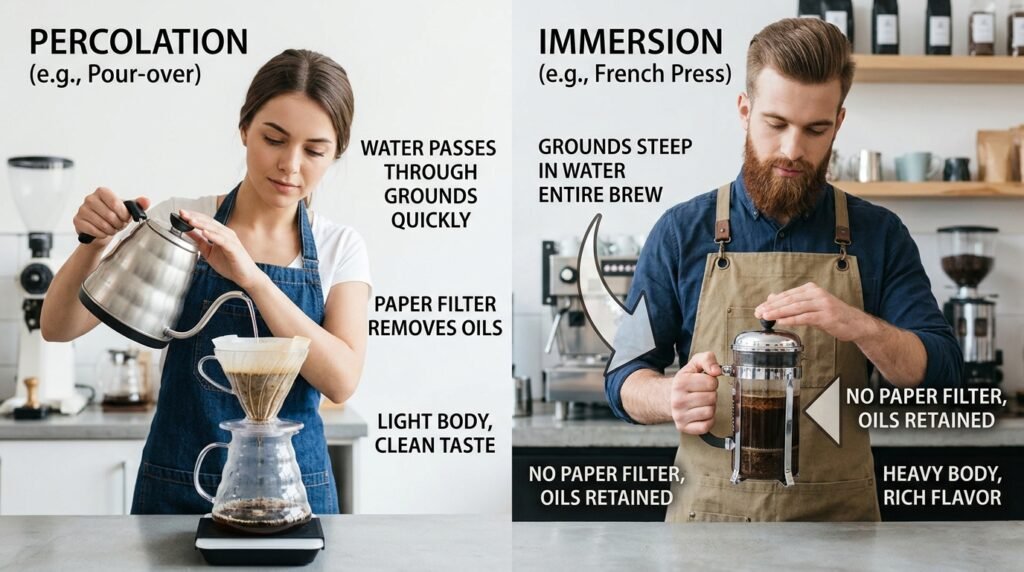
To master the French Press, you first have to understand the difference between “Immersion” and “Percolation.”
Methods like the V60 or the Chemex use percolation. Fresh water passes through the coffee grounds and out the bottom. This is efficient at extracting flavors quickly, but it also filters out many of the coffee’s natural oils.
The French Press uses immersion. The coffee grounds sit in the water for the entire duration of the brew. This allows for a more “gentle” extraction. Because there is no paper filter, the natural lipids and tiny micro-particles of the bean remain in the liquid.
This is why a French Press coffee feels “heavier” on your tongue. It is chemically more complex in terms of oils. If you have been following my guide on The Science of Aftertaste: Why Great Coffee Lingers, you know that these oils are the carriers of flavor. This makes the French Press the king of the “long finish.”
The Grind: The Foundation of the Brew
If you use a fine grind in a French Press, you are inviting disaster. Because the coffee is immersed for several minutes, a fine grind will over-extract almost immediately, leading to intense bitterness. Furthermore, the mesh filter of a French Press isn’t designed to catch tiny particles.
You need a coarse, uniform grind—something that looks like sea salt or cracked peppercorns. This is where The Science of Grinding: Why Consistency is Key becomes non-negotiable. If your grinder produces “fines” (dust), those particles will pass through the mesh and create that muddy, sandy texture that everyone hates.
A consistent coarse grind ensures that the water extracts the sugars slowly and evenly, leaving you with a cup that is sweet and rich rather than bitter and gritty.
The “No-Press” Secret Technique
One of the biggest mistakes people make with a French Press is, ironically, pressing the plunger.
When you push the plunger down aggressively, you create a massive amount of turbulence. This forces the silt and bitter compounds into the liquid.
The professional way to use a French Press (often called the James Hoffmann method) involves a bit of patience.
-
After 4 minutes of brewing, stir the top of the “crust” so the grounds sink to the bottom.
-
Use two spoons to skim off the remaining foam and floating bits.
-
Wait another 5 to 8 minutes.
-
Instead of plunging to the bottom, simply place the plunger on top of the liquid to act as a filter as you pour.
This “patience-first” approach allows gravity to do the work that the mesh filter cannot. The result is a cup that has the heavy body of a French Press but the clarity of a pour-over. It is a game-changer for anyone who finds traditional French Press too “dirty.”
Water Quality and Temperature
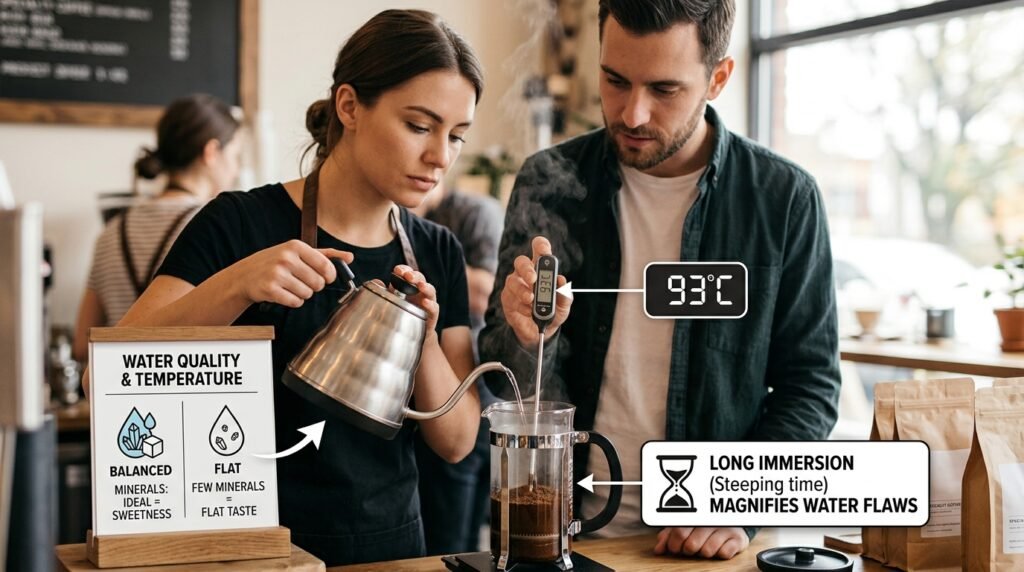
Because the French Press is an immersion method, the water stays in contact with the coffee for a long time. This means any flaws in your water will be magnified.
If your water has too many minerals, it will struggle to extract the sweetness. If it has too few, the coffee will taste flat. This is a key lesson from Water Quality: The Invisible Ingredient in Your Coffee.
As for temperature, don’t use boiling water. For a French Press, 92°C to 94°C is the sweet spot. If the water is too hot during such a long immersion, you risk “burning” the delicate aromatics of the bean.
Maintenance: The Hidden Mold Danger
The French Press is one of the most difficult brewers to clean properly, and most people do it wrong.
You cannot just rinse a French Press. The mesh filter is actually made of several layers—the spring, the mesh, and the plate. Coffee oils and tiny particles get trapped between these layers. If you don’t disassemble the filter assembly every few days, those trapped oils will turn rancid.
Even worse, if the filter is stored wet, it can develop mold in the threads of the screw.
-
The Daily Clean: Rinse thoroughly and use a brush to get grounds out of the mesh.
-
The Weekly Clean: Unscrew the plunger assembly completely. Soak the mesh in a solution of warm water and coffee detergent. Scrub each part individually.
-
The Glass Check: Be careful with the glass carafe (the beaker). Over time, small scratches can lead to cracks under the pressure of hot water. Always inspect your glass for “spider-web” fractures.
Why the Material Matters: Glass vs. Steel
You will see French Presses made of glass, stainless steel, and even ceramic.
-
Glass: Beautiful to look at and doesn’t hold flavors, but it loses heat very quickly. If your kitchen is cold, your brew temperature will drop too fast, leading to under-extraction.
-
Stainless Steel (Double-walled): This is the best for consistency. It acts like a thermos, keeping the water at a stable temperature for the full 4 to 10 minutes of brewing. It’s also nearly indestructible.
-
Ceramic: Heavy and holds heat well, but can be prone to “crazing” (tiny cracks in the glaze) over time.
For most people, a double-walled stainless steel French Press is the ultimate maintenance-friendly choice. It’s easier to clean and keeps the coffee hot enough that you can actually enjoy the “long brew” method.
Scaling the Recipe
One of the best things about the French Press is its scalability. You can make a single cup or enough for a family brunch.
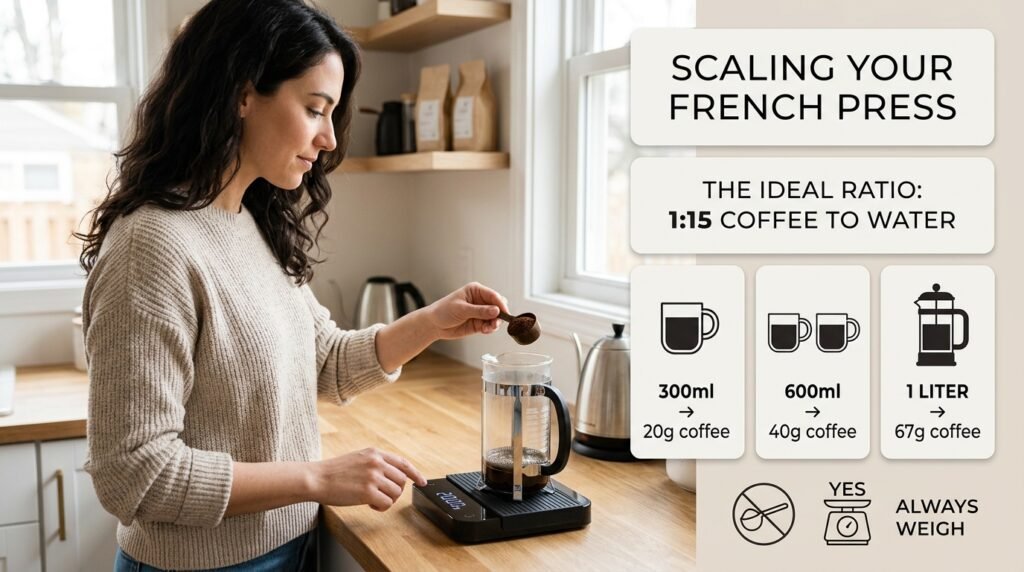
The standard ratio is 1:15. That means for every 1 gram of coffee, you use 15 grams of water.
-
For 300ml (one large mug), use 20g of coffee.
-
For 600ml (two mugs), use 40g of coffee.
-
For 1 liter, use about 67g of coffee.
Always weigh your coffee and water. Guessing with “scoops” is the fastest way to a mediocre cup.
The Role of the Roast
Because the French Press highlights body and sweetness, it is the perfect method for Medium to Medium-Dark roasts. This is where those notes of chocolate, caramel, and toasted nuts really shine.
However, don’t be afraid to try a light-roasted African coffee in a French Press using the “no-press” method. You might be surprised at how much sweetness and “creaminess” you can find in a bean that usually tastes like tea in a V60.
Summary Checklist for French Press Success:
-
Grind: Coarse and consistent (like sea salt).
-
Ratio: 1:15 (e.g., 30g coffee to 450ml water).
-
Temperature: 92°C – 94°C.
-
Time: 4 minutes for the steep, plus another 5-8 minutes for settling.
-
Technique: Don’t plunge to the bottom; let gravity settle the silt.
-
Maintenance: Disassemble the filter assembly every time you clean it.
Final Thoughts
The French Press is a classic for a reason. It is honest, it is tactile, and it produces a cup of coffee that has “soul.” It doesn’t hide behind paper filters or complex machinery. It is simply the marriage of coffee and water in their most intimate form.
Mastering it requires a shift in mindset. You have to move away from the “rush” of the morning and embrace the “wait.” You have to learn to appreciate the texture as much as the flavor. And most importantly, you have to treat the equipment with the respect it deserves by keeping it spotlessly clean.
If you treat your French Press well, it will reward you with the richest, most comforting cups of coffee you’ve ever had. It is the ultimate tool for a slow Sunday morning or a quiet moment of reflection.
Stop ignoring that glass carafe in the back of your cupboard. Clean it, grind some fresh beans, and experience the science of immersion for yourself.
Happy brewing, and may your cups be rich and clear!

Marcelo Clark combines professional industry experience with a passion for democratizing coffee knowledge. Specialist in extraction techniques and an advocate for single-origin beans, Marcelo uses this space to teach beginners how to appreciate the subtle notes of a well-crafted brew. His goal is to make learning about methods and origins simple, relevant, and inspiring for every reader’s daily routine.