
There is a specific sound that every specialty coffee lover recognizes: the low, steady hum of an electric kettle reaching its target temperature. For some, it’s the signal that the day has officially begun. For others, it’s the start of a meditative ritual where time slows down and the focus shifts to the perfect pour.
When I first upgraded from a standard “boil-only” plastic kettle to a variable temperature gooseneck model, I felt like I had stepped into a new dimension of brewing. Suddenly, I wasn’t guessing anymore. I wasn’t waiting for the water to boil and then counting to sixty in my head, hoping the temperature had dropped to 92°C. I had absolute control.
However, as I soon learned, with great precision comes great responsibility. An electric kettle is more than just a pot; it is a delicate electronic instrument with heating elements, thermal sensors, and precise flow-control spouts. If you treat it like a regular kitchen appliance, it will eventually fail you. But if you understand the maintenance and the science behind it, it will be your most loyal companion for years.
The Engineering of the Gooseneck
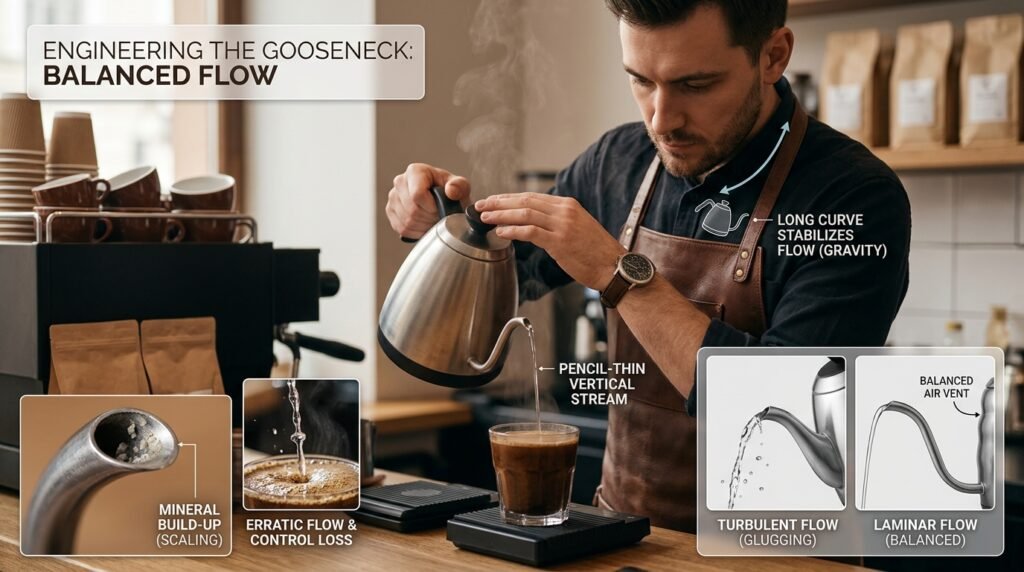
Why is the “neck” so long and thin? It’s not just for looks. The gooseneck spout is a masterpiece of fluid dynamics. By creating a long, curved path for the water, the kettle uses gravity to stabilize the flow.
In a standard kettle, the water “glugs” because air has to fight its way into the spout while water is trying to exit. In a gooseneck, the air and water find a balance, allowing for a vertical stream that is as thin as a pencil. This precision is what allows you to target specific areas of the coffee bed, which is vital when you are practicing How to Host a Coffee Cupping at Home: A Step-by-Step Guide or brewing a delicate pour-over.
But this thin spout is also a vulnerability. If mineral deposits start to form inside that narrow neck, the flow becomes erratic. You might notice the stream “wavering” or splashing, which ruins your ability to control agitation.
The Enemy Within: Scale and Mineral Calcification
If you look inside your kettle and see white, chalky spots at the bottom, you aren’t looking at “dirt”—you’re looking at scale. Scale is a build-up of calcium and magnesium minerals that are naturally present in water.
While we want some minerals for flavor—as we discussed in Water Quality: The Invisible Ingredient in Your Coffee—too much will eventually kill your kettle.
-
Thermal Efficiency: Scale acts as an insulator. The heating element has to work twice as hard to get the water through that layer of “rock,” leading to overheating and eventual burnout.
-
Sensor Accuracy: If scale coats the temperature probe (the little needle sticking up at the bottom), the kettle will give you false readings. You might think your water is 93°C when it’s actually 98°C, which can “burn” your delicate light roasts.
This is why maintenance isn’t just a chore; it’s a calibration for flavor.
The Correct Way to Descale
Most people wait until the kettle is covered in white crust before they clean it. By then, the damage to the heating element might already be started.
I recommend a “preventative descaling” every 30 days. You don’t need harsh chemicals. A simple mixture of citric acid and water is usually the safest and most effective method.
-
The Citric Acid Method: Fill the kettle halfway with water, add a tablespoon of citric acid powder, and bring it to a boil. Let it sit for 15 minutes, then rinse thoroughly. Unlike vinegar, citric acid doesn’t leave a lingering smell that could ruin your next cup of coffee.
-
The “No-Boil” Rinse: For daily maintenance, never leave water sitting in the kettle after you are done. Empty it out and leave the lid open for a few minutes to let the residual heat dry the interior. Moisture left inside is an open invitation for mineral deposits and, in rare cases, metallic oxidation.
Thermal Shock: A Silent Killer
Many people make the mistake of finishing their brew and then immediately refilling the hot kettle with ice-cold tap water. In the engineering world, this is called “thermal shock.”
The heating element and the metal base expand and contract at different rates. By forcing a sudden, extreme temperature change, you can cause micro-cracks in the heating plate or the seal around the spout.
Over time, these cracks lead to leaks. To ensure longevity, let the kettle cool down for a minute or two before refilling it, or use lukewarm water instead of cold.

The Technology of Temperature Stability
Modern electric kettles use a technology called PID (Proportional-Integral-Derivative) controllers. This is the same logic used in high-end espresso machines.
Instead of just turning the heater “ON” until it hits the target and then turning it “OFF,” a PID controller “pulses” the energy. As the water gets closer to your set temperature (say, 92°C), the pulses become shorter and more frequent. This prevents “overshooting”—the common problem where a kettle hits 95°C when you only asked for 92°C.
Understanding this allows you to appreciate why The Science of Aftertaste: Why Great Coffee Lingers is so dependent on your gear. If your kettle is constantly overshooting the temperature, you are extracting harsh, bitter tannins that will ruin the finish of your coffee.
Protecting the Electronics
The base of your electric kettle is where the “brains” live. It contains the circuit boards and the connectors.
-
The “Dry Connection” Rule: Always ensure the bottom of the kettle is completely dry before placing it on the base. A single drop of water can cause a short circuit or “arc” the electrical pins, which will eventually melt the plastic housing.
-
Cable Management: Don’t wrap the cord tightly around the base. This creates tension that can fray the internal wires over time.
-
Steam Management: Don’t place your kettle under a kitchen cabinet while it’s boiling. The escaping steam will warp your cabinets and, more importantly, the moisture can seep back into the kettle’s control buttons, causing them to malfunction.
Aesthetics and Exterior Maintenance
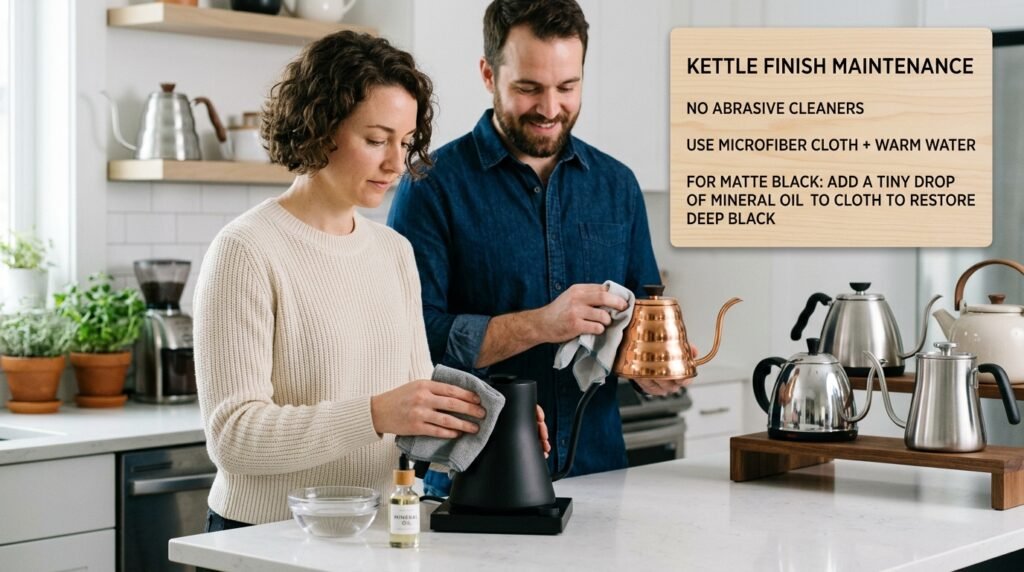
Most high-end kettles come in beautiful matte black, copper, or polished chrome finishes. These are beautiful, but they are magnets for fingerprints and coffee splashes.
Never use a scouring pad or abrasive cleaner on the exterior. A simple microfiber cloth dampened with warm water is all you need. If you have a matte black kettle, a tiny drop of mineral oil on a cloth can help restore that “factory-fresh” deep black look if it starts to look ashy.
Why Quality Gear is a Sustainability Choice
In a world of “disposable” appliances, a high-quality gooseneck kettle is a statement of sustainability. Yes, you can buy a $20 plastic kettle every year, but you are creating waste and sacrificing the quality of your brew.
A well-maintained, stainless steel, variable temperature kettle can last 10 years or more. When you consider the cost-per-cup over a decade, the “expensive” kettle actually becomes the cheaper option. It is a one-time investment in your morning happiness and the health of the planet.
Summary: Your Kettle Longevity Checklist
| Component | Maintenance Task | Frequency |
| Interior Base | Descale with Citric Acid | Every 30 days |
| The Spout | Flush with hot descaling solution | Every 30 days |
| External Base | Wipe with dry cloth | Weekly |
| Bottom Pins | Ensure they are dry | Every Use |
| Lid Seal | Check for cracks or leaks | Every 6 Months |
Final Thoughts
The kettle is the unsung hero of the coffee station. It doesn’t get the glory of the grinder or the fame of the espresso machine, but it is the provider of the energy that makes extraction possible. It is the vessel that transforms dry, dormant grounds into a vibrant, living beverage.
Treating your kettle with technical respect—keeping it clean, dry, and calibrated—is a form of gratitude for the ritual. It ensures that when you wake up tomorrow morning, the hum of the heater will be as steady and reliable as it was the day you bought it.
Maintenance isn’t just about cleaning; it’s about preserving the integrity of the science. When your temperature is exact and your pour is precise, you remove the “noise” from the process and let the music of the coffee play.
Happy brewing, and may your kettle always be scale-free and steady!

Marcelo Clark combines professional industry experience with a passion for democratizing coffee knowledge. Specialist in extraction techniques and an advocate for single-origin beans, Marcelo uses this space to teach beginners how to appreciate the subtle notes of a well-crafted brew. His goal is to make learning about methods and origins simple, relevant, and inspiring for every reader’s daily routine.