
I remember the exact moment I realized I was “lost” in my coffee journey. I had just bought a bag of expensive, award-winning beans from Panama. The first cup I made was incredible—it tasted like liquid peaches and honey. It was a revelation. But the next morning, using the exact same beans and the exact same brewer, the coffee tasted… ordinary. It was fine, but the magic was gone.
I spent the rest of the week trying to chase that first cup. I added a little more coffee, then a little less. I tried pouring the water faster, then slower. I was guessing. I was “eyeballing” my measurements using scoops and the lines on the side of my kettle.
That was the day I bought my first digital scale.
At first, my friends laughed at me. “Are you making coffee or a lab experiment?” they asked. But once they tasted the results, the laughing stopped. A scale is not about being a “perfectionist”—it is about being a “repeatist.” It is the only tool in your kit that eliminates the guesswork and allows you to actually learn from your mistakes. In the world of specialty coffee, if you aren’t measuring, you aren’t brewing; you’re just hoping.
The Flaw of the “Scoop”
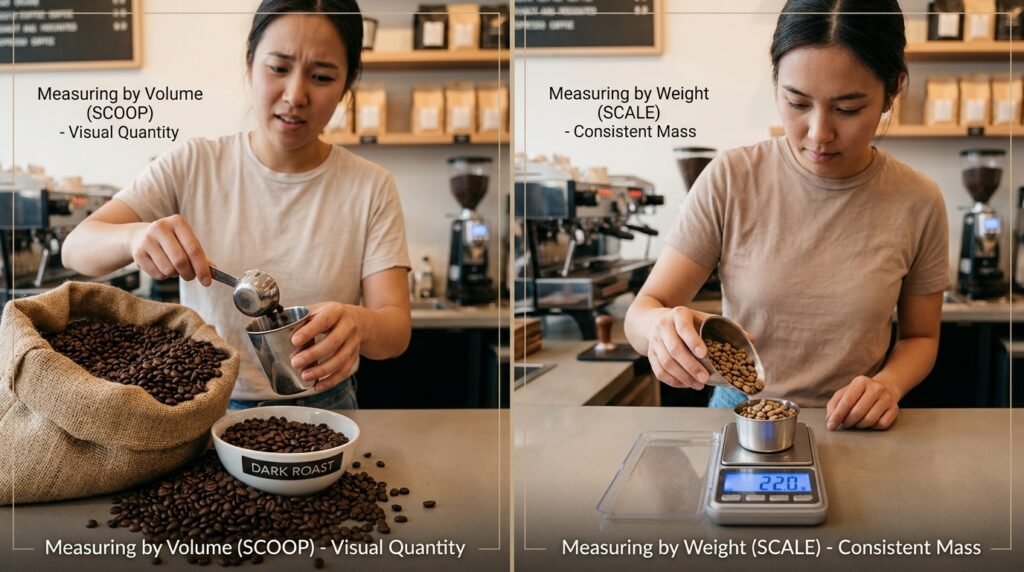
Most people measure coffee by volume. They use a scoop, a tablespoon, or a “capful.” The problem is that coffee beans are not all the same size or density.
A dark-roasted coffee bean is porous and light; a light-roasted bean from a high-altitude farm is small and extremely dense. If you take one scoop of each, the weight will be completely different. You might be using 15 grams of one and 22 grams of the other without even knowing it.
As we explored in The Secrets of High Altitude: Why Mountains Make Better Coffee, these beans have unique physical properties. Using a scoop to measure high-altitude coffee is like trying to measure gold with a measuring cup—it’s just too imprecise for the value of the product. A scale tells you exactly how much mass you are putting into your brewer, regardless of the roast level or the bean size.
The Water-to-Coffee Ratio: The Golden Rule
The most important number in coffee is the Ratio. It is the relationship between the weight of your dry coffee and the weight of your water.
The industry standard is roughly 1:16 (1 gram of coffee for every 16 grams of water). If you change this ratio even slightly, you change the entire flavor profile of the cup.
-
Too much water (1:18): The coffee becomes over-extracted and “hollow.”
-
Too much coffee (1:14): The coffee becomes under-extracted and “sour.”
Without a scale, you are essentially playing a game of chance with your ratio. When you use a scale, you can lock in that 1:16 ratio every single time. This is the foundation of Calibrating Your Espresso: The Dialing-In Process; you cannot “dial in” anything if your starting measurements are constantly shifting.
The Role of the Built-in Timer
Modern coffee scales aren’t just for weight; they are for time. In coffee extraction, time is just as important as mass.
If your pour-over takes 2 minutes today and 4 minutes tomorrow, the flavor will be completely different. A longer brew time usually leads to more bitterness, while a shorter time leads to more acidity.
Having a scale with a built-in timer allows you to track your “Flow Rate.” You can see exactly how fast you are adding water. If you see that your brew is running too slow, you know for a fact that you need to adjust your grinder. Without that timer and scale combo, you are just left wondering why the coffee tastes “off.” This is why The Science of Grinding: Why Consistency is Key and the use of a scale go hand-in-hand—one provides the uniform particles, and the other provides the uniform method.
Precision vs. Resolution: What You Actually Need
When shopping for a coffee scale, you’ll see a lot of technical terms. The most important one is Resolution.
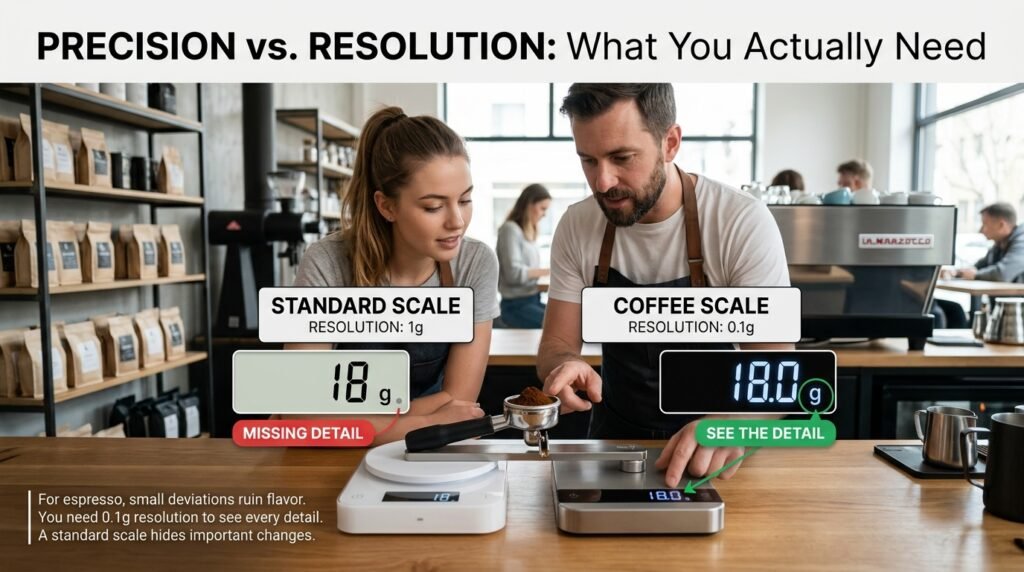
A standard kitchen scale usually has a resolution of 1 gram. This is fine for baking a cake, but it is not enough for coffee. If you are aiming for 18 grams of espresso and your scale is off by 0.9 grams (because it can’t see decimals), that is a 5% error. In espresso, a 5% error is the difference between “heavenly” and “undrinkable.”
You need a scale with 0.1g resolution. This allows you to see every single bean you add to the hopper. It gives you the “HD” version of your measurements.
Maintenance: Protecting the Load Cell
A scale is a precision instrument, but it’s often kept in a messy environment full of hot water and coffee grounds. To keep your scale accurate for years, you need to treat it with care.
-
Avoid “Shock Loading”: Never drop your heavy coffee canister onto the scale. The “load cell” inside is a delicate piece of metal that bends to measure weight. A sudden impact can permanently deform it, leading to “drift” (where the numbers keep changing even when the scale is empty).
-
Heat Protection: Most digital scales do not like heat. If you place a boiling-hot Chemex directly onto the plastic surface of a cheap scale, the heat can seep into the electronics and cause the sensor to malfunction. Always use a silicone mat or a small wooden board between your brewer and the scale.
-
Waterproofing: Coffee brewing is a wet hobby. If water gets inside the charging port or the battery compartment, it’s game over. Look for scales that are water-resistant, or be extremely careful to wipe away spills immediately.
-
Calibration: Over time, all scales lose a bit of accuracy. High-end scales allow you to “re-calibrate” them using a standard 100g or 500g weight. I recommend doing this once every six months to ensure your “18 grams” is still actually 18 grams.
The Psychology of the Scale
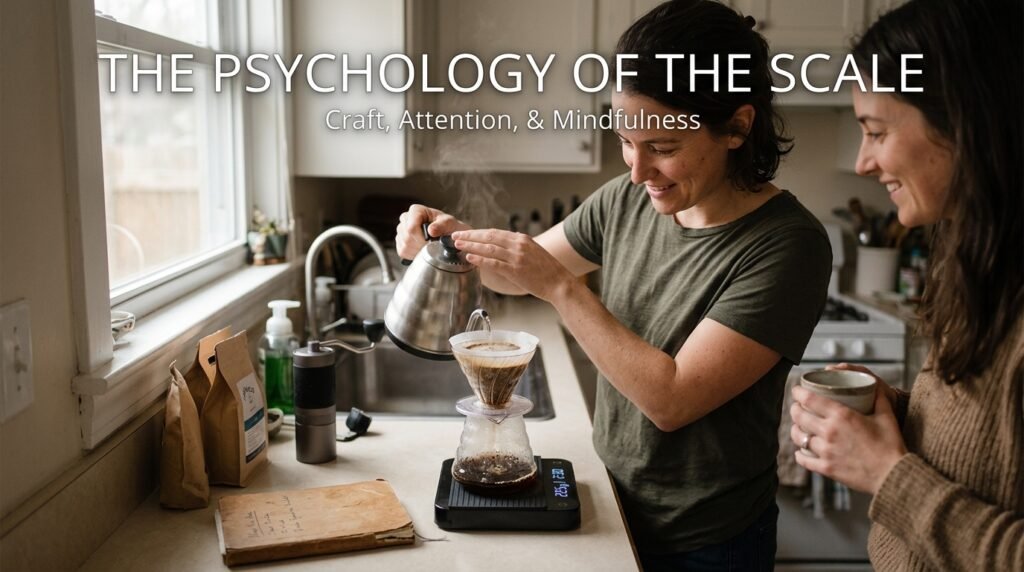
Beyond the science, there is a psychological benefit to using a scale. It turns the act of making coffee from a “task” into a “craft.”
When you weigh your beans and time your pour, you are forced to pay attention. You become mindful of the process. You start to notice the small details—the way the bloom smells, the way the water moves through the filter, the way the aroma changes as the weight increases.
It removes the frustration of “hit or miss” coffee. Even if a cup doesn’t taste perfect, the scale gives you the data to fix it. “Okay, that was 20 grams of coffee in 3 minutes. It was too bitter. Tomorrow, I’ll try 20 grams in 2 minutes and 30 seconds.” That is how you become a master of your own kitchen.
Choosing the Right Scale: A Quick Guide
-
The Budget Option: A basic $20 jewelry scale with 0.1g resolution. It won’t have a timer or a silicone mat, but it will give you the accuracy you need.
-
The Mid-Range: Dedicated coffee scales ($50 – $80). These usually have built-in timers, are water-resistant, and have faster “response times” (the speed at which the numbers update as you pour).
-
The High-End: Professional scales ($150 – $250). These have Bluetooth connectivity, “auto-start” timers, and incredibly high build quality. These are great for coffee geeks who want to track their brew data on their phones.
Summary: The Scale Success Checklist
| Feature | Why it Matters |
| 0.1g Resolution | Essential for espresso and small pour-overs. |
| Built-in Timer | To track flow rate and extraction time. |
| Fast Response Time | Prevents you from “over-pouring” water. |
| Silicone Mat | Protects the sensors from heat damage. |
| Tare Function | Allows you to zero out the weight of the brewer. |
Final Thoughts
If you are serious about specialty coffee, a scale is not an optional accessory. It is the heart of the operation. It is the tool that turns “luck” into “skill.”
We spend so much time looking for the perfect bean or the coolest-looking brewer, but the biggest improvement most people can make to their coffee is simply to start weighing it. It is the most cost-effective upgrade you will ever make.
Don’t be afraid to look like a “scientist” in your kitchen. Embrace the numbers. Once you experience the consistency that a scale provides, you will never want to go back to “eyeballing” it again. You’ll find that the “magic” of that perfect cup isn’t a mystery anymore—it’s just a recipe that you finally have the power to repeat.
Happy weighing, and may your ratios always be perfect!

Marcelo Clark combines professional industry experience with a passion for democratizing coffee knowledge. Specialist in extraction techniques and an advocate for single-origin beans, Marcelo uses this space to teach beginners how to appreciate the subtle notes of a well-crafted brew. His goal is to make learning about methods and origins simple, relevant, and inspiring for every reader’s daily routine.